
Purpose
An AI mentor app for personal growth, co-founded by Mark Manson, that pushes back on users.
Purpose, an AI mentor co-founded by Mark Manson, hit $1M ARR two weeks after launch, following a six month build and small-cohort tests of messaging, paywalls and pricing on Mark's audience. Over 40% of users report life-changing value. Another source cites about 20K downloads and $200K a month in revenue. Lesson: pair an existing audience with pre-launch testing and an onboarding that delivers an aha moment in about 10 minutes.
- 1Build product for six monthsEngineers build while growth team tests
- 2Test on small cohortsMark Manson's audience, before full launch
- 3Vary messaging, paywalls, pricingWinner: "self-help books don't text back"
- 4Launch with winning setupFire bullets, then the cannonball
- 5Reach $1M ARRTwo weeks after full launch (unverified)
From Raj Singh, Purpose co-founder
What was said about Purpose
1How Purpose reached $1M ARR in 14 days
Purpose tested messaging, paywalls and pricing on small cohorts before launching. While engineers spent about six months building the product, the growth team ran tests on small cohorts of Mark Manson's audience, varying messaging, paywalls, monetization offers and pricing. They then launched at full scale with the winning setup and reached $1M ARR two weeks later.
Raj Singh describes it as a way to "fire bullets before we fired the cannonball." The result surprised the team to the upside. The $1M ARR figure is stated without supporting data.
Framing the product against what users already tried won the messaging test. Purpose A/B tested top-of-funnel messaging and found that "self-help books don't text back" resonated.
Many prospective users had already tried self-help books, therapy or other DIY options, so the line positions Purpose against an alternative they know.
2Building on Mark Manson's audience
A cofounder with a trusted audience solved the cold start problem. Mark Manson, a three-time New York Times bestselling author with over 10 million readers and 20 million books sold, brought the audience while Raj, who had built chat products for 12 years, built and scaled the product. The traffic let Purpose test and iterate from day one.
The product had to withstand a step-function traffic spike rather than a gradual curve. A separate account puts Purpose at about 20K downloads and $200K in revenue a month, and notes that creator-tied apps like Waking Up (Sam Harris) and MacroFactor (Jeff Nippard) get distribution from day one and can hold premium prices.
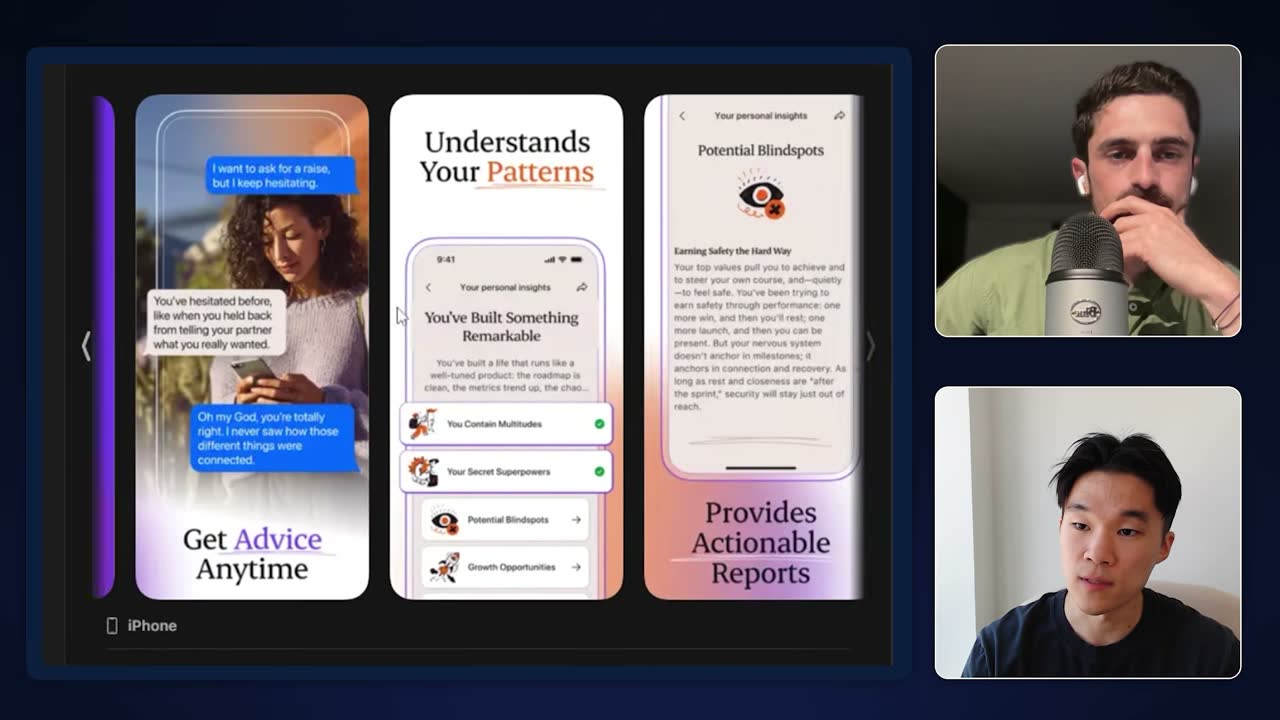
App Store screenshots for Purpose, an AI mentor app: advice chats, pattern insights, actionable reports. Start with distribution and work backwards from a billion users. Raj notes that post-exit founders often build product first the first time and distribution first the next. He and Mark began by asking how to get the product into the hands of a billion people, and a celebrity cofounder was a major part of the answer.
Vet a celebrity's track record and make them a true cofounder. Before partnering, Raj audited which products Mark had promoted and which companies he was affiliated with. Mark had not diluted his name across a hundred products, so his endorsement kept its value.
They chose a full cofounder relationship, "not endorsement not an adviser relationship." The two met at a poker game in 2024 after independently targeting the same space; Mark had earlier tried to acquire a company in it.
Move a founder's proven paid content inside the app as exclusive. Mark's courses, which had earned tens of millions of dollars in lifetime revenue, were migrated into Purpose and now live only there.
Raj compares this to starting a game at level 12 or 15 instead of level one, though it brings harder problems sooner.
Build the brand bigger than the celebrity to avoid an audience ceiling. Before incorporating, Raj and Mark discussed that Mark's audience could be a blessing upfront and a ceiling later, so they designed Purpose as a larger brand than Mark aimed at a billion people. Next channels are paid ads, word of mouth and a user-story content engine.
Raj says paid advertising is already accretive and word of mouth exceeds expectations with little effort. The risk of creator dependence is real: buyers of creator-tied apps must keep the creator on board, and creators often refuse earn-outs.
3Onboarding that makes users feel known in 10 minutes
- 1Answer structured questionsSpeed-runs getting to know the user
- 2Stack rank your valuesAutonomy or connection? Forces honest answers
- 3Get a custom reportBlind spots, growth areas, strengths
- 4Route to matching contentTopic-matched content and lifecycle messages
From Raj Singh, Purpose co-founder
Aim for an aha moment within 5 to 10 minutes, not a blank chat box. Purpose's goal is that within 5 to 10 minutes the app knows you better than a coach would in two years. It speed-runs getting to know the user with structured questions, then generates a custom report of blind spots, growth areas and strengths.
Raj calls a vanilla chat box with an AI attached a commodity. Citing Sean Puri, he says "different is better than better," so the difference had to be visible up front. Users report the app figured out in 10 minutes what friends of a decade did not know.
Forcing users to stack rank values draws out more honest answers. On first open, users must choose, for example, whether autonomy matters more than connection. Committing to a selection on screen gets answers people would not give in loose conversation.
The choices sit on a review of personality tools such as the Enneagram, the Big Five and Discovery Insights, which the team found outdated for consumers. The science runs behind the scenes so users never have to think about it.
Match what users talk about to in-app content and lifecycle messages. Users raise different topics, such as relationships or finances, and Purpose routes them to matching content inside the app and matching lifecycle touches. Raj credits this personalization for above-median retention.
The above-median retention claim is not backed by shared data.
4Giving the AI a backbone
An AI mentor helps only if it tells hard truths instead of flattering. Raj says foundation models are tuned for engagement and give all sugar, so Purpose built a mentor that pushes back. Mark prompted it thousands of times to set the tone.
The tone must not turn abrasive because users may be in a sensitive moment. One public review: "Within 10 minutes of using purpose, I was in tears because I was told things that no human would ever say to my face." Safety for vulnerable users gets little discussion beyond a note that Purpose is not right for everyone.
Humor makes hard advice easier to take. The mentor cracks jokes and makes bad puns, following Mark's writing instinct for "how much sugar to include so that the medicine kind of goes down easy." The team locked the sugar-to-medicine ratio after a long internal debate and testing.
Over 40% of users report life-changing value, a figure stated without data. Humor also builds trust and emotional attachment to the product.
Test whether the model already knows your domain before feeding it IP. The team planned to load Mark's proprietary IP but found the LLMs already knew most of the psychology. The real work was prompting, iteration and memory management.
Raj: "if you think you're going to teach an LLM to do something new, you might want to test whether or not it already knows the thing."
Differentiate with validated frameworks, not just a famous name. Raj says many celebrity AI apps add a name and some content, which is no different from asking ChatGPT to act like that person. Purpose pairs Mark's tone with scientifically validated frameworks in its Quest feature.
The four core features are a rapid self-discovery engine, an advanced memory architecture, an intelligent challenge system and guided quests.
5Founding bets and staying aligned with users
Cheap personal life advice was already in demand. Raj spent tens of thousands of dollars on coaches and therapists across 24 countries and found it was all language, which LLMs could deliver about 1,000x cheaper. About 100 million people already use ChatGPT for life advice each month.
Friends who called his early prototype, which offered emotional support, tarot readings or therapist-style chats, said it was better than a $300 an hour therapist.
Aligned funding and hiring protect an outcomes-first product. Purpose stayed founder funded, is selective about investors, and hires for mission fit, including people from Headspace. It commits to no ads, no data selling and no engagement maxing, measuring success by outcomes such as getting users off their device.
The team hopes for 10 to 30 year retention, which is an aspiration, not a result.
Copy proven playbooks everywhere except your real edge. Raj's rule from his previous company, GoMoment, is to copy what works outside your core competence and go all in only where you can be better than anyone.

How Purpose Hit $1M ARR in 14 Days
Reached $1M ARR two weeks after launch, after a roughly six month build and pre-launch tests of messaging, paywalls and pricing on small cohorts of Mark's audience. Over 40% of users report life-changing value, and the team expects 10 to 30 year retention with no ads or data selling.
Purpose tested messaging, paywalls and pricing on small cohorts before launching. While engineers spent about six months building the product, the growth team ran tests on small cohorts of Mark Manson's audience, varying messaging, paywalls, monetization offers and pricing. They then launched at full scale with the winning setup and reached $1M ARR two weeks later.
Raj Singh describes it as a way to "fire bullets before we fired the cannonball." The result surprised the team to the upside. The $1M ARR figure is stated without supporting data.
Framing the product against what users already tried won the messaging test. Purpose A/B tested top-of-funnel messaging and found that "self-help books don't text back" resonated.
Many prospective users had already tried self-help books, therapy or other DIY options, so the line positions Purpose against an alternative they know.
A cofounder with a trusted audience solved the cold start problem. Mark Manson, a three-time New York Times bestselling author with over 10 million readers and 20 million books sold, brought the audience while Raj, who had built chat products for 12 years, built and scaled the product. The traffic let Purpose test and iterate from day one.
The product had to withstand a step-function traffic spike rather than a gradual curve. A separate account puts Purpose at about 20K downloads and $200K in revenue a month, and notes that creator-tied apps like Waking Up (Sam Harris) and MacroFactor (Jeff Nippard) get distribution from day one and can hold premium prices.
App Store screenshots for Purpose, an AI mentor app: advice chats, pattern insights, actionable reports. Start with distribution and work backwards from a billion users. Raj notes that post-exit founders often build product first the first time and distribution first the next. He and Mark began by asking how to get the product into the hands of a billion people, and a celebrity cofounder was a major part of the answer.
Vet a celebrity's track record and make them a true cofounder. Before partnering, Raj audited which products Mark had promoted and which companies he was affiliated with. Mark had not diluted his name across a hundred products, so his endorsement kept its value.
They chose a full cofounder relationship, "not endorsement not an adviser relationship." The two met at a poker game in 2024 after independently targeting the same space; Mark had earlier tried to acquire a company in it.
Move a founder's proven paid content inside the app as exclusive. Mark's courses, which had earned tens of millions of dollars in lifetime revenue, were migrated into Purpose and now live only there.
Raj compares this to starting a game at level 12 or 15 instead of level one, though it brings harder problems sooner.
Build the brand bigger than the celebrity to avoid an audience ceiling. Before incorporating, Raj and Mark discussed that Mark's audience could be a blessing upfront and a ceiling later, so they designed Purpose as a larger brand than Mark aimed at a billion people. Next channels are paid ads, word of mouth and a user-story content engine.
Raj says paid advertising is already accretive and word of mouth exceeds expectations with little effort. The risk of creator dependence is real: buyers of creator-tied apps must keep the creator on board, and creators often refuse earn-outs.
Aim for an aha moment within 5 to 10 minutes, not a blank chat box. Purpose's goal is that within 5 to 10 minutes the app knows you better than a coach would in two years. It speed-runs getting to know the user with structured questions, then generates a custom report of blind spots, growth areas and strengths.
Raj calls a vanilla chat box with an AI attached a commodity. Citing Sean Puri, he says "different is better than better," so the difference had to be visible up front. Users report the app figured out in 10 minutes what friends of a decade did not know.
Forcing users to stack rank values draws out more honest answers. On first open, users must choose, for example, whether autonomy matters more than connection. Committing to a selection on screen gets answers people would not give in loose conversation.
The choices sit on a review of personality tools such as the Enneagram, the Big Five and Discovery Insights, which the team found outdated for consumers. The science runs behind the scenes so users never have to think about it.
Match what users talk about to in-app content and lifecycle messages. Users raise different topics, such as relationships or finances, and Purpose routes them to matching content inside the app and matching lifecycle touches. Raj credits this personalization for above-median retention.
The above-median retention claim is not backed by shared data.
An AI mentor helps only if it tells hard truths instead of flattering. Raj says foundation models are tuned for engagement and give all sugar, so Purpose built a mentor that pushes back. Mark prompted it thousands of times to set the tone.
The tone must not turn abrasive because users may be in a sensitive moment. One public review: "Within 10 minutes of using purpose, I was in tears because I was told things that no human would ever say to my face." Safety for vulnerable users gets little discussion beyond a note that Purpose is not right for everyone.
Humor makes hard advice easier to take. The mentor cracks jokes and makes bad puns, following Mark's writing instinct for "how much sugar to include so that the medicine kind of goes down easy." The team locked the sugar-to-medicine ratio after a long internal debate and testing.
Over 40% of users report life-changing value, a figure stated without data. Humor also builds trust and emotional attachment to the product.
Test whether the model already knows your domain before feeding it IP. The team planned to load Mark's proprietary IP but found the LLMs already knew most of the psychology. The real work was prompting, iteration and memory management.
Raj: "if you think you're going to teach an LLM to do something new, you might want to test whether or not it already knows the thing."
Differentiate with validated frameworks, not just a famous name. Raj says many celebrity AI apps add a name and some content, which is no different from asking ChatGPT to act like that person. Purpose pairs Mark's tone with scientifically validated frameworks in its Quest feature.
The four core features are a rapid self-discovery engine, an advanced memory architecture, an intelligent challenge system and guided quests.
Cheap personal life advice was already in demand. Raj spent tens of thousands of dollars on coaches and therapists across 24 countries and found it was all language, which LLMs could deliver about 1,000x cheaper. About 100 million people already use ChatGPT for life advice each month.
Friends who called his early prototype, which offered emotional support, tarot readings or therapist-style chats, said it was better than a $300 an hour therapist.
Aligned funding and hiring protect an outcomes-first product. Purpose stayed founder funded, is selective about investors, and hires for mission fit, including people from Headspace. It commits to no ads, no data selling and no engagement maxing, measuring success by outcomes such as getting users off their device.
The team hopes for 10 to 30 year retention, which is an aspiration, not a result.
Copy proven playbooks everywhere except your real edge. Raj's rule from his previous company, GoMoment, is to copy what works outside your core competence and go all in only where you can be better than anyone.

$172M of App Building Advice in 50 Minutes
It gets about 20K downloads and $200K a month in revenue, leaning on a famous creator's audience.
A cofounder with a trusted audience solved the cold start problem. Mark Manson, a three-time New York Times bestselling author with over 10 million readers and 20 million books sold, brought the audience while Raj, who had built chat products for 12 years, built and scaled the product. The traffic let Purpose test and iterate from day one.
The product had to withstand a step-function traffic spike rather than a gradual curve. A separate account puts Purpose at about 20K downloads and $200K in revenue a month, and notes that creator-tied apps like Waking Up (Sam Harris) and MacroFactor (Jeff Nippard) get distribution from day one and can hold premium prices.
App Store screenshots for Purpose, an AI mentor app: advice chats, pattern insights, actionable reports. Build the brand bigger than the celebrity to avoid an audience ceiling. Before incorporating, Raj and Mark discussed that Mark's audience could be a blessing upfront and a ceiling later, so they designed Purpose as a larger brand than Mark aimed at a billion people. Next channels are paid ads, word of mouth and a user-story content engine.
Raj says paid advertising is already accretive and word of mouth exceeds expectations with little effort. The risk of creator dependence is real: buyers of creator-tied apps must keep the creator on board, and creators often refuse earn-outs.
More in Lifestyle
 Lifestyle
Drunk Mode
A nightlife app that helps students find parties while staying safe with friends.
 2 sources · 26 tips
 Lifestyle
Gojek
An Indonesian super app for ride hailing, food delivery, payments and many other on-demand services.
 2 sources · 23 tips
 Lifestyle
Thumbtack
A marketplace connecting homeowners with local service professionals for home projects.
7 sources · 10 tips Lifestyle
Hermes
A French luxury house making handcrafted leather goods, silk scarves and clothing, run by the Dumas family.
 2 sources · 18 tips
 Lifestyle
Houzz
A home remodeling and design app and marketplace connecting homeowners with products and professionals.
 2 sources · 5 tips
 Lifestyle
Life360
A family safety app that locates and protects people, pets and things through shared circles.
 2 sources · 19 tips
Caveman
A paid app giving men one romantic tip for every day of the year.
1 source · 9 tips Lifestyle
Flame
An AI relationship app for couples built around a daily question, widgets and reply tools.
1 source · 18 tips