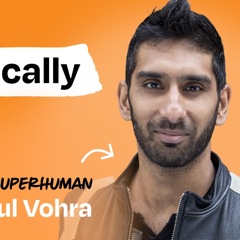
Rahul Vohra
Founder and CEO, Superhuman
Where to hear and read about Rahul Vohra1 episode or test

Rahul Vohra is the founder and CEO of Superhuman and earlier founded Rapportive, which he sold to LinkedIn. The most useful thing to learn from him is to treat product-market fit as a number, then build only for the users whose love you can actually grow.
multiple low quality reasons rarely add up to a high quality reason to do something.
Superhuman's secret to success | Rahul Vohra (CEO and founder)
Rahul Vohra: the story and the lessons
1Rahul Vohra's path from Rapportive to Superhuman
Vohra built Rapportive, the first Gmail extension to reach millions of users. It showed beside each email who the sender is, where they work, their recent tweets and their LinkedIn profile. It drew most of LinkedIn's daily active users to one free app.
He says he would have sold it for far more had he known.
Selling to LinkedIn mattered most for the person he got to learn from. The sale put him under Elliot Shmukler, LinkedIn's head of growth, who had grown it from 25 million to over 250 million members.
The sale also gave him time to decide what was next and the resources to swing for the fences.
Vohra was a professional game designer before he became a founder. Superhuman draws on five areas of game design: goals, emotions, toys, controls and flow. He builds fun toys first, then combines them into a game.
The time auto-completer turns '2d' into two days, '8am in Tokyo' into the right local time, and 'never' snoozes an email forever. He rejects points and badges, citing a Stanford study where rewarded children spent 8% of free time drawing against 17% for unrewarded ones.
He took early money only as fast as he could use it. Ed Sim wrote the first three checks after a one-slide pitch: a Gmail screenshot, mostly scribbled out. Offered $750K, Vohra took $250K, then another $250K, then another.
Sim's earlier check into Rapportive had returned about 5x.
2How Vohra finds and raises product-market fit
Vohra measures fit with one survey question and aims for 40% very disappointed. He asks how users would feel if they could no longer use the product: very, somewhat or not disappointed. Sean Ellis found struggling companies almost always had under 40% very disappointed, and the fastest growers had over 40%.
He says it predicts success better than net promoter score. Changing the survey method, such as email versus in-product, invalidates old numbers and sets a new baseline.
He builds for somewhat disappointed users whose favorite benefit matches the core one. Not disappointed users are a lost cause and very disappointed users already love the product. Loyal Superhuman users loved speed, keyboard shortcuts, design and time saved, so users who liked it for something else were set aside.
His rule: 'you have to deliberately not act on the feedback of many of your early users.' Even if you built everything those users asked for, they would pull you in another direction.
He splits each planning cycle between strengths and objections. Half the time goes to doubling down on what people love. The other half goes to overcoming the objections of the somewhat disappointed users for whom the core benefit resonates.
The two lists give a roadmap that raises the score step by step. Superhuman now runs the engine on near-products such as Superhuman for Sales, and would use it on any new product.
3Vohra on positioning, pricing and growth at Superhuman
Vohra picked speed because it was unique, available and fit the strategy. He read Positioning: The Battle for Your Mind, then interviewed hundreds of Gmail and Outlook users in year one. Most said email takes too long, and almost nobody sold on speed.
His cocktail party test was to watch how people pitch the product to others. They described it as really fast.
He sets positioning before price, and backs the claim with data. Superhuman compares each user's 30 days before and after adoption. Users get through email twice as fast, reply one to two days sooner and save four or more hours a week.
Email makes this easy to prove because the before and after is measurable.
He priced at the point where users say it starts to get expensive. About 100 early users answered four Van Westendorp questions. The median 'getting expensive' answer was $30 a month, and most startups wrongly aim at the 'bargain' answer.
As a market-size check, a $1B valuation at 10x ARR needs $100M ARR, or 300,000 subscribers at $30. The method comes from Madhavan Ramanujam's Monetizing Innovation.
He builds for word of mouth because no product stays viral for long. Facebook in its heyday had a viral factor of about 0.7 for perhaps a year. LinkedIn's address book import had about 0.4 lifetime, which counts as good.
Superhuman wrote delight and remarkable quality into its company values so people 'can't but help tell others about it'. Referrals give both sides a free month, which fails when a company pays, so teams need a genuinely collaborative product.
He hand-onboarded early users to create superfans and keep engineers on the product. At peak about 20 people onboarded users one to one, and engagement, retention and virality beat industry benchmarks. Superhuman always made money doing it.
Other companies spent almost half their engineering dollars on self-service flows for products that never found fit. Vohra says to stop when the top of the funnel gets too wide.
He says to build self-service before manual onboarding stops scaling. Some personality types never want a one-on-one session, and they matter at mass-market scale. Today almost every new customer uses self-service.
It felt terrifying to build because the company's DNA was built around manual onboarding.
Moving upmarket meant building for Outlook users and many stakeholders. Outlook users expect a full calendar, external recipient warnings and sensitivity labels. IT needs include mobile management through Microsoft Intune.
One of the big three strategy consulting firms now has thousands of users after a year-long pilot and measured 3.3 hours saved per partner per week. Vohra calls it 'a multi-threaded sale with multiple stakeholders'.
4How Vohra runs the CEO job and makes decisions
A switch log showed him spending 6 to 7% of his week on his strengths. Each time he changed task he sent his assistant a Slack DM starting 'TS:'. The log also showed only 5% of his time on recruiting, where 20 to 30% might be right.
His reasoning: 'your calendar says what you thought you were going to do, but it's really only your trail of work that describes what you actually did.'
He hired a president and moved to 60 to 70% of his week on product. He went from eight direct reports to two, and his time on product, design, technology and marketing rose from 6 to 7% to 60 to 70%. The president took over hiring, firing, goal setting and accountability conversations.
He calls the role a 'grown-up co-founder' and also uses the president as a strategy partner. His two co-founders left long ago, and at ten years in he says the journey never gets easier, it gets different.
He asks for one single decisive reason behind every important decision. He took the tool from Reid Hoffman at LinkedIn. Teams bringing a decision are asked which one reason would justify it alone if the others were untrue.
Pros and cons lists distort judgment, and groups already lean risk averse and consensus driven. Every feature built is another not built, so he builds for one strong reason.
He separates unavoidable slowdowns from avoidable ones. Work is either solution deepening (better for existing users) or market widening (available to more users). Widening in email means iOS, Mac, Windows, Android and Office 365, which lowers perceived velocity but builds a technology moat.
He fixed the avoidable part, the management structure, and grinds through the rest. Product Hunt's CEO later tweeted that Superhuman's velocity had 'kicked into another gear'.
He matches launch polish to how critical the product is. Email is mission-critical, so Superhuman could not ship half-baked. With only 10 to 15 users, he printed the UI in about 15 fonts, chose Adelle Sans and had a type designer fix a few glyphs.
He cites a founder whose investor follow-ups were double-sent by Mailbox after a demo day. A network-effect marketplace, by contrast, rewards speed above all.
He does not trust his own forecasts of which AI features users will love. Write with AI looked like a commodity but users now run it 37 times a week on average. AI-written emails sent through Superhuman grew fourfold in 2024.
Features he expected to be hits were used less than he thought. Those built with 'I don't know, but let's build the thing' were loved.
He protects his attention with transcendental meditation twice a day. He does 20 minutes plus 10 of rest each morning and at about 3 PM, and his assistant lets nothing override it. After four or five years he feels happier, holds attention longer and is more creative.
Apps and books failed him. One-on-one teaching from Laurent Valasek of the Peak Leadership Institute worked.

Superhuman's secret to success | Rahul Vohra (CEO and founder)
Rahul Vohra explains how Superhuman finds product-market fit with a survey-driven engine, onboards users by hand to build superfans, prices at the 'starting to get expensive' point, and restructures the CEO role to speed up shipping. He moved from 6 to 7% to 60 to 70% of his week on product, design, technology and marketing, and Superhuman users now run its AI write feature 37 times per week.
Vohra built Rapportive, the first Gmail extension to reach millions of users. It showed beside each email who the sender is, where they work, their recent tweets and their LinkedIn profile. It drew most of LinkedIn's daily active users to one free app.
He says he would have sold it for far more had he known.
Selling to LinkedIn mattered most for the person he got to learn from. The sale put him under Elliot Shmukler, LinkedIn's head of growth, who had grown it from 25 million to over 250 million members.
The sale also gave him time to decide what was next and the resources to swing for the fences.
Vohra was a professional game designer before he became a founder. Superhuman draws on five areas of game design: goals, emotions, toys, controls and flow. He builds fun toys first, then combines them into a game.
The time auto-completer turns '2d' into two days, '8am in Tokyo' into the right local time, and 'never' snoozes an email forever. He rejects points and badges, citing a Stanford study where rewarded children spent 8% of free time drawing against 17% for unrewarded ones.
He took early money only as fast as he could use it. Ed Sim wrote the first three checks after a one-slide pitch: a Gmail screenshot, mostly scribbled out. Offered $750K, Vohra took $250K, then another $250K, then another.
Sim's earlier check into Rapportive had returned about 5x.
Vohra measures fit with one survey question and aims for 40% very disappointed. He asks how users would feel if they could no longer use the product: very, somewhat or not disappointed. Sean Ellis found struggling companies almost always had under 40% very disappointed, and the fastest growers had over 40%.
He says it predicts success better than net promoter score. Changing the survey method, such as email versus in-product, invalidates old numbers and sets a new baseline.
He builds for somewhat disappointed users whose favorite benefit matches the core one. Not disappointed users are a lost cause and very disappointed users already love the product. Loyal Superhuman users loved speed, keyboard shortcuts, design and time saved, so users who liked it for something else were set aside.
His rule: 'you have to deliberately not act on the feedback of many of your early users.' Even if you built everything those users asked for, they would pull you in another direction.
He splits each planning cycle between strengths and objections. Half the time goes to doubling down on what people love. The other half goes to overcoming the objections of the somewhat disappointed users for whom the core benefit resonates.
The two lists give a roadmap that raises the score step by step. Superhuman now runs the engine on near-products such as Superhuman for Sales, and would use it on any new product.
Vohra picked speed because it was unique, available and fit the strategy. He read Positioning: The Battle for Your Mind, then interviewed hundreds of Gmail and Outlook users in year one. Most said email takes too long, and almost nobody sold on speed.
His cocktail party test was to watch how people pitch the product to others. They described it as really fast.
He sets positioning before price, and backs the claim with data. Superhuman compares each user's 30 days before and after adoption. Users get through email twice as fast, reply one to two days sooner and save four or more hours a week.
Email makes this easy to prove because the before and after is measurable.
He priced at the point where users say it starts to get expensive. About 100 early users answered four Van Westendorp questions. The median 'getting expensive' answer was $30 a month, and most startups wrongly aim at the 'bargain' answer.
As a market-size check, a $1B valuation at 10x ARR needs $100M ARR, or 300,000 subscribers at $30. The method comes from Madhavan Ramanujam's Monetizing Innovation.
He builds for word of mouth because no product stays viral for long. Facebook in its heyday had a viral factor of about 0.7 for perhaps a year. LinkedIn's address book import had about 0.4 lifetime, which counts as good.
Superhuman wrote delight and remarkable quality into its company values so people 'can't but help tell others about it'. Referrals give both sides a free month, which fails when a company pays, so teams need a genuinely collaborative product.
He hand-onboarded early users to create superfans and keep engineers on the product. At peak about 20 people onboarded users one to one, and engagement, retention and virality beat industry benchmarks. Superhuman always made money doing it.
Other companies spent almost half their engineering dollars on self-service flows for products that never found fit. Vohra says to stop when the top of the funnel gets too wide.
He says to build self-service before manual onboarding stops scaling. Some personality types never want a one-on-one session, and they matter at mass-market scale. Today almost every new customer uses self-service.
It felt terrifying to build because the company's DNA was built around manual onboarding.
Moving upmarket meant building for Outlook users and many stakeholders. Outlook users expect a full calendar, external recipient warnings and sensitivity labels. IT needs include mobile management through Microsoft Intune.
One of the big three strategy consulting firms now has thousands of users after a year-long pilot and measured 3.3 hours saved per partner per week. Vohra calls it 'a multi-threaded sale with multiple stakeholders'.
A switch log showed him spending 6 to 7% of his week on his strengths. Each time he changed task he sent his assistant a Slack DM starting 'TS:'. The log also showed only 5% of his time on recruiting, where 20 to 30% might be right.
His reasoning: 'your calendar says what you thought you were going to do, but it's really only your trail of work that describes what you actually did.'
He hired a president and moved to 60 to 70% of his week on product. He went from eight direct reports to two, and his time on product, design, technology and marketing rose from 6 to 7% to 60 to 70%. The president took over hiring, firing, goal setting and accountability conversations.
He calls the role a 'grown-up co-founder' and also uses the president as a strategy partner. His two co-founders left long ago, and at ten years in he says the journey never gets easier, it gets different.
He asks for one single decisive reason behind every important decision. He took the tool from Reid Hoffman at LinkedIn. Teams bringing a decision are asked which one reason would justify it alone if the others were untrue.
Pros and cons lists distort judgment, and groups already lean risk averse and consensus driven. Every feature built is another not built, so he builds for one strong reason.
He separates unavoidable slowdowns from avoidable ones. Work is either solution deepening (better for existing users) or market widening (available to more users). Widening in email means iOS, Mac, Windows, Android and Office 365, which lowers perceived velocity but builds a technology moat.
He fixed the avoidable part, the management structure, and grinds through the rest. Product Hunt's CEO later tweeted that Superhuman's velocity had 'kicked into another gear'.
He matches launch polish to how critical the product is. Email is mission-critical, so Superhuman could not ship half-baked. With only 10 to 15 users, he printed the UI in about 15 fonts, chose Adelle Sans and had a type designer fix a few glyphs.
He cites a founder whose investor follow-ups were double-sent by Mailbox after a demo day. A network-effect marketplace, by contrast, rewards speed above all.
He does not trust his own forecasts of which AI features users will love. Write with AI looked like a commodity but users now run it 37 times a week on average. AI-written emails sent through Superhuman grew fourfold in 2024.
Features he expected to be hits were used less than he thought. Those built with 'I don't know, but let's build the thing' were loved.
He protects his attention with transcendental meditation twice a day. He does 20 minutes plus 10 of rest each morning and at about 3 PM, and his assistant lets nothing override it. After four or five years he feels happier, holds attention longer and is more creative.
Apps and books failed him. One-on-one teaching from Laurent Valasek of the Peak Leadership Institute worked.