
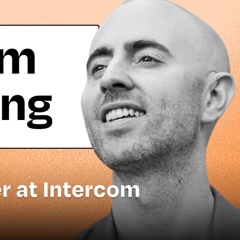
Paul Adams
Chief Product Officer at Intercom
Where to hear and read about Paul Adams1 episode or test

Paul Adams is Chief Product Officer at Intercom, who came up through design and research at Dyson, Google and Facebook and has led Intercom's product for over ten years. The most useful thing to learn from him is to start from what your product is for, ask whether AI can do that job, and rebuild strategy from first principles if it can.
I think if people don't explore AI properly, it will leave them behind.
What AI means for your product strategy | Paul Adams (CPO of Intercom)
Paul Adams: the story and the lessons
1Paul Adams's path from car interiors to Intercom
Adams reached product leadership through design and research, not product management. His first job was automotive interior designer, then product designer at Dyson, user researcher at Google and global head of brand design at Facebook. He has led product at Intercom for over ten years.
He has worked as a researcher, designer and PM, which shapes his preference for generalists who keep learning.
He joined Intercom to design a company, not just a product. Co-founder Eoghan pitched him when Intercom had about ten people: "At Facebook, you can design the product. But at Intercom, you can design the company."
Adams wanted a company built to absorb the frequent failure that big bets bring. He prefers high-risk, high-reward bets to incremental work, though incremental work has a place as companies grow.
2What Adams learned at Google and Facebook
Google's social products failed because fear of Facebook drove them. Fear of a competitor produced Buzz, Wave and Google+. Buzz was a privacy disaster and Google+ was similar. Adams spent four years at Google and about two and a half at Facebook.
Google also built Maps and Android in the same years, so he does not think it was incapable of great products. The social work "came from a place of fear."
Adams built from real user research, not competitor panic. Over 18 months he mapped the social networks of dozens of people. Each time they wanted better ways to reach small groups of family and friends, which is obvious now given WhatsApp and iMessage.
He added 20 minutes of this work to usability sessions the team had asked for. He published it in a conference talk. Facebook noticed, and Google treated his exit as spying and analyzed his laptop.
The mobile shift at Google gave him his instinct for AI. His mobile team in London was ignored by the 200-person team in Mountain View, who said no one would write docs on a phone.
He sees the same pattern in people who dismiss AI today, and his conviction draws on that experience.
Adams froze onstage at Cannes in front of 8,000 people and recovered. Facebook's keynote slot went to him after Zuckerberg got a hard time on privacy the year before. Three or four minutes in he blanked, walked off still mic'd, and cursed.
The room laughed and he walked back out. It was the first talk he had ever rehearsed word for word, under media training. He still carries a tiny doubt onstage, but it has never happened again.
3How Adams rebuilt Intercom around AI
Intercom ripped up its strategy the day ChatGPT launched. The date, November 29th, is etched in the team's heads. Intercom's head of machine learning called it a before-after moment, and Fergal tweeted: "This is it. This is the time."
The new plan began by asking why people use Intercom at all. Adams describes a bet-the-farm mindset. Other AI features were built first and Fin came later.
Fin became the first line of customer support. Some customers answer 50, 60 or even 70% of inbound questions with Fin. Support moved from tickets to messaging to bot-first.
Fin also works inside the inbox next to human agents, suggesting answers and helping rephrase them, so it both answers alone and augments people.
Adams says the real AI hurdle is how support teams reorganize. The business has not been transformed financially yet. Support leaders are curious but skeptical and ask whether the AI is as kind and empathetic as a person.
The technology is ahead of how people think about roles. New jobs appear, such as conversation designers who design what Fin says. He sees a young product on an exponential curve where the first year or two look flat, and Intercom's 900 people behave like a new startup here.
Putting a human and an AI in one inbox is a hard design problem. The questions are how they talk to each other, when the AI interjects, and how it is shown so it feels natural.
Adams calls this a really hard design problem.
4Adams's method for mapping a product against AI
Adams starts from the product's core job, not the technology. Ask why people use the product and what problem it solves, then ask: can AI do that? Expect one of three answers: yes, partly, or not yet.
Cool demos are a distraction, and he admits he gets sidetracked himself, for example by photographing his dinner. The mapping has to cover what AI can do now and what it will do later.
He sorts work into what AI replaces and what it augments. AI can write, summarize, answer queries, scan images, listen to voice and increasingly take actions. Any product built on workflows or media is in its path.
He thinks taking actions is the next big thing, such as telling an AI to change a flight to Tuesday. A reporting tool like Tableau might become a single box where you ask who your top rep was in January.
He argues a mobile-style mock-up mandate does not fit AI. Zuckerberg and Airbnb's Brian Chesky required mobile mock-ups, but AI progress sits mostly in language models and infrastructure, where it is invisible.
Leaders have to think strategically instead. Some products need a foundational change and others less.
Adams tells leaders to lean in without scaring their teams. He says announcing two engineers per team going forward would be a bad idea. Studies over the years show people rarely lose jobs outright.
Support has high attrition, so a bot likely replaces people who leave and are not backfilled. He admits it is easy to be afraid.
He builds conviction by showing people, and by reading skeptics. Adams calls his own stance an educated guess, a hunch, like product taste built on experience. Showing real examples is the easiest persuasion, and Intercom's mantra for support is adapt or die.
He deliberately reads people who think AI is hype or dangerous, since he has jumped on wrong bandwagons before. He tries to share conviction without drowning out alternative voices, such as a colleague who argued today's roadmap may be irrelevant in two years.
5How Adams builds AI into teams and keeps learning
Adams refuses to bolt AI on or give it to one team. Intercom avoids a single AI team that owns all AI features. Everyone learns AI, and the inbox team is not the only one working on AI inbox features.
He prefers generalists who learn new languages, frameworks and AI interface design. Intercom is still early in this.
He hires strong ML engineers and builds on foundation models. Intercom adapted OpenAI, Anthropic and Claude models for customer support and has an ML team far bigger than ever. It might someday build its own support model.
A standard team is a PM, a designer and three to five engineers, helped by ML. Some projects need the ML team and others are front-end design problems.
Adams treats AI learning as a priority, not longer hours. He works about 50 hours a week and thinks more leads to bad decisions. He blocks half an hour, goes deep, bookmarks a few things and returns to them.
He has no fixed reading list. He searches X and interacts with AI posts so his feed shows more of them, and reads Matt Rickard's newsletter and the OpenAI blog. He tries tools such as ChatGPT Vision, Bard and Rewind.ai to find their boundaries.
6Adams on pricing, differentiation and table stakes
Adams learned to keep pricing simple and resist add-ons. Each new feature tempts you to add a charge, which leads to add-ons and then tiers, until customers cannot understand their bill. Compounded mistakes forced Intercom to start again with a redesign.
He calls the pricing mess another scar for life. His advice: "Fight so hard to resist the temptation to add extra ways in which you price."
He ranks pricing with onboarding among the hardest design problems. Intercom's principle was to align price to value, but value is subjective. One person gets 10 units of value and pays about $5, while another would pay $5,000 for the same.
Adams says Intercom was risk averse and let mistakes compound instead of resetting early.
He balances the roadmap between differentiation and table stakes. Customers adopt a product for what is better but need basics like reports and permissions to buy it. Intercom favored differentiation, and buyers who loved it could not buy.
The split is about 50/50 today but has swung to 70/30 in both directions. He uses a simplified Kano model.
A startup in an established category should lean on differentiation first. Customer support carries decades of table stakes from ServiceNow, Salesforce Service Cloud and Zendesk. Early customers bought Intercom alongside those tools for its modern messaging.
It took years of building basics before customers could swap Zendesk for Intercom. He says the right order probably depends on the market.
Adams insists differentiation must matter to customers. He calls Google Wave an amazingly innovative product that no one really cared about.
The rule he takes from it is to be different and better in ways people care about.
After a before-after moment, Adams goes back to customers. He counts Intercom's rebrand and its pricing redesign as before-after moments, where from the day it goes live nothing is the same.
He asks whether the team was right or wrong, what happened and what people think. His rule is to talk, talk, talk, and go deeper than face value.
7Adams's mistakes: over-correcting, hiring and speed
Adams says fixes tend to overshoot into a new bad state. You step back, spot an undesirable state and fix it, but the temptation is to over-correct. He names product building and hiring as the two domains where Intercom has done this.
The differentiation versus table stakes swings are one example. The right answer usually sits in the middle.
Intercom's wave of experienced hires mostly did not work. About five years in, Intercom hired many people who had done it before. They brought their old companies' culture and ways of working.
Intercom was trying to be itself, not a bigger company that already exists. Specialists can drown in startup ambiguity, so it now hires people with a bit of specialism.
Intercom ships fast and early, and lives with the quality tension. The principle was once "Ship to Learn" and now reads "Ship fast, ship early, ship often". Shipping early makes failure cheap and speeds learning.
Intercom has design founders and never wants to be embarrassed by what it ships, so staff are asked for both high standards and speed, a constant tension.

What AI means for your product strategy | Paul Adams (CPO of Intercom)
Intercom's CPO explains how the company tore up its strategy after ChatGPT launched and rebuilt around AI, with a practical method for mapping any product against what AI can do. He also shares hard-won lessons on pricing, table stakes versus differentiation, and over-correcting when hiring or changing course.
Adams reached product leadership through design and research, not product management. His first job was automotive interior designer, then product designer at Dyson, user researcher at Google and global head of brand design at Facebook. He has led product at Intercom for over ten years.
He has worked as a researcher, designer and PM, which shapes his preference for generalists who keep learning.
He joined Intercom to design a company, not just a product. Co-founder Eoghan pitched him when Intercom had about ten people: "At Facebook, you can design the product. But at Intercom, you can design the company."
Adams wanted a company built to absorb the frequent failure that big bets bring. He prefers high-risk, high-reward bets to incremental work, though incremental work has a place as companies grow.
Google's social products failed because fear of Facebook drove them. Fear of a competitor produced Buzz, Wave and Google+. Buzz was a privacy disaster and Google+ was similar. Adams spent four years at Google and about two and a half at Facebook.
Google also built Maps and Android in the same years, so he does not think it was incapable of great products. The social work "came from a place of fear."
Adams built from real user research, not competitor panic. Over 18 months he mapped the social networks of dozens of people. Each time they wanted better ways to reach small groups of family and friends, which is obvious now given WhatsApp and iMessage.
He added 20 minutes of this work to usability sessions the team had asked for. He published it in a conference talk. Facebook noticed, and Google treated his exit as spying and analyzed his laptop.
The mobile shift at Google gave him his instinct for AI. His mobile team in London was ignored by the 200-person team in Mountain View, who said no one would write docs on a phone.
He sees the same pattern in people who dismiss AI today, and his conviction draws on that experience.
Adams froze onstage at Cannes in front of 8,000 people and recovered. Facebook's keynote slot went to him after Zuckerberg got a hard time on privacy the year before. Three or four minutes in he blanked, walked off still mic'd, and cursed.
The room laughed and he walked back out. It was the first talk he had ever rehearsed word for word, under media training. He still carries a tiny doubt onstage, but it has never happened again.
Intercom ripped up its strategy the day ChatGPT launched. The date, November 29th, is etched in the team's heads. Intercom's head of machine learning called it a before-after moment, and Fergal tweeted: "This is it. This is the time."
The new plan began by asking why people use Intercom at all. Adams describes a bet-the-farm mindset. Other AI features were built first and Fin came later.
Fin became the first line of customer support. Some customers answer 50, 60 or even 70% of inbound questions with Fin. Support moved from tickets to messaging to bot-first.
Fin also works inside the inbox next to human agents, suggesting answers and helping rephrase them, so it both answers alone and augments people.
Adams says the real AI hurdle is how support teams reorganize. The business has not been transformed financially yet. Support leaders are curious but skeptical and ask whether the AI is as kind and empathetic as a person.
The technology is ahead of how people think about roles. New jobs appear, such as conversation designers who design what Fin says. He sees a young product on an exponential curve where the first year or two look flat, and Intercom's 900 people behave like a new startup here.
Putting a human and an AI in one inbox is a hard design problem. The questions are how they talk to each other, when the AI interjects, and how it is shown so it feels natural.
Adams calls this a really hard design problem.
Adams starts from the product's core job, not the technology. Ask why people use the product and what problem it solves, then ask: can AI do that? Expect one of three answers: yes, partly, or not yet.
Cool demos are a distraction, and he admits he gets sidetracked himself, for example by photographing his dinner. The mapping has to cover what AI can do now and what it will do later.
He sorts work into what AI replaces and what it augments. AI can write, summarize, answer queries, scan images, listen to voice and increasingly take actions. Any product built on workflows or media is in its path.
He thinks taking actions is the next big thing, such as telling an AI to change a flight to Tuesday. A reporting tool like Tableau might become a single box where you ask who your top rep was in January.
He argues a mobile-style mock-up mandate does not fit AI. Zuckerberg and Airbnb's Brian Chesky required mobile mock-ups, but AI progress sits mostly in language models and infrastructure, where it is invisible.
Leaders have to think strategically instead. Some products need a foundational change and others less.
Adams tells leaders to lean in without scaring their teams. He says announcing two engineers per team going forward would be a bad idea. Studies over the years show people rarely lose jobs outright.
Support has high attrition, so a bot likely replaces people who leave and are not backfilled. He admits it is easy to be afraid.
He builds conviction by showing people, and by reading skeptics. Adams calls his own stance an educated guess, a hunch, like product taste built on experience. Showing real examples is the easiest persuasion, and Intercom's mantra for support is adapt or die.
He deliberately reads people who think AI is hype or dangerous, since he has jumped on wrong bandwagons before. He tries to share conviction without drowning out alternative voices, such as a colleague who argued today's roadmap may be irrelevant in two years.
Adams refuses to bolt AI on or give it to one team. Intercom avoids a single AI team that owns all AI features. Everyone learns AI, and the inbox team is not the only one working on AI inbox features.
He prefers generalists who learn new languages, frameworks and AI interface design. Intercom is still early in this.
He hires strong ML engineers and builds on foundation models. Intercom adapted OpenAI, Anthropic and Claude models for customer support and has an ML team far bigger than ever. It might someday build its own support model.
A standard team is a PM, a designer and three to five engineers, helped by ML. Some projects need the ML team and others are front-end design problems.
Adams treats AI learning as a priority, not longer hours. He works about 50 hours a week and thinks more leads to bad decisions. He blocks half an hour, goes deep, bookmarks a few things and returns to them.
He has no fixed reading list. He searches X and interacts with AI posts so his feed shows more of them, and reads Matt Rickard's newsletter and the OpenAI blog. He tries tools such as ChatGPT Vision, Bard and Rewind.ai to find their boundaries.
Adams learned to keep pricing simple and resist add-ons. Each new feature tempts you to add a charge, which leads to add-ons and then tiers, until customers cannot understand their bill. Compounded mistakes forced Intercom to start again with a redesign.
He calls the pricing mess another scar for life. His advice: "Fight so hard to resist the temptation to add extra ways in which you price."
He ranks pricing with onboarding among the hardest design problems. Intercom's principle was to align price to value, but value is subjective. One person gets 10 units of value and pays about $5, while another would pay $5,000 for the same.
Adams says Intercom was risk averse and let mistakes compound instead of resetting early.
He balances the roadmap between differentiation and table stakes. Customers adopt a product for what is better but need basics like reports and permissions to buy it. Intercom favored differentiation, and buyers who loved it could not buy.
The split is about 50/50 today but has swung to 70/30 in both directions. He uses a simplified Kano model.
A startup in an established category should lean on differentiation first. Customer support carries decades of table stakes from ServiceNow, Salesforce Service Cloud and Zendesk. Early customers bought Intercom alongside those tools for its modern messaging.
It took years of building basics before customers could swap Zendesk for Intercom. He says the right order probably depends on the market.
Adams insists differentiation must matter to customers. He calls Google Wave an amazingly innovative product that no one really cared about.
The rule he takes from it is to be different and better in ways people care about.
After a before-after moment, Adams goes back to customers. He counts Intercom's rebrand and its pricing redesign as before-after moments, where from the day it goes live nothing is the same.
He asks whether the team was right or wrong, what happened and what people think. His rule is to talk, talk, talk, and go deeper than face value.
Adams says fixes tend to overshoot into a new bad state. You step back, spot an undesirable state and fix it, but the temptation is to over-correct. He names product building and hiring as the two domains where Intercom has done this.
The differentiation versus table stakes swings are one example. The right answer usually sits in the middle.
Intercom's wave of experienced hires mostly did not work. About five years in, Intercom hired many people who had done it before. They brought their old companies' culture and ways of working.
Intercom was trying to be itself, not a bigger company that already exists. Specialists can drown in startup ambiguity, so it now hires people with a bit of specialism.
Intercom ships fast and early, and lives with the quality tension. The principle was once "Ship to Learn" and now reads "Ship fast, ship early, ship often". Shipping early makes failure cheap and speeds learning.
Intercom has design founders and never wants to be embarrassed by what it ships, so staff are asked for both high standards and speed, a constant tension.
 Intercom