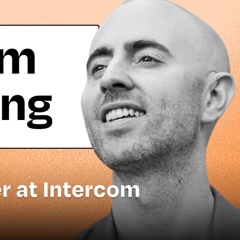
Eoghan McCabe
Founder and CEO of Intercom
Where to hear and read about Eoghan McCabe1 episode or test

Eoghan McCabe is the founder and CEO of Intercom, who returned to a stalled SaaS company and rebuilt it around an AI agent, Fin. The thing most worth learning from him is how a founder who picks one lane, prices on value and decides alone can turn a late-stage company around in a few quarters.
it is the responsibility of the CEO to make brave and hard decisions unilaterally
How Intercom rose from the ashes by betting everything on AI | Eoghan McCabe (founder and CEO)
Eoghan McCabe: the story and the lessons
1How Eoghan McCabe came back to a stalled Intercom
McCabe left the CEO role in 2020 and Intercom lost focus. He stepped away after years of illness, first from mold toxins and then a tick bite. In his absence the company tried to do all things for all people.
The post-COVID "sugar rush" of 2021 inflated revenue and valuations across late-stage software, which hid the drift for a while.
Growth slid to low single digits with net new ARR near zero. Net new ARR fell for five straight quarters. Other public software companies dropped 80 to 90% while Intercom's growth went from double digits to low single digits.
The traditional business had been valued at billions and earned hundreds of millions in ARR before it stalled.
Pride pulled him back, and ChatGPT was announced a month later. McCabe returned to the CEO role, and ChatGPT was announced one month after, which he calls a gift.
Coming back was cathartic after he had run from the business while sick and burned out. He never regretted it, but success now means 8 to 10 meetings a day, not adventure.
His reasons for the pivot were a messy mix, not one insight. He was angry at the compromises he had made to placate staff and investors, and chose an authoritarian, top-down, founder-first approach that he found cathartic.
He says founders rewrite their stories to look elegant. His own was a "big messy cocktail" of logic, desperation and intuition.
McCabe cut spending hard when growth was heading to zero. He cancelled projects, stopped fitting out a big new office and got frugal while many peers kept spending like drunken sailors. The freed cash let him set aside nearly $100 million for AI.
His reasoning was blunt: "we're about to hit negative growth territory, stop it."
2How McCabe bet Intercom on Fin
Having nothing to lose made the all-in bet possible. McCabe knows of no other company of Intercom's size and age that pivoted this hard to AI and succeeded.
He has empathy for healthier companies that try to sustain the old business while adding AI.
An AI group already inside Intercom built Fin in six weeks. About a week after GPT-3.5 launched, his co-founder Des Traynor texted that the AI team thought they could make a product out of it. A Fin beta existed six weeks after launch.
Earlier rudimentary bots, which needed a phenomenal amount of setup, meant Intercom already had an AI group able to spot the shift.
Intercom's customer base gave it a head start. It had 30,000 paying customers, hundreds of thousands of active users and billions of data points to experiment with when GPT-3.5 arrived.
Fin grew from 1 to 12 million ARR in its first year. It is now growing north of 300% and is expected to pass 100 million ARR in under three quarters. It is the biggest customer experience agent by customer count and revenue.
Fin wins head-to-head bake-offs against direct competitors and is rated number one on G2.
McCabe wants buyers to see Intercom as a brand new company. He says late-stage companies carry a handicap because people do not picture them as startups, even though Intercom works like one.
His comparison: "If I told you that IBM had made the most wildly innovative coding assistant, you'd find it hard to believe."
He tells founders to go all in on AI. McCabe warns against saying you do AI while keeping the same culture and adding a bit of weak AI. Intercom put nearly $100 million of its own cash into the bet.
His summary: "Don't half-ass it."
He insists on real AI scientists and leaders. McCabe says Intercom would be nothing without them. Fergal Reid, a long-time AI leader the company had worked with for years, is being promoted to chief AI officer.
3McCabe's rules for pricing AI and simplifying pricing
Fin charges per resolved ticket, not per seat. Fin costs 99 cents per resolution, so Intercom's revenue is fully tied to the value customers get. Resolution rate becomes the metric the agent is judged on.
Human-handled tickets cost $20 to $30 at SaaS firms. Intercom itself spent about $22 per human-resolved ticket. McCabe: "We wanted our revenue to be 100% aligned with the value that they attained."
He set Fin's price from value, not from cost. At launch each resolution cost about 120 cents against a 99 cent price. The team bet that model costs would fall, and they dropped a lot.
Margins move around but stay worth it. In his words, "pricing should come from value and not from costs."
He priced digital work below human work so it was easy to accept. Intercom considered $10, $5 and even $2.50 per resolution, but sensed customers would not value digital work as much as human work, even when it was better.
His test was that if a customer would not pay 99 cents for a perfectly solved problem, there was no business.
He simplified pricing even at the cost of revenue. Intercom's old pricing, built on seats, messages and leads plus tiers and gates, became a viral meme on Twitter. Cutting prices for many customers gave away about $50 million of ARR.
He traced it to weak strategy and an unwillingness to say no. Unfair pricing also eroded staff's sense that the company cared about customers, so "customer-obsessed" became a value.
4How McCabe reset Intercom's culture as a founder
McCabe chose one lane, customer service, and decided alone. He skipped the group spreadsheet vote and cut the other products even though they still brought in $80 million of ARR and many staff objected.
He saw an opening because Zendesk had been bought a couple of years earlier and was "strategically, energetically, culturally dead." His answer to the objections: "Sorry, this is what we're doing."
He rewrote the values and scored every employee each quarter. The new values were resilience, high standards, very hard work and shareholder value. Each quarter gave a grade on goals and a score on behavior, and below a set mark people were let go respectfully.
He hard-coded the formula so managers could not soften it. About 40% of staff turned over, and a survey 15 to 16 months in showed 98 to 99% approval of leadership.
He went hardcore founder mode when staff pushed back. Resistance included letters to the board and a soft coup attempt. McCabe argues great companies have a clear hierarchy where the CEO decides and is fired if the bets fail.
He came back to the lowest Glassdoor rating he had seen for a CEO. He says founder-led companies outperform because founders are bored if they are not risking it.
He hires for employee, founder and product market fit. Some people want a gentler, democratic workplace and are happier at places like Google or early startups. A push out the door can be a favor to them.
Culture is set by a few people, so the tenor of conversations changed within a quarter. Hiring people with the new ambition took longer.
5What McCabe thinks AI will do to work and people
He argues an instant agent is more personal than a slow human queue. McCabe was once anti-bot. He now says a friendly, consistent expert available around the clock beats waiting 2 to 4 days for a canned reply.
This let Intercom keep its mission of making internet business personal. He cites Waymo crashing 3.5 times less than human drivers as a similar case.
He expects agents to take over repetitive work and flatten companies. Customer experience covers service, success, sales and marketing, so it is the largest share of headcount in most businesses. Other mechanical functions like chasing invoices will follow.
Future organizations will be smaller and flatter, with managers working in individual contributor roles configuring and monitoring agents.
He says AI removes demeaning jobs while human trust stays. The roles at risk are customer experience and basic repetitive jobs, including sales development roles that qualify basic questions. Sales keeps its human side.
He expects friction and is not "pollyannaish." He believes former Intercom staff from repetitive work showed a bright spark and would thrive in better roles.
He thinks human craft will be worth more as automated output goes to zero. Efficiency is not the top thing people value, or everyone would buy the cheapest clothes, furniture and printer paper. People pay for beauty, human stories and connection.
He expects audiences to still want a Lenny with his own story, take and opinions who is a little imperfect.
He says AI is a young person's game and hard work is the price. Young teams use AI by default, while most people in older organizations use none. McCabe does not promote hard work in general, but says to win in AI you pay the price or get out.
Founders unwilling to work like the kids should become chairperson, as he did, and hire one: "hire a kid because you're in the wrong job, buddy."
6How McCabe grew as a leader and built product people
Therapy and a collapsed ego made him a calmer leader. Three things shaped him: fourteen years of startup battering, therapy and two years away. He found his coach, Yosi Amram, 12 years ago.
He was sick, revenue growth was soft and false press beat him up. The image of himself as a perfect, brilliant leader had to die, because holding it makes every challenge scary.
Intercom became a top source of product leaders under him. A sprawling product set needed many PM groups with high autonomy, so PMs acted like mini CEOs. The team built first-principles frameworks, such as who an event is for and how success is defined.
Research by Lenny ranks Intercom first alongside Palantir, Stripe and Revolut. McCabe is a designer who studied computer science and drove strategy with Des Traynor.
He pitched hires on learning to build companies, then starting their own. Those founder-type hires became founders, and were probably better founders than employees.
Today's hires are more mature, stable and focused on one lane.
He builds for himself to gain conviction before shipping. His early app Quitter told users when someone unfollowed them on Twitter. Nearly everyone on Twitter tried to sign up and it broke, and it was later sold for about $14K.
It taught him you can know a product makes sense without testing it first.

How Intercom rose from the ashes by betting everything on AI | Eoghan McCabe (founder and CEO)
Intercom's CEO explains how a late-stage SaaS company with stalled growth rebuilt itself around an AI agent, Fin, through a narrower strategy, outcome-based pricing and a hard culture reset. Fin grew from 1 to 12 million ARR in its first year and is growing north of 300%, heading past 100 million ARR in under three quarters.
McCabe left the CEO role in 2020 and Intercom lost focus. He stepped away after years of illness, first from mold toxins and then a tick bite. In his absence the company tried to do all things for all people.
The post-COVID "sugar rush" of 2021 inflated revenue and valuations across late-stage software, which hid the drift for a while.
Growth slid to low single digits with net new ARR near zero. Net new ARR fell for five straight quarters. Other public software companies dropped 80 to 90% while Intercom's growth went from double digits to low single digits.
The traditional business had been valued at billions and earned hundreds of millions in ARR before it stalled.
Pride pulled him back, and ChatGPT was announced a month later. McCabe returned to the CEO role, and ChatGPT was announced one month after, which he calls a gift.
Coming back was cathartic after he had run from the business while sick and burned out. He never regretted it, but success now means 8 to 10 meetings a day, not adventure.
His reasons for the pivot were a messy mix, not one insight. He was angry at the compromises he had made to placate staff and investors, and chose an authoritarian, top-down, founder-first approach that he found cathartic.
He says founders rewrite their stories to look elegant. His own was a "big messy cocktail" of logic, desperation and intuition.
McCabe cut spending hard when growth was heading to zero. He cancelled projects, stopped fitting out a big new office and got frugal while many peers kept spending like drunken sailors. The freed cash let him set aside nearly $100 million for AI.
His reasoning was blunt: "we're about to hit negative growth territory, stop it."
Having nothing to lose made the all-in bet possible. McCabe knows of no other company of Intercom's size and age that pivoted this hard to AI and succeeded.
He has empathy for healthier companies that try to sustain the old business while adding AI.
An AI group already inside Intercom built Fin in six weeks. About a week after GPT-3.5 launched, his co-founder Des Traynor texted that the AI team thought they could make a product out of it. A Fin beta existed six weeks after launch.
Earlier rudimentary bots, which needed a phenomenal amount of setup, meant Intercom already had an AI group able to spot the shift.
Intercom's customer base gave it a head start. It had 30,000 paying customers, hundreds of thousands of active users and billions of data points to experiment with when GPT-3.5 arrived.
Fin grew from 1 to 12 million ARR in its first year. It is now growing north of 300% and is expected to pass 100 million ARR in under three quarters. It is the biggest customer experience agent by customer count and revenue.
Fin wins head-to-head bake-offs against direct competitors and is rated number one on G2.
McCabe wants buyers to see Intercom as a brand new company. He says late-stage companies carry a handicap because people do not picture them as startups, even though Intercom works like one.
His comparison: "If I told you that IBM had made the most wildly innovative coding assistant, you'd find it hard to believe."
He tells founders to go all in on AI. McCabe warns against saying you do AI while keeping the same culture and adding a bit of weak AI. Intercom put nearly $100 million of its own cash into the bet.
His summary: "Don't half-ass it."
He insists on real AI scientists and leaders. McCabe says Intercom would be nothing without them. Fergal Reid, a long-time AI leader the company had worked with for years, is being promoted to chief AI officer.
Fin charges per resolved ticket, not per seat. Fin costs 99 cents per resolution, so Intercom's revenue is fully tied to the value customers get. Resolution rate becomes the metric the agent is judged on.
Human-handled tickets cost $20 to $30 at SaaS firms. Intercom itself spent about $22 per human-resolved ticket. McCabe: "We wanted our revenue to be 100% aligned with the value that they attained."
He set Fin's price from value, not from cost. At launch each resolution cost about 120 cents against a 99 cent price. The team bet that model costs would fall, and they dropped a lot.
Margins move around but stay worth it. In his words, "pricing should come from value and not from costs."
He priced digital work below human work so it was easy to accept. Intercom considered $10, $5 and even $2.50 per resolution, but sensed customers would not value digital work as much as human work, even when it was better.
His test was that if a customer would not pay 99 cents for a perfectly solved problem, there was no business.
He simplified pricing even at the cost of revenue. Intercom's old pricing, built on seats, messages and leads plus tiers and gates, became a viral meme on Twitter. Cutting prices for many customers gave away about $50 million of ARR.
He traced it to weak strategy and an unwillingness to say no. Unfair pricing also eroded staff's sense that the company cared about customers, so "customer-obsessed" became a value.
McCabe chose one lane, customer service, and decided alone. He skipped the group spreadsheet vote and cut the other products even though they still brought in $80 million of ARR and many staff objected.
He saw an opening because Zendesk had been bought a couple of years earlier and was "strategically, energetically, culturally dead." His answer to the objections: "Sorry, this is what we're doing."
He rewrote the values and scored every employee each quarter. The new values were resilience, high standards, very hard work and shareholder value. Each quarter gave a grade on goals and a score on behavior, and below a set mark people were let go respectfully.
He hard-coded the formula so managers could not soften it. About 40% of staff turned over, and a survey 15 to 16 months in showed 98 to 99% approval of leadership.
He went hardcore founder mode when staff pushed back. Resistance included letters to the board and a soft coup attempt. McCabe argues great companies have a clear hierarchy where the CEO decides and is fired if the bets fail.
He came back to the lowest Glassdoor rating he had seen for a CEO. He says founder-led companies outperform because founders are bored if they are not risking it.
He hires for employee, founder and product market fit. Some people want a gentler, democratic workplace and are happier at places like Google or early startups. A push out the door can be a favor to them.
Culture is set by a few people, so the tenor of conversations changed within a quarter. Hiring people with the new ambition took longer.
He argues an instant agent is more personal than a slow human queue. McCabe was once anti-bot. He now says a friendly, consistent expert available around the clock beats waiting 2 to 4 days for a canned reply.
This let Intercom keep its mission of making internet business personal. He cites Waymo crashing 3.5 times less than human drivers as a similar case.
He expects agents to take over repetitive work and flatten companies. Customer experience covers service, success, sales and marketing, so it is the largest share of headcount in most businesses. Other mechanical functions like chasing invoices will follow.
Future organizations will be smaller and flatter, with managers working in individual contributor roles configuring and monitoring agents.
He says AI removes demeaning jobs while human trust stays. The roles at risk are customer experience and basic repetitive jobs, including sales development roles that qualify basic questions. Sales keeps its human side.
He expects friction and is not "pollyannaish." He believes former Intercom staff from repetitive work showed a bright spark and would thrive in better roles.
He thinks human craft will be worth more as automated output goes to zero. Efficiency is not the top thing people value, or everyone would buy the cheapest clothes, furniture and printer paper. People pay for beauty, human stories and connection.
He expects audiences to still want a Lenny with his own story, take and opinions who is a little imperfect.
He says AI is a young person's game and hard work is the price. Young teams use AI by default, while most people in older organizations use none. McCabe does not promote hard work in general, but says to win in AI you pay the price or get out.
Founders unwilling to work like the kids should become chairperson, as he did, and hire one: "hire a kid because you're in the wrong job, buddy."
Therapy and a collapsed ego made him a calmer leader. Three things shaped him: fourteen years of startup battering, therapy and two years away. He found his coach, Yosi Amram, 12 years ago.
He was sick, revenue growth was soft and false press beat him up. The image of himself as a perfect, brilliant leader had to die, because holding it makes every challenge scary.
Intercom became a top source of product leaders under him. A sprawling product set needed many PM groups with high autonomy, so PMs acted like mini CEOs. The team built first-principles frameworks, such as who an event is for and how success is defined.
Research by Lenny ranks Intercom first alongside Palantir, Stripe and Revolut. McCabe is a designer who studied computer science and drove strategy with Des Traynor.
He pitched hires on learning to build companies, then starting their own. Those founder-type hires became founders, and were probably better founders than employees.
Today's hires are more mature, stable and focused on one lane.
He builds for himself to gain conviction before shipping. His early app Quitter told users when someone unfollowed them on Twitter. Nearly everyone on Twitter tried to sign up and it broke, and it was later sold for about $14K.
It taught him you can know a product makes sense without testing it first.

 Intercom