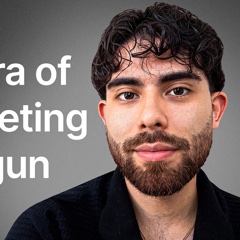
Matt Espinoza
Founder of Clover Labs
Where to hear and read about Matt Espinoza1 episode or test

Matt Espinoza is the founder of Clover Labs, an organic distribution company that grew from zero to $8M a year in six months. The most useful lesson is to clone content that already performed, change one element at a time, and spread the winners across accounts, countries and languages.
Cloning content is really about 90% of any campaign that we've done and then 10% is really kind of the crazy experiments worth testing.
The NEW App Content Strategy Dominating in 2026
Matt Espinoza: the story and the lessons
1What Matt Espinoza built at Clover Labs
Espinoza grew Clover to $8M a year in six months. Clover solves one problem, distribution, and now produces about a quarter of a billion organic views a month for OpusClip, Superwall and Typing.com.
The work is organic, not paid ads. Espinoza calls Clover one of the fastest-growing companies in Canada.
Clover works for both consumer and B2B apps. Consumer apps retain better, while B2B is more about awareness.
Espinoza sees four distribution channels and wants one click to launch them all. The channels are search (Reddit, blogs, backlinks), video (TikTok, Instagram, later YouTube and Snapchat), ads that adapt from organic learnings, and mass outreach, which suits B2B better.
The long-term plan is agents running all four for a new or existing product, and he imagines launching apps or e-commerce brands and running their distribution. He bets on cloning what works now because formats like hook and demo may not last.
The reported results come only from Clover's own tool and customers. The 'about 20% of the original' median is stated without a sample size or method, and no independent data backs it.
The approach also skips the risk that platforms penalize near-duplicate posts and mass-created accounts, even though avoiding detection is the stated goal.
2Espinoza's cloning method for organic content
Espinoza makes about 90% of every campaign clones. He takes a post that already performed, varies the hook, CTA or avatar, and reposts it. The other 10% is reserved for wild experiments.
A trucker slideshow with 110k views was cloned into variations that together drew about 34k views in a week and a half.
He tests organic content like paid ad creative. Clover changes one variable at a time (CTA, hook, one small visual), tracks which wins, and carries it into future campaigns.
Host Joseph Choi said he had not seen organic done 'to this scientific level' before.
Espinoza plans for a clone to earn about 20% of the original. The median clone gets about a fifth of the original's views, so five to ten clones match the original. Extreme cases do two to six times better.
He says results are 'very random': a 100k-view post could reach 600k with a tiny tweak.
Small visual edits make a clone look like new content. In the trucker slideshow, one click produced a variant with a blue truck and slightly shifted images. The aim is that TikTok does not flag it as a duplicate or shadowban it.
A more dramatic change makes detection harder. Another variant swaps in the product the team wants to push.
For slideshows, Espinoza says account aesthetic matters most. He keeps one account themed around a single look, such as trucks, and tests hook, CTA and avatar inside it.
Espinoza clones a competitor's best post in about seven minutes. The tool lists a competitor's top five posts, clones one, and swaps in the customer's logo or demo. A set took about six to seven minutes, and 20 image variations take about as long as four.
A campaign for the Natural camera app, cloned from a Dazz post, reached about 100k organic views, about $1,000 in downloads and about 200 signups in five days. The database behind it holds about 4 million TikTok and Instagram accounts.
He splits winning videos into hook and demo and recombines them. The hook is the first two seconds, and AI finds the cut by spotting the big visual change. A proven hook can then carry a different demo.
Most organic hits owe their reach to the hook. 'As long as you have a good hook set, you can then switch the demo to the one that you're looking to promote.'
3How Clover multiplies winners across accounts, countries and languages
Clover remixes only posts that pass a view threshold. When a creator's post clears a mark such as a million views, it is re-hooked and posted on other accounts, countries or niches.
A creator posting twice a day makes about 60 posts a month, about 10 pass, and three variations of each give 30 new videos. Instagram limits reposting less than TikTok does.
Clover creates accounts in bulk on real phones. One interface launches batches of accounts across platforms and 20 countries, with more added every other week. Each account posts two to three times a day at random.
Accounts are made on physical devices. Bulk-ordering enough phones is near impossible, so about half of campaigns run on rented phones, while Clover's own network covers North America.
Espinoza dubs proven videos into new languages for a 20% lift per country. A 37.4M-view Rhyme video was subbed, dubbed and mouth-synced into German. A million views a month gains about 200k per new country.
Spain, Germany and Australia come first, then Italy and Brazil. Germany suited Rhyme because buyers there repurchase more and no rival app targeted German. Dialects are the hard part.
He adds Canada to US campaigns as the cheapest expansion. Canada has nearly the same purchasing power and conversion as the US and needs no translation. Canadians have not seen the content yet.
Adding Canada to a US ad set is an easy 20% lift, and Espinoza says organic gains the same way.
Clover pays creators high CPM to find formats, then base pay once proven. New experiments lean on high CPM because the goal is discovering formats. Cloned content leans on base pay.
One campaign pays $3 a post plus a $3.50 CPM. 'Base plus performance is the best scenario.'
4How Espinoza approaches AI search and Reddit
Clover estimates AI search volume at 30% of Google volume. It builds a list of about 2,000 prompts and takes each query's volume from Ahrefs or Search Console. A 15,000-impression query becomes about 5,000.
No real prompt volume exists, so Google volume is the proxy. Clover began with AI search and now makes about 150 million views a year there across customers.
Espinoza targets the Reddit threads that AI models already cite. One thread can be cited for five prompts across ChatGPT, Gemini and Google AI Overview. Clover either outranks it with a cloned, tweaked post or joins it with a comment.
Post seeding pushes the cited thread down. Comment seeding adds a take inside the thread, such as a personal ranked list.
A single Reddit comment can become what models cite. One commenter listed 22 design agencies, and that list became the source of truth. Cutting it to one agency would change the answer at the next live-search refresh.
Over the prior six months, a couple of links in a post and its comments were enough. Now a comment is often cited instead of the post.
Clover owns about 4,000 subreddits to keep seeded content live. It also owns accounts, customer-owned or its own, that see and lift the comments and posts.
The same tool is used for TikTok and Instagram.
He tracks the shift toward community sources like Reddit, Quora and Pinterest. ChatGPT cites Reddit slightly less but still cites blogs strongly. In the last three weeks before recording, Gemini, Perplexity and AI Overview cited Reddit, Quora and Pinterest more.
Clover covers both blogs and community posts.
Espinoza runs AI search and organic video as one funnel. A viral video sends people to the app store, while a Reddit post or blog still shows up when they search the app name.
For consumer apps he says to go hard on both at once if money and people allow.

The NEW App Content Strategy Dominating in 2026
Organic app distribution works best by cloning formats that already performed, changing one element at a time, and publishing across many accounts, countries and languages. Clover went from zero to 8 million a year in six months and now does a quarter of a billion views a month for customers like OpusClip, Superwall and Typing.com.
Espinoza grew Clover to $8M a year in six months. Clover solves one problem, distribution, and now produces about a quarter of a billion organic views a month for OpusClip, Superwall and Typing.com.
The work is organic, not paid ads. Espinoza calls Clover one of the fastest-growing companies in Canada.
Clover works for both consumer and B2B apps. Consumer apps retain better, while B2B is more about awareness.
Espinoza sees four distribution channels and wants one click to launch them all. The channels are search (Reddit, blogs, backlinks), video (TikTok, Instagram, later YouTube and Snapchat), ads that adapt from organic learnings, and mass outreach, which suits B2B better.
The long-term plan is agents running all four for a new or existing product, and he imagines launching apps or e-commerce brands and running their distribution. He bets on cloning what works now because formats like hook and demo may not last.
The reported results come only from Clover's own tool and customers. The 'about 20% of the original' median is stated without a sample size or method, and no independent data backs it.
The approach also skips the risk that platforms penalize near-duplicate posts and mass-created accounts, even though avoiding detection is the stated goal.
Espinoza makes about 90% of every campaign clones. He takes a post that already performed, varies the hook, CTA or avatar, and reposts it. The other 10% is reserved for wild experiments.
A trucker slideshow with 110k views was cloned into variations that together drew about 34k views in a week and a half.
He tests organic content like paid ad creative. Clover changes one variable at a time (CTA, hook, one small visual), tracks which wins, and carries it into future campaigns.
Host Joseph Choi said he had not seen organic done 'to this scientific level' before.
Espinoza plans for a clone to earn about 20% of the original. The median clone gets about a fifth of the original's views, so five to ten clones match the original. Extreme cases do two to six times better.
He says results are 'very random': a 100k-view post could reach 600k with a tiny tweak.
Small visual edits make a clone look like new content. In the trucker slideshow, one click produced a variant with a blue truck and slightly shifted images. The aim is that TikTok does not flag it as a duplicate or shadowban it.
A more dramatic change makes detection harder. Another variant swaps in the product the team wants to push.
For slideshows, Espinoza says account aesthetic matters most. He keeps one account themed around a single look, such as trucks, and tests hook, CTA and avatar inside it.
Espinoza clones a competitor's best post in about seven minutes. The tool lists a competitor's top five posts, clones one, and swaps in the customer's logo or demo. A set took about six to seven minutes, and 20 image variations take about as long as four.
A campaign for the Natural camera app, cloned from a Dazz post, reached about 100k organic views, about $1,000 in downloads and about 200 signups in five days. The database behind it holds about 4 million TikTok and Instagram accounts.
He splits winning videos into hook and demo and recombines them. The hook is the first two seconds, and AI finds the cut by spotting the big visual change. A proven hook can then carry a different demo.
Most organic hits owe their reach to the hook. 'As long as you have a good hook set, you can then switch the demo to the one that you're looking to promote.'
Clover remixes only posts that pass a view threshold. When a creator's post clears a mark such as a million views, it is re-hooked and posted on other accounts, countries or niches.
A creator posting twice a day makes about 60 posts a month, about 10 pass, and three variations of each give 30 new videos. Instagram limits reposting less than TikTok does.
Clover creates accounts in bulk on real phones. One interface launches batches of accounts across platforms and 20 countries, with more added every other week. Each account posts two to three times a day at random.
Accounts are made on physical devices. Bulk-ordering enough phones is near impossible, so about half of campaigns run on rented phones, while Clover's own network covers North America.
Espinoza dubs proven videos into new languages for a 20% lift per country. A 37.4M-view Rhyme video was subbed, dubbed and mouth-synced into German. A million views a month gains about 200k per new country.
Spain, Germany and Australia come first, then Italy and Brazil. Germany suited Rhyme because buyers there repurchase more and no rival app targeted German. Dialects are the hard part.
He adds Canada to US campaigns as the cheapest expansion. Canada has nearly the same purchasing power and conversion as the US and needs no translation. Canadians have not seen the content yet.
Adding Canada to a US ad set is an easy 20% lift, and Espinoza says organic gains the same way.
Clover pays creators high CPM to find formats, then base pay once proven. New experiments lean on high CPM because the goal is discovering formats. Cloned content leans on base pay.
One campaign pays $3 a post plus a $3.50 CPM. 'Base plus performance is the best scenario.'
Clover estimates AI search volume at 30% of Google volume. It builds a list of about 2,000 prompts and takes each query's volume from Ahrefs or Search Console. A 15,000-impression query becomes about 5,000.
No real prompt volume exists, so Google volume is the proxy. Clover began with AI search and now makes about 150 million views a year there across customers.
Espinoza targets the Reddit threads that AI models already cite. One thread can be cited for five prompts across ChatGPT, Gemini and Google AI Overview. Clover either outranks it with a cloned, tweaked post or joins it with a comment.
Post seeding pushes the cited thread down. Comment seeding adds a take inside the thread, such as a personal ranked list.
A single Reddit comment can become what models cite. One commenter listed 22 design agencies, and that list became the source of truth. Cutting it to one agency would change the answer at the next live-search refresh.
Over the prior six months, a couple of links in a post and its comments were enough. Now a comment is often cited instead of the post.
Clover owns about 4,000 subreddits to keep seeded content live. It also owns accounts, customer-owned or its own, that see and lift the comments and posts.
The same tool is used for TikTok and Instagram.
He tracks the shift toward community sources like Reddit, Quora and Pinterest. ChatGPT cites Reddit slightly less but still cites blogs strongly. In the last three weeks before recording, Gemini, Perplexity and AI Overview cited Reddit, Quora and Pinterest more.
Clover covers both blogs and community posts.
Espinoza runs AI search and organic video as one funnel. A viral video sends people to the app store, while a Reddit post or blog still shows up when they search the app name.
For consumer apps he says to go hard on both at once if money and people allow.