
Clover Labs
A distribution company that scales organic social and AI search content for apps by cloning proven posts.
Clover Labs reached $8M a year in six months and about 250 million organic views a month by cloning proven posts, changing one element, and spreading them across many accounts and countries. Clones earn about 20% of the original's views, and each new country adds about 20% more. Lesson: copy what already works, then scale it with distribution, including Reddit and AI search.
- 1Find a proven postOwn, creator or competitor post that performed
- 2Change one elementHook, CTA, visual, creator, language or demo
- 3Repost across accountsPhone-made accounts, two to three daily
- 4Winners shape next campaignAbout 90% clones, 10% experiments
From Matt Espinoza and Joseph Choi interview
What was said about Clover Labs
1Why Clover sells distribution, not content
AI made content cheap, so the bottleneck moved to finding formats and posting them. Clover Labs grew to $8M a year in six months by selling one thing, distribution, and drives about a quarter of a billion organic views a month for customers like OpusClip, Superwall and Typing.com.
The work is organic, not paid ads. Both B2B and consumer apps work: consumer retains better, while B2B is more about awareness. Joseph Choi: "People just underestimate how much you can juice the views on the stuff that you're doing already."
Clover plans distribution across four channels: search, video, ads and outreach. Matt Espinoza names search (Reddit, blogs, backlinks), video (TikTok, Instagram, later YouTube and Snapchat), ads that adapt using organic learnings, and mass outreach, which suits B2B better.
Because hook-and-demo formats may not work forever, the approach is to clone whatever is working now rather than bet on one format.
2Cloning proven posts with one element changed
Make about 90% of a campaign clones and 10% wild experiments. Take a post that already performed, change one element (hook, CTA, visual, creator, language or demo) and repost it. Espinoza puts cloning at about 90% of any campaign Clover has run.
It works like Facebook ad creative testing: each clone tests one variable and the winners shape the next campaign. For slideshows, an account's overall aesthetic matters more than anything else. Joseph Choi says he has not seen organic done this scientifically.
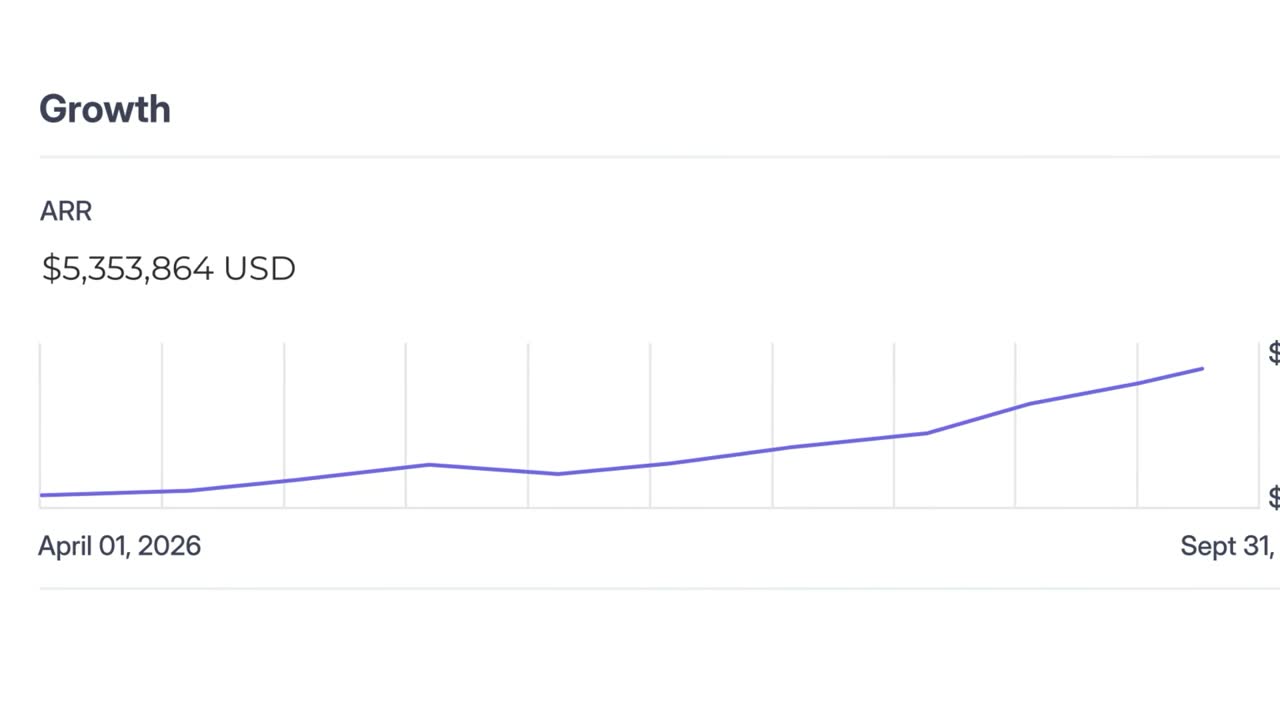
Clover's growth dashboard shows ARR at $5,353,864 USD, climbing steadily from April 2026. Expect a clone to earn about 20% of the original's views. The median clone gets about 20% of the original, so five to ten clones match the original's volume, while extreme cases do two to six times better. A trucker slideshow with 110k views produced clones that together reached about 34k in a week and a half.
Results are "very random": a 100k-view post could have reached 600k with a tiny tweak. The 20% median comes from Clover's own tool and customers, with no sample size or method given.
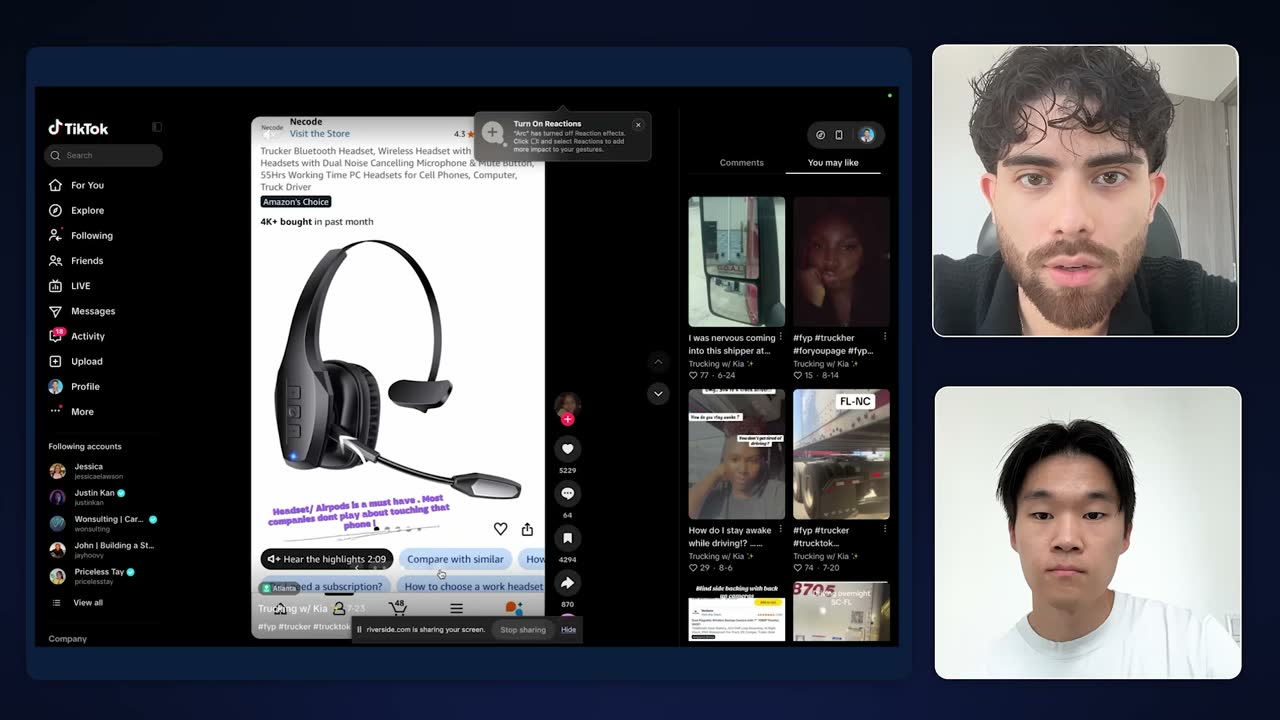
TikTok trucker slideshow slide promoting an Amazon Bluetooth headset, a cloned variation with 4K+ bought. Small visual edits keep a clone from being flagged as a duplicate. In the "10 trucker essentials, Amazon edition" slideshow, one click turned the truck blue and shifted the images slightly; another variant swapped one slide for the product the team wanted to push.
The aim is for TikTok to treat each clone as original content and avoid a shadowban. Clover's tool lets you set change strength as subtle, moderate or dramatic, and more dramatic edits are harder to detect. The source does not address the risk of platforms penalizing near-duplicate posts.
Split winning videos into hook and demo, then recombine them. The hook is the first two seconds and carries most of a video's organic reach, so a proven hook can carry any app's demo. AI finds the cut by spotting the big visual change between the two parts.
The example is a clip where a woman covers her mouth, then cuts to the demo. This builds a library of mix-and-match hooks and demos from competitor or creator videos. "As long as you have a good hook set, you can then switch the demo to the one that you're looking to promote."
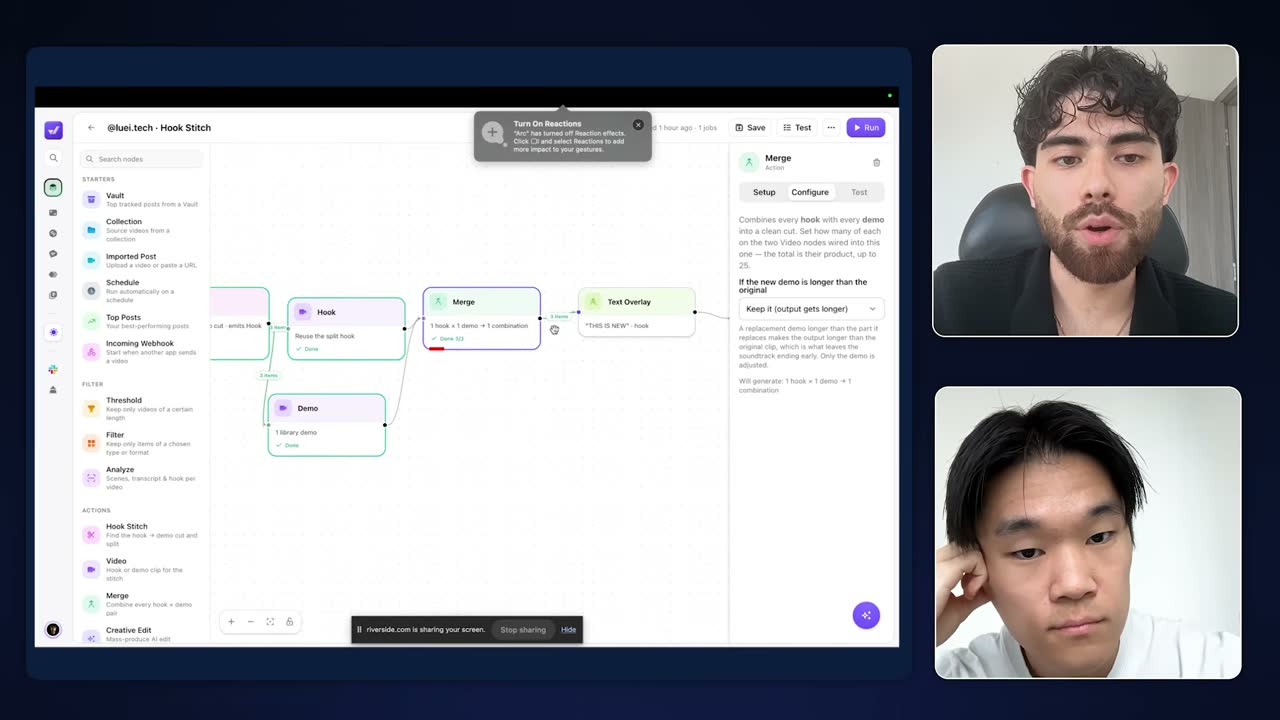
Hook Stitch workflow merging one hook with one library demo, then adding a "THIS IS NEW" text overlay. Only remix creator posts that pass a view threshold. When a UGC creator's post hits a threshold such as a million views, it is re-edited with a new hook, demo or avatar and published on other accounts, countries or niches. A creator posting twice a day makes about 60 posts a month; about 10 pass, and three variations each give 30 new videos.
One creator can keep posting while every other part of the video changes on autopilot. Repeat posts are less restricted on Instagram than on TikTok.
Pay high CPM to find formats, base pay once they're proven. For experiments, pay creators a high CPM because the goal is discovery; for proven formats and pure clones, weight toward a lower base plus performance. Some campaigns pay $3 per post with a 3.5 CPM, others a much higher CPM and no base.
"Base plus performance is the best scenario."
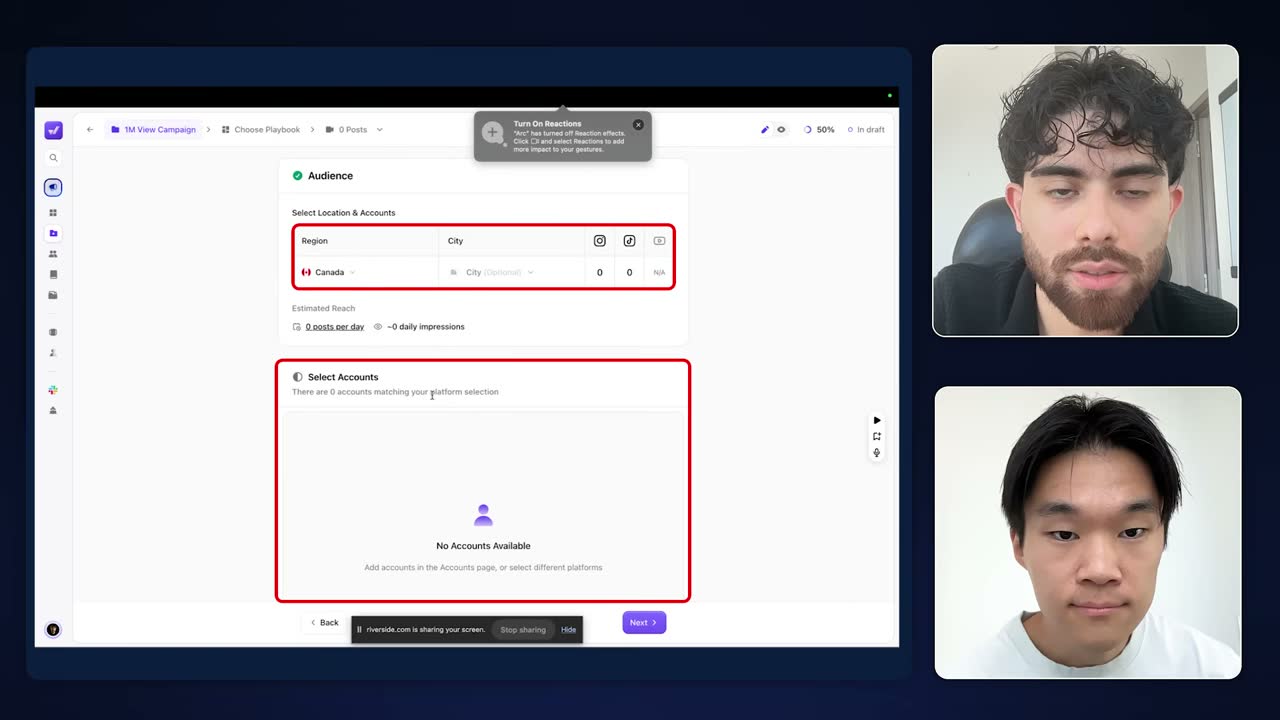
Campaign builder's audience step: selecting Canada shows zero accounts available, while US has 13.
3Cloning a competitor's top post in minutes
A cloned Dazz post launched the Natural camera app in minutes. For Natural, a camera app by Superwall founder Jake, the tool listed competitor Dazz's top five clone-worthy posts. The team cloned a camera-plus-flash slideshow, swapped in Jake's logo, and in about five days reached about 100k organic views, about $1,000 in downloads and about 200 signups.
A full set took about six to seven minutes, and images run in parallel so 20 variations take about as long as four. The database holds about 4 million TikTok and Instagram accounts, scraped continuously, plus live search.
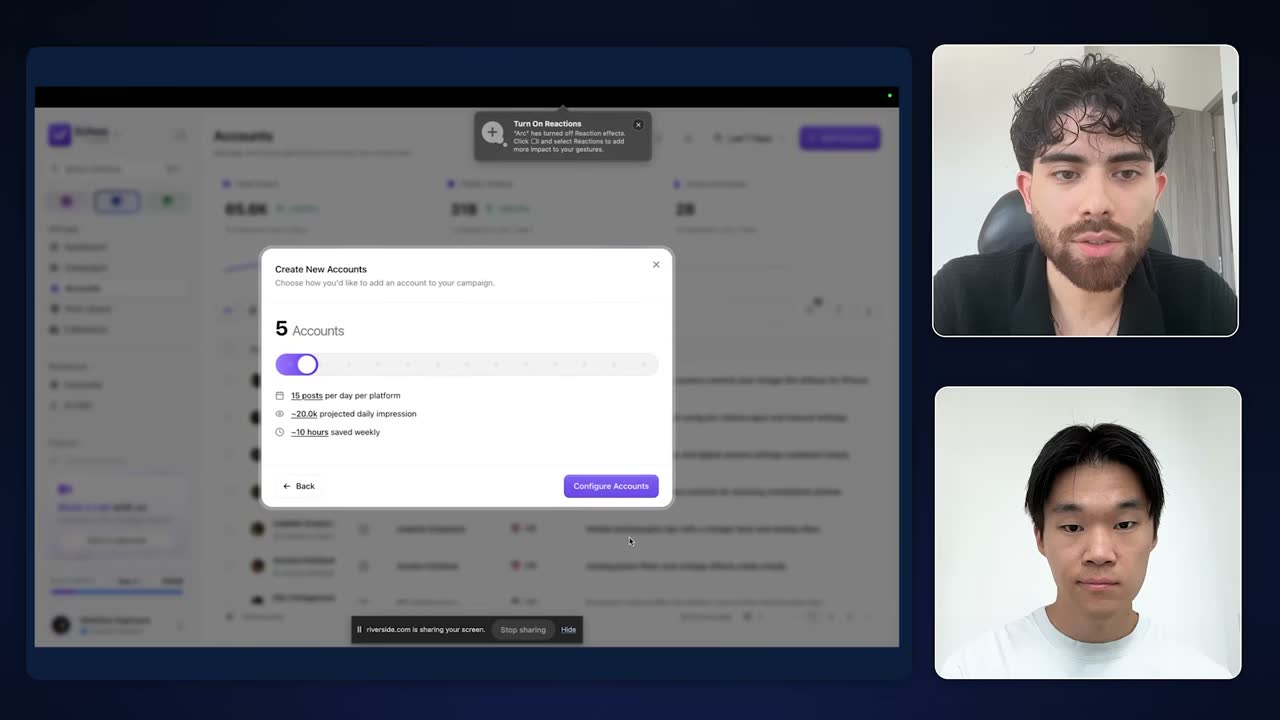
Create New Accounts dialog: 5 accounts yield 15 posts per day per platform, ~20.0k daily impressions, ~10 hours saved weekly.
4The phone-based account network
Post from many accounts created on real phones to avoid detection. One interface creates batches of accounts across platforms and 20 countries, setting age range, gender, search terms, usernames, bios and locations. Each account posts two to three times a day at a random rate.
Accounts are made on physical devices, not virtual ones. Bulk-ordering enough phones is near impossible, so about half of campaigns run on rented phones, mostly for other countries, while Clover's own network covers North America. Check which campaigns each account serves to avoid overlap.
5Dubbing winners into new countries
From Matt Espinoza and Joseph Choi interview
Each new country adds about 20% more views to a campaign. Sub, dub and lip-sync a proven video into the new language, match the on-screen text and dialect, and post from an account in that country. A campaign at a million views a month gains about 200k per new country, and around five countries typically work well.
Travel app Rhyme's 37.4M-view hook-and-demo video was first localized by only swapping in German text in the same TikTok font, then fully subbed, dubbed and mouth-synced. Dialects are the hard part.
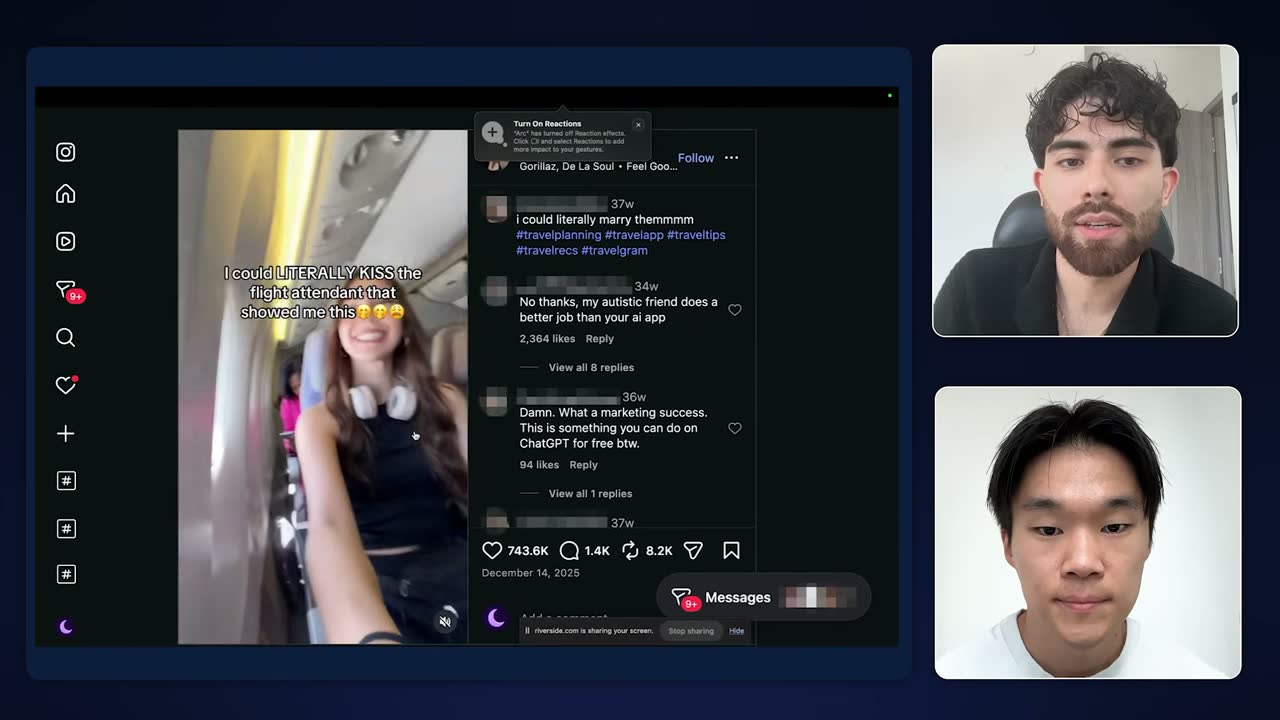
Rhyme's English travel-app Instagram reel with 743.6K likes, the original later relaunched in German. Rhyme picked Germany for repurchase rates and no German-language rivals. Rhyme's data showed Germany as its highest-converting audience outside North America: conversion was similar, but purchase and repurchase rates were higher.
No rival app targeted German, a "blue ocean" that multiplied the repurchase advantage.
Start with Spain, Germany and Australia; add Canada for free. These markets spend like US buyers, with Italy and Brazil next. Canada needs no translation and has nearly the same purchasing power and conversion as the US, so it is an easy 20% lift on a US campaign.
Spain can be split into regions inside the platform. Joseph Choi says US teams forget Canada, and notes app acquirers he knows saw 5 to 10x potential in international expansion.
6Seeding Reddit for AI search
Estimate AI search volume as about 30% of Google volume. With no reliable prompt volume data, Clover builds a list of around 2,000 prompts, takes each query's Google volume from Ahrefs or Search Console, and assumes 30% happens in AI search. A 15,000-impression query becomes about 5,000.
It then checks which sources get cited per prompt. Clover generates about 150 million AI search views a year across customers and seeds about 4,000 subreddits.
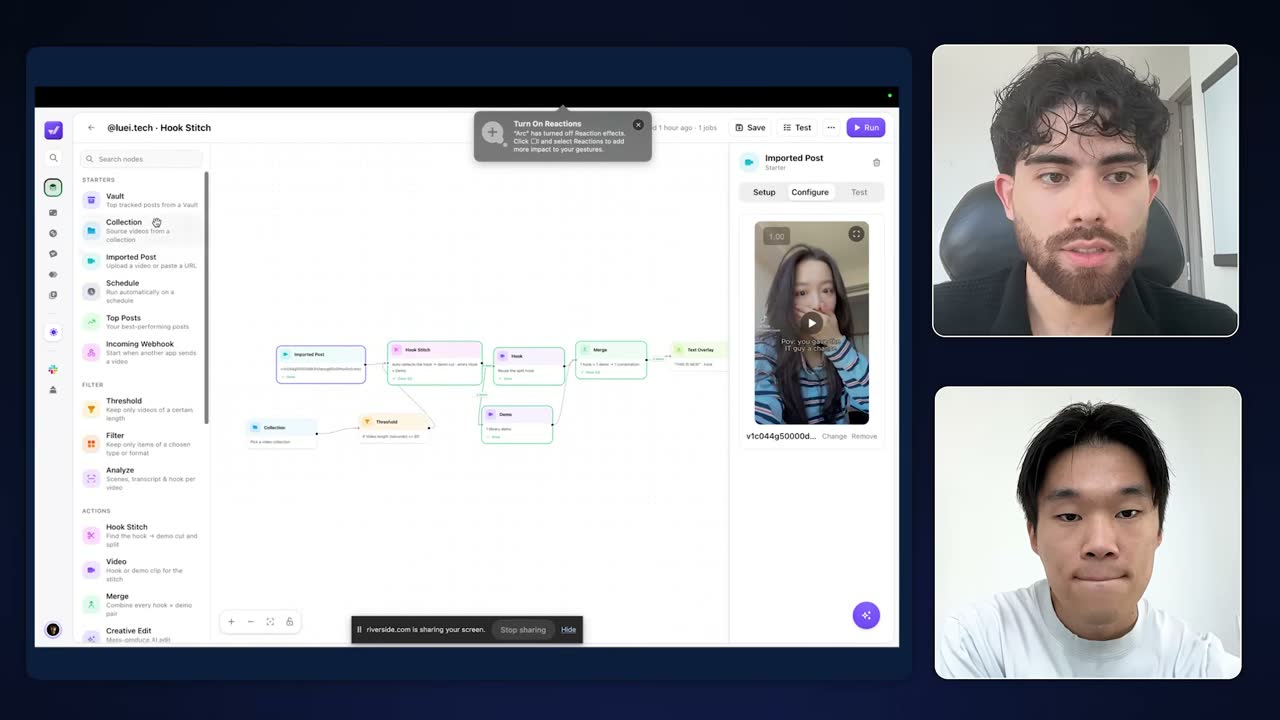
Echo's node editor showing a Hook Stitch workflow: Imported Post and Collection feeding Threshold, Hook, Demo, Merge and Text Overlay nodes. Target the Reddit threads and comments that AI engines already cite. One Reddit URL was cited for five queries across ChatGPT, Gemini and Google AI Overview. Clover either posts a better version of the cited post or adds a comment with its own ranked list.
Increasingly the cited item is a single comment; one listing a personal top 20 became the source of truth. "You essentially get automatically be ranking on that particular search query."

The NEW App Content Strategy Dominating in 2026
Grew to $8M a year in six months and drives about a quarter of a billion organic views a month. Its tool clones posts, dubs videos, runs a phone-based account network across 20 countries, and seeds Reddit (about 4,000 subreddits), producing about 150 million AI search views a year.
AI made content cheap, so the bottleneck moved to finding formats and posting them. Clover Labs grew to $8M a year in six months by selling one thing, distribution, and drives about a quarter of a billion organic views a month for customers like OpusClip, Superwall and Typing.com.
The work is organic, not paid ads. Both B2B and consumer apps work: consumer retains better, while B2B is more about awareness. Joseph Choi: "People just underestimate how much you can juice the views on the stuff that you're doing already."
Clover plans distribution across four channels: search, video, ads and outreach. Matt Espinoza names search (Reddit, blogs, backlinks), video (TikTok, Instagram, later YouTube and Snapchat), ads that adapt using organic learnings, and mass outreach, which suits B2B better.
Because hook-and-demo formats may not work forever, the approach is to clone whatever is working now rather than bet on one format.
Make about 90% of a campaign clones and 10% wild experiments. Take a post that already performed, change one element (hook, CTA, visual, creator, language or demo) and repost it. Espinoza puts cloning at about 90% of any campaign Clover has run.
It works like Facebook ad creative testing: each clone tests one variable and the winners shape the next campaign. For slideshows, an account's overall aesthetic matters more than anything else. Joseph Choi says he has not seen organic done this scientifically.
Clover's growth dashboard shows ARR at $5,353,864 USD, climbing steadily from April 2026. Expect a clone to earn about 20% of the original's views. The median clone gets about 20% of the original, so five to ten clones match the original's volume, while extreme cases do two to six times better. A trucker slideshow with 110k views produced clones that together reached about 34k in a week and a half.
Results are "very random": a 100k-view post could have reached 600k with a tiny tweak. The 20% median comes from Clover's own tool and customers, with no sample size or method given.
TikTok trucker slideshow slide promoting an Amazon Bluetooth headset, a cloned variation with 4K+ bought. Small visual edits keep a clone from being flagged as a duplicate. In the "10 trucker essentials, Amazon edition" slideshow, one click turned the truck blue and shifted the images slightly; another variant swapped one slide for the product the team wanted to push.
The aim is for TikTok to treat each clone as original content and avoid a shadowban. Clover's tool lets you set change strength as subtle, moderate or dramatic, and more dramatic edits are harder to detect. The source does not address the risk of platforms penalizing near-duplicate posts.
Split winning videos into hook and demo, then recombine them. The hook is the first two seconds and carries most of a video's organic reach, so a proven hook can carry any app's demo. AI finds the cut by spotting the big visual change between the two parts.
The example is a clip where a woman covers her mouth, then cuts to the demo. This builds a library of mix-and-match hooks and demos from competitor or creator videos. "As long as you have a good hook set, you can then switch the demo to the one that you're looking to promote."
Hook Stitch workflow merging one hook with one library demo, then adding a "THIS IS NEW" text overlay. Only remix creator posts that pass a view threshold. When a UGC creator's post hits a threshold such as a million views, it is re-edited with a new hook, demo or avatar and published on other accounts, countries or niches. A creator posting twice a day makes about 60 posts a month; about 10 pass, and three variations each give 30 new videos.
One creator can keep posting while every other part of the video changes on autopilot. Repeat posts are less restricted on Instagram than on TikTok.
Pay high CPM to find formats, base pay once they're proven. For experiments, pay creators a high CPM because the goal is discovery; for proven formats and pure clones, weight toward a lower base plus performance. Some campaigns pay $3 per post with a 3.5 CPM, others a much higher CPM and no base.
"Base plus performance is the best scenario."
Campaign builder's audience step: selecting Canada shows zero accounts available, while US has 13. A cloned Dazz post launched the Natural camera app in minutes. For Natural, a camera app by Superwall founder Jake, the tool listed competitor Dazz's top five clone-worthy posts. The team cloned a camera-plus-flash slideshow, swapped in Jake's logo, and in about five days reached about 100k organic views, about $1,000 in downloads and about 200 signups.
A full set took about six to seven minutes, and images run in parallel so 20 variations take about as long as four. The database holds about 4 million TikTok and Instagram accounts, scraped continuously, plus live search.
Create New Accounts dialog: 5 accounts yield 15 posts per day per platform, ~20.0k daily impressions, ~10 hours saved weekly. Post from many accounts created on real phones to avoid detection. One interface creates batches of accounts across platforms and 20 countries, setting age range, gender, search terms, usernames, bios and locations. Each account posts two to three times a day at a random rate.
Accounts are made on physical devices, not virtual ones. Bulk-ordering enough phones is near impossible, so about half of campaigns run on rented phones, mostly for other countries, while Clover's own network covers North America. Check which campaigns each account serves to avoid overlap.
Each new country adds about 20% more views to a campaign. Sub, dub and lip-sync a proven video into the new language, match the on-screen text and dialect, and post from an account in that country. A campaign at a million views a month gains about 200k per new country, and around five countries typically work well.
Travel app Rhyme's 37.4M-view hook-and-demo video was first localized by only swapping in German text in the same TikTok font, then fully subbed, dubbed and mouth-synced. Dialects are the hard part.
Rhyme's English travel-app Instagram reel with 743.6K likes, the original later relaunched in German. Rhyme picked Germany for repurchase rates and no German-language rivals. Rhyme's data showed Germany as its highest-converting audience outside North America: conversion was similar, but purchase and repurchase rates were higher.
No rival app targeted German, a "blue ocean" that multiplied the repurchase advantage.
Start with Spain, Germany and Australia; add Canada for free. These markets spend like US buyers, with Italy and Brazil next. Canada needs no translation and has nearly the same purchasing power and conversion as the US, so it is an easy 20% lift on a US campaign.
Spain can be split into regions inside the platform. Joseph Choi says US teams forget Canada, and notes app acquirers he knows saw 5 to 10x potential in international expansion.
Estimate AI search volume as about 30% of Google volume. With no reliable prompt volume data, Clover builds a list of around 2,000 prompts, takes each query's Google volume from Ahrefs or Search Console, and assumes 30% happens in AI search. A 15,000-impression query becomes about 5,000.
It then checks which sources get cited per prompt. Clover generates about 150 million AI search views a year across customers and seeds about 4,000 subreddits.
Echo's node editor showing a Hook Stitch workflow: Imported Post and Collection feeding Threshold, Hook, Demo, Merge and Text Overlay nodes. Target the Reddit threads and comments that AI engines already cite. One Reddit URL was cited for five queries across ChatGPT, Gemini and Google AI Overview. Clover either posts a better version of the cited post or adds a comment with its own ranked list.
Increasingly the cited item is a single comment; one listing a personal top 20 became the source of truth. "You essentially get automatically be ranking on that particular search query."
More in Marketing & growth tools
 Marketing & growth tools
App Masters
An app marketing and growth consultancy run by Steve P. Young, which also hosts a podcast.
 115 sources · 465 tips
Apple Search Ads
Apple's ad platform for promoting apps in the App Store.
 44 sources · 132 tips
 Marketing & growth tools
Meta
The parent company of Facebook, Instagram, WhatsApp and Threads, run by Mark Zuckerberg.


 42 sources · 106 tips
 Marketing & growth tools
Sensor Tower
An app intelligence and ASO platform with keyword rankings, competitor research and download estimates.
42 sources · 90 tips Marketing & growth tools
Mobile Action
An app store optimization and mobile marketing intelligence platform.
28 sources · 81 tips Marketing & growth tools
HubSpot
A CRM and marketing software platform built for small and medium businesses.
14 sources · 41 tips Marketing & growth tools
AdMob
Google's mobile ad monetization platform with mediation, open bidding and unified payments for app developers.
10 sources · 47 tips Marketing & growth tools
AppsFlyer
A mobile attribution and marketing analytics platform for app marketers.
17 sources · 30 tips