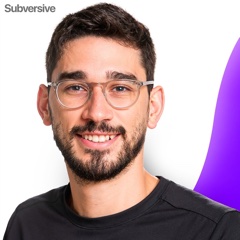
Leon Sasson
Co-founder and CTO of Rise Science
Where to hear and read about Leon Sasson2 episodes and tests

 SubversiveHow Rise Turned “Sleep Debt” Into a 10M+ User Sleep App

 Sub ClubWhy Web Onboarding Should Sell The Problem, Not The Solution – Leon Sasson, Rise Science
Leon Sasson is co-founder and CTO of Rise Science, the sleep app that grew past 10 million users by turning sleep science into the simple idea of sleep debt. The most useful thing to learn from him is how a small team tests everything against long-term results and treats each channel, like web, as its own surface.
Never write your own statistics engine, right? Like don't want your product manager trying to do spreadsheets to like determine if a test is a winner.
How Rise Turned “Sleep Debt” Into a 10M+ User Sleep App
Leon Sasson: the story and the lessons
1How Leon Sasson and Rise started with athlete sleep research
Sasson once thought sleep was a waste of time. A friend, Jeff, dug into the sleep research and pulled Leon in. Leon is now co-founder and CTO of Rise Science.
Rise began as sleep research with Northwestern sports teams. Coaches saw sleep tied to sprint speed, three-point percentage and bench press gains. Word spread between teams and other teams started asking for help.
There were no consumer wearables then. Fitbit had just launched, so the research used lab-grade devices only elite sports could afford.
Rise pivoted from team coaching to consumers around 2020. The sports offer was white-glove coaching sold to teams, which cost thousands per athlete per year and could not scale. The new goal was reaching anyone with a smartphone, without a device.
The work has now run almost a decade. Leon says many people still don't connect feeling tired with needing more sleep, which is the gap Rise exists to fill.
2How Sasson turned sleep science into sleep debt
Rise renamed two sleep systems into terms people already understand. Sleep pressure, built from hormones and proteins like adenosine as you stay awake, became sleep debt. Circadian rhythm became the energy schedule because the science term is not catchy.
Calling it the "homeostatic sleep drive" would make a poor product name. The sleep debt label emerged from research and customer interviews until people could make sense of it.
Sleep debt works because it reflects weeks of sleep, not one night. After weeks of good sleep, one terrible night leaves you fine the next day. After two weeks of poor sleep, one great night before a big game helps only a little.
3Sasson's rules for onboarding and paywalls
Sasson uses onboarding to teach one concept, not to cut friction. Rise collects the right information, then gives back the person's sleep need and sleep debt before asking for a trial. User interviews show people are glad they learned a concept during onboarding.
His line: "once you get that clicks for people, then you almost like earn the right to be like all right, do you want to start a free trial?"
He keeps every question easy to answer, even in a long flow. Rise avoids questions that make people think hard and avoids open-ended text. Length matters less than whether the person can keep a steady pace.
He lets the user's context decide how long onboarding can run. Most Rise users are on a couch or in bed, scrolling and winding down, not solving a task in three minutes. A flow that is entertaining earns 5 to 10 minutes.
Leon treats this as a bet on Rise's own users, not a rule for every product. Health, finance and other complex topics tend to run longer, as with Noom.
Sasson tests the screens before the paywall, not only the paywall. Moving the paywall or changing the few screens before it has often produced wins. Those screens build anticipation that something worth having sits behind the paywall.
Rise calls this the pre-paywall onboarding phase. Leon says nobody needs a sleep app, so the product has to tease why they will want it.
He judges tests on day 31 and day 60, not trial starts. Trial start rate, paywall shown rate, onboarding drop-off and day one retention are fast but can mislead. Rise built predictive day 31 monetization and day 60 net revenue metrics as a default.
Some changes lower the first purchase rate and still win later because they bring users who stay longer.
4How Rise runs several A/B tests a week
Sasson labels each test "do no harm" or "expected to win" up front. A do no harm test ships unless metrics get worse. Any other test that fails to move its metric does not earn its place by default.
Rise also removes things this way when the product feels cluttered. It avoids rehashing whether to keep something that was supposed to move the needle and didn't.
Rise runs parallel tests across separate surfaces. Onboarding, pre-paywall, paywall, win-back paywall and day one app open can each carry their own test. Ten on one surface is not possible, but ten across the stack is normal.
This works as long as analytics are set up so the tests do not interfere.
He standardized on a ready-made statistics engine. Rise tracks with Segment and Amplitude and runs tests in GrowthBook, which sits on the data warehouse. Leon calls standardizing on one engine the biggest gain, with checks for pitfalls like sample ratio mismatch.
He also insists on clean metric definitions, since real user journeys are not linear: users download, leave, return weeks later and reinstall.
He picks one or two North Star metrics per test. With 20 metrics on a test, one or two will hit significance by chance. Rise decides mainly on its chosen few.
Sasson says A/B tools cannot replace looking at what users did. Leon calls laziness a disease, since teams can check four metrics and kill or ship. Rise reviews behavior, talks to users and looks for confusion.
Even a losing test can teach something, such as 85% of users preferring one version, which informs the next test.
5Where Sasson was wrong and what he changed
Rise adopted always-on A/A tests too late. Rise now keeps A/A tests running to catch tracking and infrastructure problems. It is sometimes surprised by how much noise appears, because the user mix shifts by day of week and time of day.
Leon says it took Rise too long to adopt them.
Sasson stopped trying to predict which tests would win. Tests expected to win have failed, and tiny changes have made a big difference. Building is now easy enough to test an idea instead of debating it in 20 conversations.
He still has an opinion on direction but does not force a result.
Rise re-checks called tests at 3 and 6 months. A test judged a loser or flat, and not released, later showed a cohort that retained much better. Rise automatically revisits experiments and can change the decision.
Rise also ships a likely winner it likes without waiting for significance, since it is not publishing a paper.
6How Sasson built web funnels after years of failing
Rise first copied its app onboarding to web and it failed. The IDFA change crippled mobile ads, so Rise started on web around late 2021 and early 2022 by rebuilding its app flow. Leon calls that pretty naive, and two attempts did not come close.
Rise then blamed missing health data and wearable integrations, and shelved web while app marketing recovered.
A third attempt also failed until he started from scratch. Around 2024 Rise again tried to keep the funnel looking like the app and chase lower Apple fees. Both goals were wrong, and the fee is one small piece of the equation.
The fix was hundreds of iterations on a funnel "not at all related to the app", treated as a different surface from marketing to user experience.
On web, Sasson sells the problem and saves the solution for the app. Web visitors are still weighing whether they have a problem. Rise helps them see that exhaustion may trace back to sleep before any plan or feature list.
Rise had to unlearn the app habit of reaching an aha moment in the first 30 seconds.
Web reaches older, e-commerce minded people app ads miss. Rise reaches 40, 50 and 60 year olds at scale on web. They start with low intent but often have high willingness to pay.
Leon notes this may vary by developer and company.
Running web and app separately smooths performance swings. Web and app results move independently. A bad month on web can coincide with a good one on app, which makes acquisition more robust to flukes.
He tests creative on both channels and organizes it by persona. A concept that flops on app can win on web, so testing twice gives more chances. The creative team works from personas, hooks and value props, not channels.
Web just brings a different persona, such as more women over 50. Rise did not test both channels separately at the start.
Web gives faster creative signal than app. Web ad platforms see clean e-commerce data, while app privacy limits delay data and break attribution. Creative results come in much sooner than the week or two it can take on app.
Leon calls the faster iteration cycle a huge unlock.
Matching funnels to creative personas is the next unlock. Web lets a funnel match a persona, such as someone wanting productive mornings or a 50-year-old woman with menopause-related sleep problems. App campaigns cannot do this because the user must download the app mid-flow.
It takes far more coordination between marketing and product, so Rise has seen interesting success but not yet a breakthrough.
Sasson tests a heavily discounted first month instead of a free trial. On web Rise mostly skips free trials and offers a first month at about half price. Free trials attract people who cancel a minute later, which hurts the ad algorithm.
Leon says this is specific to Rise and that other teams find free trials work just as well on web.
Rise skews to shorter plans on web and tests every package. Monthly and quarterly plans tend to fit web users, who are earlier in consideration. Pricing depends on the space, the app and the brand.
He polishes billing and cancellation before trusting any web signal. Off Apple, payments, cancellation, plan changes, refunds, support and chargebacks all become Rise's problem. Without an easy cancel, trial conversion looks high while app reviews suffer and credit card systems flag the business.
His line: "you're just making money on people that have no clue how to cancel a subscription."
7Where Sasson is taking Rise: AI, niches and clinical care
Sasson uses AI to personalize for segments once too small to serve. Night owls aged 25 to 35 or night-shift workers are 10 to 20% buckets that were not worth building for before. At scale Rise can also A/B test these small segments.
Leon says users start churning if the product feels too generic. Menopause is another life stage needing different advice than a parent of two young kids.
He wants AI products that know context without forcing a chat box. Users will not want to explain their situation 27 times, so remembered context becomes table stakes. Most Rise users don't want to chat; they want to solve a problem quickly.
Rise shares a big market with Oura and Whoop instead of seeking an empty one. Most Rise users have no wearable, and Rise also works alongside Oura. Leon notes wearable fans often get obsessed for 3 months, then try something else.
He says an empty market may mean users don't want the product or won't pay for it.
Rise is extending into clinical care for users it already attracts. About 5 to 10% of users have deeper problems like insomnia or sleep apnea. Treatments such as CBT-I and CPAP exist, but therapists and insured providers are hard to reach, so Rise uses AI to guide users through them.
Leon: "we know where the people that are tired are and they are in the Rise app."
A 16-person team works because everyone has end-to-end autonomy. Ideas go to execution fast, with no gatekeeping or internal politics. Product, design, engineering and data science roles are becoming more self-serve.
Leon says autonomy also means full responsibility, which is sometimes scary.
How Rise Turned “Sleep Debt” Into a 10M+ User Sleep App
Rise's CTO explains how the app turned sleep debt into the aha moment of a long, educational onboarding flow, and how a small team runs several A/B tests a week. The episode also covers checking test results months later, finding that some "losers" actually retained better, and how Rise is moving into AI coaching and clinical care.
Sasson once thought sleep was a waste of time. A friend, Jeff, dug into the sleep research and pulled Leon in. Leon is now co-founder and CTO of Rise Science.
Rise began as sleep research with Northwestern sports teams. Coaches saw sleep tied to sprint speed, three-point percentage and bench press gains. Word spread between teams and other teams started asking for help.
There were no consumer wearables then. Fitbit had just launched, so the research used lab-grade devices only elite sports could afford.
Rise pivoted from team coaching to consumers around 2020. The sports offer was white-glove coaching sold to teams, which cost thousands per athlete per year and could not scale. The new goal was reaching anyone with a smartphone, without a device.
The work has now run almost a decade. Leon says many people still don't connect feeling tired with needing more sleep, which is the gap Rise exists to fill.
Rise renamed two sleep systems into terms people already understand. Sleep pressure, built from hormones and proteins like adenosine as you stay awake, became sleep debt. Circadian rhythm became the energy schedule because the science term is not catchy.
Calling it the "homeostatic sleep drive" would make a poor product name. The sleep debt label emerged from research and customer interviews until people could make sense of it.
Sleep debt works because it reflects weeks of sleep, not one night. After weeks of good sleep, one terrible night leaves you fine the next day. After two weeks of poor sleep, one great night before a big game helps only a little.
Sasson uses onboarding to teach one concept, not to cut friction. Rise collects the right information, then gives back the person's sleep need and sleep debt before asking for a trial. User interviews show people are glad they learned a concept during onboarding.
His line: "once you get that clicks for people, then you almost like earn the right to be like all right, do you want to start a free trial?"
He keeps every question easy to answer, even in a long flow. Rise avoids questions that make people think hard and avoids open-ended text. Length matters less than whether the person can keep a steady pace.
He lets the user's context decide how long onboarding can run. Most Rise users are on a couch or in bed, scrolling and winding down, not solving a task in three minutes. A flow that is entertaining earns 5 to 10 minutes.
Leon treats this as a bet on Rise's own users, not a rule for every product. Health, finance and other complex topics tend to run longer, as with Noom.
Sasson tests the screens before the paywall, not only the paywall. Moving the paywall or changing the few screens before it has often produced wins. Those screens build anticipation that something worth having sits behind the paywall.
Rise calls this the pre-paywall onboarding phase. Leon says nobody needs a sleep app, so the product has to tease why they will want it.
He judges tests on day 31 and day 60, not trial starts. Trial start rate, paywall shown rate, onboarding drop-off and day one retention are fast but can mislead. Rise built predictive day 31 monetization and day 60 net revenue metrics as a default.
Some changes lower the first purchase rate and still win later because they bring users who stay longer.
Sasson labels each test "do no harm" or "expected to win" up front. A do no harm test ships unless metrics get worse. Any other test that fails to move its metric does not earn its place by default.
Rise also removes things this way when the product feels cluttered. It avoids rehashing whether to keep something that was supposed to move the needle and didn't.
Rise runs parallel tests across separate surfaces. Onboarding, pre-paywall, paywall, win-back paywall and day one app open can each carry their own test. Ten on one surface is not possible, but ten across the stack is normal.
This works as long as analytics are set up so the tests do not interfere.
He standardized on a ready-made statistics engine. Rise tracks with Segment and Amplitude and runs tests in GrowthBook, which sits on the data warehouse. Leon calls standardizing on one engine the biggest gain, with checks for pitfalls like sample ratio mismatch.
He also insists on clean metric definitions, since real user journeys are not linear: users download, leave, return weeks later and reinstall.
He picks one or two North Star metrics per test. With 20 metrics on a test, one or two will hit significance by chance. Rise decides mainly on its chosen few.
Sasson says A/B tools cannot replace looking at what users did. Leon calls laziness a disease, since teams can check four metrics and kill or ship. Rise reviews behavior, talks to users and looks for confusion.
Even a losing test can teach something, such as 85% of users preferring one version, which informs the next test.
Rise adopted always-on A/A tests too late. Rise now keeps A/A tests running to catch tracking and infrastructure problems. It is sometimes surprised by how much noise appears, because the user mix shifts by day of week and time of day.
Leon says it took Rise too long to adopt them.
Sasson stopped trying to predict which tests would win. Tests expected to win have failed, and tiny changes have made a big difference. Building is now easy enough to test an idea instead of debating it in 20 conversations.
He still has an opinion on direction but does not force a result.
Rise re-checks called tests at 3 and 6 months. A test judged a loser or flat, and not released, later showed a cohort that retained much better. Rise automatically revisits experiments and can change the decision.
Rise also ships a likely winner it likes without waiting for significance, since it is not publishing a paper.
Sasson uses AI to personalize for segments once too small to serve. Night owls aged 25 to 35 or night-shift workers are 10 to 20% buckets that were not worth building for before. At scale Rise can also A/B test these small segments.
Leon says users start churning if the product feels too generic. Menopause is another life stage needing different advice than a parent of two young kids.
He wants AI products that know context without forcing a chat box. Users will not want to explain their situation 27 times, so remembered context becomes table stakes. Most Rise users don't want to chat; they want to solve a problem quickly.
Rise shares a big market with Oura and Whoop instead of seeking an empty one. Most Rise users have no wearable, and Rise also works alongside Oura. Leon notes wearable fans often get obsessed for 3 months, then try something else.
He says an empty market may mean users don't want the product or won't pay for it.
Rise is extending into clinical care for users it already attracts. About 5 to 10% of users have deeper problems like insomnia or sleep apnea. Treatments such as CBT-I and CPAP exist, but therapists and insured providers are hard to reach, so Rise uses AI to guide users through them.
Leon: "we know where the people that are tired are and they are in the Rise app."
A 16-person team works because everyone has end-to-end autonomy. Ideas go to execution fast, with no gatekeeping or internal politics. Product, design, engineering and data science roles are becoming more self-serve.
Leon says autonomy also means full responsibility, which is sometimes scary.
Why Web Onboarding Should Sell The Problem, Not The Solution – Leon Sasson, Rise Science
Rise Science spent years failing at web funnels by copying its app onboarding, then found success by treating web as a separate channel with a different audience, a problem-first flow, and discounted paid trials. The episode shows how to design, market and bill for a web funnel that works alongside app install campaigns.
Rise first copied its app onboarding to web and it failed. The IDFA change crippled mobile ads, so Rise started on web around late 2021 and early 2022 by rebuilding its app flow. Leon calls that pretty naive, and two attempts did not come close.
Rise then blamed missing health data and wearable integrations, and shelved web while app marketing recovered.
A third attempt also failed until he started from scratch. Around 2024 Rise again tried to keep the funnel looking like the app and chase lower Apple fees. Both goals were wrong, and the fee is one small piece of the equation.
The fix was hundreds of iterations on a funnel "not at all related to the app", treated as a different surface from marketing to user experience.
On web, Sasson sells the problem and saves the solution for the app. Web visitors are still weighing whether they have a problem. Rise helps them see that exhaustion may trace back to sleep before any plan or feature list.
Rise had to unlearn the app habit of reaching an aha moment in the first 30 seconds.
Web reaches older, e-commerce minded people app ads miss. Rise reaches 40, 50 and 60 year olds at scale on web. They start with low intent but often have high willingness to pay.
Leon notes this may vary by developer and company.
Running web and app separately smooths performance swings. Web and app results move independently. A bad month on web can coincide with a good one on app, which makes acquisition more robust to flukes.
He tests creative on both channels and organizes it by persona. A concept that flops on app can win on web, so testing twice gives more chances. The creative team works from personas, hooks and value props, not channels.
Web just brings a different persona, such as more women over 50. Rise did not test both channels separately at the start.
Web gives faster creative signal than app. Web ad platforms see clean e-commerce data, while app privacy limits delay data and break attribution. Creative results come in much sooner than the week or two it can take on app.
Leon calls the faster iteration cycle a huge unlock.
Matching funnels to creative personas is the next unlock. Web lets a funnel match a persona, such as someone wanting productive mornings or a 50-year-old woman with menopause-related sleep problems. App campaigns cannot do this because the user must download the app mid-flow.
It takes far more coordination between marketing and product, so Rise has seen interesting success but not yet a breakthrough.
Sasson tests a heavily discounted first month instead of a free trial. On web Rise mostly skips free trials and offers a first month at about half price. Free trials attract people who cancel a minute later, which hurts the ad algorithm.
Leon says this is specific to Rise and that other teams find free trials work just as well on web.
Rise skews to shorter plans on web and tests every package. Monthly and quarterly plans tend to fit web users, who are earlier in consideration. Pricing depends on the space, the app and the brand.
He polishes billing and cancellation before trusting any web signal. Off Apple, payments, cancellation, plan changes, refunds, support and chargebacks all become Rise's problem. Without an easy cancel, trial conversion looks high while app reviews suffer and credit card systems flag the business.
His line: "you're just making money on people that have no clue how to cancel a subscription."