
Rise
A sleep and energy app that helps people track and pay down their sleep debt.
Rise grew past 10 million users by turning sleep science into the plain idea of sleep debt, using onboarding to teach it and judging tests on day 31 and day 60 revenue. Web only worked after two failed rebuilds and a failed app copy, then hundreds of iterations on a from-scratch funnel. Lesson: teach one concept users grasp, and build each channel's funnel separately.
- 1Arrives tired, desperateTried coffee, supplements, maybe a wearable
- 2Answers easy questionsNo open text, steady pace
- 3Sees sleep need, debtPersonal numbers from their answers
- 4Concept clicksUsers glad they learned something
- 5Offered free trialRise has "earned the right" to ask
From Leon Sasson, Rise co-founder and CTO
What was said about Rise
1Sleep debt: turning sleep science into one product idea
Rise started as elite athlete sleep research, then moved to consumers. Working with Northwestern teams, Rise showed coaches that sleep tracked with sprint speed, three-point percentage and bench press gains, using lab-grade devices only elite sports could afford. Around 2020 it pivoted from white-glove team coaching to a phone app for anyone, with no device needed.
Co-founder and CTO Leon Sasson once thought sleep was a waste of time until his friend Jeff pulled him into the research. Word spread between teams before the pivot. Rise has since grown to over 10 million users with a 16-person team. Leon says many people still don't connect feeling tired with needing more sleep: "That is why we're in business."
Rename the science into words users already understand. Rise built on two well-studied systems, the homeostatic sleep drive and circadian rhythm, and renamed them sleep debt and energy schedule. The labels emerged from research and customer interviews until people could make sense of them.
Sleep debt reflects weeks of past sleep, not only last night, so one bad night after weeks of good sleep leaves you fine, while one great night after two poor weeks helps only a little. Leon notes that "homeostatic sleep drive" would make a poor product name.
2Onboarding built around the sleep debt aha moment
Use onboarding to teach one concept, then ask for the trial. Rise asks the right questions, then gives back each person's sleep need and sleep debt before offering a free trial. In user interviews, people say they are glad they learned a concept during onboarding.
Users arrive desperate after trying supplements, tea, coffee, energy drinks or another wearable, with anything from a year of Oura data to none. Leon: "once you get that clicks for people, then you almost like earn the right to be like all right, do you want to start a free trial?"
Keep every question easy; length matters less than pace. Rise avoids questions that make people think hard and avoids open-ended text, but treats efficiency as a non-goal. More screens and questions are fine if the person can keep a steady pace.
Health, finance and complex products justify longer flows than entertainment apps, with Noom as an extreme case. Answers add "good friction" because they personalize the experience for users ranging from elite athletes to people with sleep apnea.
Users winding down in bed give a good flow 5 to 10 minutes. Most Rise users download the app on the couch or in bed, scrolling, not solving a three-minute task. That leaves headroom for a longer onboarding as long as it is entertaining.
Rise treats this as a bet on its own users, not a rule for every product. Leon: "If something is good and it's entertaining, it's worth 5 10 minutes, like for sure."
Test the screens before the paywall, not just the paywall. Moving the paywall or changing the few screens before it has often produced wins for Rise without touching the paywall design. Rise calls this the pre-paywall onboarding phase and considers it crucial.
Those screens build anticipation that something worth having sits behind the paywall. Nobody needs a sleep app, so the product has to tease why they will want it. Leon says many teams fixate on the paywall and undervalue onboarding tests.
AI makes it worth personalizing for small user segments. Segments like night owls aged 25 to 35 or night-shift workers, each 10 to 20% of users, were not worth building for before; AI now makes it practical. A larger user base also lets Rise A/B test segments once too small to measure.
Sports coaching cost thousands per athlete per year and could not scale. Leon says users "start churning if the product feels too generic."
3How a 16-person team runs many tests a week
Judge tests on day 31 and day 60 revenue, not trial starts. Trial start rate, paywall shown rate, onboarding drop-off and day one retention are fast but can mislead. Rise built predictive metrics that tie fast readouts to day 31 monetization and day 60 net revenue, now a default part of its growth stack.
A higher trial start rate can bring the wrong users, while some changes lower the first purchase rate and still win because those users stay longer.
Revisit called tests at 3 and 6 months and change decisions. Rise automatically re-checks past experiments to see how winning and losing cohorts retained. Some tests judged losers or flat, and not released, had cohorts that retained a lot better three months later.
Rise does not need publication-level rigor, so a likely winner the team likes can ship without statistical significance.
Label each test "do no harm" or "expected to win" before launch. A do no harm test ships unless metrics get worse; it covers directions the team likes or removals of clutter. An expected winner that fails to move its metric does not earn its place by default.
Deciding up front avoids rehashing whether to keep something that was supposed to move the needle and didn't.
Keep A/A tests always running to check the machinery. Always-on A/A tests catch tracking and infrastructure problems, and often show more noise than expected because the user mix shifts by day of week and time of day.
Rise says it took too long to adopt this.
Run parallel tests on separate surfaces to raise velocity. Onboarding, pre-paywall, paywall, win-back paywall and day one app open can each carry their own test. About ten tests across the stack at once is normal, but not ten on one surface.
This depends on analytics set up so tests do not interfere. Leon says ten may be pushing it.
Use a standard stats engine and define metrics cleanly. Rise uses Segment for tracking, Amplitude for product analytics and GrowthBook on the warehouse for test statistics. GrowthBook was its biggest move toward standardizing experimentation and is cheap if data is organized.
Product managers should not judge winners in spreadsheets, given pitfalls like sample ratio mismatch. Metrics like trial start rate need clean definitions because real journeys include reinstalls and returns. Leon: "never write your own statistics engine."
Decide on one or two North Star metrics per test. With 20 metrics on a test, one or two will hit significance by chance, so Rise makes decisions mainly on one or two primary metrics.
Look at what users did, not only the target metrics. A/B tools can make teams lazy about judging on a few metrics like day 30 revenue. Rise also reviews behavior, talks to users and checks for confusion; a losing test can still show most users preferred the new version.
Leon: "AB testing tools do not replace going deeper into what you actually ship."
Stop predicting winners and test instead of debating. Leon no longer forecasts whether a test will lift 5%, 10% or go negative, because clear winners fail and tiny changes win big. Since building is easier now, Rise tests instead of arguing.
The habit comes from Rise's start as a science project: hypothesis, test, measure. Leon: "you don't need to hash it out in 20 conversations."
4Why Rise's web funnel sells the problem, not the solution
- Copied app onboarding
- Aimed to avoid Apple fees
- Failed after IDFA, again around 2024
- Helps people see their problem first
- Half-off first month, not free trial
- Reaches 40 to 60 year olds
- Hundreds of iterations
Pieces began "really clicking" in the last year
From Leon Sasson, Rise co-founder and CTO
Web only worked once built from scratch, unrelated to the app. After Apple's IDFA change in late 2021, Rise rebuilt its app onboarding on web twice and failed, shelved it, then fell short again around 2024 trying to mirror the app and avoid Apple fees. It worked after hundreds of iterations on a funnel "not at all related to the app."
Rise first blamed missing health data and wearable integrations. Leon calls the first approach "pretty naive" and says the Apple fee is one small piece of the equation. In the last year the pieces began "really clicking."
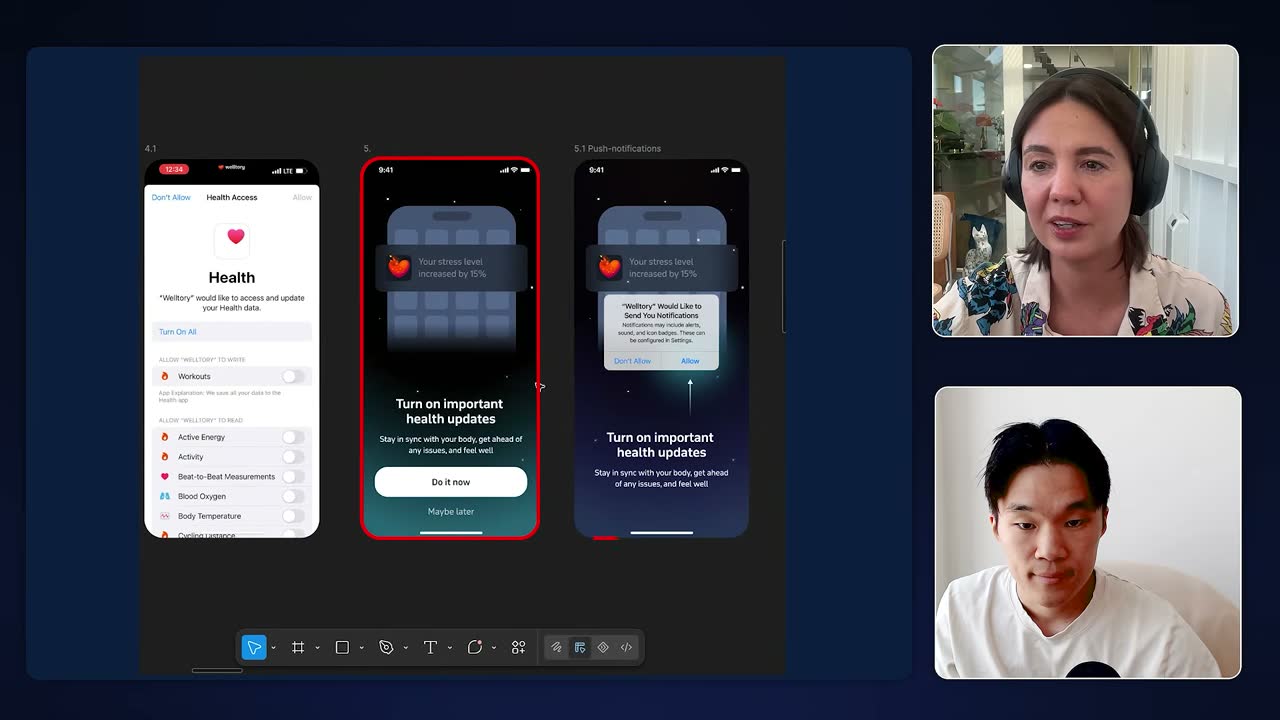
Welltory's onboarding screens: Apple Health access, then an early push-notification request ('Turn on important health updates'). On web, help people see their problem before offering a plan. Web visitors are still weighing the problem, so Rise goes deeper on helping them recognize it, such as showing that exhaustion may come from sleep, and saves solutions for the app.
Rise had to unlearn the app's focus on time to value and an aha moment in the first 30 seconds. Telling web visitors their plan and features may fail because they are not sold yet.
Web reaches older, e-commerce minded buyers app ads missed. Rise reaches 40, 50 and 60 year olds at scale on web, people who would not normally download an app to fix a problem. They start with lower intent but often high willingness to pay.
The older audience tilts toward Facebook over Instagram, though Meta and Google perform about the same and creative decides results. Leon notes this may vary by company.
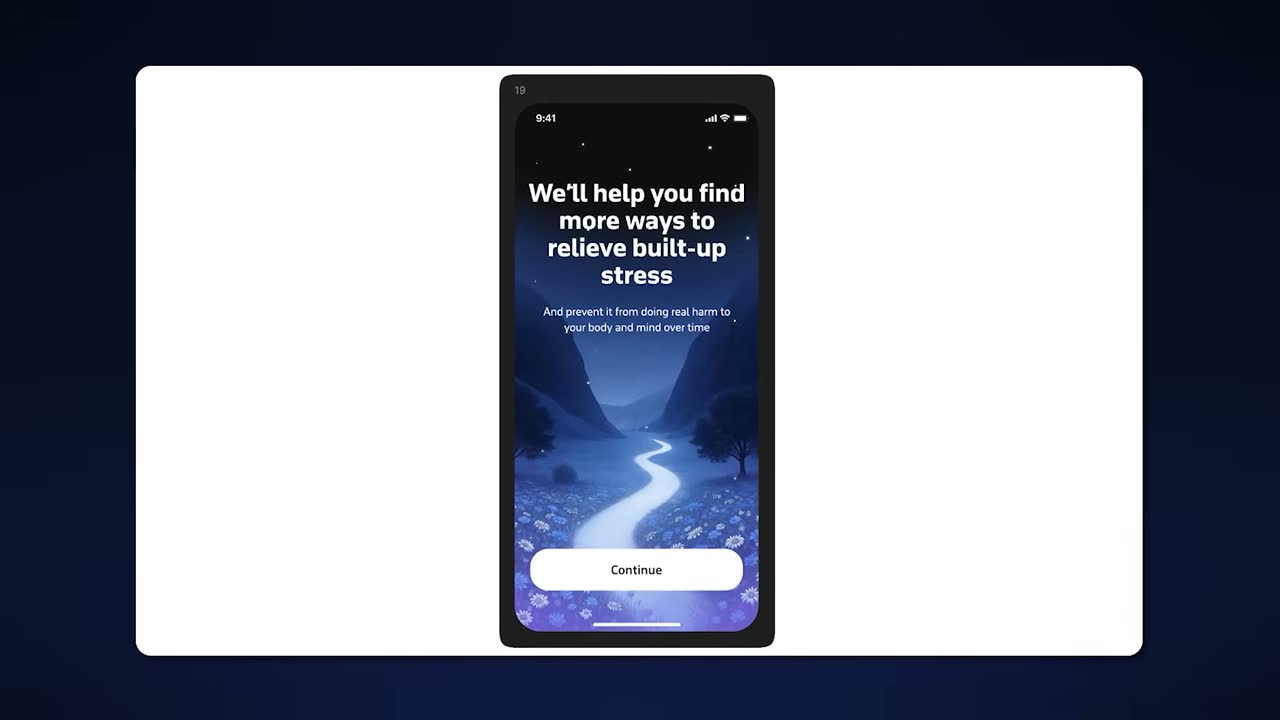
Onboarding screen 19 shifts to hope: "We'll help you find more ways to relieve built-up stress." A half-price first month beat a free trial on web. Rise mostly skips free trials on web and offers roughly half off the first month, and skews toward monthly and quarterly plans because web users are earlier in consideration.
Free trials attract people who cancel a minute later, which hurts the ad algorithm's ability to find buyers. Leon says this is specific to Rise; some teams find free trials work just as well on web. No conversion numbers were given.
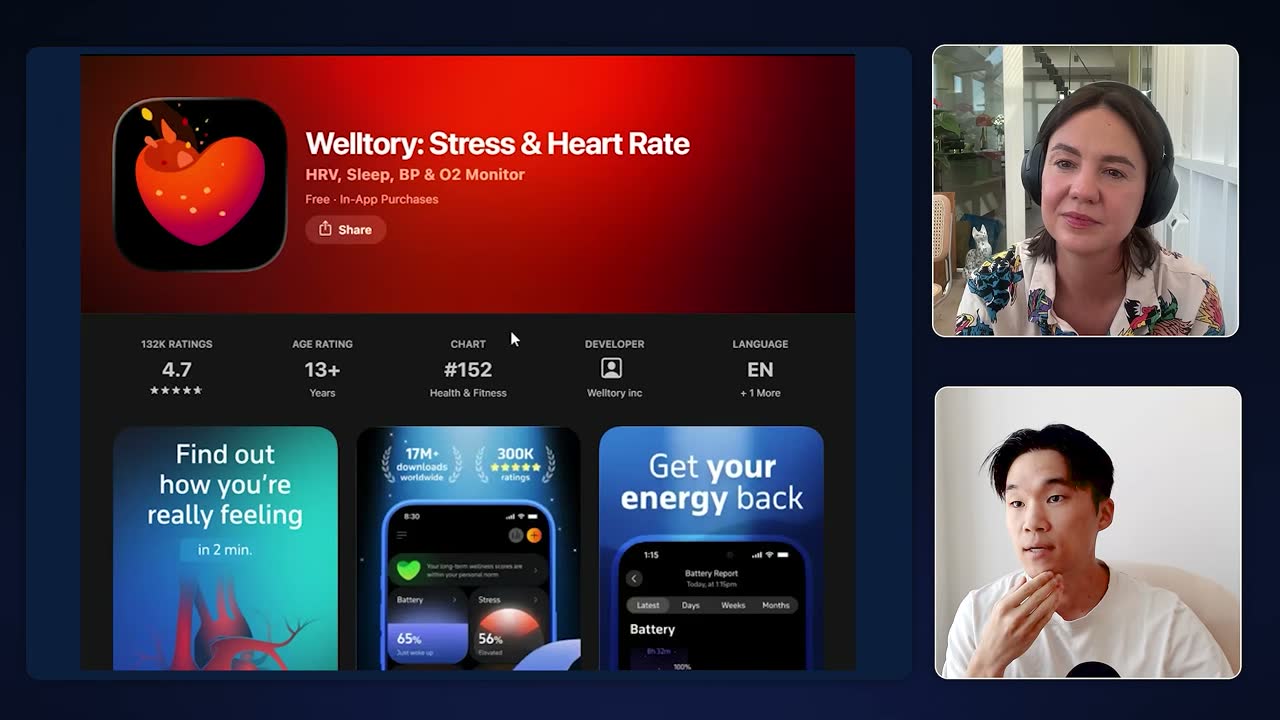
Welltory's App Store page: 4.7 rating from 132K reviews, #152 in Health & Fitness, benefit-led screenshots. Polish billing and cancellation before trusting any web signal. Off Apple, payments, cancellation, plan changes, refunds, support and chargebacks become the company's problem. Without easy cancellation, trial conversion looks high while reviews suffer and card systems flag the business.
High chargebacks and refunds lower the payment acceptance rate. Leon: "if not, you're just making money on people that have no clue how to cancel a subscription."
Test each creative on web and app separately for two chances. Because the audiences differ, creative that flopped on app often starts working on web and the reverse. Rise did not do this at first but now tests most creative across both.
Creative is planned around personas, hooks and value props rather than channels; web just brings a different persona, such as more women over 50.
Web gives faster creative signal and steadier overall results. Ad platforms treat web as plain e-commerce with clean data, so creative results come in much sooner, while on app they can take a week or two and platforms may see only about 50% of traffic. Run separately, web and app performance rise and fall independently.
A bad month on web can coincide with a good one on app, which Leon says makes the acquisition engine more robust to flukes.
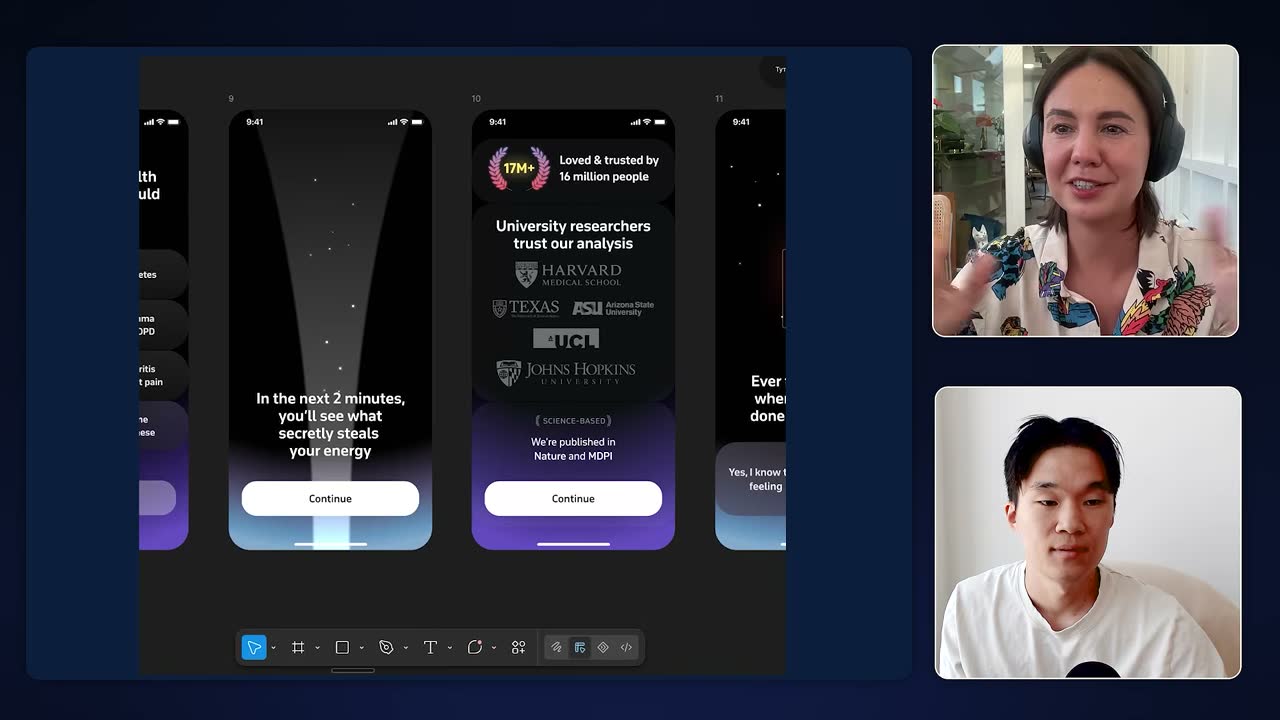
Onboarding trust screen citing 17M+ users and Harvard, Texas, ASU, UCL, Johns Hopkins researchers. Matching each funnel to a creative persona is the next unlock. Web lets a funnel match one persona, like a tired person wanting productive mornings or a 50-year-old woman with menopause-related sleep problems. Rise sees interesting success but not yet a breakthrough.
App campaigns cannot do this because users must download mid-flow, and it needs much more coordination between marketing and product.
5Competing with wearables and moving into AI and clinical care
Rise serves people without wearables in a crowded, roomy market. Most Rise users have no wearable, and the app works with or without one, including alongside Oura. Rise treats Oura and Whoop as part of a big market with room for several players.
Leon: "there's a reason why there's no one else, cuz maybe users don't want it." Rise is also named as a rival that, like Bevel, gives guidance from data. It is unclear how its phone-only sleep debt estimate compares with wearable data now that Oura and Whoop track sleep debt too.
Rise uses AI to guide its 5 to 10% with clinical problems. About 5 to 10% of users have insomnia, sleep apnea or other problems an app cannot solve. Rise uses AI and a small team to help them navigate pathways like CBT for insomnia and CPAP, including insurance, testing and providers.
Leon: "we know where the people that are tired are and they are in the Rise app."
Make AI products context-aware without forcing a chat interface. Users will expect products to understand their situation without explaining it 27 times, but most do not want to chat when they want a quick fix. Rise builds context and closes the loop while keeping a UI.
Leon: "That doesn't mean products need to be chat-based."

How Rise Turned “Sleep Debt” Into a 10M+ User Sleep App
Grew to over 10 million users by turning sleep science into the simple idea of sleep debt, and judges tests on day 31 and day 60 revenue. A 16-person team runs many tests weekly and is extending into AI coaching and clinical care, since 5 to 10% of users have problems like insomnia or sleep apnea.
Rise started as elite athlete sleep research, then moved to consumers. Working with Northwestern teams, Rise showed coaches that sleep tracked with sprint speed, three-point percentage and bench press gains, using lab-grade devices only elite sports could afford. Around 2020 it pivoted from white-glove team coaching to a phone app for anyone, with no device needed.
Co-founder and CTO Leon Sasson once thought sleep was a waste of time until his friend Jeff pulled him into the research. Word spread between teams before the pivot. Rise has since grown to over 10 million users with a 16-person team. Leon says many people still don't connect feeling tired with needing more sleep: "That is why we're in business."
Rename the science into words users already understand. Rise built on two well-studied systems, the homeostatic sleep drive and circadian rhythm, and renamed them sleep debt and energy schedule. The labels emerged from research and customer interviews until people could make sense of them.
Sleep debt reflects weeks of past sleep, not only last night, so one bad night after weeks of good sleep leaves you fine, while one great night after two poor weeks helps only a little. Leon notes that "homeostatic sleep drive" would make a poor product name.
Use onboarding to teach one concept, then ask for the trial. Rise asks the right questions, then gives back each person's sleep need and sleep debt before offering a free trial. In user interviews, people say they are glad they learned a concept during onboarding.
Users arrive desperate after trying supplements, tea, coffee, energy drinks or another wearable, with anything from a year of Oura data to none. Leon: "once you get that clicks for people, then you almost like earn the right to be like all right, do you want to start a free trial?"
Keep every question easy; length matters less than pace. Rise avoids questions that make people think hard and avoids open-ended text, but treats efficiency as a non-goal. More screens and questions are fine if the person can keep a steady pace.
Health, finance and complex products justify longer flows than entertainment apps, with Noom as an extreme case. Answers add "good friction" because they personalize the experience for users ranging from elite athletes to people with sleep apnea.
Users winding down in bed give a good flow 5 to 10 minutes. Most Rise users download the app on the couch or in bed, scrolling, not solving a three-minute task. That leaves headroom for a longer onboarding as long as it is entertaining.
Rise treats this as a bet on its own users, not a rule for every product. Leon: "If something is good and it's entertaining, it's worth 5 10 minutes, like for sure."
Test the screens before the paywall, not just the paywall. Moving the paywall or changing the few screens before it has often produced wins for Rise without touching the paywall design. Rise calls this the pre-paywall onboarding phase and considers it crucial.
Those screens build anticipation that something worth having sits behind the paywall. Nobody needs a sleep app, so the product has to tease why they will want it. Leon says many teams fixate on the paywall and undervalue onboarding tests.
AI makes it worth personalizing for small user segments. Segments like night owls aged 25 to 35 or night-shift workers, each 10 to 20% of users, were not worth building for before; AI now makes it practical. A larger user base also lets Rise A/B test segments once too small to measure.
Sports coaching cost thousands per athlete per year and could not scale. Leon says users "start churning if the product feels too generic."
Judge tests on day 31 and day 60 revenue, not trial starts. Trial start rate, paywall shown rate, onboarding drop-off and day one retention are fast but can mislead. Rise built predictive metrics that tie fast readouts to day 31 monetization and day 60 net revenue, now a default part of its growth stack.
A higher trial start rate can bring the wrong users, while some changes lower the first purchase rate and still win because those users stay longer.
Revisit called tests at 3 and 6 months and change decisions. Rise automatically re-checks past experiments to see how winning and losing cohorts retained. Some tests judged losers or flat, and not released, had cohorts that retained a lot better three months later.
Rise does not need publication-level rigor, so a likely winner the team likes can ship without statistical significance.
Label each test "do no harm" or "expected to win" before launch. A do no harm test ships unless metrics get worse; it covers directions the team likes or removals of clutter. An expected winner that fails to move its metric does not earn its place by default.
Deciding up front avoids rehashing whether to keep something that was supposed to move the needle and didn't.
Keep A/A tests always running to check the machinery. Always-on A/A tests catch tracking and infrastructure problems, and often show more noise than expected because the user mix shifts by day of week and time of day.
Rise says it took too long to adopt this.
Run parallel tests on separate surfaces to raise velocity. Onboarding, pre-paywall, paywall, win-back paywall and day one app open can each carry their own test. About ten tests across the stack at once is normal, but not ten on one surface.
This depends on analytics set up so tests do not interfere. Leon says ten may be pushing it.
Use a standard stats engine and define metrics cleanly. Rise uses Segment for tracking, Amplitude for product analytics and GrowthBook on the warehouse for test statistics. GrowthBook was its biggest move toward standardizing experimentation and is cheap if data is organized.
Product managers should not judge winners in spreadsheets, given pitfalls like sample ratio mismatch. Metrics like trial start rate need clean definitions because real journeys include reinstalls and returns. Leon: "never write your own statistics engine."
Decide on one or two North Star metrics per test. With 20 metrics on a test, one or two will hit significance by chance, so Rise makes decisions mainly on one or two primary metrics.
Look at what users did, not only the target metrics. A/B tools can make teams lazy about judging on a few metrics like day 30 revenue. Rise also reviews behavior, talks to users and checks for confusion; a losing test can still show most users preferred the new version.
Leon: "AB testing tools do not replace going deeper into what you actually ship."
Stop predicting winners and test instead of debating. Leon no longer forecasts whether a test will lift 5%, 10% or go negative, because clear winners fail and tiny changes win big. Since building is easier now, Rise tests instead of arguing.
The habit comes from Rise's start as a science project: hypothesis, test, measure. Leon: "you don't need to hash it out in 20 conversations."
Rise serves people without wearables in a crowded, roomy market. Most Rise users have no wearable, and the app works with or without one, including alongside Oura. Rise treats Oura and Whoop as part of a big market with room for several players.
Leon: "there's a reason why there's no one else, cuz maybe users don't want it." Rise is also named as a rival that, like Bevel, gives guidance from data. It is unclear how its phone-only sleep debt estimate compares with wearable data now that Oura and Whoop track sleep debt too.
Rise uses AI to guide its 5 to 10% with clinical problems. About 5 to 10% of users have insomnia, sleep apnea or other problems an app cannot solve. Rise uses AI and a small team to help them navigate pathways like CBT for insomnia and CPAP, including insurance, testing and providers.
Leon: "we know where the people that are tired are and they are in the Rise app."
Make AI products context-aware without forcing a chat interface. Users will expect products to understand their situation without explaining it 27 times, but most do not want to chat when they want a quick fix. Rise builds context and closes the loop while keeping a UI.
Leon: "That doesn't mean products need to be chat-based."

Why Web Onboarding Should Sell The Problem, Not The Solution – Leon Sasson, Rise Science
Rebuilt its app onboarding on web twice and failed, then a third copy-the-app attempt fell short, and web only worked after hundreds of iterations on a funnel unrelated to the app. Web now reaches 40, 50 and 60 year olds at scale, and Rise offers a roughly half-price first month instead of a free trial, skewing to monthly and quarterly plans.
Rise serves people without wearables in a crowded, roomy market. Most Rise users have no wearable, and the app works with or without one, including alongside Oura. Rise treats Oura and Whoop as part of a big market with room for several players.
Leon: "there's a reason why there's no one else, cuz maybe users don't want it." Rise is also named as a rival that, like Bevel, gives guidance from data. It is unclear how its phone-only sleep debt estimate compares with wearable data now that Oura and Whoop track sleep debt too.

How to Build an $18M/Year Apple Watch App (FREE MASTERCLASS)
Named as a rival that, like Bevel, gives guidance from data. Welltory differs by showing stress as a real-time process rather than an abstract HRV comparison.
Web only worked once built from scratch, unrelated to the app. After Apple's IDFA change in late 2021, Rise rebuilt its app onboarding on web twice and failed, shelved it, then fell short again around 2024 trying to mirror the app and avoid Apple fees. It worked after hundreds of iterations on a funnel "not at all related to the app."
Rise first blamed missing health data and wearable integrations. Leon calls the first approach "pretty naive" and says the Apple fee is one small piece of the equation. In the last year the pieces began "really clicking."
Welltory's onboarding screens: Apple Health access, then an early push-notification request ('Turn on important health updates'). On web, help people see their problem before offering a plan. Web visitors are still weighing the problem, so Rise goes deeper on helping them recognize it, such as showing that exhaustion may come from sleep, and saves solutions for the app.
Rise had to unlearn the app's focus on time to value and an aha moment in the first 30 seconds. Telling web visitors their plan and features may fail because they are not sold yet.
Web reaches older, e-commerce minded buyers app ads missed. Rise reaches 40, 50 and 60 year olds at scale on web, people who would not normally download an app to fix a problem. They start with lower intent but often high willingness to pay.
The older audience tilts toward Facebook over Instagram, though Meta and Google perform about the same and creative decides results. Leon notes this may vary by company.
Onboarding screen 19 shifts to hope: "We'll help you find more ways to relieve built-up stress." A half-price first month beat a free trial on web. Rise mostly skips free trials on web and offers roughly half off the first month, and skews toward monthly and quarterly plans because web users are earlier in consideration.
Free trials attract people who cancel a minute later, which hurts the ad algorithm's ability to find buyers. Leon says this is specific to Rise; some teams find free trials work just as well on web. No conversion numbers were given.
Welltory's App Store page: 4.7 rating from 132K reviews, #152 in Health & Fitness, benefit-led screenshots. Polish billing and cancellation before trusting any web signal. Off Apple, payments, cancellation, plan changes, refunds, support and chargebacks become the company's problem. Without easy cancellation, trial conversion looks high while reviews suffer and card systems flag the business.
High chargebacks and refunds lower the payment acceptance rate. Leon: "if not, you're just making money on people that have no clue how to cancel a subscription."
Test each creative on web and app separately for two chances. Because the audiences differ, creative that flopped on app often starts working on web and the reverse. Rise did not do this at first but now tests most creative across both.
Creative is planned around personas, hooks and value props rather than channels; web just brings a different persona, such as more women over 50.
Web gives faster creative signal and steadier overall results. Ad platforms treat web as plain e-commerce with clean data, so creative results come in much sooner, while on app they can take a week or two and platforms may see only about 50% of traffic. Run separately, web and app performance rise and fall independently.
A bad month on web can coincide with a good one on app, which Leon says makes the acquisition engine more robust to flukes.
Onboarding trust screen citing 17M+ users and Harvard, Texas, ASU, UCL, Johns Hopkins researchers. Matching each funnel to a creative persona is the next unlock. Web lets a funnel match one persona, like a tired person wanting productive mornings or a 50-year-old woman with menopause-related sleep problems. Rise sees interesting success but not yet a breakthrough.
App campaigns cannot do this because users must download mid-flow, and it needs much more coordination between marketing and product.
More in Health & Fitness
 Health & Fitness
Calm
A meditation and sleep app with guided sessions and celebrity-narrated Sleep Stories.
 45 sources · 102 tips
 Health & Fitness
Cal AI
A calorie tracking app that logs meals from photos, grown largely through influencer and UGC videos.
28 sources · 104 tips Health & Fitness
Headspace
A meditation and mental wellness app with guided sessions and subscriptions.
 27 sources · 50 tips
 Health & Fitness
Flo
A data tool that combines app analytics into one view and is adding AI agents.
 10 sources · 31 tips
 Health & Fitness
Ladder
A strength training app with human coaches, a workout journal and a nutrition feature.
12 sources · 39 tips Health & Fitness
Zero
An intermittent fasting tracker app that teaches fasting and builds habits toward metabolic health.
6 sources · 21 tips Health & Fitness
Runna
A personalized running coach app that builds adaptive training plans around a runner's race goals.
6 sources · 28 tips Health & Fitness
Strava
A fitness social platform for runners and cyclists.
13 sources · 13 tips