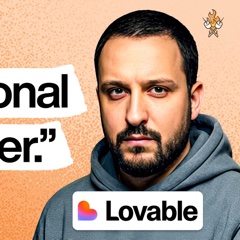
Lazar Jovanovic
Professional vibe coder at Lovable (first official vibe coding engineer)
Where to hear and read about Lazar Jovanovic1 episode or test

Lazar Jovanovic is Lovable's first official vibe coding engineer, a non-technical builder who ships production internal and customer-facing products with AI alone. The lesson most worth taking is to spend most of your time on clarity, context and taste, because AI makes good enough cheap for everyone.
We won't be rewarded in the world of AI for faster raw output. We will be rewarded for better judgment.
The rise of the professional vibe coder (a new AI-era job)
Lazar Jovanovic: the story and the lessons
1How Lazar Jovanovic became Lovable's first vibe coding engineer
Jovanovic reached vibe coding through a winding, non-technical career. He is a forestry engineer who worked blue-collar jobs, waited tables and spent seven to eight years in startups, community management and social media.
He compares his path to Slumdog Millionaire, where every past experience helps answer the next question. He has never written code beyond a couple of console logs.
He gave up building for years until AI tools changed it. After failing to find technical co-founders, he stopped trying to build for 5 to 10 years. At 36 he says he feels like the six-year-old with his first computer again.
He now treats the AI tools as technical co-founders and educators.
Lovable hired him because he built in public first. He shared projects, failures and what he learned on YouTube and LinkedIn. Elena Verna picked him out of many vibe coders for her growth team.
He is the first official vibe coding engineer by title, though other firms hired for the role earlier. His advice: "You don't need a company to hire you. You can hire yourself as a professional vibe coder first."
He ships public and internal products wherever Lovable needs speed. He built most of the Shopify integration templates that users remixed, plus Lovable's merch store. Internally he is building a feature adoption matrix, and he is moving into go-to-market, enterprise and community tools.
When setting up an off-the-shelf enterprise tool would take an hour or two, he builds his own version instead.
2How Jovanovic plans and builds with AI
He spends 80% of his time planning and chatting, 20% executing. He treats clarity, not coding, as the problem to solve, because AI output is already faster than human output. He uses chat mode to settle what he wants before the agent writes anything.
In his view most people optimize for the wrong kind of speed.
He explains AI failures with a genie and three wishes. The model has a limited token budget per request, and it takes vague wishes literally: "make me taller" gets you a 13-foot man. He can't control the machine limit, so he controls the human one by being specific and giving references and context.
He admits his token explanations are best guesses from a non-expert.
He starts four or five prototypes of every project in parallel. The versions come from a voice brain dump, a typed prompt, a prompt with a Mobbin or Dribbble screenshot, and a prompt with a code snippet from 21st.dev. He compares them and keeps the clear winner.
It costs a few credits up front and saves hundreds later, because he never polishes the wrong design. He has tested the method with many people and says all called it an eye opener.
He gives the AI code snippets instead of describing a design. Libraries like 21st.dev export code, not screenshots. In his experience code gets more pixel-perfect results than English.
"If you want to get pixel perfect results, just give them code."
Four planning files and a task list carry the context for him. He writes a master plan, an implementation plan, design guidelines and a user journey, then a tasks.md. A rules file tells the agent to read them first, so his prompt becomes "proceed with the next task" and he can run five or six projects at once.
Planning can take up to a full day. He built a custom ChatGPT, the "Lovable PRD generator", that asks a few questions after a brain dump and produces the files.
He points the agent at the suspect file instead of letting it search. With 60 to 70 edge functions and no map of them, he estimates the agent spends about 80% of its tokens just reading. Reference docs and file pointers leave the budget for fixing.
He calls this giving the agent a flashlight. The 80% figure is his own estimate.
He stays neutral with the agent instead of insulting it. He saw in a thinking stream that an angry message made the model plan how to calm him down rather than solve the problem. He guesses the apology takes about 30% of tokens.
3Jovanovic's debugging routine and how he learns from agents
When stuck, he escalates through four fixes, each tried once. First he clicks the built-in try-to-fix button. Second he adds console logs, third he gets an outside review of the code, and fourth he reverts and retries with a better prompt.
Tools like Lovable, Cursor and Claude Code can fix any problem they are aware of. The hard cases are the ones where the agent doesn't know anything is wrong.
Console logs solve most stuck builds. He runs the broken function, has the agent write console logs if none exist, reruns it, and pastes the full log history into chat. He says this is enough 99% of the time.
He phrases it as "instead of me yelling at you let's find it together."
He gets an outside diagnosis but fixes the problem in Lovable. He exports the build to GitHub and imports it into Codex for diagnosis only. He doesn't let Codex edit the code, because he doesn't know its agent well enough to steer it.
The older method was Repo Mix, which compresses the codebase into one file to upload to Claude or ChatGPT with the logs. He compares it to hiring an external consultant.
He reverts and retries, because the fault is usually his prompt. He steps back three steps with version control, takes a break and rewrites the request. Sometimes the AI just stumbled on a small rock and the same request works the second time.
He says it is "100% our fault" because the tools are good enough, with causes like a missing file reference.
He turns every fixed bug into a permanent rule. After a fix he switches to chat mode and asks how he could have prompted so it worked in one go. Then he has the agent save the lesson in rules.md, which it reads every time.
His reason: "I won't remember to prompt you better two days from now." He says this step solves 99% of problems with AI today.
He reads the agent's output, not the code, to learn what is possible. He trusts models on syntax and learns from the conversation. Once he spent at least a week forcing an image generation app before OpenAI had released an API, then built it in 30 seconds when one arrived.
He levels up most in chat mode, which builds clarity and judgment rather than coding skill.
4What Jovanovic thinks will set builders apart
He bets the gap between good enough and world class keeps widening. Everyone now produces good enough with AI, so it is the baseline. He urges optimizing for world class and magic, not output, since AI amplifies whatever you bring.
He says you can "code garbage fast as well as magic fast" in the same amount of time.
Working beside Lovable's designers showed him how much hides in great design. He tried to copy a gradient from a designer's Figma file that looked simple and found 50 layers of colors at different opacities. He guesses fonts account for 60% or more of how output looks.
He calls this the big disconnect he had all along.
He builds taste through deliberate exposure to great work. He didn't know what Bauhaus or glassmorphism meant, so he built a public Lovable app listing 18 UI styles with prompts to reproduce them. He also follows a tool creator who posts 40 to 50 minute design videos.
"Set aside more time on learning than building."
He hands off ideas as prototypes instead of memos. Lovable's 2025 motto was "demo don't memo". At a previous job he built a prototype in four hours that engineers rebuilt for production six to seven months later.
He estimates writing it up would have taken a week or two.
He treats not knowing the rules as an edge, then checks feasibility. He calls the right mindset "positively delusional": everything is possible until proven wrong. A Lovable community manager prompted her way to generated video before it was a feature.
His own week lost on the image app shows the cost of ignoring facts.
He says tech stack choices matter less than quality, taste and design. Whether it is HTML or React, the user wants a stellar experience. He expects vibe coding to just be coding within 12 months, with hand-written code becoming a rare craft.
He expects much of his own advice to go stale. Lovable now handles natively about 99% of what he once taught as workarounds, and his 7-day Lovable series from March is obsolete. He admits he will likely be wrong on 95% of his claims within three months.
He had built a successful course on those workarounds with Starter Story, and he expects the manual PRD workflow to be replaced by agents soon.

The rise of the professional vibe coder (a new AI-era job)
A non-technical, full-time vibe coder at Lovable explains the workflow he uses to ship production-quality internal and customer-facing products with AI: parallel prototypes, a PRD and markdown file system, and a four-step debugging routine. He was hired after building in public, and he argues that clarity, taste and judgment now matter more than coding skill.
Jovanovic reached vibe coding through a winding, non-technical career. He is a forestry engineer who worked blue-collar jobs, waited tables and spent seven to eight years in startups, community management and social media.
He compares his path to Slumdog Millionaire, where every past experience helps answer the next question. He has never written code beyond a couple of console logs.
He gave up building for years until AI tools changed it. After failing to find technical co-founders, he stopped trying to build for 5 to 10 years. At 36 he says he feels like the six-year-old with his first computer again.
He now treats the AI tools as technical co-founders and educators.
Lovable hired him because he built in public first. He shared projects, failures and what he learned on YouTube and LinkedIn. Elena Verna picked him out of many vibe coders for her growth team.
He is the first official vibe coding engineer by title, though other firms hired for the role earlier. His advice: "You don't need a company to hire you. You can hire yourself as a professional vibe coder first."
He ships public and internal products wherever Lovable needs speed. He built most of the Shopify integration templates that users remixed, plus Lovable's merch store. Internally he is building a feature adoption matrix, and he is moving into go-to-market, enterprise and community tools.
When setting up an off-the-shelf enterprise tool would take an hour or two, he builds his own version instead.
He spends 80% of his time planning and chatting, 20% executing. He treats clarity, not coding, as the problem to solve, because AI output is already faster than human output. He uses chat mode to settle what he wants before the agent writes anything.
In his view most people optimize for the wrong kind of speed.
He explains AI failures with a genie and three wishes. The model has a limited token budget per request, and it takes vague wishes literally: "make me taller" gets you a 13-foot man. He can't control the machine limit, so he controls the human one by being specific and giving references and context.
He admits his token explanations are best guesses from a non-expert.
He starts four or five prototypes of every project in parallel. The versions come from a voice brain dump, a typed prompt, a prompt with a Mobbin or Dribbble screenshot, and a prompt with a code snippet from 21st.dev. He compares them and keeps the clear winner.
It costs a few credits up front and saves hundreds later, because he never polishes the wrong design. He has tested the method with many people and says all called it an eye opener.
He gives the AI code snippets instead of describing a design. Libraries like 21st.dev export code, not screenshots. In his experience code gets more pixel-perfect results than English.
"If you want to get pixel perfect results, just give them code."
Four planning files and a task list carry the context for him. He writes a master plan, an implementation plan, design guidelines and a user journey, then a tasks.md. A rules file tells the agent to read them first, so his prompt becomes "proceed with the next task" and he can run five or six projects at once.
Planning can take up to a full day. He built a custom ChatGPT, the "Lovable PRD generator", that asks a few questions after a brain dump and produces the files.
He points the agent at the suspect file instead of letting it search. With 60 to 70 edge functions and no map of them, he estimates the agent spends about 80% of its tokens just reading. Reference docs and file pointers leave the budget for fixing.
He calls this giving the agent a flashlight. The 80% figure is his own estimate.
He stays neutral with the agent instead of insulting it. He saw in a thinking stream that an angry message made the model plan how to calm him down rather than solve the problem. He guesses the apology takes about 30% of tokens.
When stuck, he escalates through four fixes, each tried once. First he clicks the built-in try-to-fix button. Second he adds console logs, third he gets an outside review of the code, and fourth he reverts and retries with a better prompt.
Tools like Lovable, Cursor and Claude Code can fix any problem they are aware of. The hard cases are the ones where the agent doesn't know anything is wrong.
Console logs solve most stuck builds. He runs the broken function, has the agent write console logs if none exist, reruns it, and pastes the full log history into chat. He says this is enough 99% of the time.
He phrases it as "instead of me yelling at you let's find it together."
He gets an outside diagnosis but fixes the problem in Lovable. He exports the build to GitHub and imports it into Codex for diagnosis only. He doesn't let Codex edit the code, because he doesn't know its agent well enough to steer it.
The older method was Repo Mix, which compresses the codebase into one file to upload to Claude or ChatGPT with the logs. He compares it to hiring an external consultant.
He reverts and retries, because the fault is usually his prompt. He steps back three steps with version control, takes a break and rewrites the request. Sometimes the AI just stumbled on a small rock and the same request works the second time.
He says it is "100% our fault" because the tools are good enough, with causes like a missing file reference.
He turns every fixed bug into a permanent rule. After a fix he switches to chat mode and asks how he could have prompted so it worked in one go. Then he has the agent save the lesson in rules.md, which it reads every time.
His reason: "I won't remember to prompt you better two days from now." He says this step solves 99% of problems with AI today.
He reads the agent's output, not the code, to learn what is possible. He trusts models on syntax and learns from the conversation. Once he spent at least a week forcing an image generation app before OpenAI had released an API, then built it in 30 seconds when one arrived.
He levels up most in chat mode, which builds clarity and judgment rather than coding skill.
He bets the gap between good enough and world class keeps widening. Everyone now produces good enough with AI, so it is the baseline. He urges optimizing for world class and magic, not output, since AI amplifies whatever you bring.
He says you can "code garbage fast as well as magic fast" in the same amount of time.
Working beside Lovable's designers showed him how much hides in great design. He tried to copy a gradient from a designer's Figma file that looked simple and found 50 layers of colors at different opacities. He guesses fonts account for 60% or more of how output looks.
He calls this the big disconnect he had all along.
He builds taste through deliberate exposure to great work. He didn't know what Bauhaus or glassmorphism meant, so he built a public Lovable app listing 18 UI styles with prompts to reproduce them. He also follows a tool creator who posts 40 to 50 minute design videos.
"Set aside more time on learning than building."
He hands off ideas as prototypes instead of memos. Lovable's 2025 motto was "demo don't memo". At a previous job he built a prototype in four hours that engineers rebuilt for production six to seven months later.
He estimates writing it up would have taken a week or two.
He treats not knowing the rules as an edge, then checks feasibility. He calls the right mindset "positively delusional": everything is possible until proven wrong. A Lovable community manager prompted her way to generated video before it was a feature.
His own week lost on the image app shows the cost of ignoring facts.
He says tech stack choices matter less than quality, taste and design. Whether it is HTML or React, the user wants a stellar experience. He expects vibe coding to just be coding within 12 months, with hand-written code becoming a rare craft.
He expects much of his own advice to go stale. Lovable now handles natively about 99% of what he once taught as workarounds, and his 7-day Lovable series from March is obsolete. He admits he will likely be wrong on 95% of his claims within three months.
He had built a successful course on those workarounds with Starter Story, and he expects the manual PRD workflow to be replaced by agents soon.
 Lovable