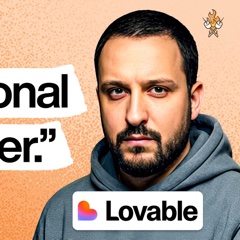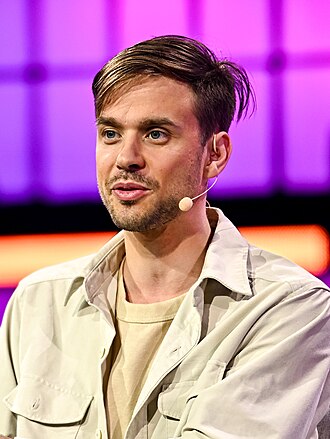
Anton Osika
Co-founder and CEO of Lovable
Where to hear and read about Anton Osika1 episode or test

Anton Osika is co-founder and CEO of Lovable, an AI software engineer for people who don't code, which reached $10M ARR in two months with 15 people. The most useful lesson is to find the exact places where your product fails users, fix those first, and let a product people love drive growth.
People love the product. That's the driver of the growth.
Building Lovable: $10M ARR in 60 days with 15 people | Anton Osika (CEO and co-founder)
Anton Osika: the story and the lessons
1How Anton Osika went from GPT Engineer to Lovable
Osika built GPT Engineer to win an argument with colleagues. He was CTO at a YC startup, and his team said he exaggerated how much AI would change. He built an open source tool that writes the files for something like a snake game and opens it.
It is still the most popular open source tool for showing what language models can build, with 50-something thousand GitHub stars and dozens of academic references.
He aimed at non-coders instead of making engineers faster. Osika sees machines taking over cognitive labor as the biggest change humanity will see. Tools like Copilot already serve engineers, so he targeted people who can't hire them.
He brought in Fabian, a former colleague and founder. The first product, GPT Engineer app, launched behind a waitlist.
GitHub cut off Lovable when it grew too fast. Lovable created a new GitHub project for every user, and GitHub had said there were no limits. At 15,000 projects a day, an on-call engineer saw the load and cut access.
The only warning was an email saying Lovable had broken some rules.
Lovable hit $10M ARR in two months with 15 people. It reached $4M ARR in the first four weeks and $10M in two months, less than three months after launch. It had 300,000 monthly users, 30,000 of them paying, almost entirely through word of mouth.
Osika says he is tired, mostly from the crazy pace of everything.
Fast growth forced a full rewrite that paused new features. The service was first written in a scripting language. At scale the team threw it away and rewrote it in a more performant way.
New features stopped for a while. Outsiders praised how fast they shipped while the team was frustrated.
2How Osika made Lovable reliable and grew it
Osika fixed the exact places where the AI gets stuck. The team found where the agent adds a bug it can't escape, then tuned the whole system quantitatively with a fast feedback loop. He calls it a scaling law: more work means more reliability.
Despite entering late and marketing less, Lovable ranks as the most reliable tool among the people he talks to. He shares few technical details because this is an unfair advantage.
He made login, data and payments never fail first. The team made sure the AI doesn't get stuck on adding login, creating data persistence and adding payments with Stripe.
Pick the few flows nearly every product needs and make them bulletproof before the long tail. Osika says the frontier of where AI gets stuck is receding very rapidly.
Lovable packages foundation models behind an interface non-coders love. Osika compares foundation models to discovered oil. The work is presenting them well, with pieces like authentication packaged to work together.
Awareness came mainly from posting what they shipped on social media. He credits a team that ships fast and has taste for simple abstractions.
Visual editing and GitHub sync make the tool fit real teams. Users select an element and edit text or color instantly, like in Squarespace or Wix, with the change written into the real code. GitHub sync lets engineers keep working in Cursor.
This avoids the roughly 30 second wait and the risk of the agent doing something different. Osika says no other tool syncs with GitHub this way.
Osika prompts with two words, then adds one precise feature at a time. His demo started with the prompt "Airbnb clone" and got a working UI in about 30 seconds. He then added login, editable listings and a backend step by step.
When the AI wrote "Book now" instead of a purchase button, the fix was to be specific. His rule: "don't say it doesn't work. Just explain exactly what you're expecting and which parts are working and which parts are not working."
3How Osika hires and builds the Lovable team
Osika hires for obsessive care plus one superpower. Hires care about the product, users and team, learn any skill fast, and are exceptional in one area. At Lovable that area is getting the most from large language models.
12 of the 18 people write code at least part-time. In his words, "have this generalist brain that quickly learns any skill but be super, super good in one dimension."
He runs a work trial of a day to a full week. Interviews probe past work for obsession and technical detail, then pose a hard, unorthodox problem to watch how candidates think.
"I pretty much always have people join the work simulation for at least a day, often a full week."
His job ad is blunt enough to repel the wrong people. Inspired by Shackleton, it promises long hours and high urgency and says those seeking comfortable work need not apply. It also promises exceptional colleagues and a generous share in the success.
Osika used AI for formatting but wrote the phrasing himself. Ambition is lower on average in Sweden, so finding the people who want an extreme mission is a big part of the job.
Raw intelligence and an owner's speed predict success at Lovable. Osika says raw cognitive capability best predicts who succeeds, with a startup mindset that prefers fast iteration over process. Hires think about the whole business, not only their own craft.
4Anton Osika's working rules and advice for builders
Osika solves the biggest problem, then the next, with no long roadmap. The team plans every Monday from a jam board of ranked problems and demos what shipped. The roadmap is clear for a month and stretches to three, but shifts.
Inputs are user conversations and a feature request board. The team is engineering-led because the right fix is often tied to a larger technical initiative.
He keeps the team in one room and eats lunch together. Working from the office gives high-bandwidth communication without formal structure, and anyone can say on the spot that the team is thinking wrong about something.
He calls lunch a productive hour of cross-pollination because people keep thinking subconsciously about the key problems.
Osika thinks taste and user insight matter more as building gets cheap. He says the bottleneck for most products is shifting from engineering to good taste and intuition about users. Engineers should see themselves as translators from human problems to technical solutions.
Because anyone can build, he sees traction as the next scarce skill, so Lovable plans to help founders find users and feedback after launch.
His Summer Labs failure taught him to start from the whole product. As first employee at the Stockholm AI startup, he worked on a personalization API that other products had to retrofit into their engines. It struggled, though the company is doing well today.
His lesson: "you have to start with how is this product working end-to-end and then add AI."
He tells people to spend one full week reaching a real outcome with AI. Osika says this puts you in the top 1% of users, and friends who share the obsession can move you toward the top 0.1%.
Ask the AI whenever you don't understand something. In Lovable, chat mode helps you learn how the software works.

Building Lovable: $10M ARR in 60 days with 15 people | Anton Osika (CEO and co-founder)
Anton Osika explains how Lovable, an AI software engineer for non-coders, grew on word of mouth and a tiny team, and how he hires, prioritizes and prompts. Lovable reached $4M ARR in four weeks and $10M ARR in two months with 15 people, then passed $1M of new ARR per week.
Osika built GPT Engineer to win an argument with colleagues. He was CTO at a YC startup, and his team said he exaggerated how much AI would change. He built an open source tool that writes the files for something like a snake game and opens it.
It is still the most popular open source tool for showing what language models can build, with 50-something thousand GitHub stars and dozens of academic references.
He aimed at non-coders instead of making engineers faster. Osika sees machines taking over cognitive labor as the biggest change humanity will see. Tools like Copilot already serve engineers, so he targeted people who can't hire them.
He brought in Fabian, a former colleague and founder. The first product, GPT Engineer app, launched behind a waitlist.
GitHub cut off Lovable when it grew too fast. Lovable created a new GitHub project for every user, and GitHub had said there were no limits. At 15,000 projects a day, an on-call engineer saw the load and cut access.
The only warning was an email saying Lovable had broken some rules.
Lovable hit $10M ARR in two months with 15 people. It reached $4M ARR in the first four weeks and $10M in two months, less than three months after launch. It had 300,000 monthly users, 30,000 of them paying, almost entirely through word of mouth.
Osika says he is tired, mostly from the crazy pace of everything.
Fast growth forced a full rewrite that paused new features. The service was first written in a scripting language. At scale the team threw it away and rewrote it in a more performant way.
New features stopped for a while. Outsiders praised how fast they shipped while the team was frustrated.
Osika fixed the exact places where the AI gets stuck. The team found where the agent adds a bug it can't escape, then tuned the whole system quantitatively with a fast feedback loop. He calls it a scaling law: more work means more reliability.
Despite entering late and marketing less, Lovable ranks as the most reliable tool among the people he talks to. He shares few technical details because this is an unfair advantage.
He made login, data and payments never fail first. The team made sure the AI doesn't get stuck on adding login, creating data persistence and adding payments with Stripe.
Pick the few flows nearly every product needs and make them bulletproof before the long tail. Osika says the frontier of where AI gets stuck is receding very rapidly.
Lovable packages foundation models behind an interface non-coders love. Osika compares foundation models to discovered oil. The work is presenting them well, with pieces like authentication packaged to work together.
Awareness came mainly from posting what they shipped on social media. He credits a team that ships fast and has taste for simple abstractions.
Visual editing and GitHub sync make the tool fit real teams. Users select an element and edit text or color instantly, like in Squarespace or Wix, with the change written into the real code. GitHub sync lets engineers keep working in Cursor.
This avoids the roughly 30 second wait and the risk of the agent doing something different. Osika says no other tool syncs with GitHub this way.
Osika prompts with two words, then adds one precise feature at a time. His demo started with the prompt "Airbnb clone" and got a working UI in about 30 seconds. He then added login, editable listings and a backend step by step.
When the AI wrote "Book now" instead of a purchase button, the fix was to be specific. His rule: "don't say it doesn't work. Just explain exactly what you're expecting and which parts are working and which parts are not working."
Osika hires for obsessive care plus one superpower. Hires care about the product, users and team, learn any skill fast, and are exceptional in one area. At Lovable that area is getting the most from large language models.
12 of the 18 people write code at least part-time. In his words, "have this generalist brain that quickly learns any skill but be super, super good in one dimension."
He runs a work trial of a day to a full week. Interviews probe past work for obsession and technical detail, then pose a hard, unorthodox problem to watch how candidates think.
"I pretty much always have people join the work simulation for at least a day, often a full week."
His job ad is blunt enough to repel the wrong people. Inspired by Shackleton, it promises long hours and high urgency and says those seeking comfortable work need not apply. It also promises exceptional colleagues and a generous share in the success.
Osika used AI for formatting but wrote the phrasing himself. Ambition is lower on average in Sweden, so finding the people who want an extreme mission is a big part of the job.
Raw intelligence and an owner's speed predict success at Lovable. Osika says raw cognitive capability best predicts who succeeds, with a startup mindset that prefers fast iteration over process. Hires think about the whole business, not only their own craft.
Osika solves the biggest problem, then the next, with no long roadmap. The team plans every Monday from a jam board of ranked problems and demos what shipped. The roadmap is clear for a month and stretches to three, but shifts.
Inputs are user conversations and a feature request board. The team is engineering-led because the right fix is often tied to a larger technical initiative.
He keeps the team in one room and eats lunch together. Working from the office gives high-bandwidth communication without formal structure, and anyone can say on the spot that the team is thinking wrong about something.
He calls lunch a productive hour of cross-pollination because people keep thinking subconsciously about the key problems.
Osika thinks taste and user insight matter more as building gets cheap. He says the bottleneck for most products is shifting from engineering to good taste and intuition about users. Engineers should see themselves as translators from human problems to technical solutions.
Because anyone can build, he sees traction as the next scarce skill, so Lovable plans to help founders find users and feedback after launch.
His Summer Labs failure taught him to start from the whole product. As first employee at the Stockholm AI startup, he worked on a personalization API that other products had to retrofit into their engines. It struggled, though the company is doing well today.
His lesson: "you have to start with how is this product working end-to-end and then add AI."
He tells people to spend one full week reaching a real outcome with AI. Osika says this puts you in the top 1% of users, and friends who share the obsession can move you toward the top 0.1%.
Ask the AI whenever you don't understand something. In Lovable, chat mode helps you learn how the software works.
 Lovable