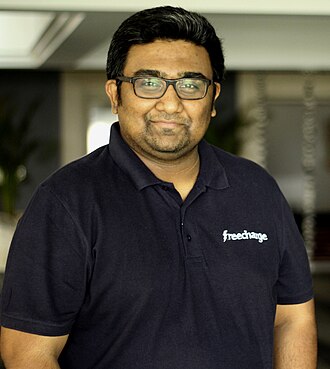
Kunal Shah
Founder and CEO of CRED, founder of Freecharge
Where to hear and read about Kunal Shah1 episode or test

Kunal Shah is the founder and CEO of CRED, previously founder of Freecharge, and one of India's best-known product thinkers. The thing most worth learning from him is to judge a product by how much better it is than the old way, and to build for how a market actually works instead of copying another country's playbook.
Every time humans unlock a Delta 4 product or service, they cannot stop talking or sharing about it.
Kunal Shah on winning in India, second-order thinking, the philosophy of startups, and more
Kunal Shah: the story and the lessons
1Kunal Shah's path from philosophy major to CRED
Shah studied philosophy and went on to found four startups. He built CRED into a fintech valued at over $6 billion. Before it he founded three other startups, one of which was Freecharge, sold to Snapdeal for over $400 million.
He says that as a philosophy major he was a write-off for society. His philosophy background shapes how he reasons about product and life.
CRED reached over 20% of India's credit card bill payments. As of a couple of years before the interview, CRED processed over 20% of all credit card bill payments in India.
A family financial crisis put Shah to work at 15. A severe crisis forced him to start working at age 15, and he says he still feels he is escaping it.
He stayed silent about it for years so he would not collect sympathy. He now shares it to show he was not a gifted, wealthy kid. He calls the missing struggle the biggest curse of successful parents: "Chips on shoulders drive chips in pockets."
His father withheld respect until he built a profitable company. Shah says his own father would not respect him until he ran a profitable business.
He uses this to explain why Indians judge startups by profit: family businesses there were built on trading.
2Kunal Shah's Delta 4 test for better products
Shah builds only if the product beats the old way by 4 points. He asks users to rate the existing solution out of 10, then rate the new one. A delta of 4 or more is the bar. It works on features, products or whole businesses.
Uber scores about 9 against a cab at 3, a delta of 6. He built the idea after asking why he beat peers with top IIT rankings at Freecharge, drawing on entropy and evolutionary biology. He says "10x better" cannot be measured, but a rating can be asked of any user.
At a delta of 4, switching is irreversible and failures are forgiven. Users stay even when Uber fails now and then, and they talk about it. Below 4, switching stays reversible and users have no tolerance for failure.
Buying a suit online scored 5 against 7 offline. That gap is under four, so nobody brags and tolerance is zero. He says making everything tech does not make things more efficient.
A Delta 4 product spreads on its own and cuts acquisition cost. Products far better than the old way create a Unique Brag-worthy Proposition, so people share them and CAC falls, sometimes to zero.
Google spread through demos from other people, not ads or performance marketing. LLMs feel like magic for the same reason: the before and after gap is so large.
Shah says a premium brand should stay wasteful and exclusive. Making a product more utilitarian and cheaper can cost it status. In animals, the highest mating success goes to those who can afford to waste resources.
He argues Zuckerberg's utility pitch for Meta's headset makes it easier for Apple to position Vision Pro as costly and not for everybody.
3Why Shah says India needs its own playbook
Shah says India delivers users fast and revenue slowly. Average income is about $2,500 a year, so a product cannot earn $100 per user. He guesses Meta earns only $3 to $4 per Indian user per year.
Netflix, Spotify and Amazon Prime have not converted users into payers as hoped. He calls India "a great MAU farm but very low on ARPU", and says Indian founders who copy that pitch must go abroad to find ARPU.
He says not to price products around the customer's time. No Indian has been paid an hourly salary, so people rarely put a price on an hour, and many Indian languages have no word for efficiency.
Someone earning $100 an hour may still spend an hour to save $10 on a flight. "When the concept of time is not the same, paying for time is hard to do."
Low trust and low ARPU push Shah toward many products, not focus. Low revenue per user forces a company to do many things. Low trust concentrates trust in a few brands, so users buy more from a name they know.
Tata sells everything from salt to cars to jewelry. He calls focus a curse in these markets, and says one app can do 400 things.
Shah reads a country's profit pools to see what it values. Among India's thousand most profitable companies, retailers number two or three, while the West has many. Women's fashion spend is lower than men's, unlike elsewhere.
He links this to India's divorce rate under 1%, and notes that patriarchal societies tend to have financial services outweigh consumption in market cap. Copying another country's profit pool fails.
CRED bet on 25 million families instead of a mass market. He built CRED for the roughly 25 million Indian families who hold the income and value of time. They are more global, so they need a very different product.
Investors wanted the next China, but he says the two countries share only population. A prior exit made a $25 million Series A on this thesis possible, which he says he would not have had otherwise.
Shah sees Indian doubt about profit as an opening. Tech is about 27 to 30% of US market cap and perhaps 2 to 3% in India, and heavy distribution spending funded by VCs looks unfamiliar to a trading culture.
Twitter asked about profit far more than his investors ever did. He sees an arbitrage for founders who can raise capital and grow revenue fast, and says this is the first generation that must prove tech can be hugely profitable.
He says India punishes failed experiments, so risk needs status. In a large CPG company, the person who launches a failed zero-to-one product gets no promotion, while the manager of a stable brand keeps rising.
He says giving risk-takers the highest status changes behavior. He points to India's changes: founders are respected, unicorns are celebrated, and there is a National Startup Day.
4How Kunal Shah leads and evolves as a founder
Shah says founders must evolve as a company scales. Skill at zero to one does not turn into skill at 10 to 100, and not everyone scales into everything. Founders absorb uncertainty for employees, investors and customers.
Seed investors accept a lot of uncertainty, while growth investors and sovereigns on the cap table want stability. Most CRED staff have never seen a bigger business, so he says the org needs a periodic "gentrifying" to value reliable things. "Entrepreneurs are uncertainty absorbers for everybody."
Founders cycle between control, delegation and destruction. Founders start by controlling and micromanaging, then delegate and empower, and when things slow down they take control again.
He maps this to the Brahma, Vishnu and Mahesh cycles of Indian mythology. He says Zuckerberg had to play Shiva, doing a lot of destruction to become big again.
Shah asks his key reports monthly for the hardest problems solved. He goes around the table and asks each senior person to name the hardest problems they solved last month. Most struggle to answer.
He says busyness crowds out real displacement, and that a senior person's role is chief problem solver.
He tests hires with absurd hypotheticals. He asks what happens to money, law and markets in 12 months if everyone who took a COVID vaccine died tonight. Fewer than 10% of really smart people answer well.
He looks for the range of areas a candidate covers and the leaps from one effect to the next. Another test: what if arranged marriages were banned in India, on pain of capital punishment?
Shah makes AI skill a minimum bar in every interview. He would give candidates, for any role, a task they can only do well if they are good at AI.
His view is that people who cannot leverage AI become a liability within five years.
He reacts only to criticism from people who have done better. If someone more accomplished criticized him, he says he would change everything, and he seeks such feedback constantly. Customer feedback always counts.
Founders who start getting online hate often call him, since he has dealt with it for years. He says envy is like wifi, a hyperlocal service, and nobody envies Elon Musk because he is too far away.
5How Shah builds curiosity and second-order thinking
Shah says curiosity grows from security. Curious people show excitement at what they cannot solve instead of performing expertise. A founder needs the security to ask a dumb question in a 60-person WhatsApp group.
Insecure people Google quietly instead of asking, which slows compounding growth.
He forms a conjecture, then hunts for proof across fields. He guessed that fortunes built on vices were later cleaned up by philanthropy, and asked GPT for 50 examples.
He follows leads into chemistry, physics or human behavior to find universal principles. He drifts and goes deep on topics instead of re-reading books, since repeating turns you into a believer.
Shah treats wealth as an information edge built from collected dots. He says the best companies hold unfair information edges, and no lifetime is long enough to connect all the dots.
Lenny credits the phrase "Always be collecting dots" to restaurateur Danny Meyer.
He asks experts how they choose and what they expect. He asks people who chose well among many options, such as hires or a spouse, how they decided, and what they think will happen to the world and why.
Many cannot explain their choices easily, so probing surfaces hidden mental models. "You see that full chain of thoughts is very powerful."
Shah gives his child one why question per meal. His "Whyfi school" has a child research one why question a day, such as why humans wear jewelry, why Super Bowl ads cost so much, or how elevators began.
Using ChatGPT to answer is fine if the learner then asks where else the same pattern appears. He credits strategy games with building second-order thinking and physical games with rigor.
He says to learn from failures and study human behavior. He says entrepreneurs keep the lesson from a failure and forget the story, and that life is too short to make every mistake yourself.
He names human behavior and evolutionary biology as the subjects to study, because customers, investors, employees and relationships are all humans. Skipping the subject plays life on hard mode.

Kunal Shah on winning in India, second-order thinking, the philosophy of startups, and more
Kunal Shah explains the Delta 4 framework for judging whether a product is truly better, and how India's low trust, low ARPU and time-insensitive market changes the way products must be built. He also covers second-order thinking, founder evolution and curiosity, drawing on a Freecharge exit near $450 million and CRED's $6 billion valuation.
Shah studied philosophy and went on to found four startups. He built CRED into a fintech valued at over $6 billion. Before it he founded three other startups, one of which was Freecharge, sold to Snapdeal for over $400 million.
He says that as a philosophy major he was a write-off for society. His philosophy background shapes how he reasons about product and life.
CRED reached over 20% of India's credit card bill payments. As of a couple of years before the interview, CRED processed over 20% of all credit card bill payments in India.
A family financial crisis put Shah to work at 15. A severe crisis forced him to start working at age 15, and he says he still feels he is escaping it.
He stayed silent about it for years so he would not collect sympathy. He now shares it to show he was not a gifted, wealthy kid. He calls the missing struggle the biggest curse of successful parents: "Chips on shoulders drive chips in pockets."
His father withheld respect until he built a profitable company. Shah says his own father would not respect him until he ran a profitable business.
He uses this to explain why Indians judge startups by profit: family businesses there were built on trading.
Shah builds only if the product beats the old way by 4 points. He asks users to rate the existing solution out of 10, then rate the new one. A delta of 4 or more is the bar. It works on features, products or whole businesses.
Uber scores about 9 against a cab at 3, a delta of 6. He built the idea after asking why he beat peers with top IIT rankings at Freecharge, drawing on entropy and evolutionary biology. He says "10x better" cannot be measured, but a rating can be asked of any user.
At a delta of 4, switching is irreversible and failures are forgiven. Users stay even when Uber fails now and then, and they talk about it. Below 4, switching stays reversible and users have no tolerance for failure.
Buying a suit online scored 5 against 7 offline. That gap is under four, so nobody brags and tolerance is zero. He says making everything tech does not make things more efficient.
A Delta 4 product spreads on its own and cuts acquisition cost. Products far better than the old way create a Unique Brag-worthy Proposition, so people share them and CAC falls, sometimes to zero.
Google spread through demos from other people, not ads or performance marketing. LLMs feel like magic for the same reason: the before and after gap is so large.
Shah says a premium brand should stay wasteful and exclusive. Making a product more utilitarian and cheaper can cost it status. In animals, the highest mating success goes to those who can afford to waste resources.
He argues Zuckerberg's utility pitch for Meta's headset makes it easier for Apple to position Vision Pro as costly and not for everybody.
Shah says India delivers users fast and revenue slowly. Average income is about $2,500 a year, so a product cannot earn $100 per user. He guesses Meta earns only $3 to $4 per Indian user per year.
Netflix, Spotify and Amazon Prime have not converted users into payers as hoped. He calls India "a great MAU farm but very low on ARPU", and says Indian founders who copy that pitch must go abroad to find ARPU.
He says not to price products around the customer's time. No Indian has been paid an hourly salary, so people rarely put a price on an hour, and many Indian languages have no word for efficiency.
Someone earning $100 an hour may still spend an hour to save $10 on a flight. "When the concept of time is not the same, paying for time is hard to do."
Low trust and low ARPU push Shah toward many products, not focus. Low revenue per user forces a company to do many things. Low trust concentrates trust in a few brands, so users buy more from a name they know.
Tata sells everything from salt to cars to jewelry. He calls focus a curse in these markets, and says one app can do 400 things.
Shah reads a country's profit pools to see what it values. Among India's thousand most profitable companies, retailers number two or three, while the West has many. Women's fashion spend is lower than men's, unlike elsewhere.
He links this to India's divorce rate under 1%, and notes that patriarchal societies tend to have financial services outweigh consumption in market cap. Copying another country's profit pool fails.
CRED bet on 25 million families instead of a mass market. He built CRED for the roughly 25 million Indian families who hold the income and value of time. They are more global, so they need a very different product.
Investors wanted the next China, but he says the two countries share only population. A prior exit made a $25 million Series A on this thesis possible, which he says he would not have had otherwise.
Shah sees Indian doubt about profit as an opening. Tech is about 27 to 30% of US market cap and perhaps 2 to 3% in India, and heavy distribution spending funded by VCs looks unfamiliar to a trading culture.
Twitter asked about profit far more than his investors ever did. He sees an arbitrage for founders who can raise capital and grow revenue fast, and says this is the first generation that must prove tech can be hugely profitable.
He says India punishes failed experiments, so risk needs status. In a large CPG company, the person who launches a failed zero-to-one product gets no promotion, while the manager of a stable brand keeps rising.
He says giving risk-takers the highest status changes behavior. He points to India's changes: founders are respected, unicorns are celebrated, and there is a National Startup Day.
Shah says founders must evolve as a company scales. Skill at zero to one does not turn into skill at 10 to 100, and not everyone scales into everything. Founders absorb uncertainty for employees, investors and customers.
Seed investors accept a lot of uncertainty, while growth investors and sovereigns on the cap table want stability. Most CRED staff have never seen a bigger business, so he says the org needs a periodic "gentrifying" to value reliable things. "Entrepreneurs are uncertainty absorbers for everybody."
Founders cycle between control, delegation and destruction. Founders start by controlling and micromanaging, then delegate and empower, and when things slow down they take control again.
He maps this to the Brahma, Vishnu and Mahesh cycles of Indian mythology. He says Zuckerberg had to play Shiva, doing a lot of destruction to become big again.
Shah asks his key reports monthly for the hardest problems solved. He goes around the table and asks each senior person to name the hardest problems they solved last month. Most struggle to answer.
He says busyness crowds out real displacement, and that a senior person's role is chief problem solver.
He tests hires with absurd hypotheticals. He asks what happens to money, law and markets in 12 months if everyone who took a COVID vaccine died tonight. Fewer than 10% of really smart people answer well.
He looks for the range of areas a candidate covers and the leaps from one effect to the next. Another test: what if arranged marriages were banned in India, on pain of capital punishment?
Shah makes AI skill a minimum bar in every interview. He would give candidates, for any role, a task they can only do well if they are good at AI.
His view is that people who cannot leverage AI become a liability within five years.
He reacts only to criticism from people who have done better. If someone more accomplished criticized him, he says he would change everything, and he seeks such feedback constantly. Customer feedback always counts.
Founders who start getting online hate often call him, since he has dealt with it for years. He says envy is like wifi, a hyperlocal service, and nobody envies Elon Musk because he is too far away.
Shah says curiosity grows from security. Curious people show excitement at what they cannot solve instead of performing expertise. A founder needs the security to ask a dumb question in a 60-person WhatsApp group.
Insecure people Google quietly instead of asking, which slows compounding growth.
He forms a conjecture, then hunts for proof across fields. He guessed that fortunes built on vices were later cleaned up by philanthropy, and asked GPT for 50 examples.
He follows leads into chemistry, physics or human behavior to find universal principles. He drifts and goes deep on topics instead of re-reading books, since repeating turns you into a believer.
Shah treats wealth as an information edge built from collected dots. He says the best companies hold unfair information edges, and no lifetime is long enough to connect all the dots.
Lenny credits the phrase "Always be collecting dots" to restaurateur Danny Meyer.
He asks experts how they choose and what they expect. He asks people who chose well among many options, such as hires or a spouse, how they decided, and what they think will happen to the world and why.
Many cannot explain their choices easily, so probing surfaces hidden mental models. "You see that full chain of thoughts is very powerful."
Shah gives his child one why question per meal. His "Whyfi school" has a child research one why question a day, such as why humans wear jewelry, why Super Bowl ads cost so much, or how elevators began.
Using ChatGPT to answer is fine if the learner then asks where else the same pattern appears. He credits strategy games with building second-order thinking and physical games with rigor.
He says to learn from failures and study human behavior. He says entrepreneurs keep the lesson from a failure and forget the story, and that life is too short to make every mistake yourself.
He names human behavior and evolutionary biology as the subjects to study, because customers, investors, employees and relationships are all humans. Skipping the subject plays life on hard mode.