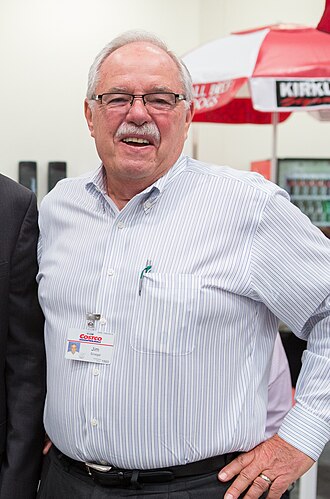
Jim Sinegal
Sinegal co-founded Costco; Price founded FedMart and Price Club
Where to hear and read about Jim Sinegal1 episode or test

Jim Sinegal started as a teenage bagger at Sol Price's FedMart, ran its warehouse operation, and in 1983 co-founded Costco as a clone of Price Club, later merging the two. The most useful lesson from him is discipline: he capped markups, paid people well and kept the product range tiny, and refused every easy chance to trade member trust for short-term profit.
Raising prices just three percent would add fifty percent to our pre-tax income. Why not do it? It's like heroin.
Costco
Jim Sinegal: the story and the lessons
1Jim Sinegal's path from FedMart bagger to Costco co-founder
Sinegal began as a teenage bagger at Sol Price's FedMart. He went to San Diego City College and started on the floor at FedMart, the discounter Price opened in San Diego in 1954.
Asked what he learned from Price, Sinegal said he did not learn a lot from him: "I learned everything."
He rose to run FedMart's centralized warehousing. That warehouse operation held almost all of FedMart's margin, while the stores were barely profitable and hard to defend against Kmart and Walmart.
When German partner Hugo Mann took control, fired Price and his son Robert and changed the locks, Sinegal was the executive told to inform the staff.
Price built Price Club around the warehouse business Sinegal had run. Price Club sold in bulk to small businesses that had no warehouse of their own, with about 3,000 items against roughly 50,000 at Walmart and Kmart.
A credit union deal later let consumers in, and the $1.50 hot dog and soda was born when Price Club ran its own cart at the exit.
Sinegal cloned Price Club as Costco with Jeff Brotman in 1983. Price Club refused the Brotmans a franchise, and Price's nephew pointed Brotman to Sinegal. They raised $7.5 million, sold 50% of the company and hired about eight FedMart and Price Club veterans.
Costco reached $1 billion in under three years and $3 billion in under six, a first, and went public in 1985.
2The Sol Price ideas Sinegal carried into Costco
Costco's values come straight from FedMart's four priorities. FedMart ranked value, good wages, honest practices, then investors, and those became Costco's code of ethics.
Price grew up in the Bronx among garment workers whose conditions shaped the labor movement, which colored his view of how to treat staff.
Sinegal kept Price's refusal to sell loss leaders. Costco will not sell anything it cannot make money on, a rule passed from Price to Sinegal.
Price said loss leaders mean "you're treating your customers like they're stupid." The $1.50 hot dog and soda, unchanged for 47 years, is likely the only exception.
Costco accepts an intelligent loss of sales to keep the range small. At FedMart Price stocked only the 8 oz can of oil and lost buyers who wanted 3 oz, because fewer SKUs were worth more than those sales.
Costco takes this to the extreme with only the 2.5 pound tub of nuts, and has trimmed SKUs from about 4,500 to 3,800 over the last decade.
Membership began as a legal workaround and became the model. A club closed to the public could sell below manufacturers' legal minimum prices, so FedMart sold only to federal employees and did $3 million in its first year against a hoped-for $1 million.
Price Club later found that a real service could carry a real membership fee.
Price gave his playbook away, and rivals built empires on it. Sam Walton launched Sam's Club within a year of dining with the Prices in 1982, and Bernie Marcus used the model to start Home Depot.
Price mailed back Walton's confiscated tape recorder and told him to keep his notes.
3How Jim Sinegal held the line on price
Costco caps markup at 14% so members trust every price. Nothing is marked up more than 14% over supplier cost, Kirkland Signature up to 15%, and electronics only 6 to 8%, against about 25% at Walmart and often 100% at department stores.
Sinegal knew a tiny price creep would go unnoticed: "you could raise the price of a bottle of ketchup to a dollar and three cents instead of one dollar and no one would know." He still refused.
Sinegal threatened Jelinek over the $1.50 hot dog. The hot dog and soda combo stays at $1.50 because Sinegal told his successor Craig Jelinek he would "effing kill" him if he raised it.
Costco sells about 130 million hot dogs a year.
Scale savings go to members, not to margin. Costco asks suppliers for their lowest honest price, runs overhead lean at 10 to 11% and marks up the minimum, so members get about 89% of every supplier saving.
Investor Nick Sleep calls this "scale economies shared with customers." More members bring better deals, lower prices and more members.
Consistent pricing is what makes suppliers and members trust Costco. One year of cheating would break expectations for every year after, and suppliers know Costco will not squeeze them and then mark their goods up 50%.
Costco left six years between its last two membership fee increases, the same long-term habit.
Sinegal talked Jeff Bezos out of raising Amazon's prices. Over coffee at a Bellevue Barnes and Noble in 2001, Sinegal explained the Costco philosophy while Amazon was raising prices to please Wall Street. Bezos reversed the campaign the next day.
Bezos then declared Amazon would be one of the "companies that work hard to charge their customers less."
4Why the Costco model Sinegal ran is hard to copy
Buyers pick the best one or two items so members skip choosing. Costco carries about 3,800 SKUs against 100,000 or more at Walmart, and revenue per product is about ten times Walmart's.
Low selection only works if every item is high quality and the best deal. It also lets buyers challenge each supplier price rise with real cost knowledge, such as cocoa or sugar prices.
Suppliers effectively finance Costco's inventory. Inventory turns 12.4 times a year against 8 at Walmart and about 5 at Home Depot, so goods sell in about 27 days, before net 30 invoices come due.
92% of merchandise is cross-docked, against 10% at Walmart, and customers pluck goods straight off pallets. That needs fewer staff and frees money for higher pay.
Costco is a thin-margin retailer plus a high-margin club. Membership fees supply about 70% of operating income, about $7.5 billion on $230 billion of sales, and 93% of US members renew.
The executive tier costs $120 against $60, pays 2% back capped at $1,000, breaks even near average household spend and is refunded if unused. Executive members are 45% of paid members but 73% of sales.
Never taking credit cards early gave Costco leverage later. Price Club and early Costco took only cash and checks, so customers never depended on cards and Costco could later auction its card deal.
Paying card networks 3 points of an 11% gross margin would have flipped the business upside down.
Costco integrates vertically only when members gain. Facing four or five concentrated chicken processors, it rented an Alabama plant to learn, then built its own in Fremont, Nebraska with about 150 local farmers.
Capacity now reaches 200 million chickens a year, which keeps outside processors honest. Nuts, coffee and eyeglasses get the same treatment.
Break any one of fifty small choices and the model fails. Ten thousand SKUs, a sale, dropping the fee or an e-commerce push would each break it.
Sinegal called the business simple, but few retailers could run on an 11% gross margin and care about every penny.
5Sinegal's code of ethics and how he treated people
The code ranks law, members, employees, suppliers, and leaves out shareholders. Sinegal argued that doing the four things in order is how shareholders get rewarded.
It paid off in the mid 80s when the Washington State Liquor Control Board searched for a reason to deny Costco a beer and wine permit and found nothing.
Costco pays well because turnover and theft cost more than wages. Average pay is $26 an hour against $19.50 at Walmart, attrition after year one is 7% against about 20% in typical retail, and shrinkage is 0.15% of sales.
Hourly staff also get strong health care and a 401(k) match, and 36% of US employees have over 10 years of service.
Leaders rise from the floor and stay for decades. Costco has had three CEOs since 1976, Sol Price, Sinegal and Jelinek, all FedMart veterans, and nearly every executive has 25 or more years there.
Costco has never done a layoff. As the argument goes, you only earn the right to be noble if your machine works.
Sinegal visited every store every year. About 160 market and country managers still fly to Issaquah for two days every month.
Headquarters runs on Kirkland coffee and cubicles, and executives quote exact prices like $3.89 rather than rough figures.
6How Sinegal merged Costco with Price Club in 1993
Sinegal paid up rather than let Walmart get Price Club. Costco holders took 52% and Price Club holders 48%, with a premium over 30%, though Costco was growing faster and could have waited.
Price Club was going to land with Walmart or Costco, and Sol Price did not want Walmart. Sam's Club was close behind, so waiting risked letting it run away with the market.
The merger joined two equals without layoffs. Each side had about 100 stores and $8 billion of revenue, $16 billion combined, and no one lost their job.
7What Sinegal's approach produced, and where it fell short
Putting members and staff first still rewarded patient shareholders. $10,000 invested at the 1985 IPO is worth about $3.3 million, before dividends.
Costco now has 124 million members, 860 stores and revenue per square foot of $1,800 against about $600 at Walmart, and revenue has grown about 10% a year for over 30 years.
The lean cost structure made Costco about 15 years late online. Costco must run at 11% overhead against about 30% at Amazon, and home delivery needs heavy overhead.
The miss turned out lucky because Costco kept its playbook, and it now focuses on bulky items through Costco Logistics, bought for about $1 billion.
Growth is limited by building and training, not by cash. New stores need the right hires, internal training and construction, so Costco cannot scale instantly.
Its first China store reached 400,000 members in two years, against 68,000 for a mature US store.

Costco
Costco shows how trade-offs that look costly, like thin margins, high pay and few products, lock together into a durable business that members and suppliers trust. The decision that makes it worth hearing is capping markup at 14% and sharing scale savings with customers, which produced 230 billion dollars of revenue and a loyal, wealthy customer base.
Sinegal began as a teenage bagger at Sol Price's FedMart. He went to San Diego City College and started on the floor at FedMart, the discounter Price opened in San Diego in 1954.
Asked what he learned from Price, Sinegal said he did not learn a lot from him: "I learned everything."
He rose to run FedMart's centralized warehousing. That warehouse operation held almost all of FedMart's margin, while the stores were barely profitable and hard to defend against Kmart and Walmart.
When German partner Hugo Mann took control, fired Price and his son Robert and changed the locks, Sinegal was the executive told to inform the staff.
Price built Price Club around the warehouse business Sinegal had run. Price Club sold in bulk to small businesses that had no warehouse of their own, with about 3,000 items against roughly 50,000 at Walmart and Kmart.
A credit union deal later let consumers in, and the $1.50 hot dog and soda was born when Price Club ran its own cart at the exit.
Sinegal cloned Price Club as Costco with Jeff Brotman in 1983. Price Club refused the Brotmans a franchise, and Price's nephew pointed Brotman to Sinegal. They raised $7.5 million, sold 50% of the company and hired about eight FedMart and Price Club veterans.
Costco reached $1 billion in under three years and $3 billion in under six, a first, and went public in 1985.
Costco's values come straight from FedMart's four priorities. FedMart ranked value, good wages, honest practices, then investors, and those became Costco's code of ethics.
Price grew up in the Bronx among garment workers whose conditions shaped the labor movement, which colored his view of how to treat staff.
Sinegal kept Price's refusal to sell loss leaders. Costco will not sell anything it cannot make money on, a rule passed from Price to Sinegal.
Price said loss leaders mean "you're treating your customers like they're stupid." The $1.50 hot dog and soda, unchanged for 47 years, is likely the only exception.
Costco accepts an intelligent loss of sales to keep the range small. At FedMart Price stocked only the 8 oz can of oil and lost buyers who wanted 3 oz, because fewer SKUs were worth more than those sales.
Costco takes this to the extreme with only the 2.5 pound tub of nuts, and has trimmed SKUs from about 4,500 to 3,800 over the last decade.
Membership began as a legal workaround and became the model. A club closed to the public could sell below manufacturers' legal minimum prices, so FedMart sold only to federal employees and did $3 million in its first year against a hoped-for $1 million.
Price Club later found that a real service could carry a real membership fee.
Price gave his playbook away, and rivals built empires on it. Sam Walton launched Sam's Club within a year of dining with the Prices in 1982, and Bernie Marcus used the model to start Home Depot.
Price mailed back Walton's confiscated tape recorder and told him to keep his notes.
Costco caps markup at 14% so members trust every price. Nothing is marked up more than 14% over supplier cost, Kirkland Signature up to 15%, and electronics only 6 to 8%, against about 25% at Walmart and often 100% at department stores.
Sinegal knew a tiny price creep would go unnoticed: "you could raise the price of a bottle of ketchup to a dollar and three cents instead of one dollar and no one would know." He still refused.
Sinegal threatened Jelinek over the $1.50 hot dog. The hot dog and soda combo stays at $1.50 because Sinegal told his successor Craig Jelinek he would "effing kill" him if he raised it.
Costco sells about 130 million hot dogs a year.
Scale savings go to members, not to margin. Costco asks suppliers for their lowest honest price, runs overhead lean at 10 to 11% and marks up the minimum, so members get about 89% of every supplier saving.
Investor Nick Sleep calls this "scale economies shared with customers." More members bring better deals, lower prices and more members.
Consistent pricing is what makes suppliers and members trust Costco. One year of cheating would break expectations for every year after, and suppliers know Costco will not squeeze them and then mark their goods up 50%.
Costco left six years between its last two membership fee increases, the same long-term habit.
Sinegal talked Jeff Bezos out of raising Amazon's prices. Over coffee at a Bellevue Barnes and Noble in 2001, Sinegal explained the Costco philosophy while Amazon was raising prices to please Wall Street. Bezos reversed the campaign the next day.
Bezos then declared Amazon would be one of the "companies that work hard to charge their customers less."
Buyers pick the best one or two items so members skip choosing. Costco carries about 3,800 SKUs against 100,000 or more at Walmart, and revenue per product is about ten times Walmart's.
Low selection only works if every item is high quality and the best deal. It also lets buyers challenge each supplier price rise with real cost knowledge, such as cocoa or sugar prices.
Suppliers effectively finance Costco's inventory. Inventory turns 12.4 times a year against 8 at Walmart and about 5 at Home Depot, so goods sell in about 27 days, before net 30 invoices come due.
92% of merchandise is cross-docked, against 10% at Walmart, and customers pluck goods straight off pallets. That needs fewer staff and frees money for higher pay.
Costco is a thin-margin retailer plus a high-margin club. Membership fees supply about 70% of operating income, about $7.5 billion on $230 billion of sales, and 93% of US members renew.
The executive tier costs $120 against $60, pays 2% back capped at $1,000, breaks even near average household spend and is refunded if unused. Executive members are 45% of paid members but 73% of sales.
Never taking credit cards early gave Costco leverage later. Price Club and early Costco took only cash and checks, so customers never depended on cards and Costco could later auction its card deal.
Paying card networks 3 points of an 11% gross margin would have flipped the business upside down.
Costco integrates vertically only when members gain. Facing four or five concentrated chicken processors, it rented an Alabama plant to learn, then built its own in Fremont, Nebraska with about 150 local farmers.
Capacity now reaches 200 million chickens a year, which keeps outside processors honest. Nuts, coffee and eyeglasses get the same treatment.
Break any one of fifty small choices and the model fails. Ten thousand SKUs, a sale, dropping the fee or an e-commerce push would each break it.
Sinegal called the business simple, but few retailers could run on an 11% gross margin and care about every penny.
The code ranks law, members, employees, suppliers, and leaves out shareholders. Sinegal argued that doing the four things in order is how shareholders get rewarded.
It paid off in the mid 80s when the Washington State Liquor Control Board searched for a reason to deny Costco a beer and wine permit and found nothing.
Costco pays well because turnover and theft cost more than wages. Average pay is $26 an hour against $19.50 at Walmart, attrition after year one is 7% against about 20% in typical retail, and shrinkage is 0.15% of sales.
Hourly staff also get strong health care and a 401(k) match, and 36% of US employees have over 10 years of service.
Leaders rise from the floor and stay for decades. Costco has had three CEOs since 1976, Sol Price, Sinegal and Jelinek, all FedMart veterans, and nearly every executive has 25 or more years there.
Costco has never done a layoff. As the argument goes, you only earn the right to be noble if your machine works.
Sinegal visited every store every year. About 160 market and country managers still fly to Issaquah for two days every month.
Headquarters runs on Kirkland coffee and cubicles, and executives quote exact prices like $3.89 rather than rough figures.
Sinegal paid up rather than let Walmart get Price Club. Costco holders took 52% and Price Club holders 48%, with a premium over 30%, though Costco was growing faster and could have waited.
Price Club was going to land with Walmart or Costco, and Sol Price did not want Walmart. Sam's Club was close behind, so waiting risked letting it run away with the market.
The merger joined two equals without layoffs. Each side had about 100 stores and $8 billion of revenue, $16 billion combined, and no one lost their job.
Putting members and staff first still rewarded patient shareholders. $10,000 invested at the 1985 IPO is worth about $3.3 million, before dividends.
Costco now has 124 million members, 860 stores and revenue per square foot of $1,800 against about $600 at Walmart, and revenue has grown about 10% a year for over 30 years.
The lean cost structure made Costco about 15 years late online. Costco must run at 11% overhead against about 30% at Amazon, and home delivery needs heavy overhead.
The miss turned out lucky because Costco kept its playbook, and it now focuses on bulky items through Costco Logistics, bought for about $1 billion.
Growth is limited by building and training, not by cash. New stores need the right hires, internal training and construction, so Costco cannot scale instantly.
Its first China store reached 400,000 members in two years, against 68,000 for a mature US store.
 Costco