Jen Abel
Co-founder of JJELLYFISH, advisor to early-stage founders on founder-led sales
Where to hear and read about Jen Abel2 episodes and tests
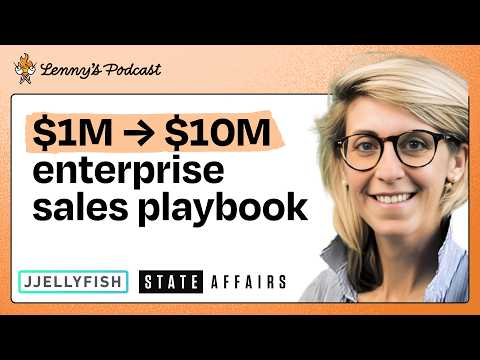
 Lenny's Podcast$1M to $10M: The enterprise sales playbook with Jen Abel
 Lenny's PodcastThe ultimate guide to founder-led sales | Jen Abel (co-founder of JJELLYFISH)
Jen Abel co-founded JJELLYFISH, which teaches early-stage founders to sell, and is now GM of Enterprise at State Affairs. The one thing most worth learning from her is to treat early sales as research led by the founder, then play enterprise as its own game with vision-led pitches and prices near $100K.
don't be better, be different
$1M to $10M: The enterprise sales playbook with Jen Abel
Jen Abel: the story and the lessons
1Jen Abel's path to teaching founders how to sell
Abel came from enterprise sales roles before co-founding Jellyfish. She was an enterprise sales director at the Muse and General Assembly. She then co-founded Jellyfish to teach founders to sell and run early customer discovery.
Jellyfish has worked with over 300 early-stage founders on the way to their first $1M ARR.
Her current role is GM of Enterprise at State Affairs. She moved from teaching founders to running enterprise sales herself. She still advises early-stage founders and answers DMs on Twitter, where her handle has a double J tied to Jellyfish.
Abel splits the early climb into two phases with different skills. Founder-led sales covers zero to $1M ARR. The $1M to $10M stretch is enterprise selling, not product-led growth.
Her opening line: "The market doesn't want to be sold to. They want to buy."
Jellyfish embeds with founders instead of selling for them. The team works alongside the founder and drives execution, but the founder stays at the front of the sales motion. It aims at the first $1M of ARR, or $500K if the founder moves fast.
Abel does not believe in outsourcing "the heartbeat of the organization, which is sales."
2Why Abel says the founder should sell first
Abel treats the founder as the product in the early days. With no brand, no marketing engine and few references, the market reacts to the founder's way of seeing the world. Buyers want to speak to the person who crafted the vision.
She says people don't realize how big this competitive advantage is. Only a founder can spot the moments in a call that reshape the vision.
She warns that selling through a middleman turns feedback into telephone. Wiz's founders held 10 to 15 conversations a day for weeks and learned people liked the product but no one was buying. When a hired salesperson reports that no one cares, the founder blames the salesperson before questioning the vision.
Abel says founder-led sales is for learning, not day-one revenue. She suggests moving off it around $500K to $1M ARR, depending on how fast you got there. Move on only after you hit velocity.
She even suggests no salespeople before Series A, since seed is for experiments. Sprig's investor First Round would not let them hire a seller before $1M ARR.
She diagnoses weak sales at the top of the funnel. Abel says she has never seen a bottom-of-funnel problem. It traces back to the wrong person, message or problem, or not being different enough.
Two similar engagements ran at 2% and 12% interest, and the gap came from the founder's insight, not from different tactics.
3Abel's rules for cold outreach and prospecting
Abel opens with relevance, then says something counterintuitive. The note should explain why it matters to the reader's role, then make them think "what?". It covers the problem and why today's options fall short, not your solution.
Jellyfish's first 20 customers came from cold email using the line "zero to one sales talent doesn't exist." She avoids claiming to be "better" because it means something different to everyone.
She keeps messages to three or four sentences. A note should fit one phone screen so the reader never scrolls. It should leave them wanting more.
She tests notes by ear, and has often changed ones that sounded passive-aggressive.
She hand-writes 30 notes before buying any outbound tool. Pick 30 people you would be excited to learn from and spend 15 to 20 minutes on each, across email, LinkedIn, calls and Twitter DMs. See whether they are findable and what they share.
Volume and tools like Clay come after you know the parameters. If finding 30 is hard, scaling to thousands will be harder.
For $100K deals she writes by hand and skips AI outbound tools. AI tools pull from the same databases, so everyone hits the same prospects. She tailors the framing and subject line, not a customized first sentence, and keeps it to about three sentences.
A hedge fund's chief legal officer replied to a one-sentence Saturday email. Her target list lives in her head: "I want to take a back door in, not the front door where everyone else is trick-or-treating."
She says deal size decides whether you run outbound or marketing. A $5K deal needs a marketing-led engine to work. A $100K deal means outbound from day one, since salespeople closing $10K to $20K deals can't earn back their cost.
She judges reply rates against win rate before blaming the channel. With a 15 to 30% win rate and a $1M quota, mature outbound conversion sits around 5 to 7%, sometimes 2 to 3%. She has seen 8 to 15% when a founder solves a heartfelt problem.
Low replies usually mean the message is dull or the problem isn't widely felt. "When a problem is truly being felt by the market, people will get on a call."
4How Abel runs discovery calls and the sales cycle
Abel opens the first call as a humble early-stage learner. Say you are early stage, passionate about one problem, and want to hear how it shows up for them. Then let them talk.
People find it hard to tell a founder that a finished product misses, so the further along you claim to be, the less candid the feedback.
She tests whether the problem is measured, managed and already attacked. If the buyer doesn't measure or manage it, move on. If they do, ask how they tried to fix it: a hire, another tool, or an open gap.
Prospects pulling in colleagues and their boss is the sign of real pull. Wiz saw prospects shift from "I like it" to adding stakeholders.
She skips "what keeps you up at night" and books call two on call one. Pain-point questions get answers that change daily. Instead she pulls up calendars on the call and asks who else should join.
"I'll email you" is usually a polite no.
She holds the demo back in upmarket sales. The demo is the one card you control, and once buyers look under the hood the mystery fades. Qualify first, get the right people in the room, and save the demo for a later call.
Fast demos suit down market, high-volume deals such as a $3,000 tool.
She qualifies hard with a yes-or-no question on the first call. She says she is getting the vibe it may not be a fit or good timing and asks if she misread it. She also asks straight out whether the deal can close this year.
Prospects usually confirm, which saves the relationship and a lot of time.
Abel keeps calls tight to shorten the cycle. A typical cycle runs five calls to a signature: intro, second call, proposal, scope co-authoring, procurement. Propose the next call in a week, not two.
Enterprise deals usually take six to 12 months, and highly regulated industries add 20 to 30%. She has seen one close in 90 days, which is rare.
She builds trust by admitting when she is not the right fit. Overselling to land a logo or impress investors shows up months later as churn. Saying you may not be right often makes the prospect probe what you are great at.
"Trust is the number one currency in sales."
5Abel on playing the enterprise game with tier-one logos
Abel says enterprise and small business are different games and the mid-market blurs them. Small business is powered by marketing and enterprise is led by sales. Selling to a 100-person company is a radically different game than selling to a 1,000-person one.
She asks whether "mid-market" means the top of small business or the bottom of enterprise, then commits to that game's hires, ACV and motion. "I say the mid-market doesn't exist."
She says to choose the game by who you built for. Both paths work: Wiz started in enterprise and others grew up from small business. Decide by where the problem is most felt and which game you want to play.
"This is going to be your life for 10 years." She calls mid-market hard to start in because it straddles two go-to-markets.
She tells founders to go after tier-one logos first, against common VC advice. Leaders like Walmart, Nvidia, Tesla and Stripe must stay number one, so they take swings on early tools. Their voice can turn a $100K deal into a $1M deal quickly.
A tier-one logo also excites investors and talent, and companies ranked two through four want what number one has.
Abel sells the gap and the alpha, not the problem. Founders should vision cast: show where the leader is now and where you can take them. For Cursor, the pitch is access to the 10x engineers who use it.
High-frequency traders were sold one second of alpha, not fiber cable. "You need to sell to a gap. Don't sell to a problem."
She reframes objections instead of arguing. If the buyer already has a tool, she agrees it is good for that problem, then moves the talk upstream to the larger opportunity.
She tells founders not to copy labels like "forward deployed engineer", because commoditizing yourself kills the new feeling buyers want.
She closes enterprise deals through relationships and fast replies. She answers client calls and texts immediately. Buyers adopt a new tool rarely and put their reputation on it, so she makes them feel like a superhero.
A Fortune 10 client said a rushed deadline was a tall order but agreed to try. "These are how enterprise deals gets done. It's relationships."
She says $10K deals stall in procurement and repel strong sellers. Small deals still go through procurement, while a $100K deal pulls in an executive who can move it. She has seen a $10K deal take nine months to close.
Stuck procurement is often a qualification error from selling to someone too junior. Good salespeople will not chase small commissions.
6Abel on pricing and crafting enterprise deals
Abel prices the first enterprise deal between $75K and $150K. A small-business price becomes the anchor. A buyer who paid $9,000 will ask for the 10x value when you ask $90,000, which is very hard to prove.
She says to start contained: name who gets access and the value delivered, and plant what happens in year two and three. "Don't say 150k and sell the farm."
She puts a realistic first founder-led contract at $50K to $200K. Enterprises already spend more on the effort of buying than on the technology, so don't negotiate against yourself. But don't open at $1M as a seed startup.
One deal landed at $60K and grew to $280K in four months. Some contracts cap a vendor at 20% of existing revenue, so ask whether that is a hard line.
She structures small-seat requests from big companies as enterprise deals. If Walmart asks for three seats on a self-serve plan, she does not quote small business pricing. She involves a senior executive instead.
Without an executive stamp, it ends up on a credit card and is hard to grow.
She co-authors the price with the champion. She names the engagement, such as $150,000, and asks how to shape it so the buyer can go to bat and win. Options include a smaller year one that steps up in year two.
She has never seen a buyer in a real relationship try to discount unfairly. If they want lower, she gives it and locks them in longer.
Abel adds extras that cost her little and cost the buyer a lot. Examples are building a custom integration over a year, which saves an engineering hire, or offering a speaking slot at her event. She contains scope so buyers can't sidetrack her.
"As soon as you become one of three that they're testing out, you've already sort of lost."
She discounts only in exchange for something. Discounting just to close means negotiating with yourself. If a buyer asks, she makes them defend it: if I give you 30% off, can I remove 30% of the value?
Good reasons are being a design partner or giving a two-year reference.
She does the procurement work for the buyer and finds the signer early. Procurement can point you to one of 17 preferred vendors if you seem only slightly better, adding three to four months. She offers to fill out their forms and states exactly what she does and doesn't do.
On a pharma deal the CFO asked "what am I signing?" at the finish line, sending the deal to the back of the queue for about a month. So she arms the signer with a few tight bullets.
7Abel on services, design partners and channels
Abel sells a service first when the market can't yet buy the technology. She has the customer co-author the scope and sells paid work such as mapping their workflow or building the internal pitch. She time-boxes it to 90 days.
She estimates 40 to 50% of B2B SaaS companies must sell a service before the technology. A founder in a traditional industry did a nominal paid workflow engagement, then won the technology contract.
She uses services as the fastest way into an enterprise. Enterprises know how to buy services, their largest budget item. A bundled service can be prorated to something like $10K a month so the number feels familiar.
Whether bundled or unbundled, it nets out to $75K to $150K.
She treats design partners as guides, not a million-dollar pipeline. She picks technology-minded Fortune 1000 companies and a contact eager to give feedback on a janky product. She sets a design-partner price and a perpetual concession, such as 30%, up front.
A founder she worked with found about 80% of the feedback was noise and 20% gold. "It is the founders's job to interpret that."
She does not believe in channel partnerships with big consultancies. Firms like Accenture and Deloitte sell a service first and mention startups only afterward. A hundred startups sit on the same list, so yours gets no push.
They are consultants, not vision casters, so they can't carry the pitch that wins an enterprise deal.
8How Abel hires and pays enterprise sellers
Abel wants first sellers who can cosplay the founder. They must sell the vision, run through walls and craft a different deal each time. Strong profiles are former founders or people with deep product or engineering backgrounds.
She avoids junior reps with no corporate experience and big-company VPs, whose brand did the trust-building for them. She can count on one hand the candidates she has been excited by.
She hires the first seller only after the founder has a pattern. That is around $1M ARR and the first 7 to 10 customers. The founder should join the seller's first five calls to judge them.
She also borrows Jason Lemkin's test: would you want to buy from this person?
She hires two salespeople at once and expects to lose one. Roughly one in every two salespeople is fired, and the failure rate may be higher than 50%. Hiring two lets the founder compare them.
She calls Lemkin's advice to hire two "spot on" and names him as the sales mind she follows.
She structures pay at 50% base and 50% variable. In technology, commission on a deal typically runs 8 to 12%, so about 10%. She shows sellers how much they could earn.
"Salespeople love to make money."
$1M to $10M: The enterprise sales playbook with Jen Abel
Enterprise sales is a different game from small business sales, and getting from $1M to $10M ARR means pricing near $100K, targeting tier-one logos, selling vision instead of problems, and hiring founder-like sellers. Abel explains why a $10K-$20K price traps startups and how to craft deals and run outbound by hand.
Her current role is GM of Enterprise at State Affairs. She moved from teaching founders to running enterprise sales herself. She still advises early-stage founders and answers DMs on Twitter, where her handle has a double J tied to Jellyfish.
Abel splits the early climb into two phases with different skills. Founder-led sales covers zero to $1M ARR. The $1M to $10M stretch is enterprise selling, not product-led growth.
Her opening line: "The market doesn't want to be sold to. They want to buy."
For $100K deals she writes by hand and skips AI outbound tools. AI tools pull from the same databases, so everyone hits the same prospects. She tailors the framing and subject line, not a customized first sentence, and keeps it to about three sentences.
A hedge fund's chief legal officer replied to a one-sentence Saturday email. Her target list lives in her head: "I want to take a back door in, not the front door where everyone else is trick-or-treating."
She says deal size decides whether you run outbound or marketing. A $5K deal needs a marketing-led engine to work. A $100K deal means outbound from day one, since salespeople closing $10K to $20K deals can't earn back their cost.
She qualifies hard with a yes-or-no question on the first call. She says she is getting the vibe it may not be a fit or good timing and asks if she misread it. She also asks straight out whether the deal can close this year.
Prospects usually confirm, which saves the relationship and a lot of time.
Abel says enterprise and small business are different games and the mid-market blurs them. Small business is powered by marketing and enterprise is led by sales. Selling to a 100-person company is a radically different game than selling to a 1,000-person one.
She asks whether "mid-market" means the top of small business or the bottom of enterprise, then commits to that game's hires, ACV and motion. "I say the mid-market doesn't exist."
She tells founders to go after tier-one logos first, against common VC advice. Leaders like Walmart, Nvidia, Tesla and Stripe must stay number one, so they take swings on early tools. Their voice can turn a $100K deal into a $1M deal quickly.
A tier-one logo also excites investors and talent, and companies ranked two through four want what number one has.
Abel sells the gap and the alpha, not the problem. Founders should vision cast: show where the leader is now and where you can take them. For Cursor, the pitch is access to the 10x engineers who use it.
High-frequency traders were sold one second of alpha, not fiber cable. "You need to sell to a gap. Don't sell to a problem."
She reframes objections instead of arguing. If the buyer already has a tool, she agrees it is good for that problem, then moves the talk upstream to the larger opportunity.
She tells founders not to copy labels like "forward deployed engineer", because commoditizing yourself kills the new feeling buyers want.
She closes enterprise deals through relationships and fast replies. She answers client calls and texts immediately. Buyers adopt a new tool rarely and put their reputation on it, so she makes them feel like a superhero.
A Fortune 10 client said a rushed deadline was a tall order but agreed to try. "These are how enterprise deals gets done. It's relationships."
She says $10K deals stall in procurement and repel strong sellers. Small deals still go through procurement, while a $100K deal pulls in an executive who can move it. She has seen a $10K deal take nine months to close.
Stuck procurement is often a qualification error from selling to someone too junior. Good salespeople will not chase small commissions.
Abel prices the first enterprise deal between $75K and $150K. A small-business price becomes the anchor. A buyer who paid $9,000 will ask for the 10x value when you ask $90,000, which is very hard to prove.
She says to start contained: name who gets access and the value delivered, and plant what happens in year two and three. "Don't say 150k and sell the farm."
She structures small-seat requests from big companies as enterprise deals. If Walmart asks for three seats on a self-serve plan, she does not quote small business pricing. She involves a senior executive instead.
Without an executive stamp, it ends up on a credit card and is hard to grow.
She co-authors the price with the champion. She names the engagement, such as $150,000, and asks how to shape it so the buyer can go to bat and win. Options include a smaller year one that steps up in year two.
She has never seen a buyer in a real relationship try to discount unfairly. If they want lower, she gives it and locks them in longer.
Abel adds extras that cost her little and cost the buyer a lot. Examples are building a custom integration over a year, which saves an engineering hire, or offering a speaking slot at her event. She contains scope so buyers can't sidetrack her.
"As soon as you become one of three that they're testing out, you've already sort of lost."
Abel sells a service first when the market can't yet buy the technology. She has the customer co-author the scope and sells paid work such as mapping their workflow or building the internal pitch. She time-boxes it to 90 days.
She estimates 40 to 50% of B2B SaaS companies must sell a service before the technology. A founder in a traditional industry did a nominal paid workflow engagement, then won the technology contract.
She uses services as the fastest way into an enterprise. Enterprises know how to buy services, their largest budget item. A bundled service can be prorated to something like $10K a month so the number feels familiar.
Whether bundled or unbundled, it nets out to $75K to $150K.
She treats design partners as guides, not a million-dollar pipeline. She picks technology-minded Fortune 1000 companies and a contact eager to give feedback on a janky product. She sets a design-partner price and a perpetual concession, such as 30%, up front.
A founder she worked with found about 80% of the feedback was noise and 20% gold. "It is the founders's job to interpret that."
She does not believe in channel partnerships with big consultancies. Firms like Accenture and Deloitte sell a service first and mention startups only afterward. A hundred startups sit on the same list, so yours gets no push.
They are consultants, not vision casters, so they can't carry the pitch that wins an enterprise deal.
Abel wants first sellers who can cosplay the founder. They must sell the vision, run through walls and craft a different deal each time. Strong profiles are former founders or people with deep product or engineering backgrounds.
She avoids junior reps with no corporate experience and big-company VPs, whose brand did the trust-building for them. She can count on one hand the candidates she has been excited by.
She hires the first seller only after the founder has a pattern. That is around $1M ARR and the first 7 to 10 customers. The founder should join the seller's first five calls to judge them.
She also borrows Jason Lemkin's test: would you want to buy from this person?
She hires two salespeople at once and expects to lose one. Roughly one in every two salespeople is fired, and the failure rate may be higher than 50%. Hiring two lets the founder compare them.
She calls Lemkin's advice to hire two "spot on" and names him as the sales mind she follows.
She structures pay at 50% base and 50% variable. In technology, commission on a deal typically runs 8 to 12%, so about 10%. She shows sellers how much they could earn.
"Salespeople love to make money."
The ultimate guide to founder-led sales | Jen Abel (co-founder of JJELLYFISH)
Founder-led sales is about learning from the market first and earning the right to sell, and the episode walks through each step of the sales cycle with exact phrasing and pitfalls. Jen Abel draws on work with 300+ early-stage founders heading toward their first $1M ARR, including benchmarks for win rate, conversion rate, deal size and cycle length.
Abel came from enterprise sales roles before co-founding Jellyfish. She was an enterprise sales director at the Muse and General Assembly. She then co-founded Jellyfish to teach founders to sell and run early customer discovery.
Jellyfish has worked with over 300 early-stage founders on the way to their first $1M ARR.
Jellyfish embeds with founders instead of selling for them. The team works alongside the founder and drives execution, but the founder stays at the front of the sales motion. It aims at the first $1M of ARR, or $500K if the founder moves fast.
Abel does not believe in outsourcing "the heartbeat of the organization, which is sales."
Abel treats the founder as the product in the early days. With no brand, no marketing engine and few references, the market reacts to the founder's way of seeing the world. Buyers want to speak to the person who crafted the vision.
She says people don't realize how big this competitive advantage is. Only a founder can spot the moments in a call that reshape the vision.
She warns that selling through a middleman turns feedback into telephone. Wiz's founders held 10 to 15 conversations a day for weeks and learned people liked the product but no one was buying. When a hired salesperson reports that no one cares, the founder blames the salesperson before questioning the vision.
Abel says founder-led sales is for learning, not day-one revenue. She suggests moving off it around $500K to $1M ARR, depending on how fast you got there. Move on only after you hit velocity.
She even suggests no salespeople before Series A, since seed is for experiments. Sprig's investor First Round would not let them hire a seller before $1M ARR.
She diagnoses weak sales at the top of the funnel. Abel says she has never seen a bottom-of-funnel problem. It traces back to the wrong person, message or problem, or not being different enough.
Two similar engagements ran at 2% and 12% interest, and the gap came from the founder's insight, not from different tactics.
Abel opens with relevance, then says something counterintuitive. The note should explain why it matters to the reader's role, then make them think "what?". It covers the problem and why today's options fall short, not your solution.
Jellyfish's first 20 customers came from cold email using the line "zero to one sales talent doesn't exist." She avoids claiming to be "better" because it means something different to everyone.
She keeps messages to three or four sentences. A note should fit one phone screen so the reader never scrolls. It should leave them wanting more.
She tests notes by ear, and has often changed ones that sounded passive-aggressive.
She hand-writes 30 notes before buying any outbound tool. Pick 30 people you would be excited to learn from and spend 15 to 20 minutes on each, across email, LinkedIn, calls and Twitter DMs. See whether they are findable and what they share.
Volume and tools like Clay come after you know the parameters. If finding 30 is hard, scaling to thousands will be harder.
She judges reply rates against win rate before blaming the channel. With a 15 to 30% win rate and a $1M quota, mature outbound conversion sits around 5 to 7%, sometimes 2 to 3%. She has seen 8 to 15% when a founder solves a heartfelt problem.
Low replies usually mean the message is dull or the problem isn't widely felt. "When a problem is truly being felt by the market, people will get on a call."
Abel opens the first call as a humble early-stage learner. Say you are early stage, passionate about one problem, and want to hear how it shows up for them. Then let them talk.
People find it hard to tell a founder that a finished product misses, so the further along you claim to be, the less candid the feedback.
She tests whether the problem is measured, managed and already attacked. If the buyer doesn't measure or manage it, move on. If they do, ask how they tried to fix it: a hire, another tool, or an open gap.
Prospects pulling in colleagues and their boss is the sign of real pull. Wiz saw prospects shift from "I like it" to adding stakeholders.
She skips "what keeps you up at night" and books call two on call one. Pain-point questions get answers that change daily. Instead she pulls up calendars on the call and asks who else should join.
"I'll email you" is usually a polite no.
She holds the demo back in upmarket sales. The demo is the one card you control, and once buyers look under the hood the mystery fades. Qualify first, get the right people in the room, and save the demo for a later call.
Fast demos suit down market, high-volume deals such as a $3,000 tool.
Abel keeps calls tight to shorten the cycle. A typical cycle runs five calls to a signature: intro, second call, proposal, scope co-authoring, procurement. Propose the next call in a week, not two.
Enterprise deals usually take six to 12 months, and highly regulated industries add 20 to 30%. She has seen one close in 90 days, which is rare.
She builds trust by admitting when she is not the right fit. Overselling to land a logo or impress investors shows up months later as churn. Saying you may not be right often makes the prospect probe what you are great at.
"Trust is the number one currency in sales."
She says to choose the game by who you built for. Both paths work: Wiz started in enterprise and others grew up from small business. Decide by where the problem is most felt and which game you want to play.
"This is going to be your life for 10 years." She calls mid-market hard to start in because it straddles two go-to-markets.
She puts a realistic first founder-led contract at $50K to $200K. Enterprises already spend more on the effort of buying than on the technology, so don't negotiate against yourself. But don't open at $1M as a seed startup.
One deal landed at $60K and grew to $280K in four months. Some contracts cap a vendor at 20% of existing revenue, so ask whether that is a hard line.
She discounts only in exchange for something. Discounting just to close means negotiating with yourself. If a buyer asks, she makes them defend it: if I give you 30% off, can I remove 30% of the value?
Good reasons are being a design partner or giving a two-year reference.
She does the procurement work for the buyer and finds the signer early. Procurement can point you to one of 17 preferred vendors if you seem only slightly better, adding three to four months. She offers to fill out their forms and states exactly what she does and doesn't do.
On a pharma deal the CFO asked "what am I signing?" at the finish line, sending the deal to the back of the queue for about a month. So she arms the signer with a few tight bullets.
Abel sells a service first when the market can't yet buy the technology. She has the customer co-author the scope and sells paid work such as mapping their workflow or building the internal pitch. She time-boxes it to 90 days.
She estimates 40 to 50% of B2B SaaS companies must sell a service before the technology. A founder in a traditional industry did a nominal paid workflow engagement, then won the technology contract.