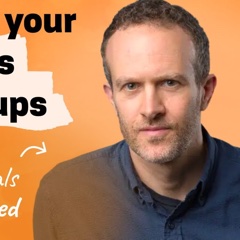
Jason Fried
Co-founder and CEO, 37signals (Basecamp, HEY)
Where to hear and read about Jason Fried2 episodes and tests

 David SenraJason Fried: Your Only Competition Is Your Costs

 Lenny's PodcastJason Fried challenges your thinking on fundraising, goals, growth, and more
Jason Fried is co-founder and CEO of 37signals, the bootstrapped, profitable company behind Basecamp and HEY, which he has run for 27 years with no outside money. The thing most worth learning from him is to keep costs low and the team small, then stop at enough customers who like what you like, so you stay independent for decades.
I don't need the whole world to like what I like. I need enough of a small world to like what I like, and we're golden.
Jason Fried: Your Only Competition Is Your Costs
Jason Fried: the story and the lessons
1Jason Fried's path from AudioFile to 37signals
Fried built his first product at 15 or 16 for himself. AudioFile was a FileMaker Pro database for tracking the tapes and CDs he lent to friends. He shipped it with a text file saying 'If you like this, send me 20 bucks' and posted it on AOL.
The first payment came in an old airmail envelope with red and blue check marks. A crisp $20 bill from Germany showed him that strangers wanted what he wanted.
A teenage income of about $20,000 taught him how few customers he needed. With almost no expenses, he earned about $20,000 a year from software sales, so he only had to find a few thousand people like him.
His working life was one line from age 13: a grocery store, a shoe store, then a reseller licence at 15. He bought electronics wholesale and sold them to friends at nearly 2x. Today he builds software for like-minded people.
He started the company at 25 and has run it 27 years. The executive team is two people, Fried and his partner David Heinemeier Hansson. 37signals has been profitable every year, which S2 counted as 24 years running at the time.
Fried says he settled into himself in his forties, after years with a chip on his shoulder. He is only competitive when slighted, as when Dave Siegel replied 'You suck' to a design he submitted.
Fried reversed course on making only one product. The company wound down its other products, stopped selling them without closing them, and even renamed itself Basecamp. A few years later the urge to make more things produced HEY, then ONCE.
He had expected to be happy polishing one sculpture for a career. His conclusion: 'We're makers. Let's be honest about ourselves.' He changes his mind constantly on smaller things like design, naming and rollout.
2Fried's rules for a small, cheap, profitable company
Fried says a company's only real competition is its costs. Rivals' prices and launches are out of your control, while your costs and your price are not. As long as you make more than you spend, you stay in business and keep doing the work.
He cites Sam Walton, early Apple, Carnegie and Rockefeller as builders who watched costs closely. A software company can have insane margins and still lose money.
Low costs mean he only needs a small world of customers. A tiny, cheap company needs a few thousand people who love the product. A high-overhead business has to find many people like you, which is much harder.
The few customers you find really love it, and you can stop there and keep making things for people like you.
He tells founders to stay as small as they can, as long as they can. Buy a good laptop (about $1,500), an internet connection and a Squarespace site at $15 a month. Skip the office, branding and web designer, and do as much alone as possible before hiring a second person.
Another person is another mouth to feed, and if they turn out wrong you lose the work you handed over. He admits following all of this may still fail.
Fried keeps cushy margins so mistakes never threaten the company. The 'blubber' carried 37signals through the dot-com crash, 2008 and COVID. The company takes risks but never bets the farm.
He finds it irresponsible that software firms with near-zero marginal costs lose billions. Leaving AWS for its own data centers is expected to save about ten million dollars.
Fried tracks one number: did we make more than we spent. There are no OKRs, KPIs, revenue targets or growth targets, and no per-product profit and loss. Profit is measured across the whole company at year end.
S2 reports double-digit million dollar profits a year over the last decade. Fried quotes his father: 'No one ever went broke making a profit.'
He caps Basecamp at $299 a month so no customer is too big. Nobody pays more than $299 however many seats, and there are no salespeople, enterprise tiers or custom work. He wants customers like the equal dots of TV static.
Losing 100 random customers then changes little. Rivals chase whales like 2,000 seats at 50 thousand dollars a month, and Fried says he doesn't want that money.
3Why Jason Fried refuses outside money
Fried says venture money leaves a company one acceptable outcome. Venture-backed firms must go huge, and anything in between 'withers on the vine'. A good business becomes one that is not good enough for investors.
He says founders think money widens options, but the business must now grow big or fail. Most blow past what would have been a good business, then need more money and end up laying people off.
Software rarely needs capital, so Fried rarely raises it. Two laptops and a couple of people are enough to start, and software margins should reach 80 to 90%. Capital is for real physical costs like ovens, factories and rent.
Airbnb and Uber needed rapid physical rollout, so they are the exception. Competitors with 1,000 to 3,000 employees have similar customer counts to 37signals' 75 people, yet most make little or no profit.
Constraints teach the skill of making money. Easy funding breeds sloppiness, and a company full of cash often can't turn on profit later. Fried says spending practice is not profit practice, like a first-time guitarist trying to play on stage.
He points to deep layoffs at venture-backed companies facing harder money, and says it is economic cycles, not an I-told-you-so. $10 million and 1,000 people dropped on him would simply be wasted.
Independence is what Fried is protecting, and he calls it optionality. By staying profitable and independent, IPO, sale or carrying on all remain his choice. With no board and no investors, 'no one can tell us no'.
He and David are drawn to ideas nobody would allow. He says bootstrapping is an alternative to 'go big or go home', not a rule for everyone, and he admires moonshot companies.
4How 37signals builds: appetites, six weeks and two people
Fried sets a time appetite for each feature instead of estimating. An appetite is a budget, while an estimate is a guess. Six weeks is the maximum, and some features get just one week.
People are terrible estimators and work expands to fill the time given, so a feature could take 12 weeks if given 12. The book Shape Up is free at basecamp.com/shapeup.
Every project gets one programmer and one designer. There are no specs, tickets or to-do lists. The idea is shaped ahead of time, and the pair creates its own tasks and trades concessions as they learn.
99% of projects take six weeks or less. The one long project was leaving AWS to run its own servers.
Unfinished work dies at the deadline instead of being extended. If a project is still uphill on the hill chart at six weeks, meaning the team doesn't know how to do it, it almost certainly dies. If only a couple days of pure execution remain, they finish it.
Extending deadlines turns a six-week budget into ten. Projects that never end are the most demoralizing, and people stuck on them want to leave.
Fried follows each six-week cycle with a two-week cooldown. He calls them cycles, not sprints, because 'You cannot sprint back to back, to back, to back in life.' The cooldown is other work, like fixing bugs, while a few people shape the next pitches.
His high-school coach made them run 20 200-meter races with two minutes between, and he threw up after the fifth. The variety of work is what replenishes people.
He promises no delivery dates, and fears 'by the end of the year'. Fried says 'Promises are the downfall of every business.' Work promised for a date seems to miss it, and the further out the promise, the easier it is to make.
The company made a couple recently, including the end of 2023 for the first Once product, and always regrets them. The cost is that sales and marketing get nothing to promise.
Fried advises trying a new way of working on low-stakes work first. Teams that adopt Shape Up wholesale often report back six weeks later that 'This sucks'. Fried suggests starting with a project that doesn't matter much.
A failure on something critical means nobody tries the method again. He says adopting 30% of it is fine, such as only the six-week cycle or only appetites.
5How Fried hires, leads and shares the profit
Fried tried a COO and engineering managers, then cut the roles. The COO was tried twice and kept about three years each time, and there was not enough work for the role. Layers created a game of telephone, and headcount came back from about 83 to about 62.
The deciding question is 'Knowing what I know now, would I hire them again?' For the management roles the answer was no. The company peaked near 80 people.
He tests finalists with a paid project, then asks what they'd do next. Five finalists get a week for a paid project. Fried critiques it, pushing back even if he loves it, and asks what they would do with a couple more days.
He wants clear, well-executed work plus fresh instincts on the spot. A scatterbrained candidate with a million ideas but a mess of a deliverable was a no go.
He asks candidates whose work they admire, then asks why. The name matters less than the reasoning. Asking where the view comes from gets past prepared answers and shows the lens they see the world through.
He hires only a few people a year: Fried hires designers and product people, and David hires programmers.
Fried models gut calls so his team shares their instincts. He says things like 'I don't really know. It feels like this,' then asks how the team feels. He asks what they think, not what they know, and never says 'prove that' or 'justify that'.
He knows owning the place and being unfireable makes this easy for him. Asked how a screen, flow, word or color feels, people open up.
He pays 10% of profits to employees in cash, by longevity. Payouts follow months worked, up to ten years, not title or salary. About 20 of 62 people got six-figure bonuses in 2024.
A principal engineer and a support person with ten years each get the same. He calls stock and options mostly worthless promises: 'No options, no RSUs, no stock, any of that BS.'
Fried sees himself as a product maker, not a CEO. He and David decide, hire with zero drama, and look after staff and customers. He answered 200 customer emails in one day and calls that the best use of a leader's time.
Every new Basecamp user sees a signed letter from him with his email address, and no AI or assistant sits between them. He wants customers' language and a feel for what it's like to be them.
6How Jason Fried designs products
Fried rarely studies competitors, to avoid building out of fear. He takes inspiration from buildings, furniture, watches and the Concept2 Rower. Watching rivals makes you believe things must be done their way, and you end up chasing parity.
Basecamp, HEY and Fizzy look and work differently from everything else and from each other. He uses the 'Galápagos Island of software' as a concept, not a label.
He builds an alternative, not a better copy. A product should differ in pricing, flows or whole concept: 'If it's not an alternative, it doesn't need to exist.' He builds for himself first.
He dislikes war language like conquer, target and destroy, and prefers 'Let's exist. Let's make something great.'
He rebuilds Basecamp every five or six years to fight bloat. Software has no physical limits pushing back, so it expands and 'slides downhill'. Basecamp 1 to 2 and 2 to 3 were total rewrites, and 4 to 5 is being built without one.
The aim is for each version to be simpler in its basics than the last. He calls fighting the slide the most fun part of the work, a puzzle that forces a clear view of what the thing is for.
Fried invests in what won't change, a lesson from Jeff Bezos. Bezos told him nobody will wish Amazon had worse service, slower delivery or higher prices in ten years. Fried keeps returning to the essence of his products.
He says the basics are easy to drop because they get boring. He prefers the first version of a product, like the 1963 Rolex Daytona, and adds only what improves it.
He wants a thin business around thick products. The business is the envelope and the product is the letter, and he wants the thinnest envelope that holds it. He prefers a rocket that reaches orbit and holds there to a hockey stick.
Fried writes all the copy, and landing pages read as personal letters. His launch demos are long and unedited, and he keeps going after a slip.
7How Fried decides and plans
Fried decides by gut and gives his intuition credit. Every decision is a judgment call shaped by things you can't list, and data is only one input. There are no focus groups, and A/B tests are run only for fun.
'Give your intuition credit. Give your gut credit. It's absorbed everything.' You don't practice intuition. Making many decisions refines it, and it needs independence to be used. He would not spend 50 million dollars on a Super Bowl ad.
He replans every six weeks and has no long-term plan. 37signals has no multi-year, one-year or quarterly plan. Fried says 'The further out you plan, the less you know about the decisions you're making.'
He calls himself a squirrel crossing a field: scurry, stop, look around, course-correct. Small decisions are cheap to get wrong, which makes the company more anti-fragile.
He answers growth and optimization questions with 'so what?'. 37signals doesn't test pricing or run constant A/B tests, so it probably leaves money on the table. An extra 100 grand on 5 million is boring to him next to a better product.
He says people often push too hard at the right size and lose what was great. Missing big opportunities is a cost he accepts.
Fried distrusts post-mortems as stories we tell ourselves. A broken stamping machine can be traced, but a business is a mix of decisions, timing, markets and mood. Post-mortems land on whatever the group can agree on.
He shares Rick Rubin's view that you did the best you could. The company has no targets, and pride in the work is the measure.
He visualizes the worst case and makes peace with it. The habit is negative visualization, which he took from David. For ONCE, the worst case is six months spent exploring something enjoyable that flops.
Margins make this affordable, and he wouldn't suggest it to anyone who can't afford the downside. He and David apply it to AI too: if it kills SaaS, the answer is 'we had a great run'.
8ONCE: Fried's bet on pay-once software
Fried bets subscription fatigue will swing the pendulum back. ONCE sells software you pay for once, download and run on your own server, with 1.x updates free and a discounted upgrade for a future 2.0. He admits they may be early.
SaaS has been the only real option for about a decade, and you pay the same monthly for a core product that is 90% unchanged after four years. He still believes in SaaS and keeps building Basecamp.
The target is commodity software still charging luxury prices. Categories with 50 near-identical alternatives are the opportunity. Each tight 80-20 product takes about three months with two people.
A price under $1,000 makes it an easy add, even as a backup beside Slack. The first product is Campfire, launched in 2006 and relaunched as pay-once, with about three more planned.
He designs ONCE to work worldwide with about 30 words. The first-run interface uses categories people already know, and a panel shows translations wherever a word appears.
Buyers get the full code, so they can change it and learn from it, though not resell it. It is built to serve as a 'book' on doing this well in CSS, HTML and Ruby on Rails.
9Fried on enough, longevity and lasting work
Fried competes by staying around longer than everyone else. He wants 37signals to be a slow-growing oak, not a fast cottonwood that dies in about 75 years. Many products were billed as 'Slack killers' or 'Basecamp killers', and few outlast the storms.
His plan is a solid foundation, a little added each year, and weathering storms. He would take 27 years over 15 for the same money.
He defines success as work you would gladly do again. It's a variant of Steve Jobs's 'Did I make something I'm proud of?' If he'd want to do it again, it was a success, and the same test covers hiring.
S2 adds a caveat: addiction also feels like 'do that again', so the test has limits. He believes small is 'a great destination itself', not a stepping stone.
Fried treats a great company as lightning in a bottle. Nobody knows why a company worked, so a second try often disappoints. He says he could not build Basecamp again, because he lacks the early hunger and stamina.
He cites Joe Coulombe, who sold Trader Joe's out of fear and regretted it in the last paragraph of his memoir. Fried treats each achievement as a moment in time, not an identity.
He admits luck and energy matter, and he doesn't urge others to copy him. Luck played a large part in 37signals' success. Energy decides whether he keeps going, and he asks himself whether it is 'enough'.
He would be proud if a future leader made the business bigger, but for now 'we're running it our way'. He would not trade his business for anyone's.
Jason Fried: Your Only Competition Is Your Costs
Jason Fried built a profitable, bootstrapped software company by keeping costs low, the team small and the products simple, and by deciding that enough customers who like what he likes is the whole business model. The result is 27 years of profit, no outside money, and cash profit sharing, with full independence over what to build.
Fried built his first product at 15 or 16 for himself. AudioFile was a FileMaker Pro database for tracking the tapes and CDs he lent to friends. He shipped it with a text file saying 'If you like this, send me 20 bucks' and posted it on AOL.
The first payment came in an old airmail envelope with red and blue check marks. A crisp $20 bill from Germany showed him that strangers wanted what he wanted.
A teenage income of about $20,000 taught him how few customers he needed. With almost no expenses, he earned about $20,000 a year from software sales, so he only had to find a few thousand people like him.
His working life was one line from age 13: a grocery store, a shoe store, then a reseller licence at 15. He bought electronics wholesale and sold them to friends at nearly 2x. Today he builds software for like-minded people.
He started the company at 25 and has run it 27 years. The executive team is two people, Fried and his partner David Heinemeier Hansson. 37signals has been profitable every year, which S2 counted as 24 years running at the time.
Fried says he settled into himself in his forties, after years with a chip on his shoulder. He is only competitive when slighted, as when Dave Siegel replied 'You suck' to a design he submitted.
Fried says a company's only real competition is its costs. Rivals' prices and launches are out of your control, while your costs and your price are not. As long as you make more than you spend, you stay in business and keep doing the work.
He cites Sam Walton, early Apple, Carnegie and Rockefeller as builders who watched costs closely. A software company can have insane margins and still lose money.
Low costs mean he only needs a small world of customers. A tiny, cheap company needs a few thousand people who love the product. A high-overhead business has to find many people like you, which is much harder.
The few customers you find really love it, and you can stop there and keep making things for people like you.
Fried keeps cushy margins so mistakes never threaten the company. The 'blubber' carried 37signals through the dot-com crash, 2008 and COVID. The company takes risks but never bets the farm.
He finds it irresponsible that software firms with near-zero marginal costs lose billions. Leaving AWS for its own data centers is expected to save about ten million dollars.
He caps Basecamp at $299 a month so no customer is too big. Nobody pays more than $299 however many seats, and there are no salespeople, enterprise tiers or custom work. He wants customers like the equal dots of TV static.
Losing 100 random customers then changes little. Rivals chase whales like 2,000 seats at 50 thousand dollars a month, and Fried says he doesn't want that money.
Fried says venture money leaves a company one acceptable outcome. Venture-backed firms must go huge, and anything in between 'withers on the vine'. A good business becomes one that is not good enough for investors.
He says founders think money widens options, but the business must now grow big or fail. Most blow past what would have been a good business, then need more money and end up laying people off.
Independence is what Fried is protecting, and he calls it optionality. By staying profitable and independent, IPO, sale or carrying on all remain his choice. With no board and no investors, 'no one can tell us no'.
He and David are drawn to ideas nobody would allow. He says bootstrapping is an alternative to 'go big or go home', not a rule for everyone, and he admires moonshot companies.
Every project gets one programmer and one designer. There are no specs, tickets or to-do lists. The idea is shaped ahead of time, and the pair creates its own tasks and trades concessions as they learn.
99% of projects take six weeks or less. The one long project was leaving AWS to run its own servers.
Fried tried a COO and engineering managers, then cut the roles. The COO was tried twice and kept about three years each time, and there was not enough work for the role. Layers created a game of telephone, and headcount came back from about 83 to about 62.
The deciding question is 'Knowing what I know now, would I hire them again?' For the management roles the answer was no. The company peaked near 80 people.
He pays 10% of profits to employees in cash, by longevity. Payouts follow months worked, up to ten years, not title or salary. About 20 of 62 people got six-figure bonuses in 2024.
A principal engineer and a support person with ten years each get the same. He calls stock and options mostly worthless promises: 'No options, no RSUs, no stock, any of that BS.'
Fried sees himself as a product maker, not a CEO. He and David decide, hire with zero drama, and look after staff and customers. He answered 200 customer emails in one day and calls that the best use of a leader's time.
Every new Basecamp user sees a signed letter from him with his email address, and no AI or assistant sits between them. He wants customers' language and a feel for what it's like to be them.
Fried rarely studies competitors, to avoid building out of fear. He takes inspiration from buildings, furniture, watches and the Concept2 Rower. Watching rivals makes you believe things must be done their way, and you end up chasing parity.
Basecamp, HEY and Fizzy look and work differently from everything else and from each other. He uses the 'Galápagos Island of software' as a concept, not a label.
He rebuilds Basecamp every five or six years to fight bloat. Software has no physical limits pushing back, so it expands and 'slides downhill'. Basecamp 1 to 2 and 2 to 3 were total rewrites, and 4 to 5 is being built without one.
The aim is for each version to be simpler in its basics than the last. He calls fighting the slide the most fun part of the work, a puzzle that forces a clear view of what the thing is for.
Fried invests in what won't change, a lesson from Jeff Bezos. Bezos told him nobody will wish Amazon had worse service, slower delivery or higher prices in ten years. Fried keeps returning to the essence of his products.
He says the basics are easy to drop because they get boring. He prefers the first version of a product, like the 1963 Rolex Daytona, and adds only what improves it.
He wants a thin business around thick products. The business is the envelope and the product is the letter, and he wants the thinnest envelope that holds it. He prefers a rocket that reaches orbit and holds there to a hockey stick.
Fried writes all the copy, and landing pages read as personal letters. His launch demos are long and unedited, and he keeps going after a slip.
Fried decides by gut and gives his intuition credit. Every decision is a judgment call shaped by things you can't list, and data is only one input. There are no focus groups, and A/B tests are run only for fun.
'Give your intuition credit. Give your gut credit. It's absorbed everything.' You don't practice intuition. Making many decisions refines it, and it needs independence to be used. He would not spend 50 million dollars on a Super Bowl ad.
He replans every six weeks and has no long-term plan. 37signals has no multi-year, one-year or quarterly plan. Fried says 'The further out you plan, the less you know about the decisions you're making.'
He calls himself a squirrel crossing a field: scurry, stop, look around, course-correct. Small decisions are cheap to get wrong, which makes the company more anti-fragile.
He answers growth and optimization questions with 'so what?'. 37signals doesn't test pricing or run constant A/B tests, so it probably leaves money on the table. An extra 100 grand on 5 million is boring to him next to a better product.
He says people often push too hard at the right size and lose what was great. Missing big opportunities is a cost he accepts.
Fried distrusts post-mortems as stories we tell ourselves. A broken stamping machine can be traced, but a business is a mix of decisions, timing, markets and mood. Post-mortems land on whatever the group can agree on.
He shares Rick Rubin's view that you did the best you could. The company has no targets, and pride in the work is the measure.
He visualizes the worst case and makes peace with it. The habit is negative visualization, which he took from David. For ONCE, the worst case is six months spent exploring something enjoyable that flops.
Margins make this affordable, and he wouldn't suggest it to anyone who can't afford the downside. He and David apply it to AI too: if it kills SaaS, the answer is 'we had a great run'.
Fried competes by staying around longer than everyone else. He wants 37signals to be a slow-growing oak, not a fast cottonwood that dies in about 75 years. Many products were billed as 'Slack killers' or 'Basecamp killers', and few outlast the storms.
His plan is a solid foundation, a little added each year, and weathering storms. He would take 27 years over 15 for the same money.
He defines success as work you would gladly do again. It's a variant of Steve Jobs's 'Did I make something I'm proud of?' If he'd want to do it again, it was a success, and the same test covers hiring.
S2 adds a caveat: addiction also feels like 'do that again', so the test has limits. He believes small is 'a great destination itself', not a stepping stone.
Fried treats a great company as lightning in a bottle. Nobody knows why a company worked, so a second try often disappoints. He says he could not build Basecamp again, because he lacks the early hunger and stamina.
He cites Joe Coulombe, who sold Trader Joe's out of fear and regretted it in the last paragraph of his memoir. Fried treats each achievement as a moment in time, not an identity.
He admits luck and energy matter, and he doesn't urge others to copy him. Luck played a large part in 37signals' success. Energy decides whether he keeps going, and he asks himself whether it is 'enough'.
He would be proud if a future leader made the business bigger, but for now 'we're running it our way'. He would not trade his business for anyone's.
Jason Fried challenges your thinking on fundraising, goals, growth, and more
Jason Fried explains how 37signals runs as a bootstrapped, profit-first company with about 75 people, using six-week appetites, small teams and gut-driven decisions instead of goals and long-term plans. The result is 24 straight profitable years, 100,000+ paying customers and double-digit million dollar annual profits with no investors or board.
A teenage income of about $20,000 taught him how few customers he needed. With almost no expenses, he earned about $20,000 a year from software sales, so he only had to find a few thousand people like him.
His working life was one line from age 13: a grocery store, a shoe store, then a reseller licence at 15. He bought electronics wholesale and sold them to friends at nearly 2x. Today he builds software for like-minded people.
He started the company at 25 and has run it 27 years. The executive team is two people, Fried and his partner David Heinemeier Hansson. 37signals has been profitable every year, which S2 counted as 24 years running at the time.
Fried says he settled into himself in his forties, after years with a chip on his shoulder. He is only competitive when slighted, as when Dave Siegel replied 'You suck' to a design he submitted.
Fried reversed course on making only one product. The company wound down its other products, stopped selling them without closing them, and even renamed itself Basecamp. A few years later the urge to make more things produced HEY, then ONCE.
He had expected to be happy polishing one sculpture for a career. His conclusion: 'We're makers. Let's be honest about ourselves.' He changes his mind constantly on smaller things like design, naming and rollout.
He tells founders to stay as small as they can, as long as they can. Buy a good laptop (about $1,500), an internet connection and a Squarespace site at $15 a month. Skip the office, branding and web designer, and do as much alone as possible before hiring a second person.
Another person is another mouth to feed, and if they turn out wrong you lose the work you handed over. He admits following all of this may still fail.
Fried tracks one number: did we make more than we spent. There are no OKRs, KPIs, revenue targets or growth targets, and no per-product profit and loss. Profit is measured across the whole company at year end.
S2 reports double-digit million dollar profits a year over the last decade. Fried quotes his father: 'No one ever went broke making a profit.'
He caps Basecamp at $299 a month so no customer is too big. Nobody pays more than $299 however many seats, and there are no salespeople, enterprise tiers or custom work. He wants customers like the equal dots of TV static.
Losing 100 random customers then changes little. Rivals chase whales like 2,000 seats at 50 thousand dollars a month, and Fried says he doesn't want that money.
Fried says venture money leaves a company one acceptable outcome. Venture-backed firms must go huge, and anything in between 'withers on the vine'. A good business becomes one that is not good enough for investors.
He says founders think money widens options, but the business must now grow big or fail. Most blow past what would have been a good business, then need more money and end up laying people off.
Software rarely needs capital, so Fried rarely raises it. Two laptops and a couple of people are enough to start, and software margins should reach 80 to 90%. Capital is for real physical costs like ovens, factories and rent.
Airbnb and Uber needed rapid physical rollout, so they are the exception. Competitors with 1,000 to 3,000 employees have similar customer counts to 37signals' 75 people, yet most make little or no profit.
Constraints teach the skill of making money. Easy funding breeds sloppiness, and a company full of cash often can't turn on profit later. Fried says spending practice is not profit practice, like a first-time guitarist trying to play on stage.
He points to deep layoffs at venture-backed companies facing harder money, and says it is economic cycles, not an I-told-you-so. $10 million and 1,000 people dropped on him would simply be wasted.
Independence is what Fried is protecting, and he calls it optionality. By staying profitable and independent, IPO, sale or carrying on all remain his choice. With no board and no investors, 'no one can tell us no'.
He and David are drawn to ideas nobody would allow. He says bootstrapping is an alternative to 'go big or go home', not a rule for everyone, and he admires moonshot companies.
Fried sets a time appetite for each feature instead of estimating. An appetite is a budget, while an estimate is a guess. Six weeks is the maximum, and some features get just one week.
People are terrible estimators and work expands to fill the time given, so a feature could take 12 weeks if given 12. The book Shape Up is free at basecamp.com/shapeup.
Every project gets one programmer and one designer. There are no specs, tickets or to-do lists. The idea is shaped ahead of time, and the pair creates its own tasks and trades concessions as they learn.
99% of projects take six weeks or less. The one long project was leaving AWS to run its own servers.
Unfinished work dies at the deadline instead of being extended. If a project is still uphill on the hill chart at six weeks, meaning the team doesn't know how to do it, it almost certainly dies. If only a couple days of pure execution remain, they finish it.
Extending deadlines turns a six-week budget into ten. Projects that never end are the most demoralizing, and people stuck on them want to leave.
Fried follows each six-week cycle with a two-week cooldown. He calls them cycles, not sprints, because 'You cannot sprint back to back, to back, to back in life.' The cooldown is other work, like fixing bugs, while a few people shape the next pitches.
His high-school coach made them run 20 200-meter races with two minutes between, and he threw up after the fifth. The variety of work is what replenishes people.
He promises no delivery dates, and fears 'by the end of the year'. Fried says 'Promises are the downfall of every business.' Work promised for a date seems to miss it, and the further out the promise, the easier it is to make.
The company made a couple recently, including the end of 2023 for the first Once product, and always regrets them. The cost is that sales and marketing get nothing to promise.
Fried advises trying a new way of working on low-stakes work first. Teams that adopt Shape Up wholesale often report back six weeks later that 'This sucks'. Fried suggests starting with a project that doesn't matter much.
A failure on something critical means nobody tries the method again. He says adopting 30% of it is fine, such as only the six-week cycle or only appetites.
He tests finalists with a paid project, then asks what they'd do next. Five finalists get a week for a paid project. Fried critiques it, pushing back even if he loves it, and asks what they would do with a couple more days.
He wants clear, well-executed work plus fresh instincts on the spot. A scatterbrained candidate with a million ideas but a mess of a deliverable was a no go.
He asks candidates whose work they admire, then asks why. The name matters less than the reasoning. Asking where the view comes from gets past prepared answers and shows the lens they see the world through.
He hires only a few people a year: Fried hires designers and product people, and David hires programmers.
Fried models gut calls so his team shares their instincts. He says things like 'I don't really know. It feels like this,' then asks how the team feels. He asks what they think, not what they know, and never says 'prove that' or 'justify that'.
He knows owning the place and being unfireable makes this easy for him. Asked how a screen, flow, word or color feels, people open up.
He builds an alternative, not a better copy. A product should differ in pricing, flows or whole concept: 'If it's not an alternative, it doesn't need to exist.' He builds for himself first.
He dislikes war language like conquer, target and destroy, and prefers 'Let's exist. Let's make something great.'
Fried decides by gut and gives his intuition credit. Every decision is a judgment call shaped by things you can't list, and data is only one input. There are no focus groups, and A/B tests are run only for fun.
'Give your intuition credit. Give your gut credit. It's absorbed everything.' You don't practice intuition. Making many decisions refines it, and it needs independence to be used. He would not spend 50 million dollars on a Super Bowl ad.
He replans every six weeks and has no long-term plan. 37signals has no multi-year, one-year or quarterly plan. Fried says 'The further out you plan, the less you know about the decisions you're making.'
He calls himself a squirrel crossing a field: scurry, stop, look around, course-correct. Small decisions are cheap to get wrong, which makes the company more anti-fragile.
Fried distrusts post-mortems as stories we tell ourselves. A broken stamping machine can be traced, but a business is a mix of decisions, timing, markets and mood. Post-mortems land on whatever the group can agree on.
He shares Rick Rubin's view that you did the best you could. The company has no targets, and pride in the work is the measure.
He visualizes the worst case and makes peace with it. The habit is negative visualization, which he took from David. For ONCE, the worst case is six months spent exploring something enjoyable that flops.
Margins make this affordable, and he wouldn't suggest it to anyone who can't afford the downside. He and David apply it to AI too: if it kills SaaS, the answer is 'we had a great run'.
Fried bets subscription fatigue will swing the pendulum back. ONCE sells software you pay for once, download and run on your own server, with 1.x updates free and a discounted upgrade for a future 2.0. He admits they may be early.
SaaS has been the only real option for about a decade, and you pay the same monthly for a core product that is 90% unchanged after four years. He still believes in SaaS and keeps building Basecamp.
The target is commodity software still charging luxury prices. Categories with 50 near-identical alternatives are the opportunity. Each tight 80-20 product takes about three months with two people.
A price under $1,000 makes it an easy add, even as a backup beside Slack. The first product is Campfire, launched in 2006 and relaunched as pay-once, with about three more planned.
He designs ONCE to work worldwide with about 30 words. The first-run interface uses categories people already know, and a panel shows translations wherever a word appears.
Buyers get the full code, so they can change it and learn from it, though not resell it. It is built to serve as a 'book' on doing this well in CSS, HTML and Ruby on Rails.
He defines success as work you would gladly do again. It's a variant of Steve Jobs's 'Did I make something I'm proud of?' If he'd want to do it again, it was a success, and the same test covers hiring.
S2 adds a caveat: addiction also feels like 'do that again', so the test has limits. He believes small is 'a great destination itself', not a stepping stone.
He admits luck and energy matter, and he doesn't urge others to copy him. Luck played a large part in 37signals' success. Energy decides whether he keeps going, and he asks himself whether it is 'enough'.
He would be proud if a future leader made the business bigger, but for now 'we're running it our way'. He would not trade his business for anyone's.
 37signals