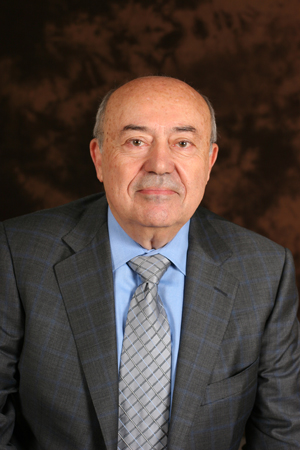
Irwin Jacobs
Co-founders of Qualcomm and earlier of Linkabit
Where to hear and read about Irwin Jacobs1 episode or test

Irwin Jacobs was a Claude Shannon-trained information theorist who co-founded Linkabit and then Qualcomm, where he bet the company on CDMA, a wireless technology most of the industry thought could not run in real time. The lesson from Jacobs is how to make an 'impossible' technical bet survivable: patent early, fund the wait with cash-generating side work, build every missing piece of the ecosystem yourself, then shed everything except the highest-value layers.
you give it one or two more turns of the crank on Moore's law here and I think we could maybe do this
Qualcomm
Irwin Jacobs: the story and the lessons
1Irwin Jacobs's path from hotel school to Shannon's lab
A guidance counselor steered the math student Jacobs into hotel school. Jacobs grew up in New Bedford, where his father ran the Boston Beef Market restaurant, and a counselor told him math and science had no future there and sent him to Cornell's hotel management school.
He asked the dean to move him to electrical engineering; the dean first assumed he had it backwards.
Jacobs credited that detour with teaching him business. He later said his year and a half of accounting and real-world business helped him leave academia and start Linkabit and Qualcomm.
He learned channel limits directly from Claude Shannon. Jacobs finished his MIT PhD in 3 years under Shannon and co-wrote the first digital communications textbook.
Shannon's work defines the theoretical ceiling on what any noisy channel can carry, and Qualcomm's founders knew how to push a radio channel to that limit.
A JPL sabbatical connected him to Andrew Viterbi and San Diego. In 1964 Jacobs worked on space program satellite communications at JPL and befriended Viterbi, then was invited to start the electrical engineering department at the new UC San Diego.
He kept consulting for defense contractors, JPL and NASA while teaching.
2How Jacobs turned a consulting shell into Linkabit
Linkabit began as a way to manage professors' consulting work. Jacobs, Viterbi and UCLA professor Len Kleinrock founded it; the name was an academic joke, and Kleinrock left soon after.
Satellite work taught the team to squeeze narrow bandwidth. That constraint pushed Linkabit toward spread spectrum, and it hired professors and grad students from the best information theory and wireless minds.
Jacobs left academia for good in 1971. He took a sabbatical to organize the company and never returned to UCSD, as Linkabit moved from subcontracting to bidding its own work.
Linkabit could never become a prime defense contractor, which capture most of the money, so it needed commercial customers.
Walmart's satellite network was Linkabit's first commercial job. Walmart spent tens of millions of dollars in the late 70s and early 80s on a private satellite relay for store data and Sam Walton's Saturday meetings.
A pay TV scrambler led to a $25 million sale. HBO and other pay channels adopted Linkabit's scrambling, and Macom bought the company in 1980 when it had over 1,000 employees.
The Linkabit leaders left Macom in 1985 after a leadership change, rich and independent.
3How Jacobs bootstrapped Qualcomm while waiting for CDMA
Seven Linkabit engineers founded Qualcomm at Jacobs's house in July 1985. They wanted to bring cellular into the digital era but knew they could not enter it yet. The name is short for Quality Communications.
Consulting paid the bills, and a consulting job produced CDMA. Work on a Hughes FCC proposal for a mobile satellite network led the team to apply spread spectrum to shared channels, inventing code division multiple access.
Jacobs sold trucking customers a full solution, not technology. Customers did not want to run their own dispatch and messaging, so Jacobs offered to operate the whole Omnitracs system for them.
That meant high costs of goods rather than software-like revenue, but it made the business work. Walmart and Schneider Trucking were early customers.
He gave up half the company to fund the cash engine. The 1988 merger with Omnet raised $3.5 million and diluted Qualcomm's owners by about 50%; Omnitracs made $32 million in 1989 and roughly doubled yearly for five years.
Some people were bitter, but the cash flow let Qualcomm borrow and raise equity for the CDMA plan.
4Jacobs's bet that Moore's Law would make CDMA real
CDMA lets every caller share spectrum at once, sorted by code. Each call carries a unique code and the receiver pulls out only the one it expects, fitting 3 to 5 times more subscribers than rival approaches.
Because the receiver knows what it is listening for, phones do not need high power.
Others knew the idea but did not believe it could run. Voice had to be digitized, coded and relayed with no perceptible delay, and handsets had to do the processing, which seemed absurd in 1986.
Qualcomm patented the method years before entering cellular. It filed in 1986 (US 4,991,307), betting one or two more turns of Moore's Law would make it feasible.
That patent became one of the most valuable in history.
The team patented every unproven piece too. Solutions to problems like the near-far problem, where a nearby phone drowns out a distant one, required real-time power control and GPS, which barely existed.
Hundreds or thousands of later patents sit behind the first one.
The plan had many miracles, but the team was sure of each step. Six or seven 'and then a miracle happens' steps would normally be an automatic pass for an investor.
5How Jacobs sold CDMA against the industry standard
Jacobs checked the rules in Washington before taking on TDMA. Jacobs and Viterbi confirmed carriers could use any technology that met the performance spec, because US standards were recommended, not mandated as in Europe.
The September 1988 spec was set so high that even the best TDMA could not meet it.
The pitch was unit economics, not technical elegance. CDMA offered better voice and security, but only the cost advantage of 3 to 5 times more subscribers on the same spectrum decided carriers.
Each demo answered the last objection. Pacific Telesis put $1 million into a prototype in February 1989, shown that November in San Diego; critics called San Diego easy, so Qualcomm demoed in Manhattan in 1990 and won 9X Mobile and Ameritech.
The prototype phone looked like a mini fridge, and when its GPS had to be rebooted mid-demo, Jacobs kept talking to fill the time.
Qualcomm went to countries with no network to replace. South Korea mandated CDMA and became close to 40% of revenue.
CDMA reached 57% of US 2G and 100% in South Korea.
Experts badly underestimated the market Jacobs was chasing. McKinsey forecast 900,000 US cellular subscribers in 2000 for AT&T; the real number was 109 million.
6Building the whole stack, then keeping only chips and licensing
Carriers would not switch until every piece existed. Qualcomm formed 51/49 joint ventures with Nortel for base stations and Sony for handsets, and made its own silicon, to answer yes to every carrier question.
Revenue went from $383 million in 1995 to $814 million in 1996.
Public markets funded the push before official approval. Qualcomm went public in December 1991, raising $68 million, then raised $150 million and about $500 million more; US bodies adopted CDMA as a second standard only in 1993.
By then half the industry had already signed, so Qualcomm saw the approval as hardly mattering.
Going fabless kept the valuable part and skipped the commodity. Foundries had only just become viable around 1989 to 1991, letting Qualcomm own IP and chip design while outsourcing manufacturing.
Ten years earlier it would have needed a partner with fabs such as Intel or Texas Instruments.
In 1999 Qualcomm shed hardware once the standard had momentum. It sold base stations to Ericsson in March as part of a lawsuit settlement and handsets to Kyocera in December, keeping QCT chips and QTL licensing.
The stock, flat until January 1999 because the ventures tied up capital, rose about 26-fold in 2000. About 1,000 employees who moved to Ericsson lost options and sued.
7The patent playbook Qualcomm ran for decades
Qualcomm created its own competitors so CDMA felt safe. No carrier would depend on one vendor, so Qualcomm helped rivals become good enough while keeping secrets about top performance.
Patent the essentials, keep the know-how secret. With about 177,000 patents, enough is patented that no one can build the systems without paying, while trade secrets are sold as services.
Licensing scales with the customer's own prices. Royalties run about 5% of a phone's price, and licensing earns a 69% margin against 34% for chips.
Each wireless generation renews the patent pot. The core CDMA patents expired, but in 2005 Qualcomm bought Flarion for $600 million to hold patents for 4G OFDMA.
Missing the 2G window would have left too little time to catch 3G a decade later.
8What happened after Irwin Jacobs retired
Jacobs retired in 2005 and his son Paul became CEO. Paul Jacobs, an electrical engineer who rose through the company, pushed early into IoT and systems on a chip that became Snapdragon.
Straying from the core repeatedly failed. In 2012 Paul Jacobs spent about $2 billion on a fab for the Mirasol reflective display, which never had a customer.
Qualcomm has also failed in servers, watches and smart home.
Squeezing customers cost Qualcomm its biggest ones. Qualcomm sought about $7.50 per iPhone in licenses plus a $1 billion penalty for using another modem; Apple sued, settled in 2019 for about $4.5 billion, and began building its own modems.
The lesson drawn: make as much money as you can 'without pissing people off too much.'
Paul Jacobs left the board in 2018. He was removed after trying to take the company private.

Qualcomm
Qualcomm shows how a team of top information theorists bootstrapped with contract work, patented a technology everyone thought impossible, and then built the whole ecosystem around it until it owned the most valuable layers. The decision that makes it worth hearing is betting on CDMA and Moore's Law against the industry standard, then shedding everything except chips and licensing.
A guidance counselor steered the math student Jacobs into hotel school. Jacobs grew up in New Bedford, where his father ran the Boston Beef Market restaurant, and a counselor told him math and science had no future there and sent him to Cornell's hotel management school.
He asked the dean to move him to electrical engineering; the dean first assumed he had it backwards.
Jacobs credited that detour with teaching him business. He later said his year and a half of accounting and real-world business helped him leave academia and start Linkabit and Qualcomm.
He learned channel limits directly from Claude Shannon. Jacobs finished his MIT PhD in 3 years under Shannon and co-wrote the first digital communications textbook.
Shannon's work defines the theoretical ceiling on what any noisy channel can carry, and Qualcomm's founders knew how to push a radio channel to that limit.
A JPL sabbatical connected him to Andrew Viterbi and San Diego. In 1964 Jacobs worked on space program satellite communications at JPL and befriended Viterbi, then was invited to start the electrical engineering department at the new UC San Diego.
He kept consulting for defense contractors, JPL and NASA while teaching.
Linkabit began as a way to manage professors' consulting work. Jacobs, Viterbi and UCLA professor Len Kleinrock founded it; the name was an academic joke, and Kleinrock left soon after.
Satellite work taught the team to squeeze narrow bandwidth. That constraint pushed Linkabit toward spread spectrum, and it hired professors and grad students from the best information theory and wireless minds.
Jacobs left academia for good in 1971. He took a sabbatical to organize the company and never returned to UCSD, as Linkabit moved from subcontracting to bidding its own work.
Linkabit could never become a prime defense contractor, which capture most of the money, so it needed commercial customers.
Walmart's satellite network was Linkabit's first commercial job. Walmart spent tens of millions of dollars in the late 70s and early 80s on a private satellite relay for store data and Sam Walton's Saturday meetings.
A pay TV scrambler led to a $25 million sale. HBO and other pay channels adopted Linkabit's scrambling, and Macom bought the company in 1980 when it had over 1,000 employees.
The Linkabit leaders left Macom in 1985 after a leadership change, rich and independent.
Seven Linkabit engineers founded Qualcomm at Jacobs's house in July 1985. They wanted to bring cellular into the digital era but knew they could not enter it yet. The name is short for Quality Communications.
Consulting paid the bills, and a consulting job produced CDMA. Work on a Hughes FCC proposal for a mobile satellite network led the team to apply spread spectrum to shared channels, inventing code division multiple access.
Jacobs sold trucking customers a full solution, not technology. Customers did not want to run their own dispatch and messaging, so Jacobs offered to operate the whole Omnitracs system for them.
That meant high costs of goods rather than software-like revenue, but it made the business work. Walmart and Schneider Trucking were early customers.
He gave up half the company to fund the cash engine. The 1988 merger with Omnet raised $3.5 million and diluted Qualcomm's owners by about 50%; Omnitracs made $32 million in 1989 and roughly doubled yearly for five years.
Some people were bitter, but the cash flow let Qualcomm borrow and raise equity for the CDMA plan.
CDMA lets every caller share spectrum at once, sorted by code. Each call carries a unique code and the receiver pulls out only the one it expects, fitting 3 to 5 times more subscribers than rival approaches.
Because the receiver knows what it is listening for, phones do not need high power.
Others knew the idea but did not believe it could run. Voice had to be digitized, coded and relayed with no perceptible delay, and handsets had to do the processing, which seemed absurd in 1986.
Qualcomm patented the method years before entering cellular. It filed in 1986 (US 4,991,307), betting one or two more turns of Moore's Law would make it feasible.
That patent became one of the most valuable in history.
The team patented every unproven piece too. Solutions to problems like the near-far problem, where a nearby phone drowns out a distant one, required real-time power control and GPS, which barely existed.
Hundreds or thousands of later patents sit behind the first one.
The plan had many miracles, but the team was sure of each step. Six or seven 'and then a miracle happens' steps would normally be an automatic pass for an investor.
Jacobs checked the rules in Washington before taking on TDMA. Jacobs and Viterbi confirmed carriers could use any technology that met the performance spec, because US standards were recommended, not mandated as in Europe.
The September 1988 spec was set so high that even the best TDMA could not meet it.
The pitch was unit economics, not technical elegance. CDMA offered better voice and security, but only the cost advantage of 3 to 5 times more subscribers on the same spectrum decided carriers.
Each demo answered the last objection. Pacific Telesis put $1 million into a prototype in February 1989, shown that November in San Diego; critics called San Diego easy, so Qualcomm demoed in Manhattan in 1990 and won 9X Mobile and Ameritech.
The prototype phone looked like a mini fridge, and when its GPS had to be rebooted mid-demo, Jacobs kept talking to fill the time.
Qualcomm went to countries with no network to replace. South Korea mandated CDMA and became close to 40% of revenue.
CDMA reached 57% of US 2G and 100% in South Korea.
Experts badly underestimated the market Jacobs was chasing. McKinsey forecast 900,000 US cellular subscribers in 2000 for AT&T; the real number was 109 million.
Carriers would not switch until every piece existed. Qualcomm formed 51/49 joint ventures with Nortel for base stations and Sony for handsets, and made its own silicon, to answer yes to every carrier question.
Revenue went from $383 million in 1995 to $814 million in 1996.
Public markets funded the push before official approval. Qualcomm went public in December 1991, raising $68 million, then raised $150 million and about $500 million more; US bodies adopted CDMA as a second standard only in 1993.
By then half the industry had already signed, so Qualcomm saw the approval as hardly mattering.
Going fabless kept the valuable part and skipped the commodity. Foundries had only just become viable around 1989 to 1991, letting Qualcomm own IP and chip design while outsourcing manufacturing.
Ten years earlier it would have needed a partner with fabs such as Intel or Texas Instruments.
In 1999 Qualcomm shed hardware once the standard had momentum. It sold base stations to Ericsson in March as part of a lawsuit settlement and handsets to Kyocera in December, keeping QCT chips and QTL licensing.
The stock, flat until January 1999 because the ventures tied up capital, rose about 26-fold in 2000. About 1,000 employees who moved to Ericsson lost options and sued.
Qualcomm created its own competitors so CDMA felt safe. No carrier would depend on one vendor, so Qualcomm helped rivals become good enough while keeping secrets about top performance.
Patent the essentials, keep the know-how secret. With about 177,000 patents, enough is patented that no one can build the systems without paying, while trade secrets are sold as services.
Licensing scales with the customer's own prices. Royalties run about 5% of a phone's price, and licensing earns a 69% margin against 34% for chips.
Each wireless generation renews the patent pot. The core CDMA patents expired, but in 2005 Qualcomm bought Flarion for $600 million to hold patents for 4G OFDMA.
Missing the 2G window would have left too little time to catch 3G a decade later.
Jacobs retired in 2005 and his son Paul became CEO. Paul Jacobs, an electrical engineer who rose through the company, pushed early into IoT and systems on a chip that became Snapdragon.
Straying from the core repeatedly failed. In 2012 Paul Jacobs spent about $2 billion on a fab for the Mirasol reflective display, which never had a customer.
Qualcomm has also failed in servers, watches and smart home.
Squeezing customers cost Qualcomm its biggest ones. Qualcomm sought about $7.50 per iPhone in licenses plus a $1 billion penalty for using another modem; Apple sued, settled in 2019 for about $4.5 billion, and began building its own modems.
The lesson drawn: make as much money as you can 'without pissing people off too much.'
Paul Jacobs left the board in 2018. He was removed after trying to take the company private.
 Qualcomm