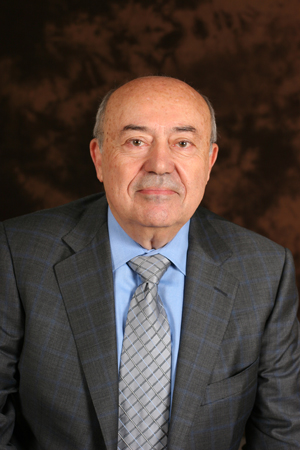
Andrew Viterbi
Co-founders of Qualcomm and earlier of Linkabit
Where to hear and read about Andrew Viterbi1 episode or test

Andrew Viterbi is an information theorist and Italian Jewish immigrant who co-founded Linkabit and then Qualcomm with Irwin Jacobs, building the company that patented CDMA before the industry believed it could run. The lesson from his story is how a team of deep technical experts paid its way with contract work, checked that the rules left room for their bet, then built a whole ecosystem until it owned the most valuable layers.
Andrew Viterbi: the story and the lessons
1How Andrew Viterbi and Irwin Jacobs found each other
Viterbi met Irwin Jacobs at JPL during a 1964 sabbatical. Jacobs came to the Jet Propulsion Laboratory to work on satellite communications for the space program and became friends with Viterbi there.
Jacobs then went on to start the electrical engineering department at the new UC San Diego, and the two kept consulting for defense contractors, JPL and NASA.
Viterbi's partner was trained at the source of information theory. Jacobs finished his MIT PhD in 3 years under Claude Shannon and co-wrote the first digital communications textbook.
That grounding meant the founding team knew how to push a radio channel to its theoretical limit, the ceiling Shannon defined for any noisy medium.
2Linkabit: Viterbi's first company
Linkabit started as a shell to manage professors' consulting work. Viterbi, Jacobs and UCLA professor Len Kleinrock founded it, and the name was an academic joke.
Kleinrock left soon after and helped found the internet. In 1971 Jacobs took a sabbatical to organize the company and never returned to UCSD.
Narrow satellite bandwidth pushed Linkabit toward spread spectrum. Squeezing the most out of very narrow satellite channels led the team to the frequency hopping idea Hedy Lamarr and George Antheil patented in 1942.
Linkabit hired professors and grad students from the best information theory and wireless minds.
Linkabit moved toward commercial work because it could never be a prime contractor. Prime defense contractors capture most of the money, so Linkabit took on commercial customers, starting with Walmart's private satellite network.
Walmart needed the network for daily store data and to broadcast Sam Walton's Saturday meetings.
A pay TV scrambling system led to a $25 million sale. HBO and other pay channels adopted Linkabit's scrambling, which beat the cable industry's security by obscurity. Macom bought Linkabit in 1980, when it had over 1,000 employees.
The Linkabit leaders left Macom in 1985 after a leadership change.
3Founding Qualcomm and paying for the wait
Seven Linkabit engineers founded Qualcomm in July 1985. They met at Jacobs's house, and the name is short for Quality Communications. They wanted to bring cellular into the digital era but knew they could not enter it yet.
First-generation cellular was analog car phones costing thousands of dollars, with a tower serving only about 100 phones.
Viterbi and Jacobs bootstrapped with consulting, as at Linkabit. A consulting job helping Hughes propose a mobile satellite network to the FCC is where Qualcomm invented CDMA.
The founders gave up half the company to fund a cash business. In 1988 Qualcomm merged with trucking customer Omnet for $3.5 million, diluting owners about 50%, and launched Omnitracs, which made $32 million in 1989 and roughly doubled yearly for five years.
Jacobs chose to operate the whole system rather than sell technology, since most customers did not want to run it themselves. Some were bitter about the dilution, but the cash flow financed the CDMA bet.
4How Viterbi and Jacobs bet Qualcomm on CDMA
They patented CDMA before anyone believed it could run. Qualcomm filed US patent 4,991,307 in 1986, betting that one or two more turns of Moore's Law would make real-time processing in handsets possible.
Others knew the idea but did not think it workable, so no one else patented it.
Viterbi and Jacobs went to Washington to check the rules first. They confirmed that US carriers could use any technology meeting the 1988 performance spec, unlike Europe's mandated standard.
That gap let Qualcomm pitch carriers one by one against the TDMA front runner backed by Ericsson.
The pitch rested on unit economics, not technical elegance. CDMA let a carrier fit 3 to 5 times more subscribers on the same spectrum and infrastructure.
CDMA also offered better voice quality and security, but only the cost advantage decided carriers.
Demos in San Diego and then Manhattan turned skeptics into customers. Pacific Telesis funded a $1 million prototype in 1989, and after critics called San Diego too easy, a 1990 New York demo won 9X Mobile and Ameritech.
The prototype phone looked like a mini fridge with a handset, and during the first demo the GPS had to be rebooted while Jacobs kept talking.
Clean-slate countries like South Korea became anchor markets. South Korea mandated CDMA and became close to 40% of Qualcomm revenue for a time. CDMA took 57% of US 2G.
5Building the whole stack, then keeping the valuable part
Qualcomm supplied every piece so carriers could say yes. It formed joint ventures with Nortel for base stations and Sony for handsets, and made its own silicon, funded by a December 1991 IPO and later raises of $150 million and about $500 million.
Official US adoption of CDMA came in 1993, after half the industry had already signed.
Fabless design kept the IP and chips while skipping commodity manufacturing. Foundries had only just become viable, and Qualcomm became the largest fabless chip company; chips now bring in $37 billion of $44 billion in revenue.
Shedding hardware in 1999 unlocked the stock. Qualcomm sold base stations to Ericsson and handsets to Kyocera, keeping chips and licensing, and the stock rose 26-fold in 2000.
Licensing earns a 69% margin against 34% for chips.
6The playbook and its limits after the founders
Qualcomm created credible rivals while keeping its best know-how secret. No carrier would depend on one vendor, so Qualcomm helped others become good enough while holding trade secrets and about 177,000 patents.
Each wireless generation renews the patent moat. Generations arrive within patent lifetimes, and the $600 million Flarion purchase in 2005 secured 4G patents after Jacobs's son Paul became CEO.
Overreaching on royalties and straying from the core proved costly. Squeezing Apple pushed it to build its own modems, and a $2 billion Mirasol display fab in 2012 never had a customer.

Qualcomm
Qualcomm shows how a team of top information theorists bootstrapped with contract work, patented a technology everyone thought impossible, and then built the whole ecosystem around it until it owned the most valuable layers. The decision that makes it worth hearing is betting on CDMA and Moore's Law against the industry standard, then shedding everything except chips and licensing.
Viterbi met Irwin Jacobs at JPL during a 1964 sabbatical. Jacobs came to the Jet Propulsion Laboratory to work on satellite communications for the space program and became friends with Viterbi there.
Jacobs then went on to start the electrical engineering department at the new UC San Diego, and the two kept consulting for defense contractors, JPL and NASA.
Viterbi's partner was trained at the source of information theory. Jacobs finished his MIT PhD in 3 years under Claude Shannon and co-wrote the first digital communications textbook.
That grounding meant the founding team knew how to push a radio channel to its theoretical limit, the ceiling Shannon defined for any noisy medium.
Linkabit started as a shell to manage professors' consulting work. Viterbi, Jacobs and UCLA professor Len Kleinrock founded it, and the name was an academic joke.
Kleinrock left soon after and helped found the internet. In 1971 Jacobs took a sabbatical to organize the company and never returned to UCSD.
Narrow satellite bandwidth pushed Linkabit toward spread spectrum. Squeezing the most out of very narrow satellite channels led the team to the frequency hopping idea Hedy Lamarr and George Antheil patented in 1942.
Linkabit hired professors and grad students from the best information theory and wireless minds.
Linkabit moved toward commercial work because it could never be a prime contractor. Prime defense contractors capture most of the money, so Linkabit took on commercial customers, starting with Walmart's private satellite network.
Walmart needed the network for daily store data and to broadcast Sam Walton's Saturday meetings.
A pay TV scrambling system led to a $25 million sale. HBO and other pay channels adopted Linkabit's scrambling, which beat the cable industry's security by obscurity. Macom bought Linkabit in 1980, when it had over 1,000 employees.
The Linkabit leaders left Macom in 1985 after a leadership change.
Seven Linkabit engineers founded Qualcomm in July 1985. They met at Jacobs's house, and the name is short for Quality Communications. They wanted to bring cellular into the digital era but knew they could not enter it yet.
First-generation cellular was analog car phones costing thousands of dollars, with a tower serving only about 100 phones.
Viterbi and Jacobs bootstrapped with consulting, as at Linkabit. A consulting job helping Hughes propose a mobile satellite network to the FCC is where Qualcomm invented CDMA.
The founders gave up half the company to fund a cash business. In 1988 Qualcomm merged with trucking customer Omnet for $3.5 million, diluting owners about 50%, and launched Omnitracs, which made $32 million in 1989 and roughly doubled yearly for five years.
Jacobs chose to operate the whole system rather than sell technology, since most customers did not want to run it themselves. Some were bitter about the dilution, but the cash flow financed the CDMA bet.
They patented CDMA before anyone believed it could run. Qualcomm filed US patent 4,991,307 in 1986, betting that one or two more turns of Moore's Law would make real-time processing in handsets possible.
Others knew the idea but did not think it workable, so no one else patented it.
Viterbi and Jacobs went to Washington to check the rules first. They confirmed that US carriers could use any technology meeting the 1988 performance spec, unlike Europe's mandated standard.
That gap let Qualcomm pitch carriers one by one against the TDMA front runner backed by Ericsson.
The pitch rested on unit economics, not technical elegance. CDMA let a carrier fit 3 to 5 times more subscribers on the same spectrum and infrastructure.
CDMA also offered better voice quality and security, but only the cost advantage decided carriers.
Demos in San Diego and then Manhattan turned skeptics into customers. Pacific Telesis funded a $1 million prototype in 1989, and after critics called San Diego too easy, a 1990 New York demo won 9X Mobile and Ameritech.
The prototype phone looked like a mini fridge with a handset, and during the first demo the GPS had to be rebooted while Jacobs kept talking.
Clean-slate countries like South Korea became anchor markets. South Korea mandated CDMA and became close to 40% of Qualcomm revenue for a time. CDMA took 57% of US 2G.
Qualcomm supplied every piece so carriers could say yes. It formed joint ventures with Nortel for base stations and Sony for handsets, and made its own silicon, funded by a December 1991 IPO and later raises of $150 million and about $500 million.
Official US adoption of CDMA came in 1993, after half the industry had already signed.
Fabless design kept the IP and chips while skipping commodity manufacturing. Foundries had only just become viable, and Qualcomm became the largest fabless chip company; chips now bring in $37 billion of $44 billion in revenue.
Shedding hardware in 1999 unlocked the stock. Qualcomm sold base stations to Ericsson and handsets to Kyocera, keeping chips and licensing, and the stock rose 26-fold in 2000.
Licensing earns a 69% margin against 34% for chips.
Qualcomm created credible rivals while keeping its best know-how secret. No carrier would depend on one vendor, so Qualcomm helped others become good enough while holding trade secrets and about 177,000 patents.
Each wireless generation renews the patent moat. Generations arrive within patent lifetimes, and the $600 million Flarion purchase in 2005 secured 4G patents after Jacobs's son Paul became CEO.
Overreaching on royalties and straying from the core proved costly. Squeezing Apple pushed it to build its own modems, and a $2 billion Mirasol display fab in 2012 never had a customer.
 Qualcomm