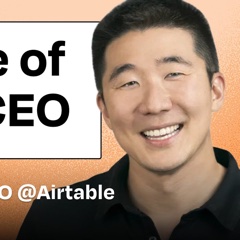
Howie Liu
Co-founder and CEO of Airtable
Where to hear and read about Howie Liu1 episode or test

Howie Liu co-founded Airtable and has run it for about 13 years, and he is now rebuilding the company around AI while working as a hands-on CEO. The lesson most worth taking is that AI can only be judged by using it, so leaders and teams have to work in the details and ship to learn.
it's actually now also hard to taste the soup without participating in like at least some part of creating the soup
How we restructured Airtable's entire org for AI | Howie Liu (co-founder and CEO)
Howie Liu: the story and the lessons
1Howie Liu's path and the Airtable reset
Liu built Airtable's first back end and front end himself. He co-founded Airtable and has run it about 13 years. It is a no-code app platform valued at around $12 billion.
He wrote both the real-time back end and the front end UX at the start. Airtable is a platform for building apps, so he says tech and product can't be separated.
Liu learned UX by building, starting with a Yelp-style map app. He taught himself through trial and error, including an app whose list updates as you pan the map. In 2008 to 2010, building JavaScript single page apps was a dark art with few tutorials.
His family was financially modest, but he still had a computer, the internet and free learning resources.
A viral "Airtable is dead" tweet used badly wrong numbers. The tweet's revenue and growth figures were wrong by a large multiple. Its author worked at CB Insights, and the All-In podcast gave the claim reach.
All-In issued a correction a few weeks later, after the story had spread. Airtable's AI overhaul came with over $100 million in free cash flow.
Two earlier reorgs left Airtable too slow for the AI era. First came feature groups such as search and mobile, then business-unit pillars for enterprise, teams, AI, solutions and infrastructure. Feature groups made teams improve their own piece incrementally instead of pursuing a mission.
The business-unit pillars allowed holistic bets, but Liu still measured them against Cursor, which ships major changes weekly as one cohesive product.
2How Howie Liu rebuilt Airtable around AI
Liu treats every new model as a new product form. Early models only supported autocomplete, like GitHub Copilot. Smarter ones enabled agentic tools like Cursor, and now whole apps from a prompt, so product market fit has to be refound repeatedly.
He calls AI a bigger shift than desktop to mobile or on-prem to cloud, because those were one-time, fairly predictable form factor changes.
Liu asks how he would found the company today, AI native. The test is to pursue the same mission from scratch with an AI-native approach, then check whether existing assets beat that. If they can't, he says to find a buyer and start the next version.
Airtable concluded its no-code components give an agent a more reliable building kit than generating every app from raw code.
Liu has the agent assemble Airtable's building blocks instead of writing code. The agent assembles a real-time data layer, views, a layout engine and automations, like a domain-specific language. Writing every line risks bugs, data and security problems, and context collapse as the app grows.
A non-technical user can fall back to the GUI to inspect and adjust the result, unlike opaque code from v0, Lovable or Replit. Airtable targets business apps like a CRM or a lawyer's case manager, not viral consumer games.
Liu split the org into a fast team and a slow team. The AI platform group ships new capabilities nearly every week, each meant to be jaw-dropping. The slow group builds deliberate bets like HyperDB, which handles data sets of several hundred million records.
Fast shipping fills the top of the funnel, and the slow work lets those first adopters grow into large deployments. Half of product and engineering now works on AI.
Liu made the agent the default way to use Airtable. The app is now an artifact the agent manipulates with tools, and the homepage opens with "tell me what you want to build".
He argues most AI capabilities are under-merchandised and a blank chat box shows users little. He wants colors and visual metaphors to show the model's states and options.
Liu prefers open trials to sales demos for AI products. ChatGPT's frictionless try-it-yourself access took it to about 700 million weekly users in under three years.
Sales-led AI products like Palantir and Harvey also succeed, but he says experience is more powerful. He wants to shift Airtable back toward builder-led, product-led adoption while keeping sales important.
Liu starts new AI features with vibes and adds evals later. For a new form factor, he throws varied prompts at it to see where it works at all. A web-crawler agent that compiles lists of entities turned out to work best on people and companies.
Evals need a fixed definition of good, so they fit once use cases are clear. Used too early, they constrain discovery.
3How Howie Liu works as an IC CEO
Liu is Airtable's top inference-cost user. He runs jobs that cost hundreds of dollars across a year of sales-call transcripts, extracting product, positioning and segmentation insights. A consulting firm could charge millions for the same insight.
He says more people should aggressively throw compute at very high-value problems.
Liu uses AI hourly and tries products far outside Airtable. He tried Runway's immersive world engine and Sesame's voice demo, neither core to Airtable. GPT-5 came out the day before the interview and he tested it on personal use cases.
AI moves weekly, so he says a TechCrunch write-up or a tweet won't tell you what a capability is. You have to try it.
Liu invents weekend projects to force real use of tools. One example is a short comedy video built from a ChatGPT deep research report, an AI-written script and a HeyGen avatar. Once proficient, it takes about an hour.
Such projects show the product forms a model can take, such as tool calling or agentic workflows.
Liu cut standing one-on-ones so meetings are timely. He uses a barbell: a long lunch or coffee walk every month or two, urgent topical meetings in between, and a weekly sprint check-in on AI execution.
He wants meetings informed by "real alpha", driven by something he just learned.
Liu tells staff to cancel meetings and play with AI. He says people can block a day or a week to try AI products, and can say he told them to. He means play in the psychological sense: curiosity, not box-checking.
He leads by example, sharing a Replit landing page or a deep research thread instead of a doc. Prototypes beat decks because they show whether a feature feels too slow or needs a progress bar.
Liu asks why behind advice instead of copying the recommendation. He says everyone is like their own LLM trained on a different corpus, such as ServiceNow, Oracle, Facebook or Airtable. He wants the chain of thought behind a decision, not just the answer.
He applied this to Brian Chesky's argument that the CEO must play the CPO role, and to Airbnb dropping the traditional PM role.
Liu's advice to his younger self is to keep the details he loves. He felt most cut off from the company's substance when he forced himself away from details to act like an at-scale CEO.
He says the best product-centric companies are run by people who love the product. Even a Procter & Gamble CEO should still taste the soup.
4Howie Liu's approach to teams and roles
Liu wants PMs, designers and engineers decent at all three roles. Each role needs a minimum baseline in the other two, then can go deep in one. A designer who understands tool calling can prototype instead of making static designs.
He points to Google's original PM spec, Apple designers and Stripe engineers as earlier multidisciplinary examples.
Liu pushes the same role collapse into sales and marketing. One marketer should handle ad setup, copy and creative. Account executives need sales-engineer fluency so they can demo the product themselves.
He describes an upside-down T: one strong skill plus a rising baseline in adjacent roles.
Liu hires autonomous full-stack thinkers for the fast team. Airtable hired through two layoffs and has done acqui-hires. Candidates don't need to be former founders.
The right person relishes open-ended design questions, such as what models can one-shot and where a human approval step is needed.
Liu says standard scaling advice costs the big-picture bets. Industrializing into swim lanes, with execs each running a lane, loses the integrated view of technical, design, pricing and go-to-market decisions. He compares it to moving from bespoke clothing to factory production.
He says the factory model does scale a single goal, such as improving search, but refinding product market fit takes a CEO acting as chief product officer.
Liu treats engineering and design as learnable skills. He says anyone can reach good-enough software engineering, and growth mindset is a core value at Airtable. AI tutors and tools like Cursor remove most of the friction.
He asks ChatGPT how it would build an open-ended agent like Manus, calling it a patient expert available 24/7. His view: the only thing stopping you is going out and doing it.

How we restructured Airtable's entire org for AI | Howie Liu (co-founder and CEO)
Howie Liu explains how Airtable reorganized around AI: a fast thinking team that ships weekly and a slow thinking team for deep infrastructure, with the CEO working as an individual contributor. Airtable reached over $100 million in free cash flow while rebuilding its product around an agent-first experience.
Liu built Airtable's first back end and front end himself. He co-founded Airtable and has run it about 13 years. It is a no-code app platform valued at around $12 billion.
He wrote both the real-time back end and the front end UX at the start. Airtable is a platform for building apps, so he says tech and product can't be separated.
Liu learned UX by building, starting with a Yelp-style map app. He taught himself through trial and error, including an app whose list updates as you pan the map. In 2008 to 2010, building JavaScript single page apps was a dark art with few tutorials.
His family was financially modest, but he still had a computer, the internet and free learning resources.
A viral "Airtable is dead" tweet used badly wrong numbers. The tweet's revenue and growth figures were wrong by a large multiple. Its author worked at CB Insights, and the All-In podcast gave the claim reach.
All-In issued a correction a few weeks later, after the story had spread. Airtable's AI overhaul came with over $100 million in free cash flow.
Two earlier reorgs left Airtable too slow for the AI era. First came feature groups such as search and mobile, then business-unit pillars for enterprise, teams, AI, solutions and infrastructure. Feature groups made teams improve their own piece incrementally instead of pursuing a mission.
The business-unit pillars allowed holistic bets, but Liu still measured them against Cursor, which ships major changes weekly as one cohesive product.
Liu treats every new model as a new product form. Early models only supported autocomplete, like GitHub Copilot. Smarter ones enabled agentic tools like Cursor, and now whole apps from a prompt, so product market fit has to be refound repeatedly.
He calls AI a bigger shift than desktop to mobile or on-prem to cloud, because those were one-time, fairly predictable form factor changes.
Liu asks how he would found the company today, AI native. The test is to pursue the same mission from scratch with an AI-native approach, then check whether existing assets beat that. If they can't, he says to find a buyer and start the next version.
Airtable concluded its no-code components give an agent a more reliable building kit than generating every app from raw code.
Liu has the agent assemble Airtable's building blocks instead of writing code. The agent assembles a real-time data layer, views, a layout engine and automations, like a domain-specific language. Writing every line risks bugs, data and security problems, and context collapse as the app grows.
A non-technical user can fall back to the GUI to inspect and adjust the result, unlike opaque code from v0, Lovable or Replit. Airtable targets business apps like a CRM or a lawyer's case manager, not viral consumer games.
Liu split the org into a fast team and a slow team. The AI platform group ships new capabilities nearly every week, each meant to be jaw-dropping. The slow group builds deliberate bets like HyperDB, which handles data sets of several hundred million records.
Fast shipping fills the top of the funnel, and the slow work lets those first adopters grow into large deployments. Half of product and engineering now works on AI.
Liu made the agent the default way to use Airtable. The app is now an artifact the agent manipulates with tools, and the homepage opens with "tell me what you want to build".
He argues most AI capabilities are under-merchandised and a blank chat box shows users little. He wants colors and visual metaphors to show the model's states and options.
Liu prefers open trials to sales demos for AI products. ChatGPT's frictionless try-it-yourself access took it to about 700 million weekly users in under three years.
Sales-led AI products like Palantir and Harvey also succeed, but he says experience is more powerful. He wants to shift Airtable back toward builder-led, product-led adoption while keeping sales important.
Liu starts new AI features with vibes and adds evals later. For a new form factor, he throws varied prompts at it to see where it works at all. A web-crawler agent that compiles lists of entities turned out to work best on people and companies.
Evals need a fixed definition of good, so they fit once use cases are clear. Used too early, they constrain discovery.
Liu is Airtable's top inference-cost user. He runs jobs that cost hundreds of dollars across a year of sales-call transcripts, extracting product, positioning and segmentation insights. A consulting firm could charge millions for the same insight.
He says more people should aggressively throw compute at very high-value problems.
Liu uses AI hourly and tries products far outside Airtable. He tried Runway's immersive world engine and Sesame's voice demo, neither core to Airtable. GPT-5 came out the day before the interview and he tested it on personal use cases.
AI moves weekly, so he says a TechCrunch write-up or a tweet won't tell you what a capability is. You have to try it.
Liu invents weekend projects to force real use of tools. One example is a short comedy video built from a ChatGPT deep research report, an AI-written script and a HeyGen avatar. Once proficient, it takes about an hour.
Such projects show the product forms a model can take, such as tool calling or agentic workflows.
Liu cut standing one-on-ones so meetings are timely. He uses a barbell: a long lunch or coffee walk every month or two, urgent topical meetings in between, and a weekly sprint check-in on AI execution.
He wants meetings informed by "real alpha", driven by something he just learned.
Liu tells staff to cancel meetings and play with AI. He says people can block a day or a week to try AI products, and can say he told them to. He means play in the psychological sense: curiosity, not box-checking.
He leads by example, sharing a Replit landing page or a deep research thread instead of a doc. Prototypes beat decks because they show whether a feature feels too slow or needs a progress bar.
Liu asks why behind advice instead of copying the recommendation. He says everyone is like their own LLM trained on a different corpus, such as ServiceNow, Oracle, Facebook or Airtable. He wants the chain of thought behind a decision, not just the answer.
He applied this to Brian Chesky's argument that the CEO must play the CPO role, and to Airbnb dropping the traditional PM role.
Liu's advice to his younger self is to keep the details he loves. He felt most cut off from the company's substance when he forced himself away from details to act like an at-scale CEO.
He says the best product-centric companies are run by people who love the product. Even a Procter & Gamble CEO should still taste the soup.
Liu wants PMs, designers and engineers decent at all three roles. Each role needs a minimum baseline in the other two, then can go deep in one. A designer who understands tool calling can prototype instead of making static designs.
He points to Google's original PM spec, Apple designers and Stripe engineers as earlier multidisciplinary examples.
Liu pushes the same role collapse into sales and marketing. One marketer should handle ad setup, copy and creative. Account executives need sales-engineer fluency so they can demo the product themselves.
He describes an upside-down T: one strong skill plus a rising baseline in adjacent roles.
Liu hires autonomous full-stack thinkers for the fast team. Airtable hired through two layoffs and has done acqui-hires. Candidates don't need to be former founders.
The right person relishes open-ended design questions, such as what models can one-shot and where a human approval step is needed.
Liu says standard scaling advice costs the big-picture bets. Industrializing into swim lanes, with execs each running a lane, loses the integrated view of technical, design, pricing and go-to-market decisions. He compares it to moving from bespoke clothing to factory production.
He says the factory model does scale a single goal, such as improving search, but refinding product market fit takes a CEO acting as chief product officer.
Liu treats engineering and design as learnable skills. He says anyone can reach good-enough software engineering, and growth mindset is a core value at Airtable. AI tutors and tools like Cursor remove most of the friction.
He asks ChatGPT how it would build an open-ended agent like Manus, calling it a patient expert available 24/7. His view: the only thing stopping you is going out and doing it.
 Airtable