Gustav Söderström
Co-President and Chief Product and Technology Officer at Spotify
Where to hear and read about Gustav Söderström2 episodes and tests

 David SenraThe Company Apple Couldn't Kill | Spotify Co-CEO Gustav Söderström
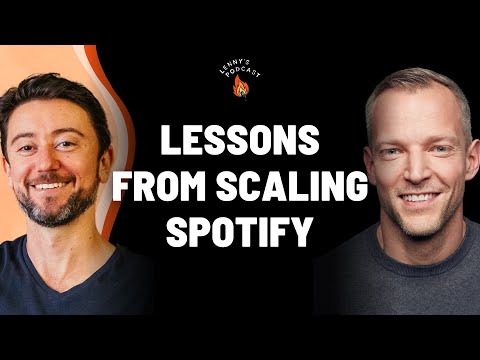
 Lenny's PodcastThe science of product, big bets, and how AI is impacting the future of music | Gustav Söderström
Gustav Söderström is Co-President and Chief Product and Technology Officer at Spotify, a two-time founder who joined in 2008 to solve mobile and now runs product and technology alongside Alex Norström. The lesson most worth taking is to pick the one thing your organization must be great at, accept being average elsewhere, and make bets that treat every big move as a hypothesis to test.
You have to believe in things 100% until the data says no. And then you believe in something else 100%.
The science of product, big bets, and how AI is impacting the future of music | Gustav Söderström
Gustav Söderström: the story and the lessons
1Gustav Söderström's path from founder to Spotify co-president
Söderström founded two startups before Spotify and worked in Yahoo Mobile. He started Kenet Works, which Yahoo acquired in 2006, and later 13th Lab, which Facebook's Oculus acquired. He was also Director of Product and Business Development for Yahoo Mobile.
Spotify hired him to solve mobile, which needed a new product and a new business model. He started in late 2008 or early 2009. Spotify had a free, on-demand desktop app, but real-time streaming did not work on mobile networks and ads could not pay for it.
He met Daniel Ek through a mutual friend after returning to Sweden from Yahoo. In 2008 a song over cellular took 20 seconds to start and then choked, and the fixes were offline sync and mobile business models.
His title stayed put while his job changed every 6 to 12 months. His scope grew from mobile to all of product, then the CTO role, then half the company. He now runs product and technology while Norström runs business and content, and he has always reported to Ek.
The company's challenge moved from Nordic to European to the US to going public. He says he stayed almost 18 years because he got a new job almost every year.
Ek prepared his successors by handing them the business for three years. Söderström and Norström ran day-to-day Spotify, including the full P&L and balance sheet, while Ek stayed CEO and gave them more rope week to week.
Only PR, government relations and being the public face were new. Ek delegated from the start, sending Söderström as a new hire to set up a deep Facebook integration with Zuckerberg.
He spent decades preparing for AI before it worked. He was drawn to AI in the late 1990s, but computers were too weak. At Spotify in 2009, Erik Bernhardsson ran collaborative filtering on one of the world's largest Hadoop clusters, which pulled him back into machine learning.
He coded his own recurrent networks, LSTMs and GRUs during vacations and nights. He read 'Attention Is All You Need' in its first days in June 2017 and told anyone who would listen.
2How Spotify beat Apple's attempt to kill it
Apple came at Spotify with a team built to beat it. Apple bought Beats Music and brought in Dr. Dre and Jimmy Iovine. Internally the message was 'We're going to kill you', and Spotify heard it had six months.
Spotify was fighting for survival while Apple Music was a side project, so Spotify could not afford to lose and Apple could.
Spotify built its strategy as deliberate opposites of Apple's habits. The three bets were freemium, personalization and ubiquity. Apple would struggle with advertising, was almost against data, and would favor its own hardware over a Samsung TV or an Android phone.
Apple's iAd wanted so much control that it failed. 'So, these were our three bets: freemium, personalization, and ubiquity.'
The bets held up, and there was no fallback. Apple pulled back its free radio tier and still struggles on non-Apple hardware. On personalization Söderström says 'I want to say we're better'.
Spotify either died or did this, which the interviewer calls burning the boats.
3Söderström's time well spent strategy
An anonymous survey showed him heavy users felt trapped. A third party asked users how they felt about their time on Spotify, YouTube, Apple Music, Amazon and TikTok. Gen Z valued almost 90% of their time on Spotify, while on many big platforms young people regretted 60% or more.
He had assumed heavy users on big platforms loved them. Asked directly, they said they felt horrible about the time spent. That moved Spotify from an internal saying to a strategy of being among the most time well spent on the internet.
Spotify only expands into categories people are glad to spend time on. Music, podcasts, audiobooks and now fitness fit. About 70% of Spotify users already work out with it, so it is investing in fitness, such as AI-built running playlists matched to pace and beat.
Podcasts looked good because they bucked the trend toward short content. Audiobooks followed because books matter to him and Sweden's strong audiobook habits gave the team conviction.
He rejects dark engagement patterns that would lift usage. Söderström says such patterns could be added today to raise usage and retention. He refuses because they would not be good for the user.
Caring about the experience is the shallow version. The deeper version is how users feel about what you do afterward.
Spotify lets anyone turn off video and accepts the engagement hit. Video podcasts are popular and good for engagement, but some parents felt the videos hurt their time well spent. Spotify let anyone switch video off and just listen.
'If you're going to have these principles, you kind of have to live with them, and they're going to have consequences.' He says principles only count if they force you to stay away from some things.
Subscription revenue makes user value the incentive. Almost 90% of Spotify's revenue comes from subscribers, who pay for the value they feel rather than for captured time. An ad model pushes toward maximum time spent at any cost.
He says Spotify may have lucked into the model or been semi-deliberate, and now doubles down. 'I think it's a luxury for us.'
4Why Söderström runs Spotify as one team and one experience
Söderström chose the pain of one super app to solve distribution. At least seven good podcast apps existed, yet Apple Podcasts held about 98.5% of usage. Spotify built podcasts inside its own app to reach what was then 300-something million users, and did the same with audiobooks.
A separate app would have let teams run in parallel. 'We chose pain and cost somewhere to get benefit somewhere else.'
He worries most about shipping the org chart. A super app that combines music, podcasts and books fails if parallel teams each build their own part. Parallel work feels good for about six months, then the experience crumbles.
Complexity would be pushed onto the user instead of fought out internally. In Spotify's autonomous era, the now playing view ended up with several toasters.
He says no org model wins, so optimize for what matters. Amazon, Apple and Elon Musk's companies are organized very differently and each reached a trillion dollars. He takes the thesis from Steven Sinofsky.
Switching models swaps one weakness for another. Spotify optimized for the single experience and accepts being average elsewhere. The worst case is excelling at the unimportant thing and failing at the important one.
Söderström models Spotify's org on Apple's functional structure. Functional orgs tend to dissolve into politics. At Yahoo the EVPs fought and hid information, and the company had four CEOs in about two and a half years.
Apple works because long-serving leaders trust each other, and Spotify copies that. Many of his reports have stayed 14 or 15 years, and the average is 7 or 8.
Spotify's leaders swim together in a three-hour weekly meeting. About 14 SVPs from every function meet for three hours every Tuesday in the E Team. It replaced 'let's take it offline'.
It costs leadership time, but if a music video feature is blocked on licensing, licensing is across the table. Everyone gets the full CEO perspective, which suits a business where licensors, contracts and product are interdependent.
5How Söderström leads, hires and sets autonomy
Long tenure buys trust and honest disagreement. Long-tenured colleagues have argued with him and learned there are no consequences. A new hire from corporate America cannot be expected to push back, because there you usually get fired.
Once he told Ek he was not good at running product. Ek first wanted to fire him, then saw he was right. Söderström admits he cannot always control himself when passionate.
He offsets the costs of tenure on purpose. The Rising Stars program takes 20 to 30 nominated people a year through markets like India, the US and Germany and an internal MBA with Norström and him. After 12 months they rise faster.
A completely new skill is bought, not grown: Spotify bought The Echo Nest in Boston to get close to MIT for deep learning. 'You have to mitigate for the problems of tenure.'
He puts autonomy at the VP level. Autonomy at the leaves produced '100 squads with 100 strategies'. Autonomy at the top bottlenecks every decision. VPs are senior, numerous and rich in pattern recognition, so each defines the strategy for their area.
Spotify moved away from squads of about seven to teams of roughly 14 per manager with fewer overhead roles. He says that if they started over, squads would not be the structure.
Centralization fits because Spotify's strategy needs one simple experience. Amazon's decentralized model is fast but ships complexity to users. Apple's central model is simple for users but slow. Spotify sits closer to Apple.
Music, podcasts and audiobooks have very different back-end deals. One recommendation organization must weigh a book against a podcast against a song for each user.
He tells people why, even when they disagree. Employees need not agree, but they are entitled to understand a decision. 'I'm more senior' is not an answer.
Explaining is also his test of whether he understands an idea. He pushes Socratic debate so the best idea wins, not the most senior one. 'You owe an explanation.'
He used a podcast to make leaders approachable and to recruit. It began as an employee-gated show interviewing Ek's direct reports, such as the CMO, CHRO and CFO. The public version had no special promotion.
Many tens of new hires say it was a key reason they joined. Making it also gave him empathy for creators trying to find listeners.
He caps planning at about 10% of the cycle. A 10-week quarter gets one week. Spotify works in six-month increments, so it spends two weeks.
The rule comes from board member Shishir Mehrotra, who used it at YouTube. Planning much longer means over-planning or an execution period too short for it.
6How Söderström builds products around AI
He bought Sonantic to intercept the AI curve instead of waiting. Spotify bought Sonantic to produce voice cheaply, before LLMs could write the script. Buying voice at market prices for 700 million users with minutes a day would bankrupt it.
'We just bet on intercepting that curve instead of waiting for it and then building for it.' He credits personal interest plus working at a company with huge datasets.
He designs the interface around how often the machine learning is right. A single big play button only works at near 100% accuracy. At one hit in five, show about five options and an easy way out, as Midjourney showed four fast low-res images because about one in four was good.
'If you don't understand the performance of your machine learning, you can't design for it.'
He matches the needed hit rate to the context. Background listening needs about nine hits in ten, because five duds make people think the playlist is broken. Breaking out of a taste bubble works at one in ten, in a feed where a miss costs a swipe.
Söderström loves reggaeton, which his EDM and metal profile would never reveal, so a reggaeton track in a metal playlist would feel like a bug.
The AI DJ works because it does as little as possible. A digitized real person speaks while AI writes the script, giving each listener a personal voice at half-a-billion scale. It avoids weather and news because people came for the music.
It solved the 'I don't know what I want' case Spotify had failed at for years. Users wondered how a person could record so many lines about their music, and that magic feeling correlates with going viral.
He treats generative AI as a new era, not more of the same. Recommendation forced a rethink of the user experience and sometimes the business model. He expects generation to be as big a shift and asks teams to think of it as completely new.
On AI music, he sees a more powerful instrument, like the workstation that gave EDM. Creators will only benefit if a new business model pays rights holders, as it did after piracy.
His mission is to give users control of the algorithm. He sees generative AI as dual use: it could be the most addictive algorithm ever or return control. Spotify tells users who its models think they are, and a listener of mostly EDM can ask for classical.
Researchers used to study about 10 users and apply it to 761 million. His aim is a conversation with each of the 761 million users.
A small active minority improves the product for everyone. Using the 1% create, 9% curate, 90% consume split, he says around 10 billion user playlists feed Spotify's personalization for those who only consume.
He expects the same with AI control, where users who correct Spotify improve results for similar users who never will. He hedges the exact numbers with 'something like that'.
He uses an agent to filter what he knows will capture him. An agent combines his documents, his Spotify listening interests and fresh news into a private podcast via Save to Spotify. He tells it to filter rage bait, clickbait and politics.
His own weakness is road rage videos, and he says he gets captured as easily as anyone. He calls this premeditated media and expects the need to grow.
7Söderström's home feed redesign and what he learned
The redesign targeted a real problem: users stuck in a taste bubble. Users love Spotify but are bored with their genre, and a new genre has no signal behind it. People usually break out on TikTok or YouTube, where skipping is cheap.
The team added discovery to home because users kept asking and discovery correlates with retention.
Flipping home from 90% recall to 90% discovery hid what users needed. The old home was about 90% recall and 10% discovery, and the test flipped it. Traffic shifted from home to search and library as users hunted for what they could no longer reach.
He compares using a discovery feed to find a workout playlist to pulling a slot machine. He says the team underestimated the old home's strength at holding several sessions at once.
He kept the goal and changed the hypothesis. The new test keeps the sub feeds for podcasts, playlists and new genres easy to find but optional, and leaves recall intact. The team runs variants plus user research to build a theory of mind.
He calls being precious about work you have invested in the biggest risk. 'You have to believe in things 100% until the data says no.'
He separates change aversion from a wrong design using new cohorts. Anger comes either from broken habits or from a bad design. New user cohorts have no old habits, so comparing them with old cohorts and reading traffic shifts tells the two apart.
He warned teams to expect painful tweets. He has done big redesigns three or four times, two successfully and one not.
A big redesign needs a big MVP or a failure tells you nothing. A new single-item feed without matching algorithms cannot show whether the idea was wrong or the machine learning was weak, which risks a false negative.
The worst pain was the internal cost of building so much before knowing if the hypothesis was right, not the outside feedback.
8How Söderström thinks about change and decisions
His rule for the AI era is to always be first. Spotify grew most in periods of change. In stable periods market share stays put, while in change it can be lost or won.
Technology waves force a new business model each time, as with streaming and then mobile. He notes extrapolating 2005 to 2015 would have missed smartphones and Uber. 'My principle is just always be first.'
He looks for new technology married to a contrarian business model. He admires the Kindle for building mobile data into the device price through fixed-cost carrier deals priced from average book size, so books updated invisibly.
'Technology is a necessary ingredient for change, but not sufficient.' Spotify's version is access over ownership.
He thinks in phases and cheap early thinking. Products pass through think it, build it, ship it, tweak it. Thinking should be cheap, and the risk of being wrong must be cut before the costly build phase.
He said it off the cuff about 12 years ago and other companies still use the phrases.
He applies three different mental models to important problems. Each model cuts the world down to three or four dimensions and may drop an important one. If a second model that reduces the world differently reaches the same conclusion, the odds of being right rise.
He recommends Hamilton Helmer's 7 Powers as a strategy framework, since having one beats having none.
He thinks through problems on a distributed walk and talk. He and a peer walk in different places, connected by AirPods, for an hour on one topic. A second mind adds brainpower.
He expected strategy work to suffer in the pandemic, but it improved. It replaced much of the writing he used to do.
The Company Apple Couldn't Kill | Spotify Co-CEO Gustav Söderström
Spotify's co-CEO explains how the company chose a single-experience org, a time well spent strategy and three bets against Apple, so it could survive an incumbent that vowed to kill it. The decisions worth hearing are choosing the pain of one super app for distribution, and making anti-engagement choices that a subscription model can afford.
Spotify hired him to solve mobile, which needed a new product and a new business model. He started in late 2008 or early 2009. Spotify had a free, on-demand desktop app, but real-time streaming did not work on mobile networks and ads could not pay for it.
He met Daniel Ek through a mutual friend after returning to Sweden from Yahoo. In 2008 a song over cellular took 20 seconds to start and then choked, and the fixes were offline sync and mobile business models.
His title stayed put while his job changed every 6 to 12 months. His scope grew from mobile to all of product, then the CTO role, then half the company. He now runs product and technology while Norström runs business and content, and he has always reported to Ek.
The company's challenge moved from Nordic to European to the US to going public. He says he stayed almost 18 years because he got a new job almost every year.
Ek prepared his successors by handing them the business for three years. Söderström and Norström ran day-to-day Spotify, including the full P&L and balance sheet, while Ek stayed CEO and gave them more rope week to week.
Only PR, government relations and being the public face were new. Ek delegated from the start, sending Söderström as a new hire to set up a deep Facebook integration with Zuckerberg.
He spent decades preparing for AI before it worked. He was drawn to AI in the late 1990s, but computers were too weak. At Spotify in 2009, Erik Bernhardsson ran collaborative filtering on one of the world's largest Hadoop clusters, which pulled him back into machine learning.
He coded his own recurrent networks, LSTMs and GRUs during vacations and nights. He read 'Attention Is All You Need' in its first days in June 2017 and told anyone who would listen.
Apple came at Spotify with a team built to beat it. Apple bought Beats Music and brought in Dr. Dre and Jimmy Iovine. Internally the message was 'We're going to kill you', and Spotify heard it had six months.
Spotify was fighting for survival while Apple Music was a side project, so Spotify could not afford to lose and Apple could.
Spotify built its strategy as deliberate opposites of Apple's habits. The three bets were freemium, personalization and ubiquity. Apple would struggle with advertising, was almost against data, and would favor its own hardware over a Samsung TV or an Android phone.
Apple's iAd wanted so much control that it failed. 'So, these were our three bets: freemium, personalization, and ubiquity.'
The bets held up, and there was no fallback. Apple pulled back its free radio tier and still struggles on non-Apple hardware. On personalization Söderström says 'I want to say we're better'.
Spotify either died or did this, which the interviewer calls burning the boats.
An anonymous survey showed him heavy users felt trapped. A third party asked users how they felt about their time on Spotify, YouTube, Apple Music, Amazon and TikTok. Gen Z valued almost 90% of their time on Spotify, while on many big platforms young people regretted 60% or more.
He had assumed heavy users on big platforms loved them. Asked directly, they said they felt horrible about the time spent. That moved Spotify from an internal saying to a strategy of being among the most time well spent on the internet.
Spotify only expands into categories people are glad to spend time on. Music, podcasts, audiobooks and now fitness fit. About 70% of Spotify users already work out with it, so it is investing in fitness, such as AI-built running playlists matched to pace and beat.
Podcasts looked good because they bucked the trend toward short content. Audiobooks followed because books matter to him and Sweden's strong audiobook habits gave the team conviction.
He rejects dark engagement patterns that would lift usage. Söderström says such patterns could be added today to raise usage and retention. He refuses because they would not be good for the user.
Caring about the experience is the shallow version. The deeper version is how users feel about what you do afterward.
Spotify lets anyone turn off video and accepts the engagement hit. Video podcasts are popular and good for engagement, but some parents felt the videos hurt their time well spent. Spotify let anyone switch video off and just listen.
'If you're going to have these principles, you kind of have to live with them, and they're going to have consequences.' He says principles only count if they force you to stay away from some things.
Subscription revenue makes user value the incentive. Almost 90% of Spotify's revenue comes from subscribers, who pay for the value they feel rather than for captured time. An ad model pushes toward maximum time spent at any cost.
He says Spotify may have lucked into the model or been semi-deliberate, and now doubles down. 'I think it's a luxury for us.'
Söderström chose the pain of one super app to solve distribution. At least seven good podcast apps existed, yet Apple Podcasts held about 98.5% of usage. Spotify built podcasts inside its own app to reach what was then 300-something million users, and did the same with audiobooks.
A separate app would have let teams run in parallel. 'We chose pain and cost somewhere to get benefit somewhere else.'
He worries most about shipping the org chart. A super app that combines music, podcasts and books fails if parallel teams each build their own part. Parallel work feels good for about six months, then the experience crumbles.
Complexity would be pushed onto the user instead of fought out internally. In Spotify's autonomous era, the now playing view ended up with several toasters.
He says no org model wins, so optimize for what matters. Amazon, Apple and Elon Musk's companies are organized very differently and each reached a trillion dollars. He takes the thesis from Steven Sinofsky.
Switching models swaps one weakness for another. Spotify optimized for the single experience and accepts being average elsewhere. The worst case is excelling at the unimportant thing and failing at the important one.
Söderström models Spotify's org on Apple's functional structure. Functional orgs tend to dissolve into politics. At Yahoo the EVPs fought and hid information, and the company had four CEOs in about two and a half years.
Apple works because long-serving leaders trust each other, and Spotify copies that. Many of his reports have stayed 14 or 15 years, and the average is 7 or 8.
Spotify's leaders swim together in a three-hour weekly meeting. About 14 SVPs from every function meet for three hours every Tuesday in the E Team. It replaced 'let's take it offline'.
It costs leadership time, but if a music video feature is blocked on licensing, licensing is across the table. Everyone gets the full CEO perspective, which suits a business where licensors, contracts and product are interdependent.
Long tenure buys trust and honest disagreement. Long-tenured colleagues have argued with him and learned there are no consequences. A new hire from corporate America cannot be expected to push back, because there you usually get fired.
Once he told Ek he was not good at running product. Ek first wanted to fire him, then saw he was right. Söderström admits he cannot always control himself when passionate.
He offsets the costs of tenure on purpose. The Rising Stars program takes 20 to 30 nominated people a year through markets like India, the US and Germany and an internal MBA with Norström and him. After 12 months they rise faster.
A completely new skill is bought, not grown: Spotify bought The Echo Nest in Boston to get close to MIT for deep learning. 'You have to mitigate for the problems of tenure.'
He bought Sonantic to intercept the AI curve instead of waiting. Spotify bought Sonantic to produce voice cheaply, before LLMs could write the script. Buying voice at market prices for 700 million users with minutes a day would bankrupt it.
'We just bet on intercepting that curve instead of waiting for it and then building for it.' He credits personal interest plus working at a company with huge datasets.
His mission is to give users control of the algorithm. He sees generative AI as dual use: it could be the most addictive algorithm ever or return control. Spotify tells users who its models think they are, and a listener of mostly EDM can ask for classical.
Researchers used to study about 10 users and apply it to 761 million. His aim is a conversation with each of the 761 million users.
A small active minority improves the product for everyone. Using the 1% create, 9% curate, 90% consume split, he says around 10 billion user playlists feed Spotify's personalization for those who only consume.
He expects the same with AI control, where users who correct Spotify improve results for similar users who never will. He hedges the exact numbers with 'something like that'.
He uses an agent to filter what he knows will capture him. An agent combines his documents, his Spotify listening interests and fresh news into a private podcast via Save to Spotify. He tells it to filter rage bait, clickbait and politics.
His own weakness is road rage videos, and he says he gets captured as easily as anyone. He calls this premeditated media and expects the need to grow.
His rule for the AI era is to always be first. Spotify grew most in periods of change. In stable periods market share stays put, while in change it can be lost or won.
Technology waves force a new business model each time, as with streaming and then mobile. He notes extrapolating 2005 to 2015 would have missed smartphones and Uber. 'My principle is just always be first.'
He looks for new technology married to a contrarian business model. He admires the Kindle for building mobile data into the device price through fixed-cost carrier deals priced from average book size, so books updated invisibly.
'Technology is a necessary ingredient for change, but not sufficient.' Spotify's version is access over ownership.
The science of product, big bets, and how AI is impacting the future of music | Gustav Söderström
Spotify's product chief explains how to design UIs around the real hit rate of machine learning, where to place autonomy in an org, and how to treat a big redesign as a scientific hypothesis. He walks through Spotify's home feed redesign, where a 90% recall, 10% discovery page flipped to 10% recall, 90% discovery and drew backlash, which led to a revised test that kept recall intact.
Söderström founded two startups before Spotify and worked in Yahoo Mobile. He started Kenet Works, which Yahoo acquired in 2006, and later 13th Lab, which Facebook's Oculus acquired. He was also Director of Product and Business Development for Yahoo Mobile.
Spotify hired him to solve mobile, which needed a new product and a new business model. He started in late 2008 or early 2009. Spotify had a free, on-demand desktop app, but real-time streaming did not work on mobile networks and ads could not pay for it.
He met Daniel Ek through a mutual friend after returning to Sweden from Yahoo. In 2008 a song over cellular took 20 seconds to start and then choked, and the fixes were offline sync and mobile business models.
His title stayed put while his job changed every 6 to 12 months. His scope grew from mobile to all of product, then the CTO role, then half the company. He now runs product and technology while Norström runs business and content, and he has always reported to Ek.
The company's challenge moved from Nordic to European to the US to going public. He says he stayed almost 18 years because he got a new job almost every year.
He worries most about shipping the org chart. A super app that combines music, podcasts and books fails if parallel teams each build their own part. Parallel work feels good for about six months, then the experience crumbles.
Complexity would be pushed onto the user instead of fought out internally. In Spotify's autonomous era, the now playing view ended up with several toasters.
He puts autonomy at the VP level. Autonomy at the leaves produced '100 squads with 100 strategies'. Autonomy at the top bottlenecks every decision. VPs are senior, numerous and rich in pattern recognition, so each defines the strategy for their area.
Spotify moved away from squads of about seven to teams of roughly 14 per manager with fewer overhead roles. He says that if they started over, squads would not be the structure.
Centralization fits because Spotify's strategy needs one simple experience. Amazon's decentralized model is fast but ships complexity to users. Apple's central model is simple for users but slow. Spotify sits closer to Apple.
Music, podcasts and audiobooks have very different back-end deals. One recommendation organization must weigh a book against a podcast against a song for each user.
He tells people why, even when they disagree. Employees need not agree, but they are entitled to understand a decision. 'I'm more senior' is not an answer.
Explaining is also his test of whether he understands an idea. He pushes Socratic debate so the best idea wins, not the most senior one. 'You owe an explanation.'
He used a podcast to make leaders approachable and to recruit. It began as an employee-gated show interviewing Ek's direct reports, such as the CMO, CHRO and CFO. The public version had no special promotion.
Many tens of new hires say it was a key reason they joined. Making it also gave him empathy for creators trying to find listeners.
He caps planning at about 10% of the cycle. A 10-week quarter gets one week. Spotify works in six-month increments, so it spends two weeks.
The rule comes from board member Shishir Mehrotra, who used it at YouTube. Planning much longer means over-planning or an execution period too short for it.
He designs the interface around how often the machine learning is right. A single big play button only works at near 100% accuracy. At one hit in five, show about five options and an easy way out, as Midjourney showed four fast low-res images because about one in four was good.
'If you don't understand the performance of your machine learning, you can't design for it.'
He matches the needed hit rate to the context. Background listening needs about nine hits in ten, because five duds make people think the playlist is broken. Breaking out of a taste bubble works at one in ten, in a feed where a miss costs a swipe.
Söderström loves reggaeton, which his EDM and metal profile would never reveal, so a reggaeton track in a metal playlist would feel like a bug.
The AI DJ works because it does as little as possible. A digitized real person speaks while AI writes the script, giving each listener a personal voice at half-a-billion scale. It avoids weather and news because people came for the music.
It solved the 'I don't know what I want' case Spotify had failed at for years. Users wondered how a person could record so many lines about their music, and that magic feeling correlates with going viral.
He treats generative AI as a new era, not more of the same. Recommendation forced a rethink of the user experience and sometimes the business model. He expects generation to be as big a shift and asks teams to think of it as completely new.
On AI music, he sees a more powerful instrument, like the workstation that gave EDM. Creators will only benefit if a new business model pays rights holders, as it did after piracy.
The redesign targeted a real problem: users stuck in a taste bubble. Users love Spotify but are bored with their genre, and a new genre has no signal behind it. People usually break out on TikTok or YouTube, where skipping is cheap.
The team added discovery to home because users kept asking and discovery correlates with retention.
Flipping home from 90% recall to 90% discovery hid what users needed. The old home was about 90% recall and 10% discovery, and the test flipped it. Traffic shifted from home to search and library as users hunted for what they could no longer reach.
He compares using a discovery feed to find a workout playlist to pulling a slot machine. He says the team underestimated the old home's strength at holding several sessions at once.
He kept the goal and changed the hypothesis. The new test keeps the sub feeds for podcasts, playlists and new genres easy to find but optional, and leaves recall intact. The team runs variants plus user research to build a theory of mind.
He calls being precious about work you have invested in the biggest risk. 'You have to believe in things 100% until the data says no.'
He separates change aversion from a wrong design using new cohorts. Anger comes either from broken habits or from a bad design. New user cohorts have no old habits, so comparing them with old cohorts and reading traffic shifts tells the two apart.
He warned teams to expect painful tweets. He has done big redesigns three or four times, two successfully and one not.
A big redesign needs a big MVP or a failure tells you nothing. A new single-item feed without matching algorithms cannot show whether the idea was wrong or the machine learning was weak, which risks a false negative.
The worst pain was the internal cost of building so much before knowing if the hypothesis was right, not the outside feedback.
He thinks in phases and cheap early thinking. Products pass through think it, build it, ship it, tweak it. Thinking should be cheap, and the risk of being wrong must be cut before the costly build phase.
He said it off the cuff about 12 years ago and other companies still use the phrases.
He applies three different mental models to important problems. Each model cuts the world down to three or four dimensions and may drop an important one. If a second model that reduces the world differently reaches the same conclusion, the odds of being right rise.
He recommends Hamilton Helmer's 7 Powers as a strategy framework, since having one beats having none.
He thinks through problems on a distributed walk and talk. He and a peer walk in different places, connected by AirPods, for an hour on one topic. A second mind adds brainpower.
He expected strategy work to suffer in the pandemic, but it improved. It replaced much of the writing he used to do.
 Spotify