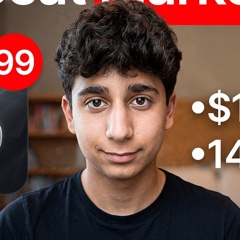
Evan Yadegari
Founder of Locked (gamified self-improvement app) and 10X (Shopify for apps platform)
Where to hear and read about Evan Yadegari1 episode or test

Evan Yadegari is a teenage founder who took the gamified focus app Locked to over $14,000 a month and then built 10X, a 'Shopify for apps' platform. The most useful thing to learn from him is his manual influencer system: pick creators on real engagement, pay on views, and keep cost per thousand views below revenue per thousand.
Either you win or you learn.
The 14-Year-Old Who Built a $14k/Month AI App
Evan Yadegari: the story and the lessons
1Evan Yadegari's path from Roblox games to Locked and 10X
Yadegari was running small businesses by age nine. At nine he built two Roblox games, then sold shoe cards and sports cards. He grew the Totally Science account from about 30K to almost 100K followers.
Totally Science was his brother Zack's gaming site, sold to the owner of FreezeNova, who then hired Evan. His older brother Zach also founded Cal AI, and Evan says he learned by testing channels himself rather than copying him.
He earned his first real income from content at age 12. Working for the FreezeNova owner, he made $1,000 in the first month and $2,000 in the second. He then built his own site, EvanClub, and made more.
His first app, Problem Pal, a homework helper, reached $2,000 a month.
One TikTok account carried three products in turn. The account began as an unblocked-games channel promoting his gaming site, then promoted Problem Pal, and finally Locked.
A Problem Pal video on finishing homework quickly drew 200,000 views. He credits it with scaling that app to $2,000 a month because it pitched the app throughout.
Locked started from a friend who couldn't stay focused. Yadegari saw many teens struggling with distraction and applied the principles that make video games addictive, using XP and competition with others, to self-improvement.
The gamified flow also made the product easy to show in creator videos. 'I figured why not apply the same principles to Locked to turn self-improvement into a game.'
He built Locked without learning to code. He and his co-founder scoped onboarding and the main screens in Figma, finalized them, then gave them to Claude to build a prototype.
After that came constant iteration: plugging in keys, fixing bugs, improving UX and UI. His background was content, not engineering.
He followed Locked with 10X, a platform that turns prompts into apps. A prompt generates a working app, and built-in marketing tools cover Instagram posts, AI slideshows and competitor metrics. One user reached the App Store in 2 hours.
His goal is to get users to $10,000 a month without leaving the platform. The 10X revenue claims (about 30K ARR) are self-reported.
2Why Yadegari bet on day-in-the-life influencers
He tested four channels and influencers clearly won. Yadegari tried Reddit, X, influencer marketing and paid ads for Locked. Influencers took the app past $14,000 a month with almost no budget.
His view on risk: paying a creator $500 either turns a profit or teaches you something. He credits his brother Zach for the risk-taking habit.
He matched creator format to what the app does. Of gym, self-improvement and day-in-the-life creators, day in the life worked best. Creators already list tasks through the day, so checking them off in Locked adds no extra ad step.
'When the Gen Z audience sees them checking off tasks on a gamified app, getting XP, competing with others, they're intrigued.' He tested several niches before settling here.
One Jeremiah Jones video earned at least $3,000. The video drew about a million views across Instagram, Facebook and TikTok and brought Locked's first $1,000 day. Its hook was that the schedule would keep you locked in for 2026.
The creator shows the app after every task, and the app name sits big and bold in the top left when the first task opens. There is no explicit 'download this' line.
3How Yadegari chooses creators
He picks creators on engagement and views, not followers. He looks for creators pulling anywhere from 5,000 to millions of views per video, and skips anyone under about 5,000 per video however large their following.
'followers don't matter at all. It's mainly just engagement rates and also the amount of views the creators pull.'
He reads the comment section before paying anyone. Good comments are on-topic, ask questions, get many likes and include replies between viewers. A pile of emoji-only comments is a bad sign.
His biggest early mistake was paying creators with poor comments because he only looked at followers and views. He took a lot of losses before changing.
4Yadegari's outreach system for creator deals
He treats outreach as volume work with low reply rates. Replies run about 3 to 4% on Instagram and about 2% on TikTok. He sent at least 5,000 to 10,000 DMs to reach $14K a month, up to 500 a day at peak.
The work is manual: search niche terms like gym or day in the life, open profiles, message, repeat. The 3 to 4% figure assumes an account with at least 1,000 followers and a verified badge.
He ran several verified accounts to beat DM limits. Instagram caps an account at about 100 DMs a day, resetting the next day. The team created multiple accounts, bought them over 1,000 followers and got them verified.
The 500-DMs-a-day pace came at Locked's peak, when the full team was working.
He opens with 'paid promo?' and pushes for a call. Creators get hundreds of DMs, and the word 'promo' makes them stop. The follow-up says he is the founder, partnering with a select group of creators, and asks for a call.
'I always push for a call. I would almost never negotiate over DMs unless I absolutely have to.' A call builds the relationship before the negotiation.
5How Yadegari prices and structures creator deals
He keeps cost per thousand views below revenue per thousand. Locked's revenue per thousand views averages $3 to $4, while his CPMs run about $1 to $2. About 10 downloads yield one subscriber, on a $30 annual or $7 weekly plan.
CPM deals carry a hard cap, such as $500, so a viral video cannot blow the budget.
His favorite deal is a flat fee with a minimum view clause. An example is $1,000 per post with 500,000 views. If the first video falls short, the creator keeps posting until videos collectively hit the number.
He sizes the clause from the price at a $1 to $2 CPM, so an $800 deal gets 400,000 to 800,000 views. 'Definitely the minimum view clause deal structure.'
He lets creators take proportional pay but keeps the full target visible. On a $400 deal with a 400,000 view clause, a creator who stops after 50,000 views gets $50.
Naming the full amount up front motivates creators to reach it, and Yadegari agrees it does.
He offers standard, CPM and bonus deals for other creators. Standard is $500 for one video or $1,200 for four, only for creators who reliably pull huge views. CPM is $1 to $2 per thousand views. Bonus is $250 up front plus $250 if the video hits 250,000 views.
The bonus can be mixed with any of the other three structures.
He sets a few fixed rules and leaves the rest to the creator. The app must appear in the first 15 seconds. Earlier looks like an ad, later loses retention. A personal account comments 'What's this app? I need this', and the creator replies with the name and pins it.
He sends a contract, and the creator submits the post for approval before it goes live.
He reads download spikes to decide which creators to renew. Instagram doesn't allow direct link attribution, so he matches each post's timing to download and revenue spikes. A winning creator gets the same deal renewed, then a bigger one.
Spikes can't show which creator drove which sale, and retention, refunds, churn and total spend are never shown, so the profit behind $14K a month is unclear.
6How Yadegari picks and speedruns app ideas
He starts from a real problem in a big enough market. He checks that the total addressable market is high enough before moving forward. Problem-solving apps suit fast revenue because people pay to fix problems.
Trend apps are fine, but 'it's best to stick to problems or pain points, but if you can hop on a trend, that's also great.'
He watches new AI models and social trends for openings. Each new AI model release opens room for new apps. Viral social trends, such as the imposter party game where players hint at a word, can also become app niches.
'stay on top of trends, stay on top of AI models launching and that's how you can really jump on a goldmine.'
His $10K-a-month speedrun is spec, build, then influencers. He writes a doc with the exact problem and features, prompts 10X to generate the app, then uses its market tabs.
He pairs those tools with the influencer playbook of creator vetting, DM outreach and view-based deals.

The 14-Year-Old Who Built a $14k/Month AI App
A 14-year-old founder explains the influencer outreach and deal system he used to take a gamified productivity app to over $14,000 a month. It covers DM scripts, four deal structures, how to vet creators, and how to pick app ideas.
Yadegari was running small businesses by age nine. At nine he built two Roblox games, then sold shoe cards and sports cards. He grew the Totally Science account from about 30K to almost 100K followers.
Totally Science was his brother Zack's gaming site, sold to the owner of FreezeNova, who then hired Evan. His older brother Zach also founded Cal AI, and Evan says he learned by testing channels himself rather than copying him.
He earned his first real income from content at age 12. Working for the FreezeNova owner, he made $1,000 in the first month and $2,000 in the second. He then built his own site, EvanClub, and made more.
His first app, Problem Pal, a homework helper, reached $2,000 a month.
One TikTok account carried three products in turn. The account began as an unblocked-games channel promoting his gaming site, then promoted Problem Pal, and finally Locked.
A Problem Pal video on finishing homework quickly drew 200,000 views. He credits it with scaling that app to $2,000 a month because it pitched the app throughout.
Locked started from a friend who couldn't stay focused. Yadegari saw many teens struggling with distraction and applied the principles that make video games addictive, using XP and competition with others, to self-improvement.
The gamified flow also made the product easy to show in creator videos. 'I figured why not apply the same principles to Locked to turn self-improvement into a game.'
He built Locked without learning to code. He and his co-founder scoped onboarding and the main screens in Figma, finalized them, then gave them to Claude to build a prototype.
After that came constant iteration: plugging in keys, fixing bugs, improving UX and UI. His background was content, not engineering.
He followed Locked with 10X, a platform that turns prompts into apps. A prompt generates a working app, and built-in marketing tools cover Instagram posts, AI slideshows and competitor metrics. One user reached the App Store in 2 hours.
His goal is to get users to $10,000 a month without leaving the platform. The 10X revenue claims (about 30K ARR) are self-reported.
He tested four channels and influencers clearly won. Yadegari tried Reddit, X, influencer marketing and paid ads for Locked. Influencers took the app past $14,000 a month with almost no budget.
His view on risk: paying a creator $500 either turns a profit or teaches you something. He credits his brother Zach for the risk-taking habit.
He matched creator format to what the app does. Of gym, self-improvement and day-in-the-life creators, day in the life worked best. Creators already list tasks through the day, so checking them off in Locked adds no extra ad step.
'When the Gen Z audience sees them checking off tasks on a gamified app, getting XP, competing with others, they're intrigued.' He tested several niches before settling here.
One Jeremiah Jones video earned at least $3,000. The video drew about a million views across Instagram, Facebook and TikTok and brought Locked's first $1,000 day. Its hook was that the schedule would keep you locked in for 2026.
The creator shows the app after every task, and the app name sits big and bold in the top left when the first task opens. There is no explicit 'download this' line.
He picks creators on engagement and views, not followers. He looks for creators pulling anywhere from 5,000 to millions of views per video, and skips anyone under about 5,000 per video however large their following.
'followers don't matter at all. It's mainly just engagement rates and also the amount of views the creators pull.'
He reads the comment section before paying anyone. Good comments are on-topic, ask questions, get many likes and include replies between viewers. A pile of emoji-only comments is a bad sign.
His biggest early mistake was paying creators with poor comments because he only looked at followers and views. He took a lot of losses before changing.
He treats outreach as volume work with low reply rates. Replies run about 3 to 4% on Instagram and about 2% on TikTok. He sent at least 5,000 to 10,000 DMs to reach $14K a month, up to 500 a day at peak.
The work is manual: search niche terms like gym or day in the life, open profiles, message, repeat. The 3 to 4% figure assumes an account with at least 1,000 followers and a verified badge.
He ran several verified accounts to beat DM limits. Instagram caps an account at about 100 DMs a day, resetting the next day. The team created multiple accounts, bought them over 1,000 followers and got them verified.
The 500-DMs-a-day pace came at Locked's peak, when the full team was working.
He opens with 'paid promo?' and pushes for a call. Creators get hundreds of DMs, and the word 'promo' makes them stop. The follow-up says he is the founder, partnering with a select group of creators, and asks for a call.
'I always push for a call. I would almost never negotiate over DMs unless I absolutely have to.' A call builds the relationship before the negotiation.
He keeps cost per thousand views below revenue per thousand. Locked's revenue per thousand views averages $3 to $4, while his CPMs run about $1 to $2. About 10 downloads yield one subscriber, on a $30 annual or $7 weekly plan.
CPM deals carry a hard cap, such as $500, so a viral video cannot blow the budget.
His favorite deal is a flat fee with a minimum view clause. An example is $1,000 per post with 500,000 views. If the first video falls short, the creator keeps posting until videos collectively hit the number.
He sizes the clause from the price at a $1 to $2 CPM, so an $800 deal gets 400,000 to 800,000 views. 'Definitely the minimum view clause deal structure.'
He lets creators take proportional pay but keeps the full target visible. On a $400 deal with a 400,000 view clause, a creator who stops after 50,000 views gets $50.
Naming the full amount up front motivates creators to reach it, and Yadegari agrees it does.
He offers standard, CPM and bonus deals for other creators. Standard is $500 for one video or $1,200 for four, only for creators who reliably pull huge views. CPM is $1 to $2 per thousand views. Bonus is $250 up front plus $250 if the video hits 250,000 views.
The bonus can be mixed with any of the other three structures.
He sets a few fixed rules and leaves the rest to the creator. The app must appear in the first 15 seconds. Earlier looks like an ad, later loses retention. A personal account comments 'What's this app? I need this', and the creator replies with the name and pins it.
He sends a contract, and the creator submits the post for approval before it goes live.
He reads download spikes to decide which creators to renew. Instagram doesn't allow direct link attribution, so he matches each post's timing to download and revenue spikes. A winning creator gets the same deal renewed, then a bigger one.
Spikes can't show which creator drove which sale, and retention, refunds, churn and total spend are never shown, so the profit behind $14K a month is unclear.
He starts from a real problem in a big enough market. He checks that the total addressable market is high enough before moving forward. Problem-solving apps suit fast revenue because people pay to fix problems.
Trend apps are fine, but 'it's best to stick to problems or pain points, but if you can hop on a trend, that's also great.'
He watches new AI models and social trends for openings. Each new AI model release opens room for new apps. Viral social trends, such as the imposter party game where players hint at a word, can also become app niches.
'stay on top of trends, stay on top of AI models launching and that's how you can really jump on a goldmine.'
His $10K-a-month speedrun is spec, build, then influencers. He writes a doc with the exact problem and features, prompts 10X to generate the app, then uses its market tabs.
He pairs those tools with the influencer playbook of creator vetting, DM outreach and view-based deals.