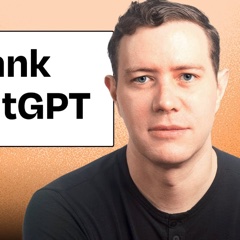
Ethan Smith
CEO of Graphite, SEO growth agency
Where to hear and read about Ethan Smith2 episodes and tests

 Lenny's PodcastThe ultimate guide to AEO: How to get ChatGPT to recommend your product | Ethan Smith (Graphite)
 Lenny's PodcastThe ultimate guide to SEO | Ethan Smith (Graphite)
Ethan Smith is the CEO of Graphite, an SEO growth agency, and has worked in SEO since 2007, from shopping-comparison spam to MasterClass, Thumbtack and Webflow. The thing most worth learning from him is to plan by topic and ship the work, then test every claim against your own data, including about AI answer engines.
most of what is recommended never gets launched
The ultimate guide to SEO | Ethan Smith (Graphite)
Ethan Smith: the story and the lessons
1Ethan Smith's path from UX designer to SEO agency founder
Smith learned SEO because his commerce site's designs had no users. His career began in user research and UX design. In 2007 his designs at a commerce company had no users and ads were too expensive, so he learned SEO in his spare time.
He hired several consultants, including a great one from shopping.com and eBay who gave him playbooks. Most of their tests failed and some worked.
Three years of tests led him to programmatic search pages. Over about three years the team arrived at the programmatic search page strategy. Whirlpool bought his company, and he then specialized in SEO.
His early shopping site had 10 million plus pages, one per way to search. It worked then but no longer does.
He once built the spam Google later wiped out. In 2007 Smith built scraped shopping-comparison pages. They worked, then Google's crackdown (Panda and similar algorithms) ended that kind of site.
He now asks platforms to think like a 2007 spammer: ask what 2007 Ethan would do to create spam, then close that door.
Smith started Graphite because SEO was the most underserved market he could serve. He began consulting on the side in 2014 with Thumbtack, and MasterClass, Honey and Ticketmaster followed. His product and growth background fits an SEO that is mostly core product changes.
His proudest win was ranking MasterClass for butter lettuce. MasterClass had far less authority than Allrecipes and Martha Stewart. He was unsure he should take the project because it might be too hard, yet it ranked better than he expected.
2Why Smith plans SEO by topic, not keyword
Smith plans pages around topics because one page ranks for hundreds of keywords. A page typically ranks for 200 to 2,000 keywords. The keyword 'best cameras' might have 1,000 searches while its topic is probably 100,000.
To decide between one page and two, search both keywords and compare results. Different results mean two pages. His line: "it's much much better to think in terms of topics rather than keywords".
He hands writers outlines that cover every subtopic. Gaps hurt both Google's content score and user engagement. MasterClass outranked Food Network on butter lettuce because rivals skipped subtopics like health benefits, across about 400 keywords.
Writers usually guess subtopics wrong, so the SEO manager builds the outline. Smith uses Clearscope to find the gaps.
Smith copies the page type that already ranks, then builds a more useful page. Searching the target keywords shows whether Google ranks articles, category pages or listicles. MasterClass chapter pages with Gordon Ramsay transcripts would not rank for how to poach an egg.
Ranking pages are inspiration, not a formula. He asks what helps the searcher, which makes algorithm changes less likely to hurt.
Smith grows authority by expanding next to what a site is already known for. MasterClass started with topics adjacent to Gordon Ramsay, like beef wellington and poached eggs, and branched out later. A viral jello shots post lifted a recipe domain's vodka and whiskey pages that were not even linked from it.
This lets a smaller site beat higher-authority domains where it is disproportionately known.
He says Google ranks on click-through and time on page. Clicking your result, going back and picking another is a very bad signal. Staying on the page is probably the more important part.
He says Google sees post-click behavior through Chrome and Android, and wants the session to end with the answer found.
He starts from competitors' data and ranks topics by expected conversions. Pull rivals' pages and keywords from Ahrefs or Semrush, cluster them into topics, then multiply search volume by topical authority and conversion intent.
For food this gives about 10,000 topics sorted by volume. Food, comics and photography convert differently, so intent matters.
3Smith's internal link fix, his first move for most sites
Smith found internal links drove traffic and raised it about 300% in 2007. At a shopping site he saw that pages with more internal links got more traffic. Adding links to the starved products lifted their traffic by about 300%.
Graphite typically sees a 25% or larger lift from fixing link spread, and sometimes 100%.
He says most sites leave 5% of pages holding 95% of links. Facet, popular, recent and related-page algorithms keep linking to the same pages. Crawl with Screaming Frog and read the unique inlinks count to see the power curve.
His estimate: "I would say probably 90 to 95 percent of sites have this problem right now". A sitemap entry counts as only one link.
Every page should have at least 5, ideally 10, body links. The goal is a flat link graph, with every page a few hops from where Google enters, like the home page or a popular press release.
Smith's team built its own algorithm at Thumbtack and the 2007 shopping site. It now runs as an API on sites like Upwork.
He puts link modules above the footer, never in it. Google separates navigation and footer links from body links and counts navigational ones for less. Place them at the bottom of an article or category page.
4How Smith decides whether SEO is worth doing
Smith says seed and Series A companies are usually too early for SEO. Benchmarks are about 1,000 non-SEO visits a day and about 1,000 referring domains. Non-SEO traffic is an authority signal because Google does not want to rank a site that only exists for SEO.
A site can grow below those numbers, but it is much harder.
He sizes the market from product and audience competitors' traffic. Put competitors into Similarweb, including audience competitors like Investopedia for Robinhood. Multiply by your conversion rate and compare with paid, email and social.
Most markets are large once you target the persona. Power's clinical-trial site grows by writing for gig workers or college students, not only people searching for a trial.
Smith calls the technical audit the biggest myth in SEO. An audit is mostly a Screaming Frog crawl (about $150) turned into a bug list. Growth comes from programmatic and editorial SEO.
In his words: "a tech audit is basically give me a list of bugs to fix which is different from help me grow".
He picks editorial SEO unless the queries need programmatic pages. Editorial now drives more traffic than programmatic and suits every company with a market. Programmatic fits database or UGC sites like Zillow and eBay, where pages cost nothing each.
Dotdash, which owns AllRecipes and Investopedia, is probably the most successful editorial SEO company in his view.
Smith thinks companies under-resource SEO against ads. A company spending $100 million on ads gets similar traffic value from SEO, so investing only $50,000 there makes no sense to him.
If SEO is worth a billion dollars, as at Zillow, he says to just spend the money.
5How Smith builds and runs an SEO team
Smith starts editorial SEO with one SEO manager and one writer. The SEO person picks topics and writes outlines, a domain-expert writer writes, and someone manages publishing. Graphite usually runs 3 to 5 people to go faster.
"One SEO person and one writer is the smallest group that you could have", because SEO people rarely want to write.
He hires programmatic SEO talent from obscure sites that grew on SEO. Look for sites where SEO is even 80% of traffic and the brand has little authority. Big-brand candidates are in heavy demand and results there are easier.
Editorial SEO can be learned on the job. MasterClass's team had no SEO background and became very strong.
He launches 10 to 30 articles, then scales on early rankings. A new company needs about 3 months to launch and 3 to 6 more to see ranking growth. Pages climbing from 15 to 12 to 8 to 5 signal it is time to scale.
A first failure is often poor implementation, so one attempt proves little. No rankings at all means the strategy is wrong or authority is too low.
Smith generates hypotheses from other sites and uses tests to confirm them. He found internal links correlated with traffic, then tested adding links and got the 300% lift. He says to launch first and begin testing around month six.
"The test validates the hypothesis." Random page samples work as buckets, and sequential tests work when splits aren't possible.
He asks the SEO lead at a winning company what worked. For an international plan, analysis showed TripAdvisor outperforming eBay and others abroad. He reached its SEO lead, Luke Levesque, and got answers that saved him testing.
Smith says SEO work stalls because it never gets built. It sits outside the product org, feels mysterious and is large. Agency candidates describe detailed strategies, then admit almost none launched.
His fix is product-led SEO routed through product prioritization, plus asking an executive directly to launch a specific big opportunity.
6Smith's view of answer engine optimization (AEO)
Smith calls AEO the second biggest change in his 18 years. The biggest was Google turning SEO from spam into non-spam. AEO is second because it is still search, but summarized, with new inputs.
Everything that works in SEO also works in AEO. He prefers 'answer' to 'generative' because generative also covers images and video.
He says only the retrieval layer can be optimized. An LLM with retrieval runs a live search and summarizes it. A model almost never names a product missing from those results, and influencing the core model takes a year or more.
Smith says to get mentioned across many citations, not rank first. The model summarizes many sources, so a number one URL does not win the answer. The brand mentioned most across citations is named first.
"You need to get mentioned as many times as possible." The sources are your own pages, video, Reddit and Quora, affiliates and blogs.
He expects LLM traffic to convert far better than Google traffic. Webflow saw a 6x conversion difference and gets 8% of signups from LLMs, though search is still bigger.
Smith infers that a multi-turn chat builds intent before the click. The 6x gap is his evidence and the cause is his inference.
Smith tells early startups to skip SEO and chase citations. Google ranking needs domain authority that takes years, so SEO is usually a Series A or B move. A Reddit thread, YouTube video or blog mention can put a brand in an answer tomorrow.
Skip mid-tail pages and answer very specific questions. Chats average about 25 words against about 6 in Google, so the long tail is wide open.
7Smith's AEO playbook: questions, citations and measurement
He builds the question list from paid search keywords. Take your and competitors' paid money terms and have ChatGPT rewrite them as questions. Mine sales calls, support and Reddit for the long tail.
ChatGPT offers no volume data, so these are proxies. For Rippling, look at what Deel bids on.
Each page should answer every follow-up question on its topic. A page targets hundreds or thousands of questions. Answering a follow-up that no competitor answers makes it more likely to be cited.
"The more of the questions that I answer, the better."
Smith posts on Reddit as a real person, naming his employer. Webflow has a couple of employees who say who they are and where they work, then give a useful answer. Even five good comments can matter.
Mass fake accounts get banned and deleted. Deel grew early the same way, answering Reddit questions before AI search existed.
He makes videos for unglamorous, high-value B2B questions. Video sites are full of food, travel and beauty, with few videos on topics like AI-powered payment processing APIs. YouTube was one of three tactics that worked best for Webflow, with straight SEO and Reddit.
No community can remove a video, so it is easy to control.
Smith treats the help center as a high-value AEO asset. Chat users ask whether a tool supports a feature, use case or integration. Move the help center to a subdirectory, cross-link its pages and fill the tail from sales and support questions.
His example is a meeting transcription tool that integrates with Looker. No article covered it, so a page could be the only citation.
He allows AI indexing but blocks training bots. Blocking all AI crawlers hands your place in answers to competitors. Training and index bots use different user agents, so robots.txt can split them.
"It's not your choice whether to play the game." Webflow is building an app for this.
Smith measures AEO as share of voice across repeated runs. Answers vary by run, phrasing and engine, so track how often you appear and your average rank across engines. ChatGPT's citations overlap Google's about 35% of the time, Perplexity's about 70%.
About 60 tools exist, and he says to pick the cheapest that does what you need. Expect around three engines worth optimizing for.
For B2B he tracks answer appearance and asks how people heard. Most B2B answers have nothing to click, and users open a new tab and type the brand, so it looks like branded or direct traffic. A buyer picks payroll software after about 50 touch points.
Commerce differs: answers are clickable shoppable cards, so referral traffic shows the real impact and schema and review counts matter.
8Smith on testing, skepticism and AI-written content
Smith runs AEO tests against an untouched control group. Take about 200 questions, leave 100 alone, and split the rest into buckets like Reddit comments, a YouTube video or a paid placement. Measure a couple of weeks before and after.
Answers vary even when you do nothing and LLM usage keeps growing. He says maybe half of his own list will not work for you.
He trusts a result only when it repeats. From his academic background, a result counts only if others reproduce it. In SEO it is common to credit the wrong cause and believe it forever.
If it works 10 times, it probably works. He says most SEO and AEO work is wasted, and experiments show which part isn't.
Smith says fully AI-generated content does not win. A study found only 10 to 12% of content in Google and ChatGPT results was AI generated, using Surfer's AI detector with about 8% false positives. AI-assisted, edited content is fine.
If it worked, everyone would do it and AI would summarize its own derivatives, collapsing many opinions into one. His team's retrieval test of repeated summarizing ended at 'only vanilla'.
He wants information gain, original research and real expertise. Ranking systems can reward content that says something others did not. One in 20 landing pages drives about 85% of traffic, so he puts the budget into those few pages.
He suggests asking: "did you say something that somebody else didn't say?"
He uses AI for SEO research and structure, and humans to write. AI clusters keywords, finds subtopics and builds outlines. GPT-3 once called a soap oxide free because another product's page said so.
AI writing works only from structured data, like basketball play-by-play or Power's clinical trial data.
Smith warns against overpriced AEO tools and loud AEO claims. He says answer tracking is keyword tracking, yet teams pay $50,000 for it. He also says predictions that Google is dying keep proving false, since new platforms add to Google's searches.
The ultimate guide to AEO: How to get ChatGPT to recommend your product | Ethan Smith (Graphite)
Answer engine optimization (AEO) is how a product gets mentioned in ChatGPT, Claude, Gemini and Perplexity answers, and it works like SEO plus citation building and long-tail question coverage. Webflow saw LLM traffic convert 6x better than Google search and now gets 8% of signups from LLMs, and early-stage startups can win in days rather than years.
He once built the spam Google later wiped out. In 2007 Smith built scraped shopping-comparison pages. They worked, then Google's crackdown (Panda and similar algorithms) ended that kind of site.
He now asks platforms to think like a 2007 spammer: ask what 2007 Ethan would do to create spam, then close that door.
His proudest win was ranking MasterClass for butter lettuce. MasterClass had far less authority than Allrecipes and Martha Stewart. He was unsure he should take the project because it might be too hard, yet it ranked better than he expected.
Smith calls AEO the second biggest change in his 18 years. The biggest was Google turning SEO from spam into non-spam. AEO is second because it is still search, but summarized, with new inputs.
Everything that works in SEO also works in AEO. He prefers 'answer' to 'generative' because generative also covers images and video.
He says only the retrieval layer can be optimized. An LLM with retrieval runs a live search and summarizes it. A model almost never names a product missing from those results, and influencing the core model takes a year or more.
Smith says to get mentioned across many citations, not rank first. The model summarizes many sources, so a number one URL does not win the answer. The brand mentioned most across citations is named first.
"You need to get mentioned as many times as possible." The sources are your own pages, video, Reddit and Quora, affiliates and blogs.
He expects LLM traffic to convert far better than Google traffic. Webflow saw a 6x conversion difference and gets 8% of signups from LLMs, though search is still bigger.
Smith infers that a multi-turn chat builds intent before the click. The 6x gap is his evidence and the cause is his inference.
Smith tells early startups to skip SEO and chase citations. Google ranking needs domain authority that takes years, so SEO is usually a Series A or B move. A Reddit thread, YouTube video or blog mention can put a brand in an answer tomorrow.
Skip mid-tail pages and answer very specific questions. Chats average about 25 words against about 6 in Google, so the long tail is wide open.
He builds the question list from paid search keywords. Take your and competitors' paid money terms and have ChatGPT rewrite them as questions. Mine sales calls, support and Reddit for the long tail.
ChatGPT offers no volume data, so these are proxies. For Rippling, look at what Deel bids on.
Each page should answer every follow-up question on its topic. A page targets hundreds or thousands of questions. Answering a follow-up that no competitor answers makes it more likely to be cited.
"The more of the questions that I answer, the better."
Smith posts on Reddit as a real person, naming his employer. Webflow has a couple of employees who say who they are and where they work, then give a useful answer. Even five good comments can matter.
Mass fake accounts get banned and deleted. Deel grew early the same way, answering Reddit questions before AI search existed.
He makes videos for unglamorous, high-value B2B questions. Video sites are full of food, travel and beauty, with few videos on topics like AI-powered payment processing APIs. YouTube was one of three tactics that worked best for Webflow, with straight SEO and Reddit.
No community can remove a video, so it is easy to control.
Smith treats the help center as a high-value AEO asset. Chat users ask whether a tool supports a feature, use case or integration. Move the help center to a subdirectory, cross-link its pages and fill the tail from sales and support questions.
His example is a meeting transcription tool that integrates with Looker. No article covered it, so a page could be the only citation.
He allows AI indexing but blocks training bots. Blocking all AI crawlers hands your place in answers to competitors. Training and index bots use different user agents, so robots.txt can split them.
"It's not your choice whether to play the game." Webflow is building an app for this.
Smith measures AEO as share of voice across repeated runs. Answers vary by run, phrasing and engine, so track how often you appear and your average rank across engines. ChatGPT's citations overlap Google's about 35% of the time, Perplexity's about 70%.
About 60 tools exist, and he says to pick the cheapest that does what you need. Expect around three engines worth optimizing for.
For B2B he tracks answer appearance and asks how people heard. Most B2B answers have nothing to click, and users open a new tab and type the brand, so it looks like branded or direct traffic. A buyer picks payroll software after about 50 touch points.
Commerce differs: answers are clickable shoppable cards, so referral traffic shows the real impact and schema and review counts matter.
Smith runs AEO tests against an untouched control group. Take about 200 questions, leave 100 alone, and split the rest into buckets like Reddit comments, a YouTube video or a paid placement. Measure a couple of weeks before and after.
Answers vary even when you do nothing and LLM usage keeps growing. He says maybe half of his own list will not work for you.
He trusts a result only when it repeats. From his academic background, a result counts only if others reproduce it. In SEO it is common to credit the wrong cause and believe it forever.
If it works 10 times, it probably works. He says most SEO and AEO work is wasted, and experiments show which part isn't.
Smith says fully AI-generated content does not win. A study found only 10 to 12% of content in Google and ChatGPT results was AI generated, using Surfer's AI detector with about 8% false positives. AI-assisted, edited content is fine.
If it worked, everyone would do it and AI would summarize its own derivatives, collapsing many opinions into one. His team's retrieval test of repeated summarizing ended at 'only vanilla'.
He wants information gain, original research and real expertise. Ranking systems can reward content that says something others did not. One in 20 landing pages drives about 85% of traffic, so he puts the budget into those few pages.
He suggests asking: "did you say something that somebody else didn't say?"
Smith warns against overpriced AEO tools and loud AEO claims. He says answer tracking is keyword tracking, yet teams pay $50,000 for it. He also says predictions that Google is dying keep proving false, since new platforms add to Google's searches.
The ultimate guide to SEO | Ethan Smith (Graphite)
A full guide to SEO: when it is worth investing in, the three buckets (programmatic, editorial, technical), how to plan by topics instead of keywords, and how to hire and test. Ethan Smith's work with MasterClass, Thumbtack and others shows how topical authority and internal links drive large traffic gains, including a 300% lift from adding internal links in 2007.
Smith learned SEO because his commerce site's designs had no users. His career began in user research and UX design. In 2007 his designs at a commerce company had no users and ads were too expensive, so he learned SEO in his spare time.
He hired several consultants, including a great one from shopping.com and eBay who gave him playbooks. Most of their tests failed and some worked.
Three years of tests led him to programmatic search pages. Over about three years the team arrived at the programmatic search page strategy. Whirlpool bought his company, and he then specialized in SEO.
His early shopping site had 10 million plus pages, one per way to search. It worked then but no longer does.
Smith started Graphite because SEO was the most underserved market he could serve. He began consulting on the side in 2014 with Thumbtack, and MasterClass, Honey and Ticketmaster followed. His product and growth background fits an SEO that is mostly core product changes.
Smith plans pages around topics because one page ranks for hundreds of keywords. A page typically ranks for 200 to 2,000 keywords. The keyword 'best cameras' might have 1,000 searches while its topic is probably 100,000.
To decide between one page and two, search both keywords and compare results. Different results mean two pages. His line: "it's much much better to think in terms of topics rather than keywords".
He hands writers outlines that cover every subtopic. Gaps hurt both Google's content score and user engagement. MasterClass outranked Food Network on butter lettuce because rivals skipped subtopics like health benefits, across about 400 keywords.
Writers usually guess subtopics wrong, so the SEO manager builds the outline. Smith uses Clearscope to find the gaps.
Smith copies the page type that already ranks, then builds a more useful page. Searching the target keywords shows whether Google ranks articles, category pages or listicles. MasterClass chapter pages with Gordon Ramsay transcripts would not rank for how to poach an egg.
Ranking pages are inspiration, not a formula. He asks what helps the searcher, which makes algorithm changes less likely to hurt.
Smith grows authority by expanding next to what a site is already known for. MasterClass started with topics adjacent to Gordon Ramsay, like beef wellington and poached eggs, and branched out later. A viral jello shots post lifted a recipe domain's vodka and whiskey pages that were not even linked from it.
This lets a smaller site beat higher-authority domains where it is disproportionately known.
He says Google ranks on click-through and time on page. Clicking your result, going back and picking another is a very bad signal. Staying on the page is probably the more important part.
He says Google sees post-click behavior through Chrome and Android, and wants the session to end with the answer found.
He starts from competitors' data and ranks topics by expected conversions. Pull rivals' pages and keywords from Ahrefs or Semrush, cluster them into topics, then multiply search volume by topical authority and conversion intent.
For food this gives about 10,000 topics sorted by volume. Food, comics and photography convert differently, so intent matters.
Smith found internal links drove traffic and raised it about 300% in 2007. At a shopping site he saw that pages with more internal links got more traffic. Adding links to the starved products lifted their traffic by about 300%.
Graphite typically sees a 25% or larger lift from fixing link spread, and sometimes 100%.
He says most sites leave 5% of pages holding 95% of links. Facet, popular, recent and related-page algorithms keep linking to the same pages. Crawl with Screaming Frog and read the unique inlinks count to see the power curve.
His estimate: "I would say probably 90 to 95 percent of sites have this problem right now". A sitemap entry counts as only one link.
Every page should have at least 5, ideally 10, body links. The goal is a flat link graph, with every page a few hops from where Google enters, like the home page or a popular press release.
Smith's team built its own algorithm at Thumbtack and the 2007 shopping site. It now runs as an API on sites like Upwork.
He puts link modules above the footer, never in it. Google separates navigation and footer links from body links and counts navigational ones for less. Place them at the bottom of an article or category page.
Smith says seed and Series A companies are usually too early for SEO. Benchmarks are about 1,000 non-SEO visits a day and about 1,000 referring domains. Non-SEO traffic is an authority signal because Google does not want to rank a site that only exists for SEO.
A site can grow below those numbers, but it is much harder.
He sizes the market from product and audience competitors' traffic. Put competitors into Similarweb, including audience competitors like Investopedia for Robinhood. Multiply by your conversion rate and compare with paid, email and social.
Most markets are large once you target the persona. Power's clinical-trial site grows by writing for gig workers or college students, not only people searching for a trial.
Smith calls the technical audit the biggest myth in SEO. An audit is mostly a Screaming Frog crawl (about $150) turned into a bug list. Growth comes from programmatic and editorial SEO.
In his words: "a tech audit is basically give me a list of bugs to fix which is different from help me grow".
He picks editorial SEO unless the queries need programmatic pages. Editorial now drives more traffic than programmatic and suits every company with a market. Programmatic fits database or UGC sites like Zillow and eBay, where pages cost nothing each.
Dotdash, which owns AllRecipes and Investopedia, is probably the most successful editorial SEO company in his view.
Smith thinks companies under-resource SEO against ads. A company spending $100 million on ads gets similar traffic value from SEO, so investing only $50,000 there makes no sense to him.
If SEO is worth a billion dollars, as at Zillow, he says to just spend the money.
Smith starts editorial SEO with one SEO manager and one writer. The SEO person picks topics and writes outlines, a domain-expert writer writes, and someone manages publishing. Graphite usually runs 3 to 5 people to go faster.
"One SEO person and one writer is the smallest group that you could have", because SEO people rarely want to write.
He hires programmatic SEO talent from obscure sites that grew on SEO. Look for sites where SEO is even 80% of traffic and the brand has little authority. Big-brand candidates are in heavy demand and results there are easier.
Editorial SEO can be learned on the job. MasterClass's team had no SEO background and became very strong.
He launches 10 to 30 articles, then scales on early rankings. A new company needs about 3 months to launch and 3 to 6 more to see ranking growth. Pages climbing from 15 to 12 to 8 to 5 signal it is time to scale.
A first failure is often poor implementation, so one attempt proves little. No rankings at all means the strategy is wrong or authority is too low.
Smith generates hypotheses from other sites and uses tests to confirm them. He found internal links correlated with traffic, then tested adding links and got the 300% lift. He says to launch first and begin testing around month six.
"The test validates the hypothesis." Random page samples work as buckets, and sequential tests work when splits aren't possible.
He asks the SEO lead at a winning company what worked. For an international plan, analysis showed TripAdvisor outperforming eBay and others abroad. He reached its SEO lead, Luke Levesque, and got answers that saved him testing.
Smith says SEO work stalls because it never gets built. It sits outside the product org, feels mysterious and is large. Agency candidates describe detailed strategies, then admit almost none launched.
His fix is product-led SEO routed through product prioritization, plus asking an executive directly to launch a specific big opportunity.
He uses AI for SEO research and structure, and humans to write. AI clusters keywords, finds subtopics and builds outlines. GPT-3 once called a soap oxide free because another product's page said so.
AI writing works only from structured data, like basketball play-by-play or Power's clinical trial data.