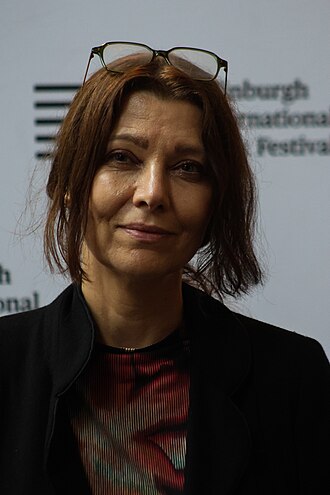
Elif Shafak
Novelist and president of the Royal Society of Literature (Shafak)
Where to hear and read about Elif Shafak2 episodes and tests
 How I WriteThe Deepest Conversation You’ll Ever Watch About Writing (Shafak & Macfarlane Interview)
 How I WriteHow to Unlock Your Imagination as a Writer (Elif Shafak Interview)
Elif Shafak is a novelist of 21 books, 13 of them novels, who writes in English after starting in Turkish and is president of the Royal Society of Literature. The one thing most worth learning from her is to prepare by reading and listening widely, then write intuitively inside the story, free of audience worries, and leave the answers to the reader.
I've always believed in being intellectual nomads. We shouldn't have comfort zones.
How to Unlock Your Imagination as a Writer (Elif Shafak Interview)
Elif Shafak: the story and the lessons
1Elif Shafak's path from a lonely childhood to the page
Shafak found her first companions in books, as a lonely only child. She grew up in a conservative, patriarchal neighbourhood, and Dickens and Don Quixote took her beyond that little box.
The need for stories came long before any idea of a career. She calls people story-remembering creatures.
Each city she lived in gave her something different. Born in Strasbourg, she lost French when her parents separated. She grew up in Ankara beside a wise, matriarchal grandmother, found Istanbul loved but hard for a writer, and moved to London for freedom.
The Arizona desert connected her to nature in a new way. She calls herself a commuter, inspired by James Baldwin.
Her grandmother's world of speaking mountains stayed with her. Her grandmother raised her until she was 10, in a world where mountains spoke and stones whispered, but you had to become a listener.
As a child Shafak found this irrational. She values it more as she gets older.
School forced her left hand into exile, so she types. Teachers in Turkey converted left-handed children to the right hand. She was the last in a class of about 44 to learn to write.
Her teacher told her to send her left hand into exile under the desk. Her handwriting is still messy, so she has always used a typewriter or computer.
She writes knowing a sentence can bring a trial. She has been prosecuted, investigated and targeted for her books. Where she comes from, touching history, gender, politics or sexuality can bring a suit, and prosecutors have asked for three to five years in prison over fiction.
She has seen fictional characters defended in court. If she thought about the reaction while drafting she probably could not write, so she lets herself panic only after the book goes to her editor.
2Why Shafak moved from Turkish to English
Shafak wrote four novels in Turkish, then switched to English. She made the switch more than 20 years ago. Giving up her mother tongue felt like cutting off the hand she writes with.
She needed freedom and cognitive distance, like stepping back from a painting to see it from a new angle. She says it is her own path, not advice for everyone.
Each language gives her different feelings to work with. Turkish is the emotional language of her childhood and grandmother, and she finds sorrow and melancholy easier there. English is more cerebral, and humor, irony and satire come easier.
She began English at about 10 or 11, after Spanish, so English is her third language. Poetry's melody, cadence and rhythm are the biggest challenge.
She treats language as a space she enters, not a tool. A writer is a different person in Turkish, Spanish or English, and more words for a tree or a bee change how we think about bees.
Starting again in English forced her to refind her voice and take no word for granted.
She sees English as open to foreign words where Turkish purged them. English takes in chutzpah from Yiddish and kismet from Arabic without protest. Turkey removed words of Arabic, Persian and minority origin, so its vocabulary shrank.
She reads poetry in both Turkish and English, because the gap between mind and tongue stops her taking anything for granted.
3How Shafak drafts a novel
She does heavy research first, then writes by intuition. She reads, researches and listens a great deal beforehand. That learning gives her the confidence to plunge into a novel without knowing where it goes.
After the research, she reaches a point where she feels she can take off. She trusts intuition even when she does not know exactly what she is doing. "I really love writing with intuition as my guide."
She prefers writing a little drunk to engineering a plot. She contrasts the writer as engineer, who plots everything and controls the characters, with the writer who is lost inside the text, not above it. She does not know what a character will do five chapters on, and lets a side character take over.
She respects the engineer approach, but it is not hers.
She weaves several storylines at once, like a braid. In There Are Rivers in the Sky she held three storylines in her hands and wrote them together, without finishing one character before starting the next.
It took heavy thinking, notes and arrows, and she still trusts intuition alongside structure. She keeps promising herself a linear book and cannot write one. She links the braided shape to a nomadic life of ruptures and migrations.
She keeps no fixed schedule but reads and takes notes every day. Writing is not a nine-to-five job for her, and it seeps into her dreams. If she cannot write in the day she writes at night, and if not then the next morning.
She thinks precise schedules suit only a few writers of a certain age or background, and that mothers and others with many duties carve out space where they can. Much of what she writes is deleted.
She works at night, in noise, with one metal song on loop. She is nocturnal because night leaves more time to hear the voices from the page, and she cannot work in silence. She plays a single heavy metal song 70 or 80 times in a row.
The loop lets her zoom in and out and arrive somewhere different. She links the need for noise to her loud Istanbul neighborhood, and says metal is honest, raw and calming.
She expects valleys of doubt in every book. It makes no difference whether it is the first book or the tenth. One week she feels she has an amazing story, and the next she is throwing pages away.
She learned the pattern over the years and does not expect it to fade. She says writing does not get easier with age. "We always and always go through valleys of anxiety, mountains of depression."
She edits as she writes, then polishes in circles. She edits while drafting, then works with an editor, copy editors and translators. Her path is never linear, and she jumps back and forth.
A copy editor once caught that a hotel in 1943 had pink curtains, not green. She cites Walter Benjamin on storytelling as the loneliest kind of art.
4How Shafak builds characters and keeps fiction open
Shafak does not believe in heroes. Her characters are neither purely brave nor purely good. She is drawn to the moment a timid person shows courage or a brave person is terrified.
Transformation holds her attention, and she cares more about the periphery, the unseen and the unheard, than the center.
She replaces "write what you know" with "write what you feel". She says the old motto reduces literature to the autobiographical and cannot cover all fiction. With real connection and effort, a writer can cross identity boundaries.
She began writing because her own life seemed boring and she wanted to become someone else. She then found the other is not that different from her.
She becomes each character, including the unlikable ones, without judging them. Small or unlikable characters need understanding too. She stays in that zone as long and as deep as she can, and says the novel is where she can be multiple.
She cites Whitman: we all contain multitudes. She does not look down at her characters from a height.
She wrote a talking tree into a literary novel. Her agent flickered with panic at the announcement, since a failed tree could collapse the whole book. She heard the tree's voice day and night and could not resist it.
In daily life, a glass of water that spoke would make people think you had gone bonkers, but in fiction nobody stops you. Her lines include that water is the consummate immigrant trapped in transit.
She makes characters remember through smell and taste. In 10 Minutes 38 Seconds in This Strange World, a woman is dead on page one but her brain stays active for a few minutes. Shafak asked how she would remember.
Memory runs on emotion and the senses, as in Proust's cookie dipped in tea. The surfacing memories are the small, sensory ones that stay longest.
She raises questions and leaves the answers to the reader. She cares about silences and minorities but says that when writing there is no preaching, teaching or lecturing. She opens a space of nuance and plurality, then steps back.
No two readers read the same book. Even a couple married for decades can disagree about one novel.
She mixes sorrow with compassionate humor. In Istanbul a sad moment carries something absurd underneath, and a funny one carries sorrow. She wants humor that understands human follies, not humor that mocks from above.
Her editors did not expect humor in books on such heavy subjects. She identifies so closely with her characters that their sadness affects her.
5What Shafak believes about wonder, nature and forgotten stories
She rejects the split between magic and reality. She dislikes the term magical realism, though it fits taking the ordinary and filling it with wonder. In daily life we shift into a left-brain mode of utility and categories and stop seeing beauty in objects.
Forced magic turns cheesy, so she follows intuition and stays inside the story. Fiction can let a drop of water tell its story, the same water that circulates through the Mississippi, the Ganges and our own bodies.
A fig tree let her approach the partition of Cyprus. The Island of Missing Trees deals with clashing memories over the partition of Cyprus. The fig tree let her approach it without deepening the us-versus-them divide.
Readers have told her they now talk to their fig tree.
Yazidi grandmothers taught her that the earth is pregnant in April. For There Are Rivers in the Sky she researched the Yazidis, a persecuted minority with no written holy book whose memory lives in oral storytelling. Grandmothers tell children to tread softly in April.
She says only a culture not cut off from nature could come up with this. It sounds irrational to a modern mind but teaches respect for a living earth, and it also keeps small feet from crushing fragile tulips. Writing about them forced her to unlearn the idea that humans stand above nature.
She listens to oral culture and to silences. Much knowledge travels through ballads, folktales, legends and riddles, and she wants her work to bridge written and oral culture. She listens to word choice, pauses and what people leave unsaid.
Where Turkey has many silences and ruptures, she calls the novelist a linguistic cultural archaeologist digging through layers of memory and amnesia.
She says a writer must attend to what history forgets. Benjamin taught her to read a city through its ruins and absences. She asks what the Ottoman Empire was like for a peasant woman, a concubine, an Armenian silversmith, a Kurdish farmer or a Greek sailor.
She says if we cannot remember, we cannot repair, and what is not repaired keeps coming back.
She asks storytellers to work in deep, cyclical time. She contrasts Kronos, clock time, with Kairos, deep time like the journey of a rock over millennia. Nature runs in cycles, and she says we have lost touch with that old knowledge.
The Thames was declared biologically dead about 150 years ago and now holds close to 300 species, yet water companies are pumping sewage into it again.
6Shafak's rules for staying a free and curious writer
Shafak reads eclectically and refuses comfort zones. She reads classics, graphic novels, cookbooks, political philosophy and neuroscience, and rejects the highbrow and lowbrow divide. Whatever speaks to you is the right book.
She says academia atomizes people and discourages wide reading. Interdisciplinary curiosity keeps the imagination alive.
She keeps career thoughts from steering the work. Prizes, sales and readers are human wants, but the main motive must stay the early need for stories.
She cites Camus: applaud authors who say they don't want to be read, but don't believe them.
She puts freedom ahead of technique. A writer needs freedom to read, write and be before grammar. That depends on a culture that values libraries and a country that does not prosecute or exile its creative minds.
Such a society does not ban books, target librarians or remove books from libraries. She wrote that freedom is not always there, and imagination cannot flourish without it.
She says writing never gets easier, and love of the craft carries her. Twenty-one books later the risk is as hard as ever. She is a little miserable when writing and more miserable when not writing.
She calls the impulse a compulsion stronger than us. On bad days she asks why she did not choose a simpler subject, but the love of literature is stronger than those questions.
She distrusts certainty and values doubt in faith and fiction. Faith without doubt becomes dogma, and certain atheism is as closed as certain religion. She is drawn to agnostics and mystics who walk the line between faith and doubt.
She says "I don't know" is a humility lost in the age of information. She also finds faith in secular acts such as starting a novel, falling in love or moving cities without knowing the outcome.
The Deepest Conversation You’ll Ever Watch About Writing (Shafak & Macfarlane Interview)
Two writers talk about how to turn wonder and attention into sentences, with fiction and nonfiction drawing on the same rhythm, intuition and listening. The most useful habit is to give the work real attention, whether that means shaking ideas loose on a run, letting a subject set the sound of the prose, or testing a book against the future.
Shafak found her first companions in books, as a lonely only child. She grew up in a conservative, patriarchal neighbourhood, and Dickens and Don Quixote took her beyond that little box.
The need for stories came long before any idea of a career. She calls people story-remembering creatures.
Her grandmother's world of speaking mountains stayed with her. Her grandmother raised her until she was 10, in a world where mountains spoke and stones whispered, but you had to become a listener.
As a child Shafak found this irrational. She values it more as she gets older.
School forced her left hand into exile, so she types. Teachers in Turkey converted left-handed children to the right hand. She was the last in a class of about 44 to learn to write.
Her teacher told her to send her left hand into exile under the desk. Her handwriting is still messy, so she has always used a typewriter or computer.
She treats language as a space she enters, not a tool. A writer is a different person in Turkish, Spanish or English, and more words for a tree or a bee change how we think about bees.
Starting again in English forced her to refind her voice and take no word for granted.
She does heavy research first, then writes by intuition. She reads, researches and listens a great deal beforehand. That learning gives her the confidence to plunge into a novel without knowing where it goes.
After the research, she reaches a point where she feels she can take off. She trusts intuition even when she does not know exactly what she is doing. "I really love writing with intuition as my guide."
She weaves several storylines at once, like a braid. In There Are Rivers in the Sky she held three storylines in her hands and wrote them together, without finishing one character before starting the next.
It took heavy thinking, notes and arrows, and she still trusts intuition alongside structure. She keeps promising herself a linear book and cannot write one. She links the braided shape to a nomadic life of ruptures and migrations.
She expects valleys of doubt in every book. It makes no difference whether it is the first book or the tenth. One week she feels she has an amazing story, and the next she is throwing pages away.
She learned the pattern over the years and does not expect it to fade. She says writing does not get easier with age. "We always and always go through valleys of anxiety, mountains of depression."
She replaces "write what you know" with "write what you feel". She says the old motto reduces literature to the autobiographical and cannot cover all fiction. With real connection and effort, a writer can cross identity boundaries.
She began writing because her own life seemed boring and she wanted to become someone else. She then found the other is not that different from her.
She makes characters remember through smell and taste. In 10 Minutes 38 Seconds in This Strange World, a woman is dead on page one but her brain stays active for a few minutes. Shafak asked how she would remember.
Memory runs on emotion and the senses, as in Proust's cookie dipped in tea. The surfacing memories are the small, sensory ones that stay longest.
She rejects the split between magic and reality. She dislikes the term magical realism, though it fits taking the ordinary and filling it with wonder. In daily life we shift into a left-brain mode of utility and categories and stop seeing beauty in objects.
Forced magic turns cheesy, so she follows intuition and stays inside the story. Fiction can let a drop of water tell its story, the same water that circulates through the Mississippi, the Ganges and our own bodies.
A fig tree let her approach the partition of Cyprus. The Island of Missing Trees deals with clashing memories over the partition of Cyprus. The fig tree let her approach it without deepening the us-versus-them divide.
Readers have told her they now talk to their fig tree.
Yazidi grandmothers taught her that the earth is pregnant in April. For There Are Rivers in the Sky she researched the Yazidis, a persecuted minority with no written holy book whose memory lives in oral storytelling. Grandmothers tell children to tread softly in April.
She says only a culture not cut off from nature could come up with this. It sounds irrational to a modern mind but teaches respect for a living earth, and it also keeps small feet from crushing fragile tulips. Writing about them forced her to unlearn the idea that humans stand above nature.
Shafak reads eclectically and refuses comfort zones. She reads classics, graphic novels, cookbooks, political philosophy and neuroscience, and rejects the highbrow and lowbrow divide. Whatever speaks to you is the right book.
She says academia atomizes people and discourages wide reading. Interdisciplinary curiosity keeps the imagination alive.
She keeps career thoughts from steering the work. Prizes, sales and readers are human wants, but the main motive must stay the early need for stories.
She cites Camus: applaud authors who say they don't want to be read, but don't believe them.
How to Unlock Your Imagination as a Writer (Elif Shafak Interview)
Elif Shafak argues that fiction works best when you stay inside the story with your intuition, prepare by reading and listening widely, and leave the answers to the reader instead of preaching. Her habits are daily reading and note-taking, looping a single song while drafting, and writing in a second language to gain distance.
Each city she lived in gave her something different. Born in Strasbourg, she lost French when her parents separated. She grew up in Ankara beside a wise, matriarchal grandmother, found Istanbul loved but hard for a writer, and moved to London for freedom.
The Arizona desert connected her to nature in a new way. She calls herself a commuter, inspired by James Baldwin.
She writes knowing a sentence can bring a trial. She has been prosecuted, investigated and targeted for her books. Where she comes from, touching history, gender, politics or sexuality can bring a suit, and prosecutors have asked for three to five years in prison over fiction.
She has seen fictional characters defended in court. If she thought about the reaction while drafting she probably could not write, so she lets herself panic only after the book goes to her editor.
Shafak wrote four novels in Turkish, then switched to English. She made the switch more than 20 years ago. Giving up her mother tongue felt like cutting off the hand she writes with.
She needed freedom and cognitive distance, like stepping back from a painting to see it from a new angle. She says it is her own path, not advice for everyone.
Each language gives her different feelings to work with. Turkish is the emotional language of her childhood and grandmother, and she finds sorrow and melancholy easier there. English is more cerebral, and humor, irony and satire come easier.
She began English at about 10 or 11, after Spanish, so English is her third language. Poetry's melody, cadence and rhythm are the biggest challenge.
She sees English as open to foreign words where Turkish purged them. English takes in chutzpah from Yiddish and kismet from Arabic without protest. Turkey removed words of Arabic, Persian and minority origin, so its vocabulary shrank.
She reads poetry in both Turkish and English, because the gap between mind and tongue stops her taking anything for granted.
She does heavy research first, then writes by intuition. She reads, researches and listens a great deal beforehand. That learning gives her the confidence to plunge into a novel without knowing where it goes.
After the research, she reaches a point where she feels she can take off. She trusts intuition even when she does not know exactly what she is doing. "I really love writing with intuition as my guide."
She prefers writing a little drunk to engineering a plot. She contrasts the writer as engineer, who plots everything and controls the characters, with the writer who is lost inside the text, not above it. She does not know what a character will do five chapters on, and lets a side character take over.
She respects the engineer approach, but it is not hers.
She weaves several storylines at once, like a braid. In There Are Rivers in the Sky she held three storylines in her hands and wrote them together, without finishing one character before starting the next.
It took heavy thinking, notes and arrows, and she still trusts intuition alongside structure. She keeps promising herself a linear book and cannot write one. She links the braided shape to a nomadic life of ruptures and migrations.
She keeps no fixed schedule but reads and takes notes every day. Writing is not a nine-to-five job for her, and it seeps into her dreams. If she cannot write in the day she writes at night, and if not then the next morning.
She thinks precise schedules suit only a few writers of a certain age or background, and that mothers and others with many duties carve out space where they can. Much of what she writes is deleted.
She works at night, in noise, with one metal song on loop. She is nocturnal because night leaves more time to hear the voices from the page, and she cannot work in silence. She plays a single heavy metal song 70 or 80 times in a row.
The loop lets her zoom in and out and arrive somewhere different. She links the need for noise to her loud Istanbul neighborhood, and says metal is honest, raw and calming.
She expects valleys of doubt in every book. It makes no difference whether it is the first book or the tenth. One week she feels she has an amazing story, and the next she is throwing pages away.
She learned the pattern over the years and does not expect it to fade. She says writing does not get easier with age. "We always and always go through valleys of anxiety, mountains of depression."
She edits as she writes, then polishes in circles. She edits while drafting, then works with an editor, copy editors and translators. Her path is never linear, and she jumps back and forth.
A copy editor once caught that a hotel in 1943 had pink curtains, not green. She cites Walter Benjamin on storytelling as the loneliest kind of art.
Shafak does not believe in heroes. Her characters are neither purely brave nor purely good. She is drawn to the moment a timid person shows courage or a brave person is terrified.
Transformation holds her attention, and she cares more about the periphery, the unseen and the unheard, than the center.
She replaces "write what you know" with "write what you feel". She says the old motto reduces literature to the autobiographical and cannot cover all fiction. With real connection and effort, a writer can cross identity boundaries.
She began writing because her own life seemed boring and she wanted to become someone else. She then found the other is not that different from her.
She becomes each character, including the unlikable ones, without judging them. Small or unlikable characters need understanding too. She stays in that zone as long and as deep as she can, and says the novel is where she can be multiple.
She cites Whitman: we all contain multitudes. She does not look down at her characters from a height.
She wrote a talking tree into a literary novel. Her agent flickered with panic at the announcement, since a failed tree could collapse the whole book. She heard the tree's voice day and night and could not resist it.
In daily life, a glass of water that spoke would make people think you had gone bonkers, but in fiction nobody stops you. Her lines include that water is the consummate immigrant trapped in transit.
She makes characters remember through smell and taste. In 10 Minutes 38 Seconds in This Strange World, a woman is dead on page one but her brain stays active for a few minutes. Shafak asked how she would remember.
Memory runs on emotion and the senses, as in Proust's cookie dipped in tea. The surfacing memories are the small, sensory ones that stay longest.
She raises questions and leaves the answers to the reader. She cares about silences and minorities but says that when writing there is no preaching, teaching or lecturing. She opens a space of nuance and plurality, then steps back.
No two readers read the same book. Even a couple married for decades can disagree about one novel.
She mixes sorrow with compassionate humor. In Istanbul a sad moment carries something absurd underneath, and a funny one carries sorrow. She wants humor that understands human follies, not humor that mocks from above.
Her editors did not expect humor in books on such heavy subjects. She identifies so closely with her characters that their sadness affects her.
She rejects the split between magic and reality. She dislikes the term magical realism, though it fits taking the ordinary and filling it with wonder. In daily life we shift into a left-brain mode of utility and categories and stop seeing beauty in objects.
Forced magic turns cheesy, so she follows intuition and stays inside the story. Fiction can let a drop of water tell its story, the same water that circulates through the Mississippi, the Ganges and our own bodies.
Yazidi grandmothers taught her that the earth is pregnant in April. For There Are Rivers in the Sky she researched the Yazidis, a persecuted minority with no written holy book whose memory lives in oral storytelling. Grandmothers tell children to tread softly in April.
She says only a culture not cut off from nature could come up with this. It sounds irrational to a modern mind but teaches respect for a living earth, and it also keeps small feet from crushing fragile tulips. Writing about them forced her to unlearn the idea that humans stand above nature.
She listens to oral culture and to silences. Much knowledge travels through ballads, folktales, legends and riddles, and she wants her work to bridge written and oral culture. She listens to word choice, pauses and what people leave unsaid.
Where Turkey has many silences and ruptures, she calls the novelist a linguistic cultural archaeologist digging through layers of memory and amnesia.
She says a writer must attend to what history forgets. Benjamin taught her to read a city through its ruins and absences. She asks what the Ottoman Empire was like for a peasant woman, a concubine, an Armenian silversmith, a Kurdish farmer or a Greek sailor.
She says if we cannot remember, we cannot repair, and what is not repaired keeps coming back.
She asks storytellers to work in deep, cyclical time. She contrasts Kronos, clock time, with Kairos, deep time like the journey of a rock over millennia. Nature runs in cycles, and she says we have lost touch with that old knowledge.
The Thames was declared biologically dead about 150 years ago and now holds close to 300 species, yet water companies are pumping sewage into it again.
Shafak reads eclectically and refuses comfort zones. She reads classics, graphic novels, cookbooks, political philosophy and neuroscience, and rejects the highbrow and lowbrow divide. Whatever speaks to you is the right book.
She says academia atomizes people and discourages wide reading. Interdisciplinary curiosity keeps the imagination alive.
She puts freedom ahead of technique. A writer needs freedom to read, write and be before grammar. That depends on a culture that values libraries and a country that does not prosecute or exile its creative minds.
Such a society does not ban books, target librarians or remove books from libraries. She wrote that freedom is not always there, and imagination cannot flourish without it.
She says writing never gets easier, and love of the craft carries her. Twenty-one books later the risk is as hard as ever. She is a little miserable when writing and more miserable when not writing.
She calls the impulse a compulsion stronger than us. On bad days she asks why she did not choose a simpler subject, but the love of literature is stronger than those questions.
She distrusts certainty and values doubt in faith and fiction. Faith without doubt becomes dogma, and certain atheism is as closed as certain religion. She is drawn to agnostics and mystics who walk the line between faith and doubt.
She says "I don't know" is a humility lost in the age of information. She also finds faith in secular acts such as starting a novel, falling in love or moving cities without knowing the outcome.