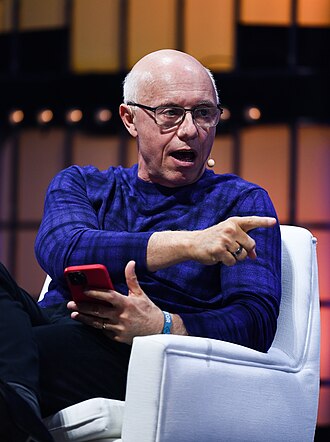
Doug Leone
Longtime leader of Sequoia Capital, now back as chairman
Where to hear and read about Doug Leone1 episode or test

Doug Leone is the immigrant who went from crawling through sailboats at a country club to co-running Sequoia Capital with Michael Moritz for 25 years, then stepped down at 65 and returned as chairman at 69. The thing most worth learning from him is how to stay great for decades: treat fear as fuel, start over at the bottom when the world shifts, chase only true outliers and hold them, and put founders first.
Each time I remade myself, it wasn't really done out of vision of greatness. It was done out of fear of just being gone.
How to Dominate for Decades | Doug Leone, Sequoia Capital
Doug Leone: the story and the lessons
1Doug Leone's path from immigrant kid to Sequoia leader
Leone arrived as an immigrant who couldn't speak English. In high school he was called "pasta", and that early fear of being left out became the root of his later drive.
He later moved from Italy via New York to California and had to learn that the West Coast is less direct than the East Coast.
Watching rich kids at a beach club gave him a chip on his shoulder. At 16 and 17 he crawled through sailboats running wires while the rich kids worked as lifeguards, and he vowed to get them later.
The anger took about 30 years to shed and faded around age 50. He calls it a weakness, because those were not bad kids and he did not want to live in a false narrative.
In his first month as a Sequoia partner he was homeless. A divorce at 30, in which he gave his ex-wife everything, left him on a $400 monthly car allowance, sleeping in his car and showering at 3000 Sand Hill Road for about a week.
An associate then let him stay about three weeks until he could rent an apartment. He stayed calm because he was healthy and knew his future earnings would be terrific, and he calls himself the only homeless partner Sequoia has had.
Don Valentine nearly let him go, then saved him. After Leone pressed a founder too hard, Valentine left a note on the table: "Doug, not fit to listen to founders." Later, when everyone wanted Leone out as insufferable, Valentine asked for a little more time.
Leone says Valentine "saved my ass."
Valentine handed Sequoia to Leone and Moritz on a yellow sheet. When Valentine stepped down in 1993, a note in green pen split the next fund's carry: Mike 1.1, Doug 1.1, another young partner 1.0, and less for the older partners.
The note ended "DTV done?", leaving them to decide what to give him. Older partners had wanted to take over, but Valentine picked the two younger men without a conversation.
He ran Sequoia for 26 years as a servant to his partners. His stance toward the partnership was "You tell me what you need."
He says he helps people because it makes him happy, and calls that selfish because he does it for himself.
2Why Doug Leone stepped down and came back as an analyst
Leone left at 65 so the old king wouldn't hover. As a hired gun rather than the founder, he stepped down on his 65th birthday and chose Roelof Botha as successor, following Valentine's example.
Ten boards and a biotech company did not keep him busy because his companies were all working. He took drum, guitar and piano lessons for about a year and thought he would lose his mind.
His return was settled in one afternoon on one page. After Roelof's exit, Pat Grady and Alfred Lin visited his house 30 days into their tenure and asked him back as chairman.
He now sits in partners meetings, helps spot crucible moments and may make a couple of investments. He asked for 90 days to do nothing and calibrate, and on day 91 he was panicked.
He calls his chairman title meaningless and himself a low-level analyst. After 90 days back, AI felt further away from him, not closer, and he says that if he feels as irrelevant a year after returning he will take himself out.
He would step aside out of kindness, never fear. About 70% of Sequoia's capital comes from nonprofits and charities, so to him it is a business, not a game, and it comes down to results.
Leone sees AI as an industrial-revolution-scale change. He keeps his instincts and checklist but refuses to lean on past experience, focusing on what the world will look like next.
He saw a startup with nothing built wanting to raise at $10 billion pre-money and first thought it was a joke. He has never seen revenue growth at this pace and says he no longer knows what things are worth.
He is rebuilding his deal flow from nothing. His Monday "most important thing" is to call people and network hard, hunting for one of the 20 or 30 investments he will make in his lifetime.
It took guts to tell nine colleagues his week was empty. Founders are now 23 and he has no 23-year-old friends, so his answer is to hustle, which he calls a compulsion he loves.
3How Doug Leone turns fear and discontent into drive
Leone attacks every fear until it becomes a strength. Afraid of public speaking, he made himself the best speaker he could be. Afraid of heights, he climbed 96-foot masts on sailboats.
He says overcoming the challenge gives him a sense of security, and that he loves fear.
He had a root canal without Novocaine, then went to a meeting. He jumped once, then did not move again.
His trick was to compare it to a soldier losing a limb: that is pain with consequences, and his was pain with no consequences.
He has tortured himself his whole life. Asked if he drives himself like Jensen Huang, who wants to "torture them into greatness", Leone answers: "Absolutely. My whole life."
He believes people follow a leader who does it to himself first. He calls himself "a miserable soul on the inside" even though his positive vibe is not an act.
Regret over misses drives him more than success. He thinks about the opportunities he let slip and his investing screw-ups, and says venture as a community has screwed up badly.
He hated the word "content" until two or three years ago because it felt like settling. He finds relief with his kids, grandkids and golf with the same three friends.
Hunger can't be handed to children, he says. He advises injecting some misery into kids' lives, even a fake one, or they won't be hungry.
He notes drive grows from many roots: one partner's rivalry with his twin, another who still wakes at 4:00 to work out decades after a girl on a bus called him fat.
Leone stays grounded by living without handlers. He has no personal assistant, washes his own pans, and most of his friends are from high school, college or Italy in blue-collar jobs.
He sold his fancy cars, no longer wanting ones "with vowels on the end of the name", and counts only about two friends in tech.
4Doug Leone's rules for picking and holding investments
Three questions screen every deal Leone backs. Would he put his kids' money in it, is it one of his 20 lifetime investments, and could it return the whole fund. Fail one and he passes.
The first tests quality, the second separates investable from a home run, and the third forces outlier thinking.
He only wants companies that can return 100 times the money. Of perhaps 200 possible lifetime investments, many return 2x or 3x, and he ignores them.
Sequoia's best gains climbed from $100 million to $500 million, $1 billion, $5 billion, $10 billion, and now about $20 billion on SpaceX, not yet cashed out. He told the partner behind it, "You kind of ruined it for me."
Selling winners too early is venture's costliest mistake. Sequoia sold its quarter of Cisco for a $90 million gain, though Cisco later reached about half a trillion dollars, and Leone's push for distributions at ServiceNow left a 10x on the table.
He says every venture investor has made this mistake, without exception, and that with a sniffer for an unbounded market "you should never sell a share."
Great investments only surprise on the upside. Failure is always a scenario already considered, but when a company runs it runs further than anyone expected, compounding for 20 years after IPO.
Sequoia owns about 20% of Nvidia and 10% of Google. A $5 billion gain compounding can become $50 billion.
Hold the rare compounder for 20 to 25 years. Only five or ten companies a cycle are like this, and most others held too long go away as technology changes.
He cites a banker around 1915 lamenting they'd be billionaires by 1950 had they kept 20% of DuPont, and agrees with Nick Sleep that the best investors are "entrepreneurs who never sold."
5What Doug Leone looks for in founders and hires
Leone wants irreverent founders who don't listen. Traits other VCs treat as negatives are praise to him, for an outlier who wakes three hours into sleep thinking about the problem.
"Who wants a founder that changes his or her mind depending on who they last spoke to?"
His one real skill is a sniffer for people. He walks into a meeting and senses what everyone is thinking and wants to hear, and says he hasn't lost a competitive deal in 30 years except on price.
He calls it EQ, says he doesn't know much about the technology, and uses the same sense to tell a real business from a pipe dream.
He backed David Vélez with no finance background to build Nubank. Leone hired Vélez out of Stanford Business School to open a Brazil office. When Sequoia dropped it, Vélez pitched a credit card business instead, and Sequoia committed $1 million.
Vélez wasn't from Brazil and knew nothing about financial services, but Leone says he had "a heart of a lion." Nubank is now worth about $60 billion.
Vélez stood out within one hour. Moritz sorts interviews into half pages and full pages, and Vélez was a full page. Moritz called Leone before he left the parking lot.
Leone had met 10 to 15 Brazilians who all went into consulting and looked identical. Vélez showed smarts, drive, clarity, toughness, goodness and judgment beyond his years.
Fred Luddy won Sequoia by listing everything wrong with ServiceNow. Luddy reduced workflow to its simplest form, one person asking and another answering, which Leone says became ServiceNow's foundation.
Leone likes similar bluntness in Israeli founders: talks have no holds barred, nothing is personal, and they reach agreement in 15 minutes.
Sequoia's hiring spec shrank to hypercompetitive with a heart of gold. It means people who will walk through walls to win ethically and do the right thing when it is highly inconvenient.
The same outlier standard applies to the founders Sequoia backs: "We look a lot like our founders. We don't give up."
A startup's first hires must be up-and-comers. No established star joins a startup because made people play it safer, so founders need an eye for rising talent in sales and marketing.
After the product is clear, the job is the first 10 engineers and first salesperson, which Leone thinks Sequoia handles best in the world.
6How Doug Leone helps founders build a business
Leone builds the business, not the technology. He sits on boards in fields he doesn't know and helps with market analysis, demand gen, revenue, support and accounting, where companies often break.
"I'm not a product manager type." If founders needed him for 10 to 20% of product shaping, he says, "we're in big trouble."
Sequoia's order is founder first, client second, partners third. Leone says doing right by founders brings the returns that get shared.
The rule came out of Valentine's school of hard knocks, including the note that Leone was not fit to listen to founders.
Trust is the zeroth tenet of Sequoia. He wrote performance and teamwork as the tenets, then added trust as number zero because it lets a firm decide quickly.
He teaches that trust has two parts, knowledge and intention, and both must be checked. "If you have trust in an organization, you can fly."
He earns founder trust by helping when they are down. Founders want him on the board but fear him, so he defuses it with humor and says up front he doesn't want to screw it up. Trust takes about a year.
He answers the first request for help fast and saves pressure for when ego is up, after a founder beats the quarter by 30%. "Don't turn the screws when they're down."
Leone honors a signed term sheet even when a higher bid appears. Once both sides sign, he won't take a better offer three days later.
He sees doing business the correct way as part of fiduciary duty and of keeping a company's culture clean.
Keeping the founder preserves the company's soul. Companies reinvent themselves when the founder is still there, as Apple did under Jobs and Nvidia did turning from graphics chips into an AI company.
No graphics chip company had survived two cycles before Nvidia. "Once you lose that founder, you do lose the soul of the company."
7Doug Leone on boards, disagreement and hard feedback
Architect your board the way you architect your product. A board is a mate for five to seven years, yet founders pick it like a date in a bar or take the first term sheet.
Choose for complementary skills and temperament, someone who has been through the cycle. An engineer founder gains nothing from an engineer on the board, and the early discomfort is where learning comes from.
Most venture board members add little and some do damage. Of ten venture investors he estimates about 30% are incompetent, 40% nod along harmlessly, and only 20% to 30% know what they're doing.
Many protect their standing, needing a win or an exit, so the founder gets a shadow of the firm.
Sequoia has real conversations, takes a break, then aligns fully. When tempers rise, a 5 or 10 minute break cools the room by about 10 degrees, then partners reach one answer and the matter is closed.
He won't call it arguing because that implies combat, and he runs boards the same way.
Feedback must be delivered so it can be acted on. Telling a founder the VP of sales sucks gets nowhere. Offering to introduce two strong VPs lets the founder see the gap alone.
Right way, time, tone and words, with examples. Leone admits he is too direct and admired Jim Breyer, who could turn down founders so they felt they'd won the lottery.
8What Doug Leone learned from Michael Moritz
Leone and Moritz were opposites who co-ran Sequoia for 25 years. Leone calls Moritz a cold-blooded strategic Brit and himself a gregarious, tactical Italian.
He kept a little black dictionary in his desk and slipped out to look up Moritz's words. Each was painful for the other, and making it work is his badge of honor.
Moritz taught him to listen to exact words. Leone now notes the words, timing, adjectives and whether someone says "I" or "we", since founders are often backed on a pitch with no code.
Moritz used to quote Leone's own words back to him, which drove him nuts until he adopted the habit.
Small habits like "to, from" carried big lessons. Moritz switched Sequoia memos from "from, to" to "to, from", putting the recipient first.
Leone calls it one of hundreds of small lessons.
Moritz's gift was asking what happens if everything goes right. Leone calls him the best in the world at dreaming broadly rather than hedging.
He points to the spectacular list of companies Moritz backed.

How to Dominate for Decades | Doug Leone, Sequoia Capital
Doug Leone shows how an investor lasts for decades by treating fear as fuel, starting over at the bottom, and helping founders turn products into businesses. His three-question filter for chasing only 100x outliers, and his regret over selling winners too early, are the clearest lessons in the story.
Leone arrived as an immigrant who couldn't speak English. In high school he was called "pasta", and that early fear of being left out became the root of his later drive.
He later moved from Italy via New York to California and had to learn that the West Coast is less direct than the East Coast.
Watching rich kids at a beach club gave him a chip on his shoulder. At 16 and 17 he crawled through sailboats running wires while the rich kids worked as lifeguards, and he vowed to get them later.
The anger took about 30 years to shed and faded around age 50. He calls it a weakness, because those were not bad kids and he did not want to live in a false narrative.
In his first month as a Sequoia partner he was homeless. A divorce at 30, in which he gave his ex-wife everything, left him on a $400 monthly car allowance, sleeping in his car and showering at 3000 Sand Hill Road for about a week.
An associate then let him stay about three weeks until he could rent an apartment. He stayed calm because he was healthy and knew his future earnings would be terrific, and he calls himself the only homeless partner Sequoia has had.
Don Valentine nearly let him go, then saved him. After Leone pressed a founder too hard, Valentine left a note on the table: "Doug, not fit to listen to founders." Later, when everyone wanted Leone out as insufferable, Valentine asked for a little more time.
Leone says Valentine "saved my ass."
Valentine handed Sequoia to Leone and Moritz on a yellow sheet. When Valentine stepped down in 1993, a note in green pen split the next fund's carry: Mike 1.1, Doug 1.1, another young partner 1.0, and less for the older partners.
The note ended "DTV done?", leaving them to decide what to give him. Older partners had wanted to take over, but Valentine picked the two younger men without a conversation.
He ran Sequoia for 26 years as a servant to his partners. His stance toward the partnership was "You tell me what you need."
He says he helps people because it makes him happy, and calls that selfish because he does it for himself.
Leone left at 65 so the old king wouldn't hover. As a hired gun rather than the founder, he stepped down on his 65th birthday and chose Roelof Botha as successor, following Valentine's example.
Ten boards and a biotech company did not keep him busy because his companies were all working. He took drum, guitar and piano lessons for about a year and thought he would lose his mind.
His return was settled in one afternoon on one page. After Roelof's exit, Pat Grady and Alfred Lin visited his house 30 days into their tenure and asked him back as chairman.
He now sits in partners meetings, helps spot crucible moments and may make a couple of investments. He asked for 90 days to do nothing and calibrate, and on day 91 he was panicked.
He calls his chairman title meaningless and himself a low-level analyst. After 90 days back, AI felt further away from him, not closer, and he says that if he feels as irrelevant a year after returning he will take himself out.
He would step aside out of kindness, never fear. About 70% of Sequoia's capital comes from nonprofits and charities, so to him it is a business, not a game, and it comes down to results.
Leone sees AI as an industrial-revolution-scale change. He keeps his instincts and checklist but refuses to lean on past experience, focusing on what the world will look like next.
He saw a startup with nothing built wanting to raise at $10 billion pre-money and first thought it was a joke. He has never seen revenue growth at this pace and says he no longer knows what things are worth.
He is rebuilding his deal flow from nothing. His Monday "most important thing" is to call people and network hard, hunting for one of the 20 or 30 investments he will make in his lifetime.
It took guts to tell nine colleagues his week was empty. Founders are now 23 and he has no 23-year-old friends, so his answer is to hustle, which he calls a compulsion he loves.
Leone attacks every fear until it becomes a strength. Afraid of public speaking, he made himself the best speaker he could be. Afraid of heights, he climbed 96-foot masts on sailboats.
He says overcoming the challenge gives him a sense of security, and that he loves fear.
He had a root canal without Novocaine, then went to a meeting. He jumped once, then did not move again.
His trick was to compare it to a soldier losing a limb: that is pain with consequences, and his was pain with no consequences.
He has tortured himself his whole life. Asked if he drives himself like Jensen Huang, who wants to "torture them into greatness", Leone answers: "Absolutely. My whole life."
He believes people follow a leader who does it to himself first. He calls himself "a miserable soul on the inside" even though his positive vibe is not an act.
Regret over misses drives him more than success. He thinks about the opportunities he let slip and his investing screw-ups, and says venture as a community has screwed up badly.
He hated the word "content" until two or three years ago because it felt like settling. He finds relief with his kids, grandkids and golf with the same three friends.
Hunger can't be handed to children, he says. He advises injecting some misery into kids' lives, even a fake one, or they won't be hungry.
He notes drive grows from many roots: one partner's rivalry with his twin, another who still wakes at 4:00 to work out decades after a girl on a bus called him fat.
Leone stays grounded by living without handlers. He has no personal assistant, washes his own pans, and most of his friends are from high school, college or Italy in blue-collar jobs.
He sold his fancy cars, no longer wanting ones "with vowels on the end of the name", and counts only about two friends in tech.
Three questions screen every deal Leone backs. Would he put his kids' money in it, is it one of his 20 lifetime investments, and could it return the whole fund. Fail one and he passes.
The first tests quality, the second separates investable from a home run, and the third forces outlier thinking.
He only wants companies that can return 100 times the money. Of perhaps 200 possible lifetime investments, many return 2x or 3x, and he ignores them.
Sequoia's best gains climbed from $100 million to $500 million, $1 billion, $5 billion, $10 billion, and now about $20 billion on SpaceX, not yet cashed out. He told the partner behind it, "You kind of ruined it for me."
Selling winners too early is venture's costliest mistake. Sequoia sold its quarter of Cisco for a $90 million gain, though Cisco later reached about half a trillion dollars, and Leone's push for distributions at ServiceNow left a 10x on the table.
He says every venture investor has made this mistake, without exception, and that with a sniffer for an unbounded market "you should never sell a share."
Great investments only surprise on the upside. Failure is always a scenario already considered, but when a company runs it runs further than anyone expected, compounding for 20 years after IPO.
Sequoia owns about 20% of Nvidia and 10% of Google. A $5 billion gain compounding can become $50 billion.
Hold the rare compounder for 20 to 25 years. Only five or ten companies a cycle are like this, and most others held too long go away as technology changes.
He cites a banker around 1915 lamenting they'd be billionaires by 1950 had they kept 20% of DuPont, and agrees with Nick Sleep that the best investors are "entrepreneurs who never sold."
Leone wants irreverent founders who don't listen. Traits other VCs treat as negatives are praise to him, for an outlier who wakes three hours into sleep thinking about the problem.
"Who wants a founder that changes his or her mind depending on who they last spoke to?"
His one real skill is a sniffer for people. He walks into a meeting and senses what everyone is thinking and wants to hear, and says he hasn't lost a competitive deal in 30 years except on price.
He calls it EQ, says he doesn't know much about the technology, and uses the same sense to tell a real business from a pipe dream.
He backed David Vélez with no finance background to build Nubank. Leone hired Vélez out of Stanford Business School to open a Brazil office. When Sequoia dropped it, Vélez pitched a credit card business instead, and Sequoia committed $1 million.
Vélez wasn't from Brazil and knew nothing about financial services, but Leone says he had "a heart of a lion." Nubank is now worth about $60 billion.
Vélez stood out within one hour. Moritz sorts interviews into half pages and full pages, and Vélez was a full page. Moritz called Leone before he left the parking lot.
Leone had met 10 to 15 Brazilians who all went into consulting and looked identical. Vélez showed smarts, drive, clarity, toughness, goodness and judgment beyond his years.
Fred Luddy won Sequoia by listing everything wrong with ServiceNow. Luddy reduced workflow to its simplest form, one person asking and another answering, which Leone says became ServiceNow's foundation.
Leone likes similar bluntness in Israeli founders: talks have no holds barred, nothing is personal, and they reach agreement in 15 minutes.
Sequoia's hiring spec shrank to hypercompetitive with a heart of gold. It means people who will walk through walls to win ethically and do the right thing when it is highly inconvenient.
The same outlier standard applies to the founders Sequoia backs: "We look a lot like our founders. We don't give up."
A startup's first hires must be up-and-comers. No established star joins a startup because made people play it safer, so founders need an eye for rising talent in sales and marketing.
After the product is clear, the job is the first 10 engineers and first salesperson, which Leone thinks Sequoia handles best in the world.
Leone builds the business, not the technology. He sits on boards in fields he doesn't know and helps with market analysis, demand gen, revenue, support and accounting, where companies often break.
"I'm not a product manager type." If founders needed him for 10 to 20% of product shaping, he says, "we're in big trouble."
Sequoia's order is founder first, client second, partners third. Leone says doing right by founders brings the returns that get shared.
The rule came out of Valentine's school of hard knocks, including the note that Leone was not fit to listen to founders.
Trust is the zeroth tenet of Sequoia. He wrote performance and teamwork as the tenets, then added trust as number zero because it lets a firm decide quickly.
He teaches that trust has two parts, knowledge and intention, and both must be checked. "If you have trust in an organization, you can fly."
He earns founder trust by helping when they are down. Founders want him on the board but fear him, so he defuses it with humor and says up front he doesn't want to screw it up. Trust takes about a year.
He answers the first request for help fast and saves pressure for when ego is up, after a founder beats the quarter by 30%. "Don't turn the screws when they're down."
Leone honors a signed term sheet even when a higher bid appears. Once both sides sign, he won't take a better offer three days later.
He sees doing business the correct way as part of fiduciary duty and of keeping a company's culture clean.
Keeping the founder preserves the company's soul. Companies reinvent themselves when the founder is still there, as Apple did under Jobs and Nvidia did turning from graphics chips into an AI company.
No graphics chip company had survived two cycles before Nvidia. "Once you lose that founder, you do lose the soul of the company."
Architect your board the way you architect your product. A board is a mate for five to seven years, yet founders pick it like a date in a bar or take the first term sheet.
Choose for complementary skills and temperament, someone who has been through the cycle. An engineer founder gains nothing from an engineer on the board, and the early discomfort is where learning comes from.
Most venture board members add little and some do damage. Of ten venture investors he estimates about 30% are incompetent, 40% nod along harmlessly, and only 20% to 30% know what they're doing.
Many protect their standing, needing a win or an exit, so the founder gets a shadow of the firm.
Sequoia has real conversations, takes a break, then aligns fully. When tempers rise, a 5 or 10 minute break cools the room by about 10 degrees, then partners reach one answer and the matter is closed.
He won't call it arguing because that implies combat, and he runs boards the same way.
Feedback must be delivered so it can be acted on. Telling a founder the VP of sales sucks gets nowhere. Offering to introduce two strong VPs lets the founder see the gap alone.
Right way, time, tone and words, with examples. Leone admits he is too direct and admired Jim Breyer, who could turn down founders so they felt they'd won the lottery.
Leone and Moritz were opposites who co-ran Sequoia for 25 years. Leone calls Moritz a cold-blooded strategic Brit and himself a gregarious, tactical Italian.
He kept a little black dictionary in his desk and slipped out to look up Moritz's words. Each was painful for the other, and making it work is his badge of honor.
Moritz taught him to listen to exact words. Leone now notes the words, timing, adjectives and whether someone says "I" or "we", since founders are often backed on a pitch with no code.
Moritz used to quote Leone's own words back to him, which drove him nuts until he adopted the habit.
Small habits like "to, from" carried big lessons. Moritz switched Sequoia memos from "from, to" to "to, from", putting the recipient first.
Leone calls it one of hundreds of small lessons.
Moritz's gift was asking what happens if everything goes right. Leone calls him the best in the world at dreaming broadly rather than hedging.
He points to the spectacular list of companies Moritz backed.