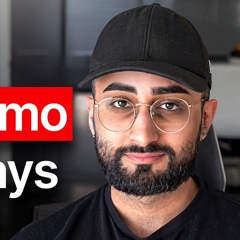
Dillion Verma
Founder of Halo AI, bootstrapped consumer app builder
Where to hear and read about Dillion Verma1 episode or test

Dillion Verma is a first-time consumer app founder who took the AI photo editor Halo AI to $300k MRR in 45 days, after 18 months of failed products. The thing most worth learning from him is to treat UGC as math: one proven viral format, many paid creators, and pay that rewards views.
One format, 1.2 billion views. There's no deviation of that.
0 to $300k/mo in 45 days with my ai app (just copy me)
Dillion Verma: the story and the lessons
1How Dillion Verma went from failed products to $300k MRR
Dillion built Halo AI after 18 months of failed products. He had built startups full-time since 2022, mostly developer tools, with no breakout. Halo was his first consumer app, and he and his partner Krishan worked 14 hours a day for months.
He called it his last Hail Mary, since he had almost no money left and a miss meant going broke.
He built Halo in two or three weeks on a new model API. Krishan spotted the new Gemini API in July, and the app went live in mid to late October. Users upload a photo, write a prompt and get an edited image.
The first $5 of MRR was Dillion testing the app himself, around October 20 to 22. He had no UGC or marketing experience and relied on stories from Twitter and YouTube.
Growth followed the creator count and then took off. Creators grew from about 10 to 25 to 85, and revenue tracked them. Early on he just told a group to post videos and growth was slow, then he found a feel for it midway.
The result was 600 million views in 60 days and 1.2 billion in 120 days, at roughly 300 posts a day.
Revenue plateaued at $300K, as he had forecast. He had predicted the plateau in advance from the same views-times-conversion math. He plans paid ads to reach $1M a month.
Existing viral videos already convert, so they give ads a quick start, but they won't reach $1M alone. He plans varied content for each awareness level on Meta.
2Dillion's UGC math and the one-format rule
Dillion models revenue as views times conversion and works only those two. Views split further into creators, videos per creator, platforms and views per post, so each variable has a clear lever. He pushes every lever up daily for weeks.
"Our revenue is equivalent to the number of views we get times the conversion rate of those views."
He runs one strict video format with no deviation. Many UGC teams test about 10 angles at once. Halo gives every creator one fixed format, and conversion stays steady at about 0.3% to 0.5% of viewers.
A proven format makes results predictable and lets anyone produce it. Trial creators post the same format, so judging is like for like.
He judges a format on three tests: viral, repeatable, converting. Halo's format is an absurd AI image hook, a demo with a big app logo loading screen for about 2 seconds, then a text-message prank story with a twist. One example hook was "Pranking my dad I cooked his koi fish".
The angry dad, a nod to Asian parents, is the payoff viewers wait for. Nothing follows the text story.
He uses fresh accounts because reach no longer needs followers. Platforms stopped needing followers for reach in 2022, so a brand new account's first video can reach 10 million views. About 5% of videos pass 100K views and 1% pass a million.
A video with real viral potential tends to do well on every platform, and a million-view TikTok can often get about a million more on Instagram.
He leaves posting uncapped but ramps TikTok volume gradually. Some creators post 20 videos a day or more, about 80 posts across four platforms. YouTube and Instagram don't limit volume.
TikTok works best by ramping from three a day to five to ten until the account is warmed up.
3How Dillion recruits, tests and pays 85 creators
Dillion recruits creators from Facebook and Reddit UGC groups. Hundreds of applicants came in, 30 to 50 a day, with 500 to 600 at the start. He filters for past UGC experience, app or tech experience, and a US base or US VPN.
US viewers drive most app and shopping revenue. He recommends the Facebook groups most.
He runs a cheap paid trial and judges creators on three things. Trial creators post five videos on four platforms, 20 posts, for $100 total, in a Discord with a private channel each. They pass on consistency, proactive communication and a sense of viral editing.
He sets no view minimum because only 5% to 10% of videos go viral and five videos are too few to expect a hit. People who miss the hook, build-up and payoff structure don't learn it, even after many retries.
He pays a base per video plus view milestone bonuses. Pay is $20 per video, with bonuses of $60, $200, $500 and $800 at 20K, 100K, 500K and 1M views. Only one of a video's four posts has to hit, and bonuses do not stack.
Views between milestones are never paid for, so effective cost stays under $1 per thousand views. Offered milestones or a slightly higher CPM, 29 of 30 creators chose milestones, and it is easier to run.
He built a creator community, not just post-and-pay. All creators share one Discord with channels for wins, ideas and feedback, and many chat in voice daily. Milestones make creators ask each other to repost and comment.
"The camaraderie helps them like be motivated to like keep building things." He says few people talk about the value of this community.
4How Halo copies every hit and coaches with an AI agent
Every viral video is recreated by all creators the same day. An automation sends each hit to every creator in the Discord. A 10 million view original becomes dozens of copies that often get 2 to 3 million views each.
Power law applies among creators too, so copies must keep the element that sparked the hit. In the koi video, one specific conversation set off the comments.
He trained an OpenClaw agent on million-view videos to write scripts. Videos over a million views are downloaded and run through Gemini for transcripts and summaries, stored as local text files. Creators ask the agent for scripts and it pattern matches on what worked.
Scrape Creators supplies trending keywords and hashtags, such as the Olympics. Sounds affect virality but hashtags don't, though they reveal trends.
5How Dillion monetizes Halo and where he goes next
Halo shows a skippable paywall first, then a gated one. The onboarding paywall can be closed so users browse, and a second paywall appears when they submit a prompt. Each converts at 16.5%, and the two together convert higher than one alone.
His theory is that undecided users lack trust, and at the moment of action they are right at the border. The dashboard shows trending examples like hairstyles, room decor and tattoos to recreate the pull of the viral TikTok.
He defaults to a weekly plan with a free trial. The main paywall has three pages, a trial-end reminder and a price of $8.99 per week. Yearly was tested, dropped and is being tested again.
Extra paywalls cover an exit offer, an abandoned cart and a cancelled trial. There are no re-engagement notifications yet.
He sees entertainment apps as weak on retention. Halo's viral entertainment drives downloads but not lasting use, and part of the demand is AI hype. He wants to focus on health, wealth and relationships for high retention and LTV.
Core problems like removing people from backgrounds or improving dating photos last longer. His next apps pair a new model with proven demand: pick a modality, find existing demand, then build.
He prefers consumer apps to his earlier B2B tools. Consumer gives quick feedback loops and instant results, and it needs little capital. He plans more consumer apps.
6Dillion's bootstrapping rules and mistakes
He tested the ROI of paid UGC before borrowing to scale. One video at about a million views showed steady conversion, and early math gave an LTV to CAC of about 5 to 1 or 6 to 1. He then took a $100k personal loan and put it all into creator payments.
"I just saw six to one. I was like, okay, like just just take out all of my money." Growth ran at break even for four to five weeks, then reached roughly 50% margin.
He puts all profit back into growth. The goal is to grow at all costs, so marketing spend takes everything. He calls the current margin zero, and each month's spend makes the next month bigger.
The loan first went to paying creators, since there was no other cash for it.
He learned UGC from first principles because no central source existed. He watched other programs and asked creators and operators. He says mass UGC beats influencer marketing on margin, since influencers convert well but cost a lot.
His conviction came from necessity, since failure was the default.
He kept a weak creator two to three weeks too long. Delayed calls compound at scale. He now acts the day he notices something is not working and trusts the gut feeling that something is off.
His advice is to "make the hard decision like as early as possible."

0 to $300k/mo in 45 days with my ai app (just copy me)
A first-time consumer app founder explains how one repeatable TikTok format, 85 paid UGC creators and a milestone bonus structure took an AI photo editor to $300k MRR in 45 days. The result is 600 million views in 60 days and 1.2 billion in 120 days, scaled with a $100k personal loan after one video showed roughly 6x return.
Dillion built Halo AI after 18 months of failed products. He had built startups full-time since 2022, mostly developer tools, with no breakout. Halo was his first consumer app, and he and his partner Krishan worked 14 hours a day for months.
He called it his last Hail Mary, since he had almost no money left and a miss meant going broke.
He built Halo in two or three weeks on a new model API. Krishan spotted the new Gemini API in July, and the app went live in mid to late October. Users upload a photo, write a prompt and get an edited image.
The first $5 of MRR was Dillion testing the app himself, around October 20 to 22. He had no UGC or marketing experience and relied on stories from Twitter and YouTube.
Growth followed the creator count and then took off. Creators grew from about 10 to 25 to 85, and revenue tracked them. Early on he just told a group to post videos and growth was slow, then he found a feel for it midway.
The result was 600 million views in 60 days and 1.2 billion in 120 days, at roughly 300 posts a day.
Revenue plateaued at $300K, as he had forecast. He had predicted the plateau in advance from the same views-times-conversion math. He plans paid ads to reach $1M a month.
Existing viral videos already convert, so they give ads a quick start, but they won't reach $1M alone. He plans varied content for each awareness level on Meta.
Dillion models revenue as views times conversion and works only those two. Views split further into creators, videos per creator, platforms and views per post, so each variable has a clear lever. He pushes every lever up daily for weeks.
"Our revenue is equivalent to the number of views we get times the conversion rate of those views."
He runs one strict video format with no deviation. Many UGC teams test about 10 angles at once. Halo gives every creator one fixed format, and conversion stays steady at about 0.3% to 0.5% of viewers.
A proven format makes results predictable and lets anyone produce it. Trial creators post the same format, so judging is like for like.
He judges a format on three tests: viral, repeatable, converting. Halo's format is an absurd AI image hook, a demo with a big app logo loading screen for about 2 seconds, then a text-message prank story with a twist. One example hook was "Pranking my dad I cooked his koi fish".
The angry dad, a nod to Asian parents, is the payoff viewers wait for. Nothing follows the text story.
He uses fresh accounts because reach no longer needs followers. Platforms stopped needing followers for reach in 2022, so a brand new account's first video can reach 10 million views. About 5% of videos pass 100K views and 1% pass a million.
A video with real viral potential tends to do well on every platform, and a million-view TikTok can often get about a million more on Instagram.
He leaves posting uncapped but ramps TikTok volume gradually. Some creators post 20 videos a day or more, about 80 posts across four platforms. YouTube and Instagram don't limit volume.
TikTok works best by ramping from three a day to five to ten until the account is warmed up.
Dillion recruits creators from Facebook and Reddit UGC groups. Hundreds of applicants came in, 30 to 50 a day, with 500 to 600 at the start. He filters for past UGC experience, app or tech experience, and a US base or US VPN.
US viewers drive most app and shopping revenue. He recommends the Facebook groups most.
He runs a cheap paid trial and judges creators on three things. Trial creators post five videos on four platforms, 20 posts, for $100 total, in a Discord with a private channel each. They pass on consistency, proactive communication and a sense of viral editing.
He sets no view minimum because only 5% to 10% of videos go viral and five videos are too few to expect a hit. People who miss the hook, build-up and payoff structure don't learn it, even after many retries.
He pays a base per video plus view milestone bonuses. Pay is $20 per video, with bonuses of $60, $200, $500 and $800 at 20K, 100K, 500K and 1M views. Only one of a video's four posts has to hit, and bonuses do not stack.
Views between milestones are never paid for, so effective cost stays under $1 per thousand views. Offered milestones or a slightly higher CPM, 29 of 30 creators chose milestones, and it is easier to run.
He built a creator community, not just post-and-pay. All creators share one Discord with channels for wins, ideas and feedback, and many chat in voice daily. Milestones make creators ask each other to repost and comment.
"The camaraderie helps them like be motivated to like keep building things." He says few people talk about the value of this community.
Every viral video is recreated by all creators the same day. An automation sends each hit to every creator in the Discord. A 10 million view original becomes dozens of copies that often get 2 to 3 million views each.
Power law applies among creators too, so copies must keep the element that sparked the hit. In the koi video, one specific conversation set off the comments.
He trained an OpenClaw agent on million-view videos to write scripts. Videos over a million views are downloaded and run through Gemini for transcripts and summaries, stored as local text files. Creators ask the agent for scripts and it pattern matches on what worked.
Scrape Creators supplies trending keywords and hashtags, such as the Olympics. Sounds affect virality but hashtags don't, though they reveal trends.
Halo shows a skippable paywall first, then a gated one. The onboarding paywall can be closed so users browse, and a second paywall appears when they submit a prompt. Each converts at 16.5%, and the two together convert higher than one alone.
His theory is that undecided users lack trust, and at the moment of action they are right at the border. The dashboard shows trending examples like hairstyles, room decor and tattoos to recreate the pull of the viral TikTok.
He defaults to a weekly plan with a free trial. The main paywall has three pages, a trial-end reminder and a price of $8.99 per week. Yearly was tested, dropped and is being tested again.
Extra paywalls cover an exit offer, an abandoned cart and a cancelled trial. There are no re-engagement notifications yet.
He sees entertainment apps as weak on retention. Halo's viral entertainment drives downloads but not lasting use, and part of the demand is AI hype. He wants to focus on health, wealth and relationships for high retention and LTV.
Core problems like removing people from backgrounds or improving dating photos last longer. His next apps pair a new model with proven demand: pick a modality, find existing demand, then build.
He prefers consumer apps to his earlier B2B tools. Consumer gives quick feedback loops and instant results, and it needs little capital. He plans more consumer apps.
He tested the ROI of paid UGC before borrowing to scale. One video at about a million views showed steady conversion, and early math gave an LTV to CAC of about 5 to 1 or 6 to 1. He then took a $100k personal loan and put it all into creator payments.
"I just saw six to one. I was like, okay, like just just take out all of my money." Growth ran at break even for four to five weeks, then reached roughly 50% margin.
He puts all profit back into growth. The goal is to grow at all costs, so marketing spend takes everything. He calls the current margin zero, and each month's spend makes the next month bigger.
The loan first went to paying creators, since there was no other cash for it.
He learned UGC from first principles because no central source existed. He watched other programs and asked creators and operators. He says mass UGC beats influencer marketing on margin, since influencers convert well but cost a lot.
His conviction came from necessity, since failure was the default.
He kept a weak creator two to three weeks too long. Delayed calls compound at scale. He now acts the day he notices something is not working and trusts the gut feeling that something is off.
His advice is to "make the hard decision like as early as possible."