
Halo AI
An AI photo editor where users upload a photo, write a prompt and get an edited image.
Halo AI went from $5 to $300k MRR in 45 days by pairing about 85 UGC creators, who posted roughly 300 times a day in one fixed prank-story format, with a weekly $8.99 trial plan. That produced 1.2 billion views, and both paywalls converted at 16.5%. A $100K loan funded it, reaching about 50% margin. Lesson: treat revenue as views times conversion, and optimize only those.
- 1Recruit creatorsRoster grew 10 to 25 to 85
- 2Post many videos eachSome creators post 20 videos a day
- 3Spread across platformsInstagram, TikTok, Facebook and YouTube
- 4Collect views1.2 billion views in 120 days
- 5Convert viewersSteady 0.3% to 0.5% conversion
From Dillion Verma on Halo AI's growth
What was said about Halo AI
1How Halo AI reached $300k MRR in 45 days
Halo AI was a quick build on a new model API. Dillion Verma and his partner Krishan built the AI photo editor in two or three weeks after Krishan spotted the new Gemini API in July. It went live in mid to late October, and the first $5 of MRR was Dillion testing it himself around October 20 to 22.
It was Dillion's first consumer app after 18 months of failed products, and he had almost no money and no UGC or marketing experience. He learned from stories on Twitter and YouTube and called the app his "last Hail Mary."
Treat UGC growth as revenue equals views times conversion. Dillion reduced growth to one equation and worked only on raising views and conversion. Views split into creators, times videos per creator, times platforms, times views per post, so each variable has its own lever.
A hook-and-demo video converted a steady 0.3% to 0.5% of viewers however often the format was posted, which let him forecast the $300K plateau in advance. "Our revenue is equivalent to the number of views we get times the conversion rate of those views."
Prove a paid UGC multiple before borrowing to scale it. One early video at about a million views showed conversion holding constant, and the math gave an LTV to CAC of about 5 or 6 to 1. Dillion took a $100K loan, ran at break even for four to five weeks, and now runs at about 50% margin.
"I just saw six to one. I was like, okay, just take out all of my money." The $300K MRR and 50% margin are his own figures with no proof shown, and churn and the share of revenue from weekly subscribers are not covered.
Revenue tracked the number of creators posting. Revenue grew as the roster went from about 10 to 25 to 85 creators, reaching roughly 300 posts a day and 1.2 billion views.
Early on he just told a group to post videos and growth was slow; it took off once he found a feel for it. Videos run on Instagram, TikTok, Facebook and YouTube, and about 100 million people in the US have both Instagram and an iPhone, so reach was rarely the limit.
2One strict viral format, copied by everyone
- 1One video goes viralA 10 million view hit
- 2Automation alerts DiscordSent to every creator
- 3Creators recreate itSame day, on their own accounts
- 4Copies go viral tooDozens at 2 to 3 million each
From Dillion Verma on Halo AI's growth
Run one fixed format with no deviation across all creators. Instead of testing many angles, every creator, including trialists, posts the same tightly specified format. One format produced 1.2 billion views in 120 days.
Many UGC teams run 10 content angles at once. Because conversion stays roughly constant per format, a proven one makes results predictable and lets anyone produce it. "There's no deviation of that."
Pick a format that is viral, repeatable and converts. Halo's format is an absurd AI image hook, a screen recording of the app with a big logo loading screen for about 2 seconds, then a text-message prank story with a build-up and a twist.
The sample hit is "Pranking my dad I cooked his koi fish," where the angry dad, a reference to Asian parents, is the payoff viewers wait for. The app name appears only on the loading screen.
Brand new accounts can go viral, so followers don't matter. Since about 2022 platforms no longer need followers for reach, so a first video can hit 10 million views. About 5% of Halo's videos pass 100K views and 1% pass a million.
A video with real viral potential tends to do well on every platform, and a TikTok with a million views can often get about a million more on Instagram at no extra cost.
Have every creator recreate each viral hit the same day. An automation sends each viral video to all creators in the Discord, who recreate it on their own accounts. A 10 million view hit becomes dozens of copies at 2 to 3 million views each.
Copies must keep the element that sparked the hit; in the koi video it was one specific conversation that set off the comments. Power law still applies, with a few creators driving most views.
An AI agent trained on million-view videos writes creators' scripts. Every video over a million views was run through Gemini for a transcript and summary, stored in local text files an OpenClaw agent searches when creators ask for scripts. Many creators use it daily.
Scrape Creators supplies trending TikTok keywords and hashtags, such as the Olympics. Sounds affect virality but hashtags don't, though hashtags reveal trends.
3Recruiting, trialing and paying 85 creators
Recruit US creators with app experience from Facebook and Reddit groups. Job posts in Reddit UGC groups and hundreds of Facebook UGC groups drew 30 to 50 applicants a day, about 500 to 600 at the start. Dillion recommends the Facebook groups most.
Applicants need past UGC experience and must be US based or on a US VPN so accounts reach US viewers, where most app revenue comes from. App or tech UGC experience is preferred over clothing e-commerce.
A $100 five-video trial filters on behavior, not views. Trialists get $20 per video for five videos, each posted on four platforms, from a private Discord channel over 4 or 5 days. They pass on consistency, proactive communication and a sense of viral editing: emotional hook, build-up, payoff.
There is no minimum view bar because only 5% to 10% of videos go viral and five is too few to expect a hit. People who miss the viral structure don't learn it even after many retries. Native English speakers write better hooks, and Gen Z creators suit the young audience.
Base pay plus view milestones beat CPM for creators and cost. Creators get $20 per video plus about $60, $200, $500 and $800 at 20K, 100K, 500K and 1M views. Offered this or a slightly higher-paying CPM deal, 29 of 30 creators chose milestones.
Only one post per video needs to hit a milestone and bonuses don't stack. Because views between milestones aren't paid, cost averages under $1 per thousand views, and the plan is easier to run.
Leave posting uncapped, but ramp TikTok volume slowly. Some creators post 20 videos a day, about 80 posts across four platforms. YouTube and Instagram don't penalize volume; TikTok works best ramped from three to five to ten a day as the account warms up.
Facebook was too new to the team to judge.
A Discord community makes creators' learning compound. All creators share one Discord with channels for wins, ideas and feedback, and they chat in voice daily as friends. Milestones turn posting into a game where creators ask each other for engagement.
Many UGC programs are just "post a video, get paid," so nothing compounds. "The camaraderie helps them be motivated to keep building things."
Cut underperforming creators the day you notice. Dillion kept one weak creator two or three weeks longer than he should have, and small delays compound at scale.
"Make the hard decision as early as possible."
4Halo AI's two paywalls and weekly pricing
A skippable onboarding paywall plus a hard one at first send. Users see a closable paywall in onboarding, then browse templates, upload a photo and write a prompt; hitting send requires sign in and a second, gated paywall. Each converts at 16.5%, and together they beat either alone.
Unsure users get to see what the app does before paying.
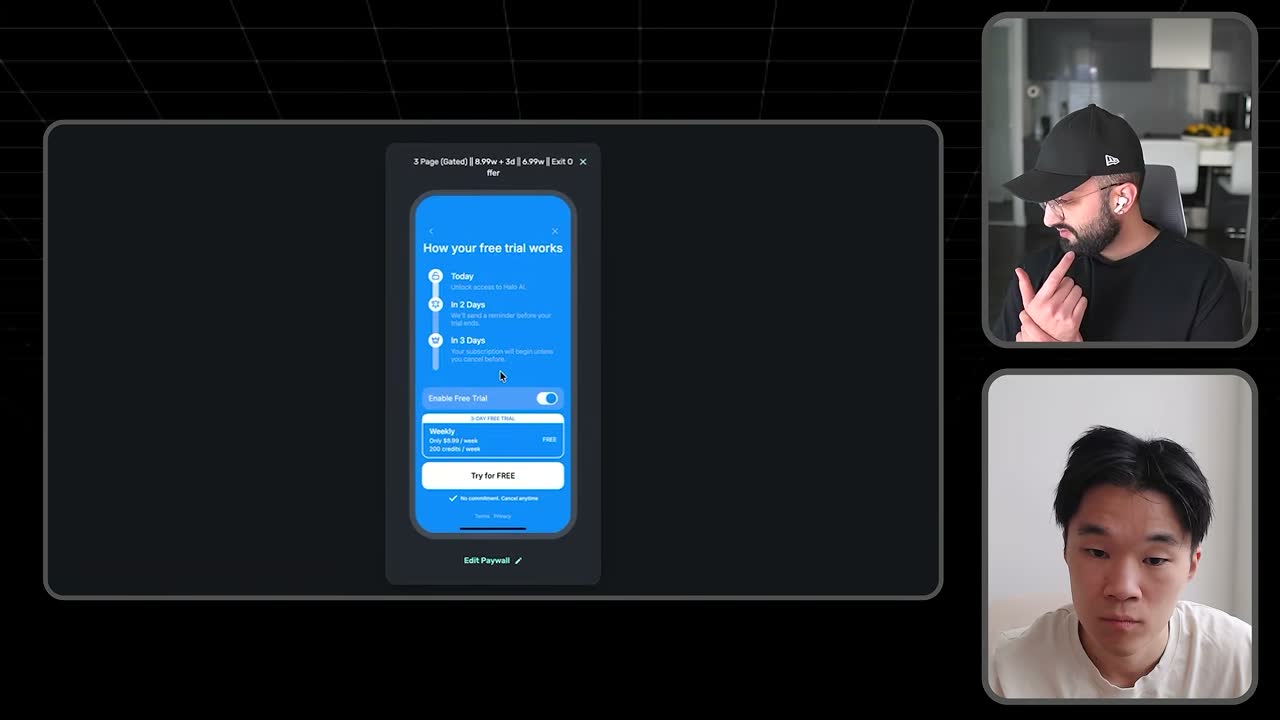
Halo AI's gated paywall: 3-day free trial, then $8.99 weekly with 200 credits. Default to a weekly plan with a free trial. The main paywall defaults to $8.99 per week with a free trial and a trial-end reminder. Weekly has beaten yearly so far, so they mostly run weekly plus yearly while retesting annual.
Extra paywalls cover exit offers, abandoned cart and trial cancellation.
5The plateau and the retention problem
Novelty drives downloads; core problems drive retention. Revenue plateaued at $300K as forecast, and paid ads are the plan for reaching $1M a month. Because demand partly comes from AI hype, Dillion wants to move toward core problems like background removal or better dating photos.
His target niches are health, wealth and relationships, which tend to have high retention and LTV. "For it to be lasting and have high retention, we need to focus on core problems."

0 to $300k/mo in 45 days with my ai app (just copy me)
Reached $300k MRR in 45 days using about 85 UGC creators posting roughly 300 times a day, producing 1.2 billion views from one fixed prank-story format. It charges $8.99 per week with a free trial, runs two paywalls that each convert at 16.5%, and is funded by a $100K loan with about 50% margin now.
Halo AI was a quick build on a new model API. Dillion Verma and his partner Krishan built the AI photo editor in two or three weeks after Krishan spotted the new Gemini API in July. It went live in mid to late October, and the first $5 of MRR was Dillion testing it himself around October 20 to 22.
It was Dillion's first consumer app after 18 months of failed products, and he had almost no money and no UGC or marketing experience. He learned from stories on Twitter and YouTube and called the app his "last Hail Mary."
Treat UGC growth as revenue equals views times conversion. Dillion reduced growth to one equation and worked only on raising views and conversion. Views split into creators, times videos per creator, times platforms, times views per post, so each variable has its own lever.
A hook-and-demo video converted a steady 0.3% to 0.5% of viewers however often the format was posted, which let him forecast the $300K plateau in advance. "Our revenue is equivalent to the number of views we get times the conversion rate of those views."
Prove a paid UGC multiple before borrowing to scale it. One early video at about a million views showed conversion holding constant, and the math gave an LTV to CAC of about 5 or 6 to 1. Dillion took a $100K loan, ran at break even for four to five weeks, and now runs at about 50% margin.
"I just saw six to one. I was like, okay, just take out all of my money." The $300K MRR and 50% margin are his own figures with no proof shown, and churn and the share of revenue from weekly subscribers are not covered.
Revenue tracked the number of creators posting. Revenue grew as the roster went from about 10 to 25 to 85 creators, reaching roughly 300 posts a day and 1.2 billion views.
Early on he just told a group to post videos and growth was slow; it took off once he found a feel for it. Videos run on Instagram, TikTok, Facebook and YouTube, and about 100 million people in the US have both Instagram and an iPhone, so reach was rarely the limit.
Run one fixed format with no deviation across all creators. Instead of testing many angles, every creator, including trialists, posts the same tightly specified format. One format produced 1.2 billion views in 120 days.
Many UGC teams run 10 content angles at once. Because conversion stays roughly constant per format, a proven one makes results predictable and lets anyone produce it. "There's no deviation of that."
Pick a format that is viral, repeatable and converts. Halo's format is an absurd AI image hook, a screen recording of the app with a big logo loading screen for about 2 seconds, then a text-message prank story with a build-up and a twist.
The sample hit is "Pranking my dad I cooked his koi fish," where the angry dad, a reference to Asian parents, is the payoff viewers wait for. The app name appears only on the loading screen.
Brand new accounts can go viral, so followers don't matter. Since about 2022 platforms no longer need followers for reach, so a first video can hit 10 million views. About 5% of Halo's videos pass 100K views and 1% pass a million.
A video with real viral potential tends to do well on every platform, and a TikTok with a million views can often get about a million more on Instagram at no extra cost.
Have every creator recreate each viral hit the same day. An automation sends each viral video to all creators in the Discord, who recreate it on their own accounts. A 10 million view hit becomes dozens of copies at 2 to 3 million views each.
Copies must keep the element that sparked the hit; in the koi video it was one specific conversation that set off the comments. Power law still applies, with a few creators driving most views.
An AI agent trained on million-view videos writes creators' scripts. Every video over a million views was run through Gemini for a transcript and summary, stored in local text files an OpenClaw agent searches when creators ask for scripts. Many creators use it daily.
Scrape Creators supplies trending TikTok keywords and hashtags, such as the Olympics. Sounds affect virality but hashtags don't, though hashtags reveal trends.
Recruit US creators with app experience from Facebook and Reddit groups. Job posts in Reddit UGC groups and hundreds of Facebook UGC groups drew 30 to 50 applicants a day, about 500 to 600 at the start. Dillion recommends the Facebook groups most.
Applicants need past UGC experience and must be US based or on a US VPN so accounts reach US viewers, where most app revenue comes from. App or tech UGC experience is preferred over clothing e-commerce.
A $100 five-video trial filters on behavior, not views. Trialists get $20 per video for five videos, each posted on four platforms, from a private Discord channel over 4 or 5 days. They pass on consistency, proactive communication and a sense of viral editing: emotional hook, build-up, payoff.
There is no minimum view bar because only 5% to 10% of videos go viral and five is too few to expect a hit. People who miss the viral structure don't learn it even after many retries. Native English speakers write better hooks, and Gen Z creators suit the young audience.
Base pay plus view milestones beat CPM for creators and cost. Creators get $20 per video plus about $60, $200, $500 and $800 at 20K, 100K, 500K and 1M views. Offered this or a slightly higher-paying CPM deal, 29 of 30 creators chose milestones.
Only one post per video needs to hit a milestone and bonuses don't stack. Because views between milestones aren't paid, cost averages under $1 per thousand views, and the plan is easier to run.
Leave posting uncapped, but ramp TikTok volume slowly. Some creators post 20 videos a day, about 80 posts across four platforms. YouTube and Instagram don't penalize volume; TikTok works best ramped from three to five to ten a day as the account warms up.
Facebook was too new to the team to judge.
A Discord community makes creators' learning compound. All creators share one Discord with channels for wins, ideas and feedback, and they chat in voice daily as friends. Milestones turn posting into a game where creators ask each other for engagement.
Many UGC programs are just "post a video, get paid," so nothing compounds. "The camaraderie helps them be motivated to keep building things."
Cut underperforming creators the day you notice. Dillion kept one weak creator two or three weeks longer than he should have, and small delays compound at scale.
"Make the hard decision as early as possible."
A skippable onboarding paywall plus a hard one at first send. Users see a closable paywall in onboarding, then browse templates, upload a photo and write a prompt; hitting send requires sign in and a second, gated paywall. Each converts at 16.5%, and together they beat either alone.
Unsure users get to see what the app does before paying.
Halo AI's gated paywall: 3-day free trial, then $8.99 weekly with 200 credits. Default to a weekly plan with a free trial. The main paywall defaults to $8.99 per week with a free trial and a trial-end reminder. Weekly has beaten yearly so far, so they mostly run weekly plus yearly while retesting annual.
Extra paywalls cover exit offers, abandoned cart and trial cancellation.
Novelty drives downloads; core problems drive retention. Revenue plateaued at $300K as forecast, and paid ads are the plan for reaching $1M a month. Because demand partly comes from AI hype, Dillion wants to move toward core problems like background removal or better dating photos.
His target niches are health, wealth and relationships, which tend to have high retention and LTV. "For it to be lasting and have high retention, we need to focus on core problems."
More in Photo & Video
 Photo & Video
Canva
An online design platform for presentations, social graphics, docs, whiteboards, video and more.


 13 sources · 46 tips
Oh Snap
A camera app launched in 2014 as an alternative to Apple's default camera.
 4 sources · 8 tips
 Photo & Video
Google Labs
Google's experimental product team that incubates early AI products and tests them with real users.
2 sources · 19 tipsReelshot
A simple video app that was featured by Apple on the App Store.
2 sources · 11 tips Photo & Video
Glam Up
A consumer app whose founders grew it through short-form UGC videos.
2 sources · 10 tips Photo & Video
PhotoRoom
An AI photo editing app that removes and generates backgrounds for online sellers.
4 sources · 17 tips Photo & Video
Captions
An AI app for generating and editing talking videos, aimed at people who could not make video before.
2 sources · 14 tips Photo & Video
Mojo
A mobile-first app for creating animated social media content.
2 sources · 14 tips