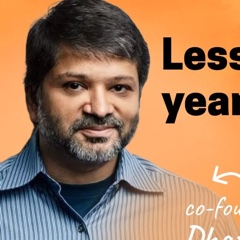
Dharmesh Shah
Co-founder and CTO of HubSpot
Where to hear and read about Dharmesh Shah1 episode or test

Dharmesh Shah is co-founder and CTO of HubSpot, which he helped grow into a roughly $30 billion company while holding no direct reports. The thing most worth learning from him is to pick a few high-conviction bets against consensus, shape your role around your strengths, and defend simplicity with built-in systems rather than slogans.
Complexity does kill companies. Maybe not as quickly as other things, but much more reliably than other things.
Zigging vs. zagging: How HubSpot built a $30B company | Dharmesh Shah (co-founder/CTO)
Dharmesh Shah: the story and the lessons
1How Dharmesh Shah shaped his own role at HubSpot
Shah ruled out management before HubSpot had a single employee. At the first founders' meeting he declined the CEO role and asked for zero direct reports. He had been CEO twice and saw management as a craft, not just vision.
Brian Halligan wanted the CEO job because he had never done it. Shah made him promise not to hand him an interim team if a VP of engineering quit.
He has had no direct reports across 18 years and 7,000 plus employees. Shah says he enjoys HubSpot more at 7,000 people than at 70. At scale he gets the big bets and long plans without managing the people mechanics.
His reason: "I don't want to spend any years of my life becoming passively okay at something." He also holds no one-on-ones, because he has nobody to hold them with.
Shah grew up in an Indian village and met his co-founder in grad school. He was born in a village with no paved streets, traffic lights or hospitals. He had promised his wife he would not found another company, then met his HubSpot co-founder in grad school.
He bent company rules to fit two night-owl founders. Both founders were night people, so HubSpot's early rule was no meetings before 11 A.M., period. After three or four years it loosened: earlier meetings were fine if neither co-founder was invited.
Shah says first-time founders assume things must go a certain way and should at least try otherwise.
Shah builds software for one user, himself, and ships it only if worth it. He calls it SoloWare: no broad testing, a UI that only has to suit him, and no users to disappoint if he switches it off. He has done this for 30 years, including his laughs-per-minute analyzer.
He asks whether a tool is worth the effort of turning it into "microware" for others. His word game Wordplay once earned $90,000 a month and reached 16 million users. He also bought chat.com for $10 million and sold it two months later for an undisclosed higher sum.
2Shah's high-conviction bets that built HubSpot
Shah says a company needs a few bets most people disagree with. He quotes Peter Thiel: be right about something others think you're wrong about for a very long time. The number of such bets must be above zero but not too high.
HubSpot dropped its no-titles rule once staff needed a signal for life outside the company.
HubSpot held its SMB focus for all 18 years despite pushback. Board members, investors and IPO roadshow questions kept asking about the path to enterprise. The founders treated small business as the market itself, not a stepping stone.
The SMB bet was never a Geoffrey Moore bowling-pin plan to move upmarket.
He chose SMB by ruling out enterprise and consumer. Enterprise means long sales cycles, long feedback loops and a big customer's roadmap demands. Consumer outcomes are bimodal: a huge win or zero. SMB offers paying customers, no revenue concentration and short feedback loops.
Shah and his co-founder had both worked in enterprise software before choosing.
Rivals drift upmarket, which thins the SMB field. Bigger customers stay longer and pay more, so software companies get pulled toward enterprise. Shah calls this reverse gravity: "over time, the market will always pull you up."
The SMB competitors left are those "stupid enough to stay focused."
Early SMB was far harder, and the doubt was real. Shah says it was "a hundred times harder" then, and HubSpot could not raise capital. Investors said only one company in software history had built a global SMB brand.
With 50 customers, a failed experiment leaves 5 million more to sell to. His advice is to keep trying "until it gets really, really, really painful, and then try some more."
HubSpot built an all-in-one product because SMBs could not assemble tools. From year one it built SEO, analytics, blogging and content tools, against strong single-purpose rivals. Good tools existed, but for most SMBs wiring them together was "a science project."
He accepted that it went against every instinct and piece of advice. The cost was a product "many miles wide and only so inches deep," which has improved since.
Shah treats a top-three rank in any category as over-investment. HubSpot measured each product category against the market. Its value is that the pieces work well together, not that each one wins.
He wants to know the zig even when choosing the zag. Shah and his co-founder still ask at every stage whether they have fully considered the alternate path. HubSpot had about three early zigs.
It is not a call to do the opposite: "you should at least know what the zig would've been and have talked it through."
3How Shah fights complexity
Shah sees complexity as the third battle every company fights. Early on the goal is to not die, then to not stagnate, then to survive complexity. Symptoms are more management layers, more headcount, falling margins and slower work.
He borrows the second law of thermodynamics as an analogy: unless you intervene, "everything goes to crap." He says he is not a physics guy.
HubSpot's guiding principle is three words: fight for simplicity. Even well-meaning people add complexity, such as more pricing tiers and more knobs and dials in the product.
Shah says simplicity "will take calories" because the universe works against it.
He counts three layers of cost in every feature. First-order cost is building it, second-order is maintaining it, and third-order is what the added complexity does to everything else. A second product adds dimensional complexity: every decision and every chart must be split by product.
Build product two only when the benefit exceeds that cost.
HubSpot removes one feature for every one it adds. Brian Halligan implemented the rule in the early product years, borrowing the idea from Apple. Every new knob or dial meant taking one out elsewhere.
Shah admits it is coarse, since a checkbox is not equal to a nav item, but it beats having no constraint.
Shah trusts systems over slogans to keep products simple. HubSpot's freemium SMB model capped complexity by default. It had no army to spend 18 months implementing the product, so someone had to get value alone.
He borrows Amazon's word "mechanisms" for guardrails. Culture docs and all-hands reminders still help, but they decay and are hard to scale.
A seat lottery avoided office politics for hundreds of people. In the first office of four chairs, the lottery winner picked from the remaining seats, since people value seats differently. Investors said it would fail at 15 to 20 people. It held at 200 and beyond, with a quarterly shuffle.
Later tweaks included keeping quiet engineers away from sales. Side benefits were people meeting each other and better chemistry.
He starts with all-or-nothing rules and scales them until they break. Transparency began when the first hire needed file access: open everything instead of deciding file by file. If it worked for employee three, they kept it for four, five and fifty.
"Binary decisions are much easier than non-binary decisions."
4Going public, transparency and titles at HubSpot
Shah says founders over-fear the IPO and underrate what it gives. There is a compliance tax, but a public company knows its market value on any business day, while a private one is marked only when it raises money.
He tells staff to focus on creating value, since valuation oscillates around it in an efficient market.
Going public let far more people share HubSpot's growth. HubSpot went public at age eight with about $1 billion in market cap, so it was never a unicorn. Only a few people shared the first billion, while every public investor could share the growth to about $30 billion.
Customers, partners and well-wishers could buy in, which private markets rarely allow.
The founders made every employee a designated insider on IPO day. Bankers advised five or six insiders. Shah and Halligan asked about seven or eight, found no legal limit, and named everyone, with no opt-out.
It still holds at 7,000 people, so HubSpot shares everything except what is illegal to share and salaries. Shah's reading of Bezos's first shareholder letter: if you disagree with the approach, don't buy the shares.
HubSpot moved from no titles to classic titles at scale. Staff said titles are shorthand outside the company and signal progression, and going without them forced HubSpot to pay them in other ways. A daylong meeting weighed no titles, classic titles and made-up titles.
Classic titles won: "there's a benchmark, there's a standard, otherwise it doesn't mean anything."
5How Shah learned public speaking with data
Shah treats talent as the slope of the curve, not a ceiling. He could not delegate the keynote. He broke public speaking into sub-skills and worked on one a year, such as slide design or humor writing.
The first conference drew 150 people at a Marriott. It now draws about 10,000 live, with hundreds of thousands online. "Talent basically controls the slope of the curve, but most things are actually acquirable skills."
He measures laughs per minute from recorded practice talks. He records runs before larger live audiences, transcribes them and marks audible laughs. Business talks rarely exceed 1 LPM, and above about 1 to 1.25 a non-professional is in the top decile.
Software maps the talk in 30-second squares. Once it showed 1 minute 17 seconds with no laugh, so he cut the segment or added a joke. Stand-ups have a very high LPM, and popular TED talks correlate with a high one.
He puts the punchline last and stops talking so the room can laugh. The funny words must be the final words of the segment, even if reordering sounds awkward. The audience needs about half a second and permission to laugh.
He took the trick from stand-up and applies it to business keynotes.
Shah stacks several punchlines on one story setup. A setup costs words, so he spends it on multiple funny bits. After the first punchline he adds more before moving on, which lifts LPM without extra context.
Stand-ups do this after, for example, 75 words of setup. "A laugh is a laugh." Two or more LPM is hard when a talk also has a message to carry.

Zigging vs. zagging: How HubSpot built a $30B company | Dharmesh Shah (co-founder/CTO)
Dharmesh Shah explains how HubSpot made high-conviction, low-consensus bets (SMB focus, an all-in-one product, no direct reports for the CTO) and fought complexity with simple rules and systems. He also shares a data-driven method for learning public speaking, which shows that most skills can be broken down and practiced.
Shah ruled out management before HubSpot had a single employee. At the first founders' meeting he declined the CEO role and asked for zero direct reports. He had been CEO twice and saw management as a craft, not just vision.
Brian Halligan wanted the CEO job because he had never done it. Shah made him promise not to hand him an interim team if a VP of engineering quit.
He has had no direct reports across 18 years and 7,000 plus employees. Shah says he enjoys HubSpot more at 7,000 people than at 70. At scale he gets the big bets and long plans without managing the people mechanics.
His reason: "I don't want to spend any years of my life becoming passively okay at something." He also holds no one-on-ones, because he has nobody to hold them with.
Shah grew up in an Indian village and met his co-founder in grad school. He was born in a village with no paved streets, traffic lights or hospitals. He had promised his wife he would not found another company, then met his HubSpot co-founder in grad school.
He bent company rules to fit two night-owl founders. Both founders were night people, so HubSpot's early rule was no meetings before 11 A.M., period. After three or four years it loosened: earlier meetings were fine if neither co-founder was invited.
Shah says first-time founders assume things must go a certain way and should at least try otherwise.
Shah builds software for one user, himself, and ships it only if worth it. He calls it SoloWare: no broad testing, a UI that only has to suit him, and no users to disappoint if he switches it off. He has done this for 30 years, including his laughs-per-minute analyzer.
He asks whether a tool is worth the effort of turning it into "microware" for others. His word game Wordplay once earned $90,000 a month and reached 16 million users. He also bought chat.com for $10 million and sold it two months later for an undisclosed higher sum.
Shah says a company needs a few bets most people disagree with. He quotes Peter Thiel: be right about something others think you're wrong about for a very long time. The number of such bets must be above zero but not too high.
HubSpot dropped its no-titles rule once staff needed a signal for life outside the company.
HubSpot held its SMB focus for all 18 years despite pushback. Board members, investors and IPO roadshow questions kept asking about the path to enterprise. The founders treated small business as the market itself, not a stepping stone.
The SMB bet was never a Geoffrey Moore bowling-pin plan to move upmarket.
He chose SMB by ruling out enterprise and consumer. Enterprise means long sales cycles, long feedback loops and a big customer's roadmap demands. Consumer outcomes are bimodal: a huge win or zero. SMB offers paying customers, no revenue concentration and short feedback loops.
Shah and his co-founder had both worked in enterprise software before choosing.
Rivals drift upmarket, which thins the SMB field. Bigger customers stay longer and pay more, so software companies get pulled toward enterprise. Shah calls this reverse gravity: "over time, the market will always pull you up."
The SMB competitors left are those "stupid enough to stay focused."
Early SMB was far harder, and the doubt was real. Shah says it was "a hundred times harder" then, and HubSpot could not raise capital. Investors said only one company in software history had built a global SMB brand.
With 50 customers, a failed experiment leaves 5 million more to sell to. His advice is to keep trying "until it gets really, really, really painful, and then try some more."
HubSpot built an all-in-one product because SMBs could not assemble tools. From year one it built SEO, analytics, blogging and content tools, against strong single-purpose rivals. Good tools existed, but for most SMBs wiring them together was "a science project."
He accepted that it went against every instinct and piece of advice. The cost was a product "many miles wide and only so inches deep," which has improved since.
Shah treats a top-three rank in any category as over-investment. HubSpot measured each product category against the market. Its value is that the pieces work well together, not that each one wins.
He wants to know the zig even when choosing the zag. Shah and his co-founder still ask at every stage whether they have fully considered the alternate path. HubSpot had about three early zigs.
It is not a call to do the opposite: "you should at least know what the zig would've been and have talked it through."
Shah sees complexity as the third battle every company fights. Early on the goal is to not die, then to not stagnate, then to survive complexity. Symptoms are more management layers, more headcount, falling margins and slower work.
He borrows the second law of thermodynamics as an analogy: unless you intervene, "everything goes to crap." He says he is not a physics guy.
HubSpot's guiding principle is three words: fight for simplicity. Even well-meaning people add complexity, such as more pricing tiers and more knobs and dials in the product.
Shah says simplicity "will take calories" because the universe works against it.
He counts three layers of cost in every feature. First-order cost is building it, second-order is maintaining it, and third-order is what the added complexity does to everything else. A second product adds dimensional complexity: every decision and every chart must be split by product.
Build product two only when the benefit exceeds that cost.
HubSpot removes one feature for every one it adds. Brian Halligan implemented the rule in the early product years, borrowing the idea from Apple. Every new knob or dial meant taking one out elsewhere.
Shah admits it is coarse, since a checkbox is not equal to a nav item, but it beats having no constraint.
Shah trusts systems over slogans to keep products simple. HubSpot's freemium SMB model capped complexity by default. It had no army to spend 18 months implementing the product, so someone had to get value alone.
He borrows Amazon's word "mechanisms" for guardrails. Culture docs and all-hands reminders still help, but they decay and are hard to scale.
A seat lottery avoided office politics for hundreds of people. In the first office of four chairs, the lottery winner picked from the remaining seats, since people value seats differently. Investors said it would fail at 15 to 20 people. It held at 200 and beyond, with a quarterly shuffle.
Later tweaks included keeping quiet engineers away from sales. Side benefits were people meeting each other and better chemistry.
He starts with all-or-nothing rules and scales them until they break. Transparency began when the first hire needed file access: open everything instead of deciding file by file. If it worked for employee three, they kept it for four, five and fifty.
"Binary decisions are much easier than non-binary decisions."
Shah says founders over-fear the IPO and underrate what it gives. There is a compliance tax, but a public company knows its market value on any business day, while a private one is marked only when it raises money.
He tells staff to focus on creating value, since valuation oscillates around it in an efficient market.
Going public let far more people share HubSpot's growth. HubSpot went public at age eight with about $1 billion in market cap, so it was never a unicorn. Only a few people shared the first billion, while every public investor could share the growth to about $30 billion.
Customers, partners and well-wishers could buy in, which private markets rarely allow.
The founders made every employee a designated insider on IPO day. Bankers advised five or six insiders. Shah and Halligan asked about seven or eight, found no legal limit, and named everyone, with no opt-out.
It still holds at 7,000 people, so HubSpot shares everything except what is illegal to share and salaries. Shah's reading of Bezos's first shareholder letter: if you disagree with the approach, don't buy the shares.
HubSpot moved from no titles to classic titles at scale. Staff said titles are shorthand outside the company and signal progression, and going without them forced HubSpot to pay them in other ways. A daylong meeting weighed no titles, classic titles and made-up titles.
Classic titles won: "there's a benchmark, there's a standard, otherwise it doesn't mean anything."
Shah treats talent as the slope of the curve, not a ceiling. He could not delegate the keynote. He broke public speaking into sub-skills and worked on one a year, such as slide design or humor writing.
The first conference drew 150 people at a Marriott. It now draws about 10,000 live, with hundreds of thousands online. "Talent basically controls the slope of the curve, but most things are actually acquirable skills."
He measures laughs per minute from recorded practice talks. He records runs before larger live audiences, transcribes them and marks audible laughs. Business talks rarely exceed 1 LPM, and above about 1 to 1.25 a non-professional is in the top decile.
Software maps the talk in 30-second squares. Once it showed 1 minute 17 seconds with no laugh, so he cut the segment or added a joke. Stand-ups have a very high LPM, and popular TED talks correlate with a high one.
He puts the punchline last and stops talking so the room can laugh. The funny words must be the final words of the segment, even if reordering sounds awkward. The audience needs about half a second and permission to laugh.
He took the trick from stand-up and applies it to business keynotes.
Shah stacks several punchlines on one story setup. A setup costs words, so he spends it on multiple funny bits. After the first punchline he adds more before moving on, which lifts LPM without extra context.
Stand-ups do this after, for example, 75 words of setup. "A laugh is a laugh." Two or more LPM is hard when a talk also has a message to carry.
 HubSpot