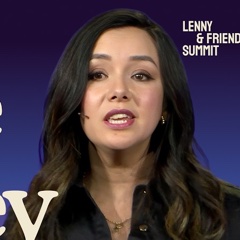
Claire Vo
Founder of ChatPRD, host of How I AI
Where to hear and read about Claire Vo2 episodes and tests

 Lenny's PodcastStop planning for 2027: how OpenAI builds product 90 days at a time | Tara Sesha and Nan Yu (OpenAI)
 Lenny's PodcastEveryone’s shipping more. Does any of it matter? | Claire Vo
Claire Vo is the founder of ChatPRD and host of How I AI, and a product leader with over two decades in the field. The lesson most worth taking from her is that when AI makes building cheap, the scarce thing is conviction about what to build, so hold your direction firmly and treat every feature as disposable.
clear progress against your convictions, but zero ego about your solutions
Everyone’s shipping more. Does any of it matter? | Claire Vo
Claire Vo: the story and the lessons
1Claire Vo's product graph and the "code to nowhere" problem
Vo built a full product graph for ChatPRD almost in one shot. The feature pulls everything a company knows about its customers into a semantic graph and an auto wiki for agents. Customers called it interesting, so a market seemed likely.
She still doubted the ROI and wondered whether the web interface should be agent first. She wanted something surprising that competitors could not imagine.
She felt her own working feature belonged in the trash. It matched competitors feature for feature, so it was competitive but not differentiated. The near one-shot build did not strengthen her conviction.
Her AI factory ran itself, and she still cannot say it mattered. Customer fixes were automated from intake through a bot to a fix, issue tracking stopped, and the team just shipped PRs. She rearchitected ChatPRD 70 times "because I could".
She calls the output "code to nowhere". Her PRs are up 3x, and she calls herself the biggest token maxer on the planet.
Vo tests shipping volume against revenue. She asked the room whose revenue is rising in proportion to their PR count, and few hands showed that link. She treats the missing link as the core problem.
Pressure from boards, bosses and peers to look AI native pushes teams to count PRs, and shipping that does not tie to revenue speeds your path to mid.
2Why Vo says the feature roadmap is finished
Vo argues scarcity did the filtering that roadmaps took credit for. Engineering said "not like that", design said "wait for us", and PMs ran cut lines and stack ranks. Items below the cut line never shipped.
With execution cheap, every bad idea can ship. Her verdict: "congratulations to us".
She calls the new state "roadmap zero". Every visible backlog item is plausible and buildable, so effort stops signaling value. RICE loses meaning because "many of those letters mean nothing anymore, especially effort."
She asks why teams still pretend prioritization is the right way to think about products.
The backlog trap: clearing requests is not progress. A single command like /go build the backlog gets every item built. That says nothing about whether a customer problem moved.
The parity trap leaves competitors building the same product. Competitors talk to the same customers, reach the same obvious conclusions and run the same taste and design skills. Moats and differentiators blur.
The churn trap means nothing compounds. A launch gets little pickup and the team abandons it for something new. Because shipping is cheap, they never learn from what they shipped.
A feature roadmap of dates becomes ammunition for a "slop cannon".
3Vo's model: durable convictions, disposable features
Vo replaces the roadmap with convictions and the evidence that would prove them. A conviction describes where things are going in one to two years, not 3, 6 or 9 months. Define up front what evidence would prove it and what would make you stop.
She moves the question upstream, from what to build to what to prove.
She keeps the AI factory but moves it in the process. The cycle runs from conviction to evidence to a fast build, then back to reality. After contact with reality you reallocate investment, effort and tokens.
AI cannot turn an untested assumption into fact, however many adversarial reviews it runs.
Vo is stubborn about the problem and has no ego about the solution. Good stubborn means staying with the problem and revising the solution. Bad stubborn means moving the goalposts and shipping again because tokens are cheap.
She answers the enterprise objection with the team and vision. When Mara objected that enterprises love feature roadmaps, Vo said consumers already accept constant product churn. Buyers can bet on the team, the space and the vision.
The sources give no data on enterprises that bought this way.
Vo holds AI output to a very high bar and trashes what fails. She expects to write and discard lots of code, and expects the AI to sometimes have better ideas than her team. The bar keeps customers from receiving trash products.
4How Vo protects customer trust while shipping fast
Vo labels each ship a probe, an experiment or a promise. A probe is a small bet, an experiment is a durable test of a conviction, and a promise is something customers can build on. She rates features by conviction strength and promise durability, not build effort.
"not every ship is a promise". Past roadmaps promised specific features on specific dates, even in contracts.
She kept the product graph feature flagged off until she had conviction. She rebuilt it over and over behind the flag. Customers would build on it once they saw it, and she did not want to burn their trust.
"code is abundant customer trust is not"
5Vo's ambition roadmap and how she measures it
She says the last 12 to 18 months were a velocity game and next is ambition. The new roadmap shows the future you believe should exist, the evidence of progress, what would prove you wrong, and what earns more time, tokens and attention. She skips small onesie-twosie items.
It should be "big on the ambition and very fuzzy on the specifics."
Vo counts big swings per month instead of PRs. Asked for an OKR on AI transformation, she suggested counting how many huge swings a team takes each month, expecting most to fail. Experiments that took a year can now run in two or three weeks.
She would define success one to two years out and accept that you can't predict a week or two ahead.
6How Claire Vo works with agents herself
Vo runs one Codex agent on her desktop and 40 Grok bots. She uses both patterns in practice: a single generic agent and many crafted micro agents in her business.
She framed agent design as two crafts: "inception" (the user's mental model) and architecture (platform and edge cases).
She would rather point computer use at a UI than wait for an MCP. She accepts that it can cost more tokens. She prefers the approach that gets the job done over waiting for integrations.
Vo names the tension between 60 to 90 day horizons and annual plans. She polled the room on 2027 annual planning against a 60 to 90 day horizon and called it the fundamental tension. She also predicted a small Codex-in-a-box device, offered as a guess to check against 2027.
She sends feedback on outputs directly to OpenAI's product and engineering team.
7Where Vo has changed her mind
Vo admits she was wrong that product management is dead. She told the same crowd the year before that product management is dead. She now says many strong product leaders remain.
She still says the job is completely different from a year ago, and jokes that OKRs are next.
She once told the room to "ship to the moon" and now doubts it. She says the bigger problem is whether any of the code matters. Even with the best coding agents and 40 bots, she says she is out of good ideas to build.
Stop planning for 2027: how OpenAI builds product 90 days at a time | Tara Sesha and Nan Yu (OpenAI)
OpenAI's product leaders explain how they build AI products when models change every few months: ship imperfect features fast, aim 2 to 3 months ahead, and finish the last mile of a task. The payoff is a practical set of rules for working with research, designing agents people can follow, and staying close to users.
Vo runs one Codex agent on her desktop and 40 Grok bots. She uses both patterns in practice: a single generic agent and many crafted micro agents in her business.
She framed agent design as two crafts: "inception" (the user's mental model) and architecture (platform and edge cases).
She would rather point computer use at a UI than wait for an MCP. She accepts that it can cost more tokens. She prefers the approach that gets the job done over waiting for integrations.
Vo names the tension between 60 to 90 day horizons and annual plans. She polled the room on 2027 annual planning against a 60 to 90 day horizon and called it the fundamental tension. She also predicted a small Codex-in-a-box device, offered as a guess to check against 2027.
She sends feedback on outputs directly to OpenAI's product and engineering team.
Everyone’s shipping more. Does any of it matter? | Claire Vo
When AI makes building cheap, the bottleneck shifts from engineering capacity to conviction about what is worth building, and feature roadmaps lead teams into backlog, parity and churn traps. Claire Vo shows how she built a full product graph feature that she felt belonged in the trash, and offers a conviction-and-evidence model to replace the roadmap.
Vo built a full product graph for ChatPRD almost in one shot. The feature pulls everything a company knows about its customers into a semantic graph and an auto wiki for agents. Customers called it interesting, so a market seemed likely.
She still doubted the ROI and wondered whether the web interface should be agent first. She wanted something surprising that competitors could not imagine.
She felt her own working feature belonged in the trash. It matched competitors feature for feature, so it was competitive but not differentiated. The near one-shot build did not strengthen her conviction.
Her AI factory ran itself, and she still cannot say it mattered. Customer fixes were automated from intake through a bot to a fix, issue tracking stopped, and the team just shipped PRs. She rearchitected ChatPRD 70 times "because I could".
She calls the output "code to nowhere". Her PRs are up 3x, and she calls herself the biggest token maxer on the planet.
Vo tests shipping volume against revenue. She asked the room whose revenue is rising in proportion to their PR count, and few hands showed that link. She treats the missing link as the core problem.
Pressure from boards, bosses and peers to look AI native pushes teams to count PRs, and shipping that does not tie to revenue speeds your path to mid.
Vo argues scarcity did the filtering that roadmaps took credit for. Engineering said "not like that", design said "wait for us", and PMs ran cut lines and stack ranks. Items below the cut line never shipped.
With execution cheap, every bad idea can ship. Her verdict: "congratulations to us".
She calls the new state "roadmap zero". Every visible backlog item is plausible and buildable, so effort stops signaling value. RICE loses meaning because "many of those letters mean nothing anymore, especially effort."
She asks why teams still pretend prioritization is the right way to think about products.
The backlog trap: clearing requests is not progress. A single command like /go build the backlog gets every item built. That says nothing about whether a customer problem moved.
The parity trap leaves competitors building the same product. Competitors talk to the same customers, reach the same obvious conclusions and run the same taste and design skills. Moats and differentiators blur.
The churn trap means nothing compounds. A launch gets little pickup and the team abandons it for something new. Because shipping is cheap, they never learn from what they shipped.
A feature roadmap of dates becomes ammunition for a "slop cannon".
Vo replaces the roadmap with convictions and the evidence that would prove them. A conviction describes where things are going in one to two years, not 3, 6 or 9 months. Define up front what evidence would prove it and what would make you stop.
She moves the question upstream, from what to build to what to prove.
She keeps the AI factory but moves it in the process. The cycle runs from conviction to evidence to a fast build, then back to reality. After contact with reality you reallocate investment, effort and tokens.
AI cannot turn an untested assumption into fact, however many adversarial reviews it runs.
Vo is stubborn about the problem and has no ego about the solution. Good stubborn means staying with the problem and revising the solution. Bad stubborn means moving the goalposts and shipping again because tokens are cheap.
She answers the enterprise objection with the team and vision. When Mara objected that enterprises love feature roadmaps, Vo said consumers already accept constant product churn. Buyers can bet on the team, the space and the vision.
The sources give no data on enterprises that bought this way.
Vo holds AI output to a very high bar and trashes what fails. She expects to write and discard lots of code, and expects the AI to sometimes have better ideas than her team. The bar keeps customers from receiving trash products.
Vo labels each ship a probe, an experiment or a promise. A probe is a small bet, an experiment is a durable test of a conviction, and a promise is something customers can build on. She rates features by conviction strength and promise durability, not build effort.
"not every ship is a promise". Past roadmaps promised specific features on specific dates, even in contracts.
She kept the product graph feature flagged off until she had conviction. She rebuilt it over and over behind the flag. Customers would build on it once they saw it, and she did not want to burn their trust.
"code is abundant customer trust is not"
She says the last 12 to 18 months were a velocity game and next is ambition. The new roadmap shows the future you believe should exist, the evidence of progress, what would prove you wrong, and what earns more time, tokens and attention. She skips small onesie-twosie items.
It should be "big on the ambition and very fuzzy on the specifics."
Vo counts big swings per month instead of PRs. Asked for an OKR on AI transformation, she suggested counting how many huge swings a team takes each month, expecting most to fail. Experiments that took a year can now run in two or three weeks.
She would define success one to two years out and accept that you can't predict a week or two ahead.
Vo admits she was wrong that product management is dead. She told the same crowd the year before that product management is dead. She now says many strong product leaders remain.
She still says the job is completely different from a year ago, and jokes that OKRs are next.
She once told the room to "ship to the moon" and now doubts it. She says the bigger problem is whether any of the code matters. Even with the best coding agents and 40 bots, she says she is out of good ideas to build.