0:06Good morning everyone. How's it going? Everybody excited to be here? >> Okay, for those of you that were in the Somebody texted me, they called it the How I AI sauna last night, the party we had. I told you all you need to hype me up this morning because I was out way past my bedtime, which is 8:15. I've got a little baby. Um but I am here prepared to do the thing that I do. So last year, last year I came here and I said product management is dead. I said that because as a product leader I like to make these big grand statements and then be proved completely wrong in the market. Just keeps me really honest. So product management is obviously not dead. There are so many amazing product leaders, product managers, product executives here in this room. But who's with me that between the last time we had Lenny's summit and now product management is completely different.
1:03Okay, got some hands. It's really different. And so last year I came for PMS that didn't work. Let's do it again. This year I'm coming for the road map. The Yeah, you're you're welcome. OKR's next and then my job is over. >> [laughter] >> So the road map has been the defining artifact of our industry, of our careers. It's supposed to tell us and our teams where we're going, what's next, and what matters. And I have been in product for over two decades. And I believe, fingers crossed, a lot of us in our room in this room are about to write our last road map. Before I go into why I think that, I want to tell you all I have a confession.
1:56I am shipping more than ever. I have access to the most intelligent coding agents in the world. I have the best developer tools anybody can ask for. I have super smart models. I've got customer context via API, via CLI, via MCP. all the letters I have. I write so many skills. And y'all, I counted yesterday. I have 40 Grock bots. I can build almost anything. And here is my true true confession. I am out of good ideas, y'all. I'm like straight up out of good ideas of things to build. I'm out. I can build. I just don't think any of it's a good idea. So, and and I'm not saying I don't have plausible requests. It's not that I'm saying I don't have things I could build. It's just that execution has outrun my ability to discover meaningful, meaty, my favorite word, commercializable products in the market. And this is a very different situation that I have been in than before. You know, it used to be that engineering capacity was the
3:22scarce resource. That was like I mean that's kind of why we exist honestly is like engineering capacity used to be the really scarce resource. We had way more ideas than people and we had way more demand than our ability to deliver against that demand. And the product manager, the products leaders job was to prioritize all those ideas, sequence them, and then spend like all our time in meetings and in Slack and in spreadsheets saying no. Saying no. PMs should say no more. we should have cut lines. It was like very aggressive like here's my cut line for the quarter. This is my priority list. This is my stack rank. And while the PM's job was to say no, it felt like engineering's job was to say like no, not like that. Not with all those features, not with perfect architecture. We can only do this much.
4:20And then it seemed like design's job was say to like no, wait for us, like please. And so everybody's like just constrained on this like precious engineering capacity. And so things got narrow narrow narrowed down till you only shipped a little bit of your road map. And now I feel like I have more [clears throat] execution capacity than like true conviction about what to build. So my bottleneck has moved from like building what what can I build to believing like what do I believe is actually worth building. And look, I am like the biggest token maxer on the planet. I'm like PR's up 3x. Like do it all. Ship, ship, ship. Agents everywhere. I don't need a PM. I don't need any specs. But like I think this gap between our building capacity and like true in our heart of hearts conviction like does any of this code matter is a much bigger problem than any of us are willing to admit. I think we're all getting a lot of pressure from
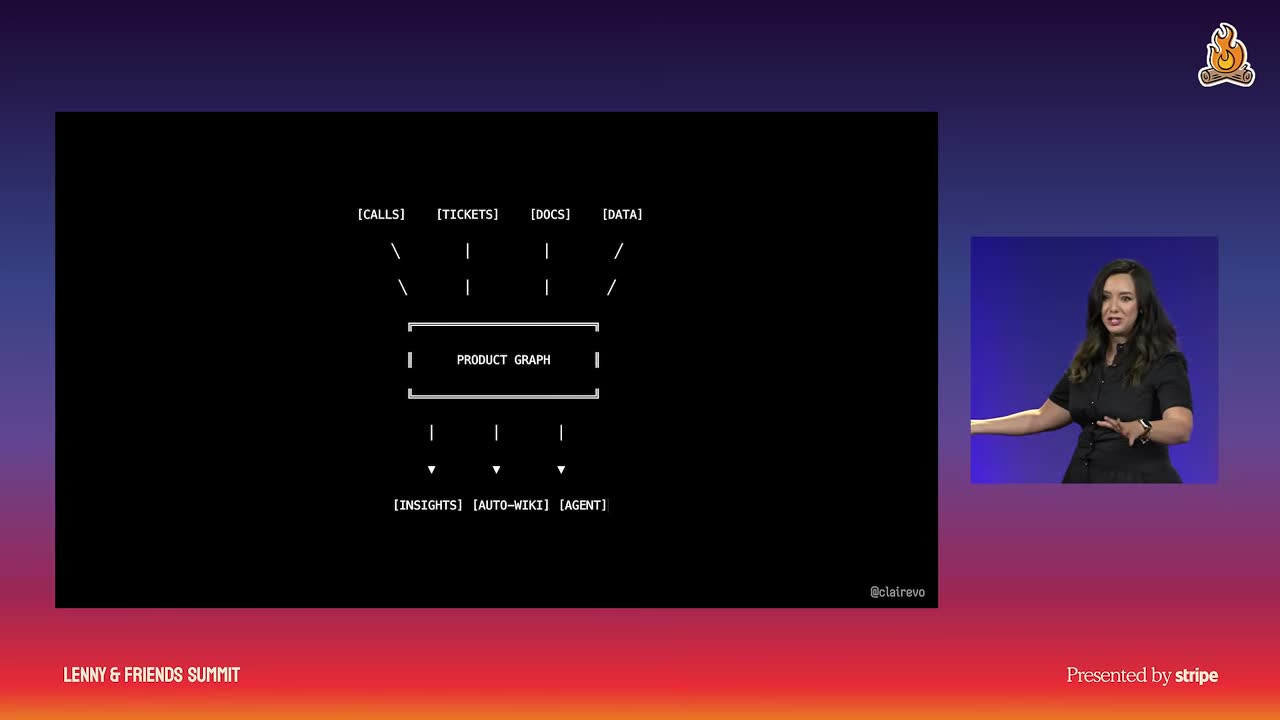
5:26the board, from the timeline, from each other, from our teams, from our bosses to move faster, to get leverage with AI, to like really lean in and show we're AI native. We can build in this new way. Claire said product management is dead. She showed all these scary circles. She said like ship to the moon. Do it, do it, do it. But like I do think none of us are I know this is a question I asked one who's who's shipping more than ever in the last year at their companies whose revenue is going up proportionate with the amount of PRs like that's the fundamental problem we're facing here and so I'm going to tell a story and like bring this home for you this like I have no good ideas and I don't know if they matter. Um so I had this idea for this thing called the product graph for chat PRD. It's like a It's a real product for product managers idea and it's not special because everybody's done it. But it's like we're
6:18going to suck in everything a company knows about customers, about what you're working on, blah blah blah blah blah. We're going to parse it. We're going to like slap, you know, opus on it and then it's all going to be available through agents and it's going to be awesome. It's going to make you be able to make these decisions better and build better products and of course write better PRDs. And so I built it. I built this like insights engine. I built this like very fancy semantic product graph. It like generates this auto wiki. Agents can consume it. It was like almost a oneshot. Not quite, but it was a pretty close oneshot. It worked. It looks pretty good. It was like feature forfeature matching competitors in the market. And I kind of just like every time I would build it, I would be like, "This just belongs in the trash. It belongs in the trash. All this work, all this amazing product belongs in the
7:09trash." And why? Because to me it was competitive, it wasn't differentiated. And so, you know, even though I had built this thing that like obviously had a market, people would probably want it, customers said it was interesting, like in my core, I felt like it wasn't worth my customers attention. I like the ROI was really shaky to me. I wasn't convinced on the interface. I was like, should this it it still had a web interface. I was like, should it be agent first? Is this the right thing? I wanted to build something surprising that competitors couldn't even imagine.
7:43And my big problem was that these tokens and this like road map that I had executed my bet, but it didn't really test or validate or strengthen my conviction. Meanwhile, I'm sitting on all this kind of like code to nowhere. I kept shipping more than ever. So, customer fixes were like automated. They would come in, they go to like one of my bots, and then they get fixed. Goals were like obliterating tech debt. I mean, I re rearchite rearchitected chat purity 70 times because I could. Um, we stopped tracking issues. We're like, we don't need issue tracking anymore. We're just going to ship PRs. This AI factory like manifested and started running itself. It did the thing that we all want it to do. It's magical. And here's the secret.
8:35I'm not sure any of it mattered. Like I'm not yet convinced that any of that mattered. And that really got me thinking. It got me thinking about what is product management? What is the purpose of building software? How do we make decisions? How do we prioritize? How do we allocate all these tokens? And I just kept going back to this idea of the road map. road maps made sense under engineering scarcity. They like laid out your strategy. They told you what features were you going to build.
9:11We had this thing called effort which was like more than me like voice noting you know Devon saying can you please build this and we thought a lot about sequencing and milestones and MVPs and scarcity helped us theoretically let's be honest it helped us theoretically filter out our bad ideas because the bottom of the list just never shipped. It never could. There were not enough engineers. There was not enough conviction across the organization. and said this like below the cut that's what we called it below the cut line never shipped and now we can ship all our bad ideas like congratulations to us cheap execution I think still needs judgment and I think we're seeing this moment where the road map plus like limitless or feeling like limitless execution capacity is creating three traps that I want to warn you about the first is the backlog track. So this is if you have a backlog, AI will build it.
10:15They will build every single thing. It will build every single thing on your list. And so I hear a lot about like, you know, I we're burned through our backlog. It's because all you have to do is slashgo build the backlog and it gets done. But the problem is clearing out requests or ideas does not mean meaningful progress against your business or even meaningful progress against a customer problem. The second thing is the parity trap. This is something I really felt in that story about the product graph. All your competitors are copying each other and they all are talking to the same customers and they're all sucking in the same insights and they're all arriving at the same obvious conclusion and building the same obvious product with the same obvious like run the taste skill. Run impeccable. Run whatever.
11:07Make it look good. Get rid of the m dashes. Get rid of the borders. Like we're all doing Can you tell I took max? Yeah. So we're all doing the exact same thing. And so this like parody trap where we used to have this like really interesting dynamic with competitors now it feels like it's evening out and again like this question about what Moes are and what differentiators are is a big one in my mind. And then the final kind of trap I see is the churn trap which is we ship something, we see noise and pick up or not because we can always ship something else, we abandon it and then we never really learn or compound on top of what we're shipping. And so all of these things from the inside feel very productive. Like my backlog's going down, my competitive features are going up. like we're shipping more than ever, but what I think this does is it just like accelerates our path to mid. And that's the thing I want to warn you
12:08about. And so this brings me to something that I'm really observing, which is this concept of road map zero. I don't mean like we've gone through the road map, although some people truly have road map zero, nothing on the road map anymore. What I mean is that every visible feature becomes both plausible and buildable. You don't have like an empty backlog. That's not what I'm talking about. It's just like everything on your backlog you can kind of do. And when everything on your backlog you can kind of do, what is the point of the backlog? I think buildability and effort stop being like this meaningful proxy for what matters and prioritization again kind of like why PMs exist as we've practiced it I think stops being strategy right like we've been doing these like rice prioritizations but when like many of those letters mean nothing anymore especially effort like why are we still pretending like prioritization
13:06is the right way to think about our products and this is why I think you know, road maps are over. They're dead. It's because I think they're really dangerous right now. I think an AI factory plus an old road map will get you to those three traps at machine speed. They will get you there fast because this factory really can't distinguish a truly consequential bet from an idea. And AI will make the consequences of this weak judgment show up at your front door faster. And so your bad ideas will become your problems quicker than ever. And so I don't think the road map is the right thing. I think the right thing is to ask yourself what do I believe strongly enough to go out and try and prove because the remaining constraint is not code. It's not building. It's not features. It is truth. It is like on the ground with our customers truth. AI cannot take an untested assumption into fact. No matter how many adversarial
14:07reviews you do, and I know you're doing them, you need real customers. You need real data. You need repeated tests. And then you need a very unique point of view and a very high unique quality bar. And what AI allows us to do is make faster contact with reality, which is great. We all want to make faster contact with reality. But that means you have a higher obligation to encounter reality in your minds. You have to both get into the market and accept what it is telling you. And this is going to feel really retro to people like, you know, me and they're a little older because we've been saying outcomes over outputs all the time, but yet this like central artifact, the road map still lists features and dates. And again, engineering scarcity once made that workable. But like I think road map zero makes those features and dates very dangerous for the reasons that I outlined. This feature list I say
15:07becomes ammunition for a very powerful slob cannon. And so what I think we need to do is move upstream from what we need to build to what we actually need to prove. And so here's how I would think about what we do instead of a road map. First we build our convictions. So what is the direction that we want to go and what do we believe the future looks like? Not in 3 months, 6 months, 9 months, in in a year, in two years.
15:33Where do we think all of this is going? I do think you need to determine what evidence would show you that your conviction is true. And you need to define that upfront. What would I need to see to prove that I'm doing the right thing? And what would I need to see to stop? You do need a factory. So I do love the factory. I'm saying that's dangerous, but I love something dangerous. You need your factory. You need the ability to build quickly to intersect reality very very fast. So I'm not saying get rid of it. I'm saying put it at the right place in the process.
16:05And then you need to allocate. You need to go through that cycle. And when you get into reality, you need to allocate your investment, your conviction, your effort, your tokens in the right direction. And what's interesting I think most about this new world we're about to move into is I think you need to have durable convictions but disposable features. And I was talking to Mara who is going to come on the stage later and she's like but Claire enterprises love feature road maps and I'm going to talk to some folks at the end of the day who have changed a lot of features around on us a lot of products around us and we as consumers at least some of us have accepted that level of churn. And so I think we're going to get into this place where customers, where teams are able to shift to, do I bet on these convictions? Do I bet on this team? Do I bet on this space? Do I bet on this vision? And I understand
16:57features need to come and go. They might be unique to me. They might be unique to a market. And so what you want to see is clear progress against your convictions, but zero ego about your solutions. And what this would look like, I think there's two ways this could go. You could be you have to be stubborn here with your durable convictions. But there's good stubborn and bad stubborn. Good stubborn is you like stay with the problem. You revise the solution. You know, you hold true what's going to happen even if the flavor of the week is trending. Bad stubborn is because you have tokens. You just move the goalpost.
17:31You're like, "Ah, we're close. We'll just ship again and ship again and ship again." And so I want you to think about what are my durable convictions? Am I being good stubborn? Am I being bad stubborn? And then how do you actually build into your system the ability to absorb disposable features and keeping rigor around quality and learning? And this is really scary, especially when it hits customers. But I think we're moving to a place where not everything we ship is a promise. And I I don't has anybody feeling come on. Like has anybody shipped some thank you right in the middle? Like you ship things and you're like this is a hypo this is like truly an experiment and I might get it wrong or the market might move underneath me or the technology might change, you know, tremendously. And so I do think we have to think about this idea of like not every ship is a process, a promise.
18:21And we used to do these road maps and I would like go hand on heart to go to market and I'd be like I swear on my children this feature will ship with these specific things on this specific date. You can definitely sell it in the contract like you know and make these promises. And now I think we have to really think how we communicate internally, how we communicate with customers. And so I think there's going to be everything from a probe. This is like kind of a bet. We're going to explore a little bit. Um to a more durable kind of experiment against your conviction. I think this is something we really believe in. We're going to stick with it till we get it right. And then there are promises. Promises are I have shipped something. Customers can rely on it. They can build their customers on it. We really believe and we'll keep compounding here. And I think you need to be honest about what your commitment
19:11is on any feature. I think that's almost the most um helpful lens on the new road map is like how strong is our conviction here and how durable is this promise versus like how hard is it to build and what is our estimated impact and while we do this I you know again you need to remember code is abundant customer trust is not. So going back to that product graph, that feature that I built over and over and over again until I felt conviction, it was feature flagged off because I just knew that as soon as I put this in front of a customer, they were going to build on it. They were going to use it. And if I didn't have conviction that it was right, I was really going to burn that customer trust. And that's something I thought about really deeply as I was rolling out this feature. So I do still think you need a road map, but I think that roadmap needs to be more about ambition.
19:58I think it needs to be bigger. I don't want to see onesie twoosies on your road map. I want to see the future you believe should exist. I want to see what evidence shows that we're making progress. What would prove us wrong? And then what earns more time tokens and customer attention. And I want to go back to ambition because I think the last 12 to 18 months as you know it was like you know the year of our claude and we were shipping everything and PMs were writing PRs and it was prototypes everywhere. I really think we're in a velocity game. We're in a inflect PRs straight up velocity game. If I can get prototypes to customers faster they can give me feedback faster. If I can hand things to customers or to engineering faster they can do PRs faster. my agents will take care of tech debt. My agents will take care of features. I think we're really in the last 12 to 18 months building up our muscle for true
20:55inflected velocity. I don't think that's the game next year. I don't think that's the game we should be playing for next year. I think next year is the ambition game. I think you should think like what huge swings can I make? What experiments can I run in two weeks, three weeks that would have taken us a year last time? and how do I build sort of this roadmap of very very very large investments in very very ambitious builds because I think that is more important than raw feature velocity and I don't think the road map as it is serves that goal you know I was talking to somebody and again going back to OKRs unfortunately not dead yet and she was like what should our OKRs be relative to our AI transformation like PRs revenue per headcount like what it should be like how many [snorts] huge experiments are you running a month like I don't care what the experiments are I don't know what they should be like how many big
21:56big swings are you taking a month with the presumption that most of them won't work out and I think that is just a very new way to think about how you build your road map and a very new way to think about how you do your product again it's big on the ambition and very fuzzy on the specifics So here is my ask slashgift to you all. Build your last road mapap. And I do not mean build your last plan. Of course not. I just mean like no more lists of ideas and features in spreadsheets where you guess impact and where you like put a date on them and then lock arms and say we'll never we'll never change anything because this is how we work. I just think that day is over. Instead, what I want you to do is truly raise your conviction, raise your ambition, come up with big ideas, define what success looks like in like a year or two. You're going to have to make some big guesses because I can't honestly
22:58tell what's going to happen in a week or two. I really think you want to get to a place where you have a factory that can surprise you. And so, you really want to be able to discard software and then hold your factory to a high bar. And look, you're going to write a lot of code and then you're going to trash it. Good. Your customers do not need trash products. Your AI is going to have better ideas than your team. Good. We need good ideas. And you need to hold that AI to a very, very high bar. And you're not going to be able to promise your team, your customers, what next year looks like. Good. Because it's probably going to be better than you can imagine right now. So, this is my ask to you. write your last road map I promise you is extremely fun on this other side.
23:47Enjoy the rest of your summit. I will see you later this afternoon and please come say hi. [applause]
 Caddie
 Lenny's Podcast · The whole library, and ask it anything