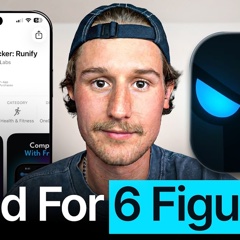
Caleb Dean
Founder of Runafy, a ranked running app, sold after 26 days of revenue
Where to hear and read about Caleb Dean1 episode or test

Caleb Dean is a solo founder who built Runafy, a ranked running app, and sold it after 26 days of revenue while keeping 30% equity. The most useful thing to learn from him is to copy a proven app's market and content format, prove demand with cheap posts and $5 payments, and only then build.
you're better off having 10% of a watermelon rather than like 80% of a grape
I speedran an ai app from 0 to $100k exit in 26 days
Caleb Dean: the story and the lessons
1Caleb Dean's path from a niche app to Runafy
Dean's first app earned $5,000 to $10,000 in a tiny niche. It began when he could not pass a drug test and found a Reddit community with the same problem. He built it on FlutterFlow, and most users and revenue came from App Store search.
People searched the condition's name, so he estimates conversion above 30%. He spent months building before testing any distribution, and had no founder connection to the problem.
Dean won a job at 10X with a tailored application in 48 hours. Blake Anderson's tweet asked for a 225 bench, a deployed app and a 1 million view day. Dean swapped the bench for a marathon run on a broken leg, added 50 influencers with CPMs, guessed Blake's email and offered a trial period.
He worked 12-hour days for about a month and a half, which he says compressed about six months of experience. Seeing Blake's intensity was the biggest lesson. Blake then ended 10X, leaving Dean free to build his own app.
Dean chose ranked running because it fit his hobby and fixed Liftoff's weakness. Running was his one hobby and he had gamed since childhood, so ranks felt natural. Liftoff's ranks rely on typed-in reps and weight, so anyone can log 1,000 kilos on the bench press.
Running data comes from GPS, so rankings and contests with friends and strangers are official. He also thinks running is a bigger market than the gym. He says of his first app: "I had like no founder connection to the product to the problem".
Dean designed and marketed while a third developer became CTO and shipped. Two earlier developers worked 2 to 3 weeks and it did not work out. The third built on their foundation, became CTO, and shipped in about six weeks working about 14 hours a day.
Caleb did all the design and made the lead decisions, and marketed the whole time. The CTO found him through an Instagram story post asking for designers, developers and marketers.
Dean forgot to push back a pre-order date and launched a broken app. Apple forces a release date on pre-orders. A date three months out would scare buyers off, so he pushed it back every two or three days. Deep in the build he missed one day and the two-tab app went live to about 1,000 users.
He woke to about 20 complaint emails. An app cannot be removed once released, so he put it back into pre-order status.
2How Dean validated and launched Runafy before it existed
Dean copied Liftoff's reel format before building anything. Liftoff, ranked workouts for the gym, was making 200 to 300k a month and had held over 100k for at least 12 months. Dean remade its rankings video with running ranks and ChatGPT-made icons.
Under 50 reels in about 2 weeks gave 2,000 waitlist signups. The content took 30 minutes to make. A Liftoff gym body-graph format had no running equivalent, so he skipped it.
Dean sold a $5 early adopter spot on a Stripe page. A ChatGPT-built HTML page carried one sentence about ranks, a Stripe link and a waitlist option. About 90 people paid $5 for an app that did not exist.
Early adopters got a lifetime subscription. Payments trickled in over days, and one tally was 80 transactions, about $400. The $5 payment worked as a commitment signal and produced a list of excited users.
Dean posted up to nine Instagram reels a day and treated each as a lottery ticket. Posts averaged 5 to 10K views and about one in ten passed 500K, reaching about 5 million views in the first month. About 90% of distribution was organic.
Instagram does not punish heavy posting. When the team raised TikTok volume, views there collapsed, so they doubled down on Instagram. Track and field reels went viral first.
Dean's CTO built a tool that makes 10,000 format variations in a minute. The tool changed timings and captions, and was built in about a day. Captions were the hardest part and were drafted with GPT.
A few casual captions with humor and emojis kept performing, so tracking winners let them be reused.
Dean turned paying early adopters into a free bug-testing panel. He emailed each one personally from his own address, reaching 50 to 80 excited users. About 20 gave him WhatsApp numbers and got TestFlight links.
Story polls to about 2,000 engaged followers settled product choices. Usage split evenly across Garmin, Apple Watch and Strava, so the app supports all three.
Dean seeded launch day with two weeks of App Store pre-orders. About 2 weeks of pre-orders gave about 3,000 automatic downloads at launch, and the 1,000-plus leaderboard filled within an hour. That solved the empty-app problem of a social product.
Apple needs an approved first version before pre-orders open, so his V1 had two tabs and no onboarding. He calls waitlists weak: 32% of his emails went to spam and about 20% were opened.
Dean's launch emails carried a half-price code that drove most day-one revenue. Waitlist subscribers got two build updates, then a launch video with a referral code for half price.
He also posted on Reddit and X, and messaged every early adopter personally with their lifetime subscription. The X demo used Rotato, copied from Blake Anderson's 10X launch.
3How Dean sold Runafy after 26 days of revenue
Dean's public tweets about Runafy attracted the acquirer. From an account with about 200 followers, he tweeted that Runafy would hit 100K a month. A buyer's contact found him a week or two after launch and later sent a cold DM.
His first reply was "Honestly, not looking to sell". The launch video got about 50K views, while the quote tweet announcing the sale got 586K.
The buyer priced Runafy at about 5x ARR on an estimated 3K MRR. With 26 days of revenue and 20 to 30 seven-day trials about to convert, the buyer applied the trial success rate to estimate roughly 3K MRR, then used about 4.5 to 5x ARR.
Dean calls 5x quite large for an app this new. Fit helped: the buyer's app studio had a wellness niche, and the app had a home feed, leaderboard, rank logic and watch and Strava links. Retention was never measured, so the price was a bet on potential.
Dean kept 30% equity and took an earnout and a bonus. The deal included a 6-month cash earnout and a cash bonus not tied to the equity. The buyer's studio offered developers, a distribution team and capital for influencers, UGC and paid ads.
The interviewer put the valuation at about 100 to 180K. Dean's view: "you're better off having 10% of a watermelon rather than like 80% of a grape".
Due diligence took days because a young app leaves little to inspect. The firm checked App Store Connect to confirm users were not bought from places like Nigeria. Six contracts were drafted by the PE side and edited by both, then funds went through escrow.
Dean called the contracts "really fair". Assets then moved into the buyer's name, with care taken so nothing broke.
Dean sold because the cash lowered his risk and funded his next app. He believed Runafy could reach 100K a month, so selling was not easy. The upfront cash alone still made sense, and the sale post lifted his personal brand.
His next app targets women, a gap he saw since Runafy's audience was about 99% men without design. It is in health and fitness, with launch about a week away at the time of the episode.
4Dean's rules for choosing and building an app
Dean only enters a niche with one to three apps above $100k a month. One app at 5k a month is not enough validation, and a single app may be a monopoly. He copies the idea's angle, not the product, as with ranked gyms becoming ranked running.
Distribution channels can often be copied and fitted to your own app. "I want to be getting into a space where there's like anywhere from one to three apps that are at least doing 100k a month."
Dean discounts revenue numbers from VC-funded competitors. Reframe, a quit-drinking app, makes about 500K to 1M a month but raised $24 million. Its ads may be unprofitable and nobody outside can tell.
His example: 70K downloads might add only 10K MRR at a cost near $50K, a payback of about five months most solo founders cannot afford. VC apps play a 10-year game.
Dean now tests distribution before spending months on product. On his first app he built for months before testing the market. On Runafy, two weeks of posting proved demand before any build and drew inbound from designers and developers.
He says testing distribution first shows whether a market is worth entering at all.
Dean designed every screen in Figma so the developer had no open questions. He spent about 15 hours a day for three days on onboarding, UI and UX. He maps what every user will do first, leaving the developer no need to improvise.
Onboarding followed Liftoff, then Cal AI, Quitter, Life Reset and Clean Eights. It said only that this was a cool app with ranks and converted poorly.
Dean rewrote onboarding around the user's outcome, not the feature. The new version says ranks make you a better runner, aimed at competitive runners.
The rewrite came right after launch. He wanted to "really drive that out of the user".

I speedran an ai app from 0 to $100k exit in 26 days
A solo founder validated a ranked running app by copying a proven competitor's Instagram format, selling a $5 early adopter spot on a Stripe page, and seeding launch day with App Store pre-orders. He then sold the app for roughly 5x ARR on an estimated 3K MRR while keeping 30% equity.
Dean's first app earned $5,000 to $10,000 in a tiny niche. It began when he could not pass a drug test and found a Reddit community with the same problem. He built it on FlutterFlow, and most users and revenue came from App Store search.
People searched the condition's name, so he estimates conversion above 30%. He spent months building before testing any distribution, and had no founder connection to the problem.
Dean won a job at 10X with a tailored application in 48 hours. Blake Anderson's tweet asked for a 225 bench, a deployed app and a 1 million view day. Dean swapped the bench for a marathon run on a broken leg, added 50 influencers with CPMs, guessed Blake's email and offered a trial period.
He worked 12-hour days for about a month and a half, which he says compressed about six months of experience. Seeing Blake's intensity was the biggest lesson. Blake then ended 10X, leaving Dean free to build his own app.
Dean chose ranked running because it fit his hobby and fixed Liftoff's weakness. Running was his one hobby and he had gamed since childhood, so ranks felt natural. Liftoff's ranks rely on typed-in reps and weight, so anyone can log 1,000 kilos on the bench press.
Running data comes from GPS, so rankings and contests with friends and strangers are official. He also thinks running is a bigger market than the gym. He says of his first app: "I had like no founder connection to the product to the problem".
Dean designed and marketed while a third developer became CTO and shipped. Two earlier developers worked 2 to 3 weeks and it did not work out. The third built on their foundation, became CTO, and shipped in about six weeks working about 14 hours a day.
Caleb did all the design and made the lead decisions, and marketed the whole time. The CTO found him through an Instagram story post asking for designers, developers and marketers.
Dean forgot to push back a pre-order date and launched a broken app. Apple forces a release date on pre-orders. A date three months out would scare buyers off, so he pushed it back every two or three days. Deep in the build he missed one day and the two-tab app went live to about 1,000 users.
He woke to about 20 complaint emails. An app cannot be removed once released, so he put it back into pre-order status.
Dean copied Liftoff's reel format before building anything. Liftoff, ranked workouts for the gym, was making 200 to 300k a month and had held over 100k for at least 12 months. Dean remade its rankings video with running ranks and ChatGPT-made icons.
Under 50 reels in about 2 weeks gave 2,000 waitlist signups. The content took 30 minutes to make. A Liftoff gym body-graph format had no running equivalent, so he skipped it.
Dean sold a $5 early adopter spot on a Stripe page. A ChatGPT-built HTML page carried one sentence about ranks, a Stripe link and a waitlist option. About 90 people paid $5 for an app that did not exist.
Early adopters got a lifetime subscription. Payments trickled in over days, and one tally was 80 transactions, about $400. The $5 payment worked as a commitment signal and produced a list of excited users.
Dean posted up to nine Instagram reels a day and treated each as a lottery ticket. Posts averaged 5 to 10K views and about one in ten passed 500K, reaching about 5 million views in the first month. About 90% of distribution was organic.
Instagram does not punish heavy posting. When the team raised TikTok volume, views there collapsed, so they doubled down on Instagram. Track and field reels went viral first.
Dean's CTO built a tool that makes 10,000 format variations in a minute. The tool changed timings and captions, and was built in about a day. Captions were the hardest part and were drafted with GPT.
A few casual captions with humor and emojis kept performing, so tracking winners let them be reused.
Dean turned paying early adopters into a free bug-testing panel. He emailed each one personally from his own address, reaching 50 to 80 excited users. About 20 gave him WhatsApp numbers and got TestFlight links.
Story polls to about 2,000 engaged followers settled product choices. Usage split evenly across Garmin, Apple Watch and Strava, so the app supports all three.
Dean seeded launch day with two weeks of App Store pre-orders. About 2 weeks of pre-orders gave about 3,000 automatic downloads at launch, and the 1,000-plus leaderboard filled within an hour. That solved the empty-app problem of a social product.
Apple needs an approved first version before pre-orders open, so his V1 had two tabs and no onboarding. He calls waitlists weak: 32% of his emails went to spam and about 20% were opened.
Dean's launch emails carried a half-price code that drove most day-one revenue. Waitlist subscribers got two build updates, then a launch video with a referral code for half price.
He also posted on Reddit and X, and messaged every early adopter personally with their lifetime subscription. The X demo used Rotato, copied from Blake Anderson's 10X launch.
Dean's public tweets about Runafy attracted the acquirer. From an account with about 200 followers, he tweeted that Runafy would hit 100K a month. A buyer's contact found him a week or two after launch and later sent a cold DM.
His first reply was "Honestly, not looking to sell". The launch video got about 50K views, while the quote tweet announcing the sale got 586K.
The buyer priced Runafy at about 5x ARR on an estimated 3K MRR. With 26 days of revenue and 20 to 30 seven-day trials about to convert, the buyer applied the trial success rate to estimate roughly 3K MRR, then used about 4.5 to 5x ARR.
Dean calls 5x quite large for an app this new. Fit helped: the buyer's app studio had a wellness niche, and the app had a home feed, leaderboard, rank logic and watch and Strava links. Retention was never measured, so the price was a bet on potential.
Dean kept 30% equity and took an earnout and a bonus. The deal included a 6-month cash earnout and a cash bonus not tied to the equity. The buyer's studio offered developers, a distribution team and capital for influencers, UGC and paid ads.
The interviewer put the valuation at about 100 to 180K. Dean's view: "you're better off having 10% of a watermelon rather than like 80% of a grape".
Due diligence took days because a young app leaves little to inspect. The firm checked App Store Connect to confirm users were not bought from places like Nigeria. Six contracts were drafted by the PE side and edited by both, then funds went through escrow.
Dean called the contracts "really fair". Assets then moved into the buyer's name, with care taken so nothing broke.
Dean sold because the cash lowered his risk and funded his next app. He believed Runafy could reach 100K a month, so selling was not easy. The upfront cash alone still made sense, and the sale post lifted his personal brand.
His next app targets women, a gap he saw since Runafy's audience was about 99% men without design. It is in health and fitness, with launch about a week away at the time of the episode.
Dean only enters a niche with one to three apps above $100k a month. One app at 5k a month is not enough validation, and a single app may be a monopoly. He copies the idea's angle, not the product, as with ranked gyms becoming ranked running.
Distribution channels can often be copied and fitted to your own app. "I want to be getting into a space where there's like anywhere from one to three apps that are at least doing 100k a month."
Dean discounts revenue numbers from VC-funded competitors. Reframe, a quit-drinking app, makes about 500K to 1M a month but raised $24 million. Its ads may be unprofitable and nobody outside can tell.
His example: 70K downloads might add only 10K MRR at a cost near $50K, a payback of about five months most solo founders cannot afford. VC apps play a 10-year game.
Dean now tests distribution before spending months on product. On his first app he built for months before testing the market. On Runafy, two weeks of posting proved demand before any build and drew inbound from designers and developers.
He says testing distribution first shows whether a market is worth entering at all.
Dean designed every screen in Figma so the developer had no open questions. He spent about 15 hours a day for three days on onboarding, UI and UX. He maps what every user will do first, leaving the developer no need to improvise.
Onboarding followed Liftoff, then Cal AI, Quitter, Life Reset and Clean Eights. It said only that this was a cool app with ranks and converted poorly.
Dean rewrote onboarding around the user's outcome, not the feature. The new version says ranks make you a better runner, aimed at competitive runners.
The rewrite came right after launch. He wanted to "really drive that out of the user".