Runafy
A ranked running app where runners compete with friends and strangers using GPS data from watches.
Runafy went from idea to a six-figure sale at roughly 5x ARR in about 26 days, with the founder keeping 30% equity. Copied Reels formats drew about 5 million views in month one, 90+ people paid $5 before the app existed, and pre-orders gave about 3,000 launch downloads. Lesson: validate and build an audience before coding, and use paid early users to shape the product.
- 1Copy Liftoff's ranked formatLiftoff made 200 to 300k a month
- 2Post copied reelsUnder 50 reels over about 2 weeks
- 3Collect signups and payments2,000 waitlist, 90-plus paid $5
- 4Open App Store pre-orders3,000 automatic downloads at release
- 5Sell after 26 daysKept 30% plus 6-month earnout
From Caleb Dean on Runafy's launch
What was said about Runafy
1Copying Liftoff to pick and validate the idea
Start from a category where an app already makes serious money. Liftoff, ranked workouts for the gym, was making 200 to 300k a month and had held over 100k a month for at least 12 months, so Caleb Dean built the same idea for running.
His rule is one to three apps already making at least 100k a month; one app at 5k a month is not enough validation. A proven app gives you both a market and a content format to copy.
Ranked running fixed Liftoff's weakness and matched the founder's passions. Liftoff's ranks rely on typed-in reps and weight, so anyone can log 1,000 kilos on the bench press; Runafy ranks come from GPS watch data, so contests with friends and strangers are official.
Running was Caleb's one hobby and he had been a gamer since childhood. His first app, for paruresis (shy bladder), made only $5K to $10K and was hard to market because he had no founder connection to the problem, though its App Store search conversion was above 30%.
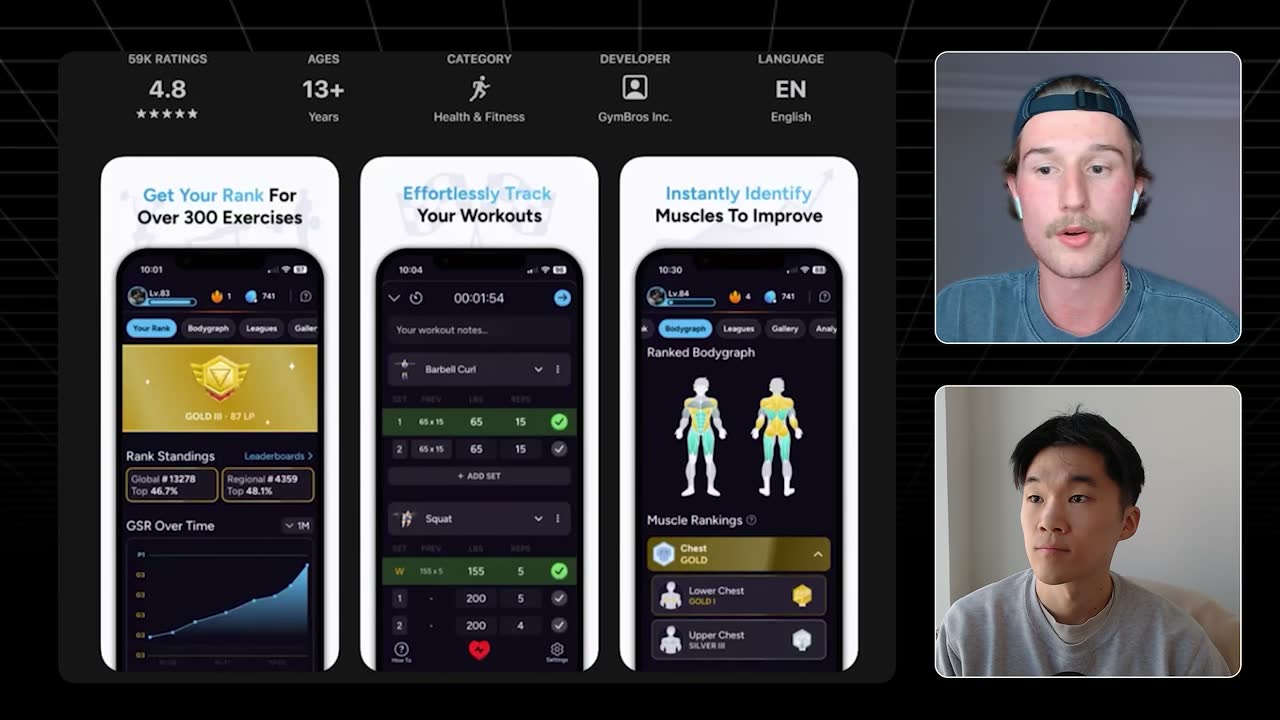
LiftOff's App Store screenshots: 4.8 rating from 59K reviews, exercise ranks, workout tracking, muscle bodygraph. Copied reels proved demand before any code was written. Under 50 reels copying Liftoff's rankings format, posted over about 2 weeks, produced 2,000 waitlist signups before the app existed.
The content took 30 minutes to make, with ChatGPT-generated icons and a scheduling tool. On his first app he spent months building before testing the market; this time posting first also drew inbound developers, and the eventual CTO found him through an Instagram story.
A $5 early-adopter payment is a stronger signal than an email signup. Viral traffic went to a ChatGPT-built HTML page with one sentence, a Stripe link and a waitlist option; 90-plus people paid $5 for an app that did not exist yet.
Early adopters got a lifetime subscription. Caleb called the setup so simple that validation needed only a scheduler, a generated page and a payment link.
2The Instagram content engine
Post many variations a day on Instagram, where volume is not punished. Runafy posted up to nine reels a day and got about 5 million views in the first month; posts averaged 5 to 10K views and about one in ten passed 500K.
When the team raised posting volume on TikTok, views on that account collapsed, so they doubled down on Instagram. About 90% of distribution was organic, and posting continued the whole time the app was being built.
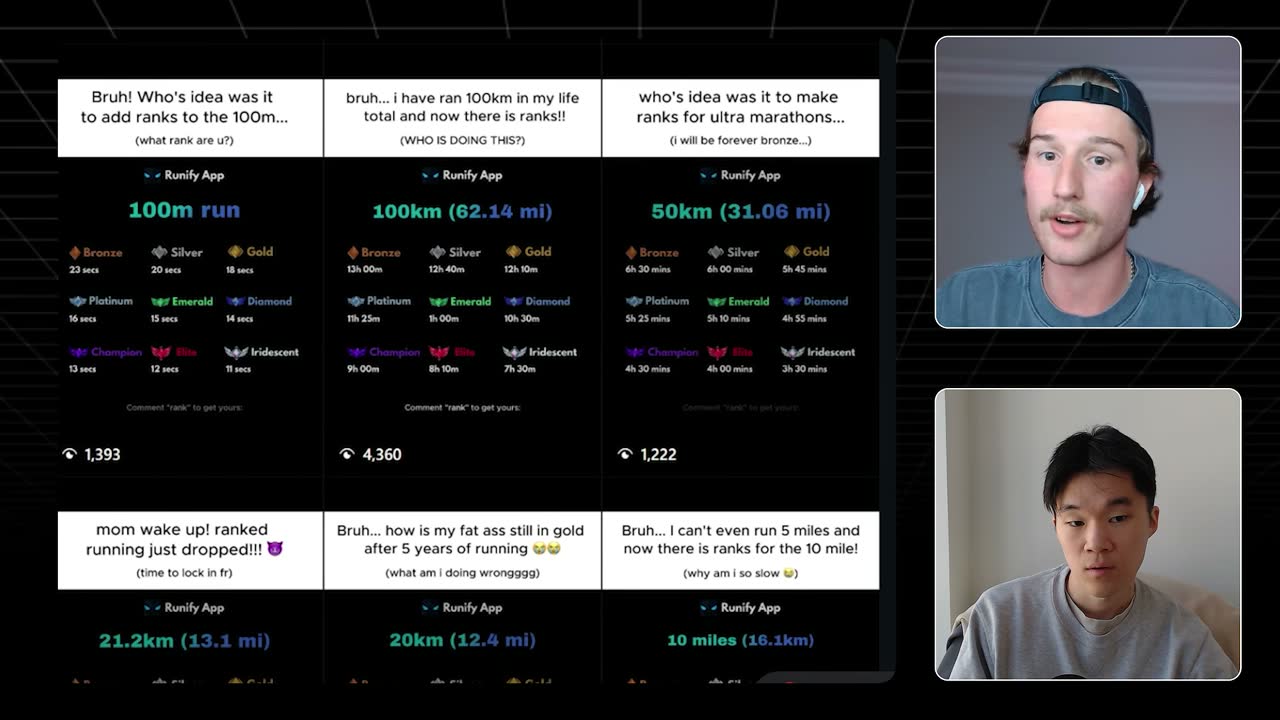
Runify App reels showing ranked running tiers by distance, with view counts like 4,360 and 1,393. An internal tool mass-produced variations of a winning format. The CTO built a tool in one day that generates thousands of slightly varied videos by changing timings and captions, about 10,000 in a minute.
Captions were the hardest part and were drafted with GPT. A few captions kept performing, so tracking winners lets you reuse them. Each format is treated as a lottery ticket.
3App Store pre-orders to fill the leaderboard on day one
- 2,000 people on the list
- 32% landed in spam
- About 20% opened
- About 2 weeks of pre-orders
- 3,000 automatic downloads
- Leaderboard filled within an hour
Pre-orders reached 3,000 devices on launch day
From Caleb Dean on Runafy's launch
Pre-orders seeded a social app that would otherwise launch empty. About 2 weeks of pre-orders gave 3,000 automatic downloads at release, and the 1,000-plus leaderboard filled within an hour.
Apple requires an approved first version before pre-orders open, so Caleb shipped a bare-bones V1 with two tabs and no onboarding, then kept marketing and building. Pre-ordered apps download automatically and Apple emails users that the app is live. Caleb had seen only one other app use this tactic.
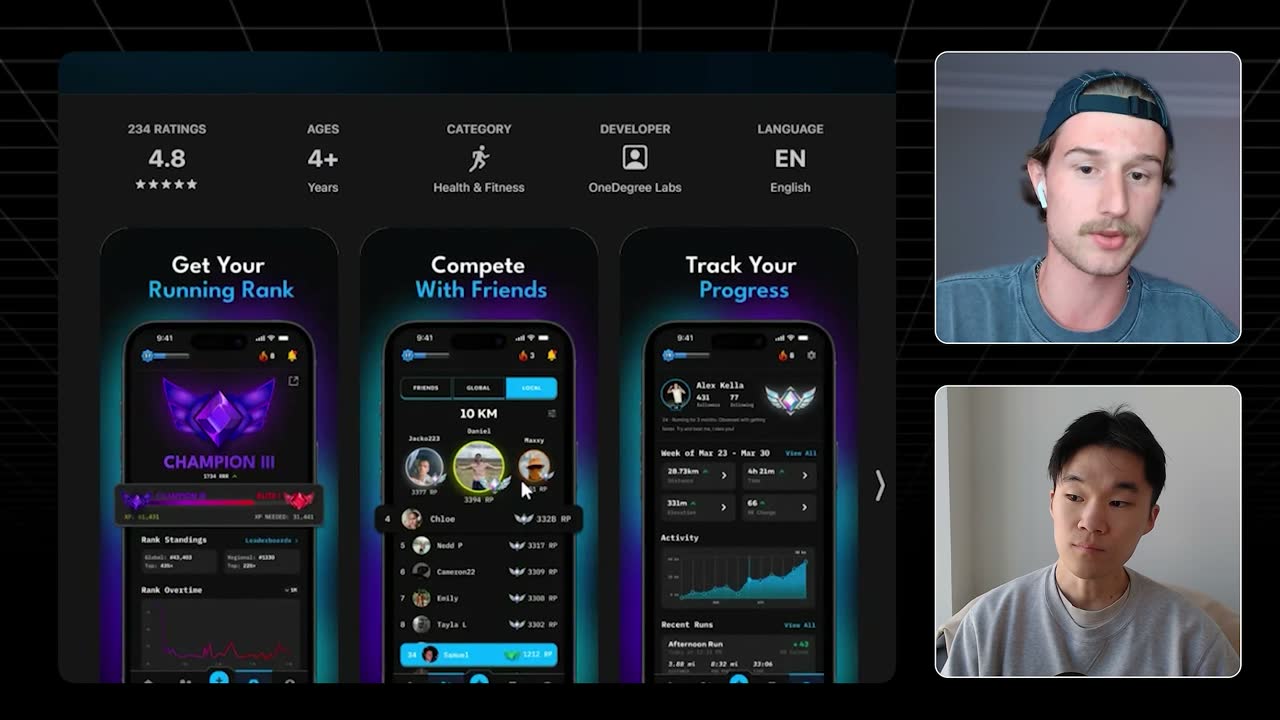
Runnafire's App Store listing: 4.8 rating from 234 reviews, showing running ranks, friend leaderboards, and progress tracking. Pre-orders beat an email waitlist for launch-day reach. Pre-orders reached 3,000 devices, while Caleb's 2,000-person email list had 32% of emails land in spam and about 20% opened.
He still sent the waitlist a couple of progress updates and, at launch, a video with a half-price referral discount code; most launch-day revenue came from those codes.
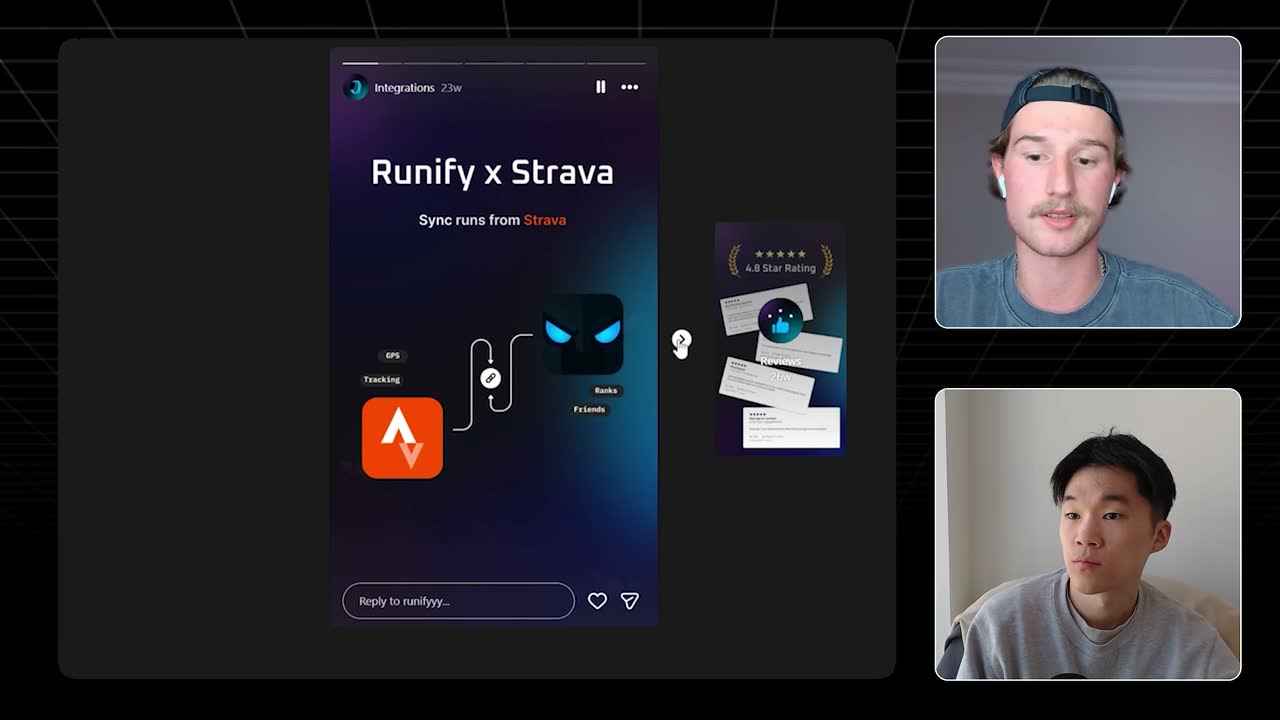
Runify's Instagram story announcing its Strava integration, part of the launch-day story campaign. Keep pushing the pre-order release date back until you are ready. Apple requires a release date, and a date months away discourages pre-orders, so Caleb pushed it back every two or three days.
He forgot once, the buggy two-tab V1 went live to about 1,000 users, and he woke up to around 20 complaint emails before returning the app to pre-order.
4Building the app
Design every screen in Figma before a developer touches it. Caleb spent three days at about 15 hours each designing every screen, the onboarding, UI and UX, so the developer had nothing to improvise.
Onboarding drew on Liftoff, Cal AI, Quitter and Life Reset. After two earlier developers did not work out, a third became CTO and shipped in about six weeks working about 14 hours a day.
Paying early adopters became the bug testers and research panel. Caleb personally emailed everyone who paid, got WhatsApp numbers from about 20 users and sent them TestFlight links, giving him 50 to 80 excited users.
Combined with Instagram story polls, the data showed users split evenly between Garmin, Apple Watch and Strava, so he built integrations for all three. "They legit like our bug testers. That sort of like process was like invaluable."
Onboarding converted better when framed around the runner's outcome. The first onboarding only said the app had ranks and its conversion rate was not high, so right after launch it was rewritten to position ranks as a way to become a better runner.
The rewrite draws the user's goal out of them: "these ranks will help you achieve this because of this."
5Selling Runafy after 26 days of revenue
Bullish public tweets from a small account attracted the buyer. From an account of about 200 followers, Caleb tweeted that Runafy would hit 100k a month; the buyer's side found him a week or two after launch and Dev Shah sent a cold DM.
The buyer was building a wellness app studio with developers and a distribution team, and judged the app, with its feeds, rank logic and watch integrations, hard to copy quickly. Caleb's post about the sale reached about 586K views.
With under a month of revenue, trials set the valuation. The buyer took 26 days of sales plus 20 to 30 pending seven-day trials, estimated about 3K MRR, and applied roughly 4.5 to 5x ARR.
Due diligence took a couple of days: verifying App Store Connect and checking users were not bought, with six contracts and escrow. Retention was never measured, so the price reflects a buyer's bet rather than proven revenue.
Keeping equity in the sale de-risked the app and funded the next one. Caleb kept 30% of Runafy plus a 6-month cash earnout and a bonus, in a deal reported at roughly 100K to 180K valuation.
The buyer added developers, distribution and capital for influencers, UGC and paid. "You're better off having 10% of a watermelon rather than 80% of a grape."

I speedran an ai app from 0 to $100k exit in 26 days
Built in about 26 days of revenue and sold for six figures at roughly 5x ARR, with Caleb keeping 30% equity. Pre-orders gave 3,000 launch downloads, copied reels drew about 5 million views in month one, and 90+ people paid $5 before it existed.
Start from a category where an app already makes serious money. Liftoff, ranked workouts for the gym, was making 200 to 300k a month and had held over 100k a month for at least 12 months, so Caleb Dean built the same idea for running.
His rule is one to three apps already making at least 100k a month; one app at 5k a month is not enough validation. A proven app gives you both a market and a content format to copy.
Ranked running fixed Liftoff's weakness and matched the founder's passions. Liftoff's ranks rely on typed-in reps and weight, so anyone can log 1,000 kilos on the bench press; Runafy ranks come from GPS watch data, so contests with friends and strangers are official.
Running was Caleb's one hobby and he had been a gamer since childhood. His first app, for paruresis (shy bladder), made only $5K to $10K and was hard to market because he had no founder connection to the problem, though its App Store search conversion was above 30%.
LiftOff's App Store screenshots: 4.8 rating from 59K reviews, exercise ranks, workout tracking, muscle bodygraph. Copied reels proved demand before any code was written. Under 50 reels copying Liftoff's rankings format, posted over about 2 weeks, produced 2,000 waitlist signups before the app existed.
The content took 30 minutes to make, with ChatGPT-generated icons and a scheduling tool. On his first app he spent months building before testing the market; this time posting first also drew inbound developers, and the eventual CTO found him through an Instagram story.
A $5 early-adopter payment is a stronger signal than an email signup. Viral traffic went to a ChatGPT-built HTML page with one sentence, a Stripe link and a waitlist option; 90-plus people paid $5 for an app that did not exist yet.
Early adopters got a lifetime subscription. Caleb called the setup so simple that validation needed only a scheduler, a generated page and a payment link.
Post many variations a day on Instagram, where volume is not punished. Runafy posted up to nine reels a day and got about 5 million views in the first month; posts averaged 5 to 10K views and about one in ten passed 500K.
When the team raised posting volume on TikTok, views on that account collapsed, so they doubled down on Instagram. About 90% of distribution was organic, and posting continued the whole time the app was being built.
Runify App reels showing ranked running tiers by distance, with view counts like 4,360 and 1,393. An internal tool mass-produced variations of a winning format. The CTO built a tool in one day that generates thousands of slightly varied videos by changing timings and captions, about 10,000 in a minute.
Captions were the hardest part and were drafted with GPT. A few captions kept performing, so tracking winners lets you reuse them. Each format is treated as a lottery ticket.
Pre-orders seeded a social app that would otherwise launch empty. About 2 weeks of pre-orders gave 3,000 automatic downloads at release, and the 1,000-plus leaderboard filled within an hour.
Apple requires an approved first version before pre-orders open, so Caleb shipped a bare-bones V1 with two tabs and no onboarding, then kept marketing and building. Pre-ordered apps download automatically and Apple emails users that the app is live. Caleb had seen only one other app use this tactic.
Runnafire's App Store listing: 4.8 rating from 234 reviews, showing running ranks, friend leaderboards, and progress tracking. Pre-orders beat an email waitlist for launch-day reach. Pre-orders reached 3,000 devices, while Caleb's 2,000-person email list had 32% of emails land in spam and about 20% opened.
He still sent the waitlist a couple of progress updates and, at launch, a video with a half-price referral discount code; most launch-day revenue came from those codes.
Runify's Instagram story announcing its Strava integration, part of the launch-day story campaign. Keep pushing the pre-order release date back until you are ready. Apple requires a release date, and a date months away discourages pre-orders, so Caleb pushed it back every two or three days.
He forgot once, the buggy two-tab V1 went live to about 1,000 users, and he woke up to around 20 complaint emails before returning the app to pre-order.
Design every screen in Figma before a developer touches it. Caleb spent three days at about 15 hours each designing every screen, the onboarding, UI and UX, so the developer had nothing to improvise.
Onboarding drew on Liftoff, Cal AI, Quitter and Life Reset. After two earlier developers did not work out, a third became CTO and shipped in about six weeks working about 14 hours a day.
Paying early adopters became the bug testers and research panel. Caleb personally emailed everyone who paid, got WhatsApp numbers from about 20 users and sent them TestFlight links, giving him 50 to 80 excited users.
Combined with Instagram story polls, the data showed users split evenly between Garmin, Apple Watch and Strava, so he built integrations for all three. "They legit like our bug testers. That sort of like process was like invaluable."
Onboarding converted better when framed around the runner's outcome. The first onboarding only said the app had ranks and its conversion rate was not high, so right after launch it was rewritten to position ranks as a way to become a better runner.
The rewrite draws the user's goal out of them: "these ranks will help you achieve this because of this."
Bullish public tweets from a small account attracted the buyer. From an account of about 200 followers, Caleb tweeted that Runafy would hit 100k a month; the buyer's side found him a week or two after launch and Dev Shah sent a cold DM.
The buyer was building a wellness app studio with developers and a distribution team, and judged the app, with its feeds, rank logic and watch integrations, hard to copy quickly. Caleb's post about the sale reached about 586K views.
With under a month of revenue, trials set the valuation. The buyer took 26 days of sales plus 20 to 30 pending seven-day trials, estimated about 3K MRR, and applied roughly 4.5 to 5x ARR.
Due diligence took a couple of days: verifying App Store Connect and checking users were not bought, with six contracts and escrow. Retention was never measured, so the price reflects a buyer's bet rather than proven revenue.
Keeping equity in the sale de-risked the app and funded the next one. Caleb kept 30% of Runafy plus a 6-month cash earnout and a bonus, in a deal reported at roughly 100K to 180K valuation.
The buyer added developers, distribution and capital for influencers, UGC and paid. "You're better off having 10% of a watermelon rather than 80% of a grape."
More in Health & Fitness
 Health & Fitness
Calm
A meditation and sleep app with guided sessions and celebrity-narrated Sleep Stories.


 45 sources · 102 tips
 Health & Fitness
Cal AI
A calorie tracking app that logs meals from photos, grown largely through influencer and UGC videos.
28 sources · 104 tips Health & Fitness
Headspace
A meditation and mental wellness app with guided sessions and subscriptions.
 27 sources · 50 tips
 Health & Fitness
Flo
A data tool that combines app analytics into one view and is adding AI agents.
 10 sources · 31 tips
 Health & Fitness
Ladder
A strength training app with human coaches, a workout journal and a nutrition feature.
12 sources · 39 tips Health & Fitness
Zero
An intermittent fasting tracker app that teaches fasting and builds habits toward metabolic health.
6 sources · 21 tips Health & Fitness
Rise
A sleep and energy app that helps people track and pay down their sleep debt.
3 sources · 29 tips Health & Fitness
Runna
A personalized running coach app that builds adaptive training plans around a runner's race goals.
6 sources · 28 tips