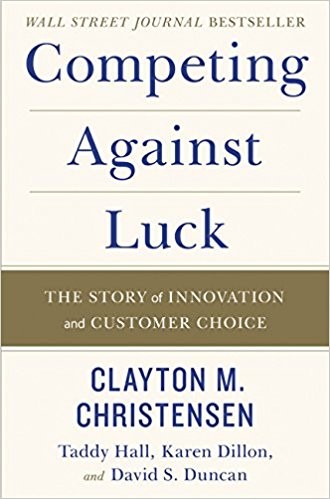
The bottom line
Customers hire a product to make progress in a specific circumstance, and that job, not who they are, causes the purchase. Builders who find the job can predict what will sell, see their real competition, and stop relying on luck.
Key takeaways
- Customer data shows who buys, not why they buy. Correlation is not cause, so a process built on it keeps producing hit-or-miss results. Introduction: Why You Should Hire This Book
- In a McKinsey poll, 84 percent of global executives called innovation extremely important to growth. Yet 94 percent were unsatisfied with their innovation performance.
- The Air Force measured more than four thousand pilots to design cockpits for the average pilot. No pilot was average, and the fix was the adjustable seat.
- The circumstance decides what gets hired, not the customer's profile. The same person hires the same product for different jobs at different times. Ch. 1 · The Milk Shake Dilemma
- A chain made its shakes cheaper, chunkier or chocolatier, and sales did not move. Eighteen hours of watching showed many shakes sold before 9:00 a.m. to lone commuters. They wanted something that lasted the boring drive and fit the cup holder.
- Seeing the job redraws your competition and the size of your market. Rivals are often workarounds, other categories or doing nothing at all. Ch. 3 · Jobs in the Wild
- Small business owners were jury-rigging Quicken. They wanted their books handled without accounting jargon. QuickBooks offered half the functionality at twice the price and became the global leader in online accounting software.
- SNHU split its online learners from its campus students and cut its reply time from a 24-hour email to a call within ten minutes. Online revenue grew from $32 million to nearly $535 million.
- Customers cannot name their job, but they can tell the story of their struggle. A switch happens only when the push and pull outweigh habit and anxiety, and a deep story reveals all four. Ch. 5 · How to Hear What Your Customers Don’t Say
- Brian Walker looked like an impulse buyer of a $699 Costco mattress. In fact his $2,000 pillow top had given him a year of pain, and he had researched for three months. Costco's easy returns removed his last fear.
- Lasting advantage comes from processes built around the job, not from the product. Products can be copied, but integrated experiences and processes are hard to copy. Ch. 7 · Integrating Around a Job
- OnStar found its job was peace of mind while driving. It built its own fast upgrade process, so GM cars ran a fifth-generation version while rivals ran version three. Ford scrapped its Wingcast rival two years after announcing it.
- After launch, give the job a champion or loud data pulls you back to products. Sales figures crowd out the quiet context of the struggle, and growth drifts into product sprawl. Ch. 8 · Keeping Your Eye on the Job
- V8 pitched itself against peeling and boiling carrots, and sales quadrupled in less than a year. Once that team moved on, the line sprawled into variants like Picante and V8 Splash!, and the brand went back to fighting other juices.
People don't really purchase products or services. They bring them into their lives to help them move forward.
Clayton M. Christensen, Progress, Not Products
1Customer data shows who buys, not why
Innovation stays a gamble because companies track who customers resemble and how they behaved, not what causes them to choose.
- Huge spending and rigorous process have not made innovation reliable. Introduction: Why You Should Hire This Book
- In 2015 one thousand publicly held companies spent $680 billion on R&D, up 5.1 percent from the prior year.
- Firms know more about customers than ever. They hope big data will yield a Moneyball-style metric.
- Stage-gates, rapid iterations, risk mitigation and six-sigma rules look scientific. They create the feeling of progress without causing it.
- Any process is built to produce exactly the results it produces. Suppose a process assumes innovation cannot be understood. It will be good at describing things and bad at predicting them, and it will keep turning out mediocre work.
- Busy, precise activity aimed the wrong way fits the joke
We're lost, but we're making good time!
- Few innovators frame their task as finding a cause. They try to make products better, more profitable or more different.
- The aim is a reliable, causal growth engine. Innovation may never become a perfect science.
- Correlations describe customers but cannot explain a purchase. Introduction: Why You Should Hire This Book
- Ice cream sales and forest fires rise together because both follow summer heat. Nate Silver uses this pairing to show correlation without cause.
- Christensen's profile is age sixty-four, six feet eight inches tall, shoe size sixteen, children in college, a Boston suburb and a Honda minivan. None of it makes him buy the New York Times.
- Records of his son Spencer's pitching cannot explain why Spencer won.
- Christensen might hire the paper to skip dull lobby magazines before a doctor's visit, to follow March Madness, or to look informed to neighbors. No ZIP code or income band would surface these reasons.
- Spencer was composed and unflappable on the mound. His wins, losses, balls and strikes record the outcome but say nothing about that cause.
- Most managers know correlation is not causation and act as if it were, because correlation feels comfortable.
- The Air Force first blamed pilot error and training for planes that were hard to control. The real flaw was cockpits sized to the average pilot of the 1920s. Todd Rose calls each person's uneven measurements a "jagged profile".
- Fields move from luck to reliability once they find the causal mechanism. Ch. 2 · Progress, Not Products
- Pasteur's germ theory ended about two thousand years of humorism and trial-and-error medicine. Vaccines, antibiotics and safe dairy followed quickly.
- Deming and Juran taught Japanese carmakers to trace each defect to its root cause, while Detroit kept building lemons.
- Copernicus replaced an earth-centered model. Bernoulli's principle of lift replaced copying feathers and wings.
- In the 1854 London cholera outbreak, authorities drained cesspools to fight bad air. John Snow saw cases cluster near the Broad Street pump. That saved many lives, but it was still a correlation and did not reveal the root cause.
- A car has nearly thirty thousand parts, and a line takes around two thousand unique parts from several hundred suppliers in up to seventeen countries. US makers blamed defects on randomness and added inventory, inspectors and rework stations. Cost rose and the cause remained.
- At Toyota, no one adds value to a part until it is ready for the next step, and each step is done the same way every time. Each repetition then works as an experiment.
- Ptolemy's epicycles kept the earth-centered model alive, yet the best versions still missed by up to eight minutes of arc. Companies that pile more data on the wrong center are adding epicycles.
- Treat failed launches as anomalies with causes, not bad luck. Ch. 2 · Progress, Not Products
- Innovation sits where carmaking stood before the quality revolution. Managers accept failure as inevitable and patch around it.
- Good theory gives if-then predictions that depend on the circumstance.
- Discovery-driven planning asks what has to prove true before heavy investment.
- The method comes from Ian MacMillan and Rita McGrath. List the assumptions the strategy rests on and test them early. Do not approve a project on its first projections and later bend those projections to fit what happens.
- Product attributes, customer traits, trends and competitive response are not wrong ways to organize. They are too weak to predict behavior.
- Theory should teach how to think, not what to think.
- Disruption theory predicts how incumbents respond, not what to build. Ch. 1 · The Milk Shake Dilemma
- Digital Equipment Corporation collapsed around 1988, and almost every other minicomputer maker failed at the same time.
- Disk drive research found well-run incumbents beaten by entrants with cheaper, at first far inferior products.
- Even a firm setting out to disrupt has under a 25 percent chance of building exactly the right product.
- DEC's managers had been praised for its rise. The same managers were then blamed for its fall. Because the whole industry fell together, the bad-manager explanation failed.
- The disk drive work came from doctoral research at Harvard Business School. Managers doing everything right took their firms to the top and then off a cliff.
- The idea later stretched to cover anything clever and new. It stays useful for spotting threats and predicting incumbent behavior.
- The open question is the reverse one. How do successful firms know where to grow? The answer lies in what makes customers pull a product into their lives.
2Customers hire products to make progress in a specific circumstance
A job is the progress a person seeks in a particular circumstance, and only a job stated precisely enough to draw rivals from different categories can guide what to build.
- The circumstance, not the customer or the product, is what innovators should study. Ch. 1 · The Milk Shake Dilemma
- People hire a product to get a job done. They rehire it if it works and fire it if it doesn't.
- The morning shake beat bananas, doughnuts, bagels and a Snickers bar because it lasted about twenty minutes and kept hunger away until midmorning.
- Each job has its own rivals and its own test of success. Averaging feedback across jobs yields a product that does none of them well.
- In the afternoon the same buyers hired a shake for a different job: a parent wanting to say yes to a child. There the rivals were a stop at the toy store or a game of catch.
- The commuter used the drive-through partly to avoid being seen by colleagues. At dinner with his son, wanting to feel like a good dad, he might pick something else entirely.
- Satisfaction scores show whether customers are happy. They give no clue how to do the job better.
- Every job has functional, social and emotional sides, and the last two can outweigh the first. Ch. 2 · Progress, Not Products
- A smoker's break delivers nicotine, calm and time outside with friends.
- A Facebook break during the workday delivers rest and a virtual water cooler with distant friends.
- So Facebook partly competes with cigarettes. Which one wins depends on the moment.
- The circumstance covers where, when, with whom and doing what. It also covers life stage, family and finances, and social or cultural pressure.
- Progress is usually an ongoing process, not a one-off event. Cost and efficiency are not core parts of a job.
- Job insights work like stories. Slicing them into binary segments destroys the meaning, so cluster them around why people act.
- A job is narrower than a need or a life theme, and it outlasts any one solution. Ch. 2 · Progress, Not Products
- Needs like eating are always present and too generic to explain a choice.
- Themes like being a good husband are too abstract to design for.
- Segway answered a general need for personal transport and solved no shared job.
- Dean Kamen's self-balancing two-wheeler launched amid a media frenzy. It was built without asking whose need, when or where. By most measures it flopped, and it ended up mostly in tourist spots and malls.
- Teens have long needed to talk without parents listening. They passed notes in hallways or dragged the phone cord into a far corner. Now many hire Snapchat, which stays exposed to anyone who understands the job better.
- Jobs are discovered, not created. The rule that follows: love the job, not your solution to it.
- A valid job uses verbs and nouns and sits where rival solutions come from different categories. Ch. 10 · Final Observations About the Theory of Jobs
- Words like "convenient" describe an experience that sways choice. They do not describe a job.
- "A chocolate shake in a twelve-ounce cup" is a spec, because every answer to it is a shake.
- Staying occupied and full until a 10:00 a.m. meeting is a job. Bananas, bagels and coffee all compete for it.
- The test runs in steps. Rewrite any adjectives as verbs and nouns. List everything the person could hire, including doing nothing. If every option comes from one product class, move up a level and repeat.
- A spec for a thin, tough, moisture-proof sheet leaves two choices: buy DuPont's Tyvek or skip it. One level up, a Boston family wants comfort in every season at low energy cost. Then fiberglass, sweaters, fans and moving to Santa Barbara all compete.
- "Job" and "hire" are constructs. They show how buying works over time, which static correlations cannot. Finding the right level is more art than science.
- The theory has boundaries, and cases it cannot explain sharpen it rather than sink it. Ch. 10 · Final Observations About the Theory of Jobs
- It does not help where there is no real struggle or current solutions are good enough.
- It does not help where choices are pure math, such as commodities trading.
- Cigarettes do many jobs yet harm the customer.
- The theory explains why people choose. It does not say whether you should offer the solution, so ethics remain a separate question.
- When a case does not fit, go back to the phenomena. Then either refine the theory or mark a boundary past which it should not be used.
Anomalies do not disprove anything.
- Stretched too far, a theory loses its power, as happened when "disruption" came to mean anything clever and new. "Job" risks the same fate if every motive gets the label.
3The job tells you who you really compete with
Defining the job redraws the business you are in, how big the market is and which rivals you actually face.
- Industry categories hide the real competition, because shoppers arrive with a job, not a category. Ch. 1 · The Milk Shake Dilemma
- Unilever held about 70 percent of US margarine. Its roughly twenty-one shelf brands differed mainly on fat percentage.
- Shoppers hired spreads to moisten bread or keep food from burning. Cream cheese, olive oil, mayonnaise and nonstick spray competed for those jobs.
- A résumé for every product a customer might hire for one job, from any aisle, shows who wins and where growth room lies.
- Unilever executives heard this around 1997 and were unmoved. Butter overtook margarine by the mid-2000s. In 2013 an analyst suggested selling the category, and at the end of 2014 Unilever said it would spin spreads into a stand-alone company. Meanwhile olive oil became one of the fastest growing food markets.
- The caveats matter. Trans fat worries partly drove butter's rise. The job analysis may have missed some rivals. Unilever is still described as a world-class company.
- A lobster burger in Bar Harbor, Maine, was nearly tasteless without butter. That suggests many foods are substrates, and an industry can profit from what goes on top.
- Incumbents often held the pieces and missed the job. Hertz never built Zipcar. Kodak came close to Facebook. AT&T showed a picture phone at the 1964 World's Fair. Big yogurt makers sensed Greek yogurt before Chobani reached $1 billion.
No customer walks into the store saying, "I need to buy something in the yellow fats category."
- Real rivals are often other categories, or nothing at all. Ch. 2 · Progress, Not Products
- Reed Hastings said Netflix competes with everything people do to relax.
- BMW redefined its job as mobility and found new rivals in Tesla, Uber and Zipcar.
- Airbnb lost on hotel measures but competed with not traveling at all.
- John Doerr asked whether Netflix competed with Amazon. Hastings named video games, a bottle of wine, other video networks and board games instead.
- BMW studied car jobs as the industry collapsed in 2008. It then launched the BMWi line and DriveNow car sharing in Berlin, Vienna, San Francisco and London. Steven Althaus called it a move from a supply-side to a demand-side view. Ford's Mark Fields called Ford a mobility company in late 2015, and GM invested in Lyft and launched Maven in early 2016.
- Brian Chesky first rented out three air mattresses to pay for a design conference. Chip Conley says 40 percent of Airbnb guests would not have traveled, or would have stayed with family. Almost no hosts would otherwise have rented out space.
- Competing with nonconsumption opens a crowded market, and nailing the job beats piling on features. Ch. 3 · Jobs in the Wild
- QuickBooks' real rivals were bookkeepers, extra hours, spreadsheets and shoeboxes of receipts. That market was far bigger than software sales.
- Sargento's ultrathin slices solved one struggle: cheese on a daily sandwich without the guilt.
- Owners wanted confidence that invoices went out, cash came in and bills got paid. They did not want accounting software. Intuit reached $4 billion in revenue and a $25 billion market cap.
- Sargento cleared $50 million in year one and over $150 million in year two. Most of the other thirty-four hundred packaged-goods launches that year died within twelve months.
- Nielsen tracked over twenty thousand launches from 2012 to 2016. Only ninety-two topped $50 million in year one and held sales in year two. Examples include International Delight Iced Coffee, Reese's Minis and Tidy Cats Lightweight, and each nailed a poorly served job.
- Customers who look identical can hire you for unrelated jobs, so one offering for all fits none. Ch. 3 · Jobs in the Wild
- An eighteen-year-old and a thirty-year-old take the same accounting courses for different reasons.
- SNHU separated campus coming-of-age from online adults needing speed, service and credentials.
- It moved the online team two miles away to a former mill yard, free of legacy rules.
- About twenty people charted admissions on a whiteboard and circled every hurdle. Financial aid and credit transfer were then settled in days, and every online student got a personal adviser.
- By fiscal 2016 SNHU had a 34 percent compounded growth rate over six years. It had more than seventy-five thousand students, 10 percent surpluses and no online tuition increase in four years. It slowed recruiting when growth strained delivery.
- At a 2015 commencement, Paul LeBlanc asked military graduates, first-generation graduates and parents to stand in turn. By the end almost the whole class was standing.
- The same lens explains choices far beyond products. Ch. 10 · Final Observations About the Theory of Jobs
- Children hire school to feel successful and have friends. Gangs, games and athletics compete for that job.
- When something breaks, a wife can hire her husband, a tradesman, herself or nobody.
- Drybar sells one service, a blowout, built around getting ready for a night out.
- Other rivals to school include a minimum wage job and a car, or friends who also feel like failures. In Corning, New York, Wendell Weeks and Kim Frock started a school built to help children feel successful.
- A four-star Air Force general facing budget limits on retention left a jobs discussion more hopeful. He had not expected milk shakes to change his view of recruiting.
- Voters may hire leaders to lead, while politicians think they are hired to voice fears. Churches lose members when they lose touch with the jobs in members' lives.
4Hunt for jobs where people struggle
Jobs worth building for show up wherever people struggle, and a jobs lens finds them with the research tools teams already have.
- Perspective, not a new research tool, is what finds a job. Ch. 4 · Job Hunting
- Personas, ethnography, focus groups and competitive analysis remain good starting points when read through a jobs lens.
- Barriers to progress and frustrating experiences are the first clue, because they mark where customers struggle.
- As with Kuhn's paradigm shifts, breakthroughs come from seeing familiar things differently, not from new instruments.
- The guiding line is
Perspective is worth 80 I.Q. points.
- Jobs Theory works as an integration tool. It shows which information matters and how the pieces fit, so teams get a whole story instead of scattered frames.
- Asking customers how to tweak the current offering, such as faster, more colors or cheaper, starts from the wrong assumption and misses the job.
- No step-by-step manual exists. The five sources below are a sampling, not a full list, and no personal flash of inspiration is required.
- Your own frustrations and the people who buy nothing are two rich sources. Ch. 4 · Job Hunting
- Sal Khan made rough math videos for his cousin. They were by his account "cheaper and crappier" than existing tutorials, yet they won.
- Sheila Marcelo started Care.com after her own struggle to find child care.
- Kimberly-Clark's Depend Silhouette briefs look like normal underwear and earned $60 million in year one.
- ING Direct offered savings accounts with no minimums and sold to Capital One in 2012 for $9 billion.
- Khan's cousin Nadia, 12, found school math, parent help and asking the teacher stressful. She hired the videos to feel successful at hard math in a low-stakes, fun way. Khan Academy blocks advancing until a student understands the current problem, with hints a click away.
- In under ten years Care.com reached nearly 10 million members in sixteen countries, with revenues approaching $60 million.
- Nearly 40 percent of adults over fifty have incontinence. Few use a product. Many suffer up to two years, use feminine pads or withdraw socially. The new briefs came in packaging with transparent windows, grew 30 percent in year two and did not hurt existing products.
- A friend ran a symbolic "Bank of Daddy," crediting allowances and paying fair interest, to feel like a good father. Banks discouraged such small savers. ING Direct opened accounts from one dollar online, at a fraction of branch costs, and became the fastest-growing bank in the US.
- Workarounds, chores people dread and odd uses of products all point to hidden jobs. Ch. 4 · Job Hunting
- OpenTable grew out of rounds of calls to restaurants and friends to settle a reservation.
- MinuteClinic serves the negative job "I don't want to see the doctor."
- Arm & Hammer spun odd uses of baking soda into detergent, cat litter and more.
- ZzzQuil came from people taking NyQuil just to sleep.
- Workarounds stay invisible unless you are immersed in the customer's context.
- Rick Krieger started QuickMedx, MinuteClinic's forerunner, after hours in an emergency room waiting for his son's strep test. Walk-ins are seen at once, nurse practitioners prescribe for routine ailments, and there are more than a thousand locations in CVS stores in thirty-three states.
- In the late 1960s Church & Dwight saw baking soda used in laundry, toothpaste, carpets and refrigerators. It launched the first phosphate-free laundry detergent. Baking soda is now less than 7 percent of Arm & Hammer's consumer revenue.
- Once a source looks promising, frack it, going deep before going wide. Ch. 4 · Job Hunting
- Pick one vein among the five sources and drill deep into it.
- Then widen sideways to capture the full context of the struggle.
- Record the functional, social and emotional dimensions before designing anything.
- Leaders can start with four questions. Which important jobs in my life and those near me go unmet? Which jobs do I hire our own products for, and where do they fall short? Who does not buy from us, and what blocks them? What do customers do with our products in the field?
- A market that seems to have no room to grow may simply have a poorly defined job.
- Teams that capture only function miss the job. Ch. 4 · Job Hunting
- Todd Dunn of Intermountain Healthcare felt the "emotional score" of a sterile exam room as a patient.
- Intermountain then adopted Design for People, which unpacks all three dimensions before any innovation brief.
- P&G's ten-cent Pampers stalled in China until it sold better sleep.
- Dunn sat anxious on crinkly paper under sterile light. Dr. Holmstrom calmed him by sketching on paper, because typing into the software took too long and meant turning away. Intermountain had built software from clinician requests in conference rooms, which led to fixes, delays and cancellations, despite years of design thinking.
- In a focus group a mother said her week's highlight was renewed intimacy with her husband, since the baby slept through the night. Her husband called it the best ten cents he ever spent. David Goulait saw that social and emotional needs could drive function.
- A two-year study with Beijing Children's Hospital's Sleep Research Center found Pampers babies fell asleep 30 percent faster and slept thirty more minutes. By 2013 Pampers had about $1.6 billion in China sales and roughly 30 percent share.
5Customers can't name the job, but they can tell the story
The job surfaces when you rebuild one customer's full story of struggle, because stated wants and purchase data both hide it.
- Trust what people do in a circumstance over what they say they want. Ch. 5 · How to Hear What Your Customers Don’t Say
- Parents who worry about climate change still buy disposable diapers, and people use plastic K-cups. Many of the same people pay more for food labeled organic.
- At the moment of choice, people pick what fits their tradeoffs in that circumstance, not their stated values.
- Sales data is no cure. It mostly records the purchase, and it can be misread.
- Pleasant Rowland did no research when she founded American Girl in 1985. She sat through one focus group because her marketing director insisted. Mothers of preteens rejected history dolls with books and accessories, saying the accessories would get caught in the vacuum.
- Toy industry data also said girls aged seven to twelve would not play with dolls. Rowland trusted her own read of the job and sold to Mattel thirteen years later for $700 million.
- Sony's research said buyers would reject a tape player that could not record and would dislike earphones. The project went on hold until Akio Morita overruled marketing. The Walkman sold over 330 million units.
- Every job involves two hires and a firing. Ch. 5 · How to Hear What Your Customers Don’t Say
- The Big Hire is the purchase. The Little Hire is each later use. Only repeated Little Hires show the job is getting done.
- The job existed before your product, so hiring it means firing something. Mobile phones fired wristwatches. ESPN fired Christensen's weekly Sports Illustrated.
- What gets fired can be doing nothing. Depend Silhouette buyers fired staying at home.
- Before launch, Airbnb storyboarded forty-five emotional moments for hosts and guests. Brian Chesky said realistic boards force choices about who hosts are, why they host and how guests feel on arrival.
- Chip Conley called the guest's arrival the first Little Hire. He suggested soft music or a scented candle where a listing promised relaxation.
- Solutions with emotional and social layers are much harder to fire than purely functional ones. A barrier at either hire can block adoption or trigger a firing.
- Innovators polish the pull of the new and neglect what holds customers in place. Ch. 5 · How to Hear What Your Customers Don’t Say
- Losses weigh about twice as much as gains, so the new must be far more appealing, not slightly better.
- Christensen kept his old phone for years despite a list of a new one's features. Health club annual contracts stopped people from joining at all.
- Reassurance is a design job. ING Direct's cafés and SNHU's not-for-profit status and real campus calm fears of a fly-by-night operation.
- ING Direct's cafés across the United States and Canada handle no teller cash transactions. Their main role is to show that the virtual bank is real.
- Jacques Goulet took over Mercer's retirement business in 2013, as pensions gave way to plans like 401(k)s. Pension buyouts took up to six months, and HR and finance leaders risked their reputations before CFOs, CEOs and boards.
- Mercer built the Pension Risk Exchange, a real-time marketplace with a module to model and monitor buyouts before committing. It worked as a practice run that eased anxiety, and it became key to Mercer's growth.
- Go deep on one person's story, then cluster whole stories into patterns. Ch. 4 · Job Hunting
- A jobs interview starts at the purchase and works back to the first thought of buying. It skips feature questions.
- A storyboard runs from "Once upon a time" through "One day" to "Finally I did."
- A condo builder's timeline interviews found no demographic pattern. They did surface a recurring worry about the dining room table.
- The Costco mattress buyer, Brian Walker, had a Stearns & Foster bought four years earlier from his uncle at Macy's Home Store. Its warranty required an inch and a half of sinkage he could not show. He skipped a cheaper Groupon deal for fear of no recourse.
- A germaphobe, Walker avoided mattress stores. At Costco his wife touched a foam sample and gave her blessing, and he bought without lying on it.
- The builder sold $120,000 to $200,000 condos with a thirty-page options checklist. It shrank the second bedroom 20 percent to fit a table and added moving help, two years of storage and a sorting room. It also cut options to three. The builder saw it was
in the business of moving lives
. - Cancellations fell from five or six a month to one, and a $3,500 price rise held. By 2007 the builder grew 25 percent while industry sales fell 49 percent.
6Get hired by designing the experiences around the job
An offering gets hired, and earns a premium, when a written job spec drives experiences that clear every obstacle between the customer and the progress they want.
- A job spec has to come before design, or even a superior product goes unhired. Ch. 6 · Building Your Résumé
- The spec lists the functional, social and emotional dimensions, the tradeoffs customers accept, every competitor including nonconsumption, and the obstacles and anxieties to remove.
- A job has too many details and tradeoffs to guess right, so the spec serves as the blueprint for design and delivery.
- Medtronic built clearly better pacemakers in India, yet few patients got one. The main rival was nonconsumption.
- Medtronic's first designs came from doctor panels and surveys. Interviews with more than a hundred physicians, nurses, administrators and patients then found four barriers: low awareness, poor diagnostics, a confusing care pathway, and cost. Local GPs had about thirty seconds per patient.
- Healthy Heart for All ran free screening clinics with local cardiologists. Medtronic first assumed patients wanted loans that ended at death. In fact families pooled money, so a bridge loan approved within two days, with no asset mortgage, was what they needed.
- Patient counselors, first called Sherpas, guided people through hospitals. Hospitals then asked for counselors for all pacemaker patients. Through December 2015 about 167,000 patients were screened and about 15,000 treated, across more than one hundred hospitals in thirty cities.
- Products win on the purchase and use experiences they create, and rivals struggle to copy those. Ch. 6 · Building Your Résumé
- American Girl sells a story, not a doll. Catalog sales and its own stores, with doll hospitals and restaurants, make buying a special day out.
- IKEA serves "furnish my place now" with child care, flat packs that fit in cars, and furniture that needs only one included tool.
- Uber beats car rental on experience, not on the car.
- Rowland's belly band added two cents and twenty-seven seconds to packing. Designers wanted to drop it. She refused, because the short wait before the tissue opens makes unboxing exciting.
- Toys"R"Us (Journey Girls), Walmart (My Life) and Disney (Princess & Me) sold cheaper lookalikes and made no dent. American Girl has sold 29 million dolls, and a typical buyer spends over six hundred dollars.
- Rental complaints like #hertzsucks target lines, refueling and damage disputes, yet firms compete on price and car variety. One man stranded by a diverted flight took an Uber from Milwaukee to Chicago rather than rent.
- A premium earned by nailing the job leaves customers grateful, while a premium forced through lock-in leaves them resentful. Ch. 6 · Building Your Résumé
- Customers weigh the price against the full cost of failed options: wasted time, frustration and money.
- Printer ink and phone chargers get paid for, but they breed anxiety and resentment.
- A product that solves a job behaves like a service in the customer's life. Removing obstacles is what makes that shift, even for product companies.
- The test is the customer's reaction:
With jobs-based innovations, customers don't resent the price, they're grateful for the solution.
- Christensen's son Michael chose IKEA when he moved to California for doctoral studies, over slow-delivery stores, Craigslist and unfinished furniture, even at a higher price.
- Reviews let customers find others with the same job, so a business must say who should not hire it. Ch. 6 · Building Your Résumé
- Amazon's reviews may be its hardest feature to copy. They let a buyer find someone who wanted a toaster for frozen pizza, not even browning.
- Buyers hiring for the wrong job write the reviews that hurt.
- In 2015 Amazon began weighting newer reviews, verified purchasers and reviews voted helpful.
- Airbnb's Chip Conley pictures an invisible report card on each guest's forehead. Listings stress the neighborhood and the kind of stay, because overselling backfires.
- One restaurateur regretted his early Yelp raves. They drew foodies hunting a hidden gem to a decent local place, and those visitors wrote bad reviews.
- Doing one job well, over and over, builds a purpose brand that steers the right customers in and the wrong ones away. Ch. 6 · Building Your Résumé
- Milwaukee's Sawzall and HOLE HAWG have held more than 80 percent of their job markets for decades against comparable rivals.
- FedEx became a verb through use, not advertising.
- Brands with no job become category placeholders that compete on price.
- Sawzall cuts safely through a wall when you can't see behind it. HOLE HAWG drills in tight spaces. Milwaukee's other tools, sold under the plain name, are far less celebrated.
- Volvo made safety its guiding principle from 1927. After Ford bought it in 1999 it chased luxury, lost money by 2005, and was sold to Geely at a loss in 2010. Its CEO said in 2013 that the brand had lost its way.
- Volvo grew again in 2015 after refocusing on safety, but it may have lost purpose-brand status for good.
7Integrate processes around the job, because they can't be copied
A company delivers the job every time only when its processes link every function around that job, are measured by customer progress, and flex as solutions change.
- Processes are the hardest asset to copy, because they blend formal steps with unspoken habits. Ch. 7 · Integrating Around a Job
- A process is any pattern of coordination, communication and decision making that turns resources into value. Having no deliberate process still counts as a process, only a chaotic one.
- Resources can be bought and products can be copied. Processes grow out of hundreds of small decisions, so firms can show them openly and keep their edge.
- Good processes work no matter who runs them. McKinsey rotates consultants from very different backgrounds every few years and quality holds.
- Toyota let rival executives tour its plant twice a month and ask anything. Longtime GM manager Ernie Schaefer told This American Life there were no secrets on the floor. The visitors asked the wrong questions and missed the bigger picture.
- Pixar president Ed Catmull published the studio's fixed processes for generating, critiquing and perfecting film ideas. Rivals still have not matched its results.
- SNHU gives tours to would-be competitors. On the first call it asks permission to chase a student's transcripts and pays the usual ten-dollar fee itself. Paul LeBlanc says richer rivals still cannot easily copy hundreds of such linked processes.
- W. Edwards Deming set the standard:
If you can't describe what you are doing as a process, then you don't know what you are doing.
- Put someone in charge of the customer's job, because redrawing the org chart rarely fixes anything. Ch. 7 · Integrating Around a Job
- In most firms each function does its part and nobody owns the job as a whole.
- In a 2010 Bain study, fewer than a third of 57 major reorgs produced meaningful improvement, and some destroyed value.
- A shared job gives specialists with conflicting missions one purpose and a common language.
- In 2015 Christensen spent a week at the Mayo Clinic with a nerve ailment no one could diagnose. One coordinator picked the specialists and their order, and she booked them on the spot from same-day openings each one keeps. His MRI was done by 11:30, ahead of a 2:00 specialist visit. At a typical hospital, getting two specialists together can take months.
- In 1952 surgeon Dwight Harken saw patients survive complex surgery, then die after transfer to general wards. He asked how everyone could do their job as designed while patients still died. The answer was the ICU, a unit that owns the critical-care job.
- Ethan Bernstein spent two years helping Elizabeth Warren set up the CFPB around one consumer job, knowing before you owe. Research, markets and regulations formed one division, and supervision, enforcement and fair lending formed another. A weekly two-hour senior policy committee took one job at a time. Without that focus, Bernstein says, people argued about their scars.
- Functional silos have value and will likely stay. The change comes through processes, metrics and culture, not restructuring.
- Measure the customer's progress, not internal efficiency, or the company gets better at the wrong things. Ch. 7 · Integrating Around a Job
- What gets measured gets done. Revenue metrics can reward changes that add friction to the job.
- Amazon opens each new project with a mock press release that states the customer job.
- Business models can work against the job itself. Fee-for-service health care profits when members get sick.
- Intuit's sales team proposed that QuickBooks trial users phone in to register, so they could be upsold payroll. Tests showed new revenue, but users who only wanted to register hit busy lines and sales pitches. Scott Cook says the team had put revenue ahead of customer benefit. The number also counted sales that solving the job might have brought anyway.
- Intuit now builds a benefit metric for each product, such as time saved or cash flow improved. It derives these by combining survey and server data. Such metrics rarely fall out of existing systems.
- Amazon presents its press release to marketers, engineers and analysts together, and every experience and process is derived from it. SVP Diego Piacentini says Amazon focuses more on processes than on organization, which lets it move fast.
- Intermountain, Kaiser Permanente and Geisinger take on the cost of care, for example by insuring consumers. Their finances then depend on keeping people healthy. FranklinCovey moved from selling training modules to delivering business outcomes. Over six years it doubled revenue and raised profit tenfold, with two-thirds of R&D going to process innovation.
- Jobs stay stable while solutions change, so processes must flex or the company bends the job to fit them. Ch. 7 · Integrating Around a Job
- The stack fallacy, Anshu Sharma's term, is the belief that building the layers above your own is trivial. It treats the customer application as an afterthought.
- OnStar could not live with GM's three-to-five-year development cycle, so it built its own midcycle validation process.
- Repeated tasks can become modular process subroutines, combined with custom pieces as needed. This beats loosely sharing best practices across regions.
- OnStar began as a bundle of cool features for luxury cars. CEO Rick Wagoner gave it no credit for car sales, and customers started canceling the concierge features.
- Chevy buyers bought OnStar as often as Cadillac buyers. CEO Chet Huber had all 300 staff spend an hour on call-center calls, where they heard crash victims in mid-accident. At one point OnStar earned an estimated $2.5 billion a year in revenue and about $500 million in net profit, with negative net assets.
- Ford announced Wingcast with Qualcomm in 2000, due by 2003. It was built around a product spec rather than a job spec, and it could not match OnStar's processes.
- New processes trigger the organization's immune system, so plan for resistance before launch. Ch. 7 · Integrating Around a Job
- Processes are built not to change. That is a strength when they serve the job and a trap when they don't.
- The milk shake chain never implemented Bob Moesta's recommendations.
- Local managers found the changes to routines and resource allocation too hard. No one killed the idea outright. It died quietly.
- New processes can look impractical on financial or cultural grounds, and the pull of existing ones is strong. Clear insight into the job does not survive on its own.
8After launch, give the job a champion or the data pulls you back to products
Once a product ships, operational data, easy growth and functional bias pull a company away from its founding job, and only a clearly stated job, used as a shared compass, keeps it on course.
- Operational numbers replace the context that revealed the job, and managers start managing the numbers. Ch. 8 · Keeping Your Eye on the Job
- Before launch, innovators live in passive data: workarounds, frustrations, bad tradeoffs. After launch, sales, profiles, returns and benchmarks arrive easy to count and reassuring.
- Steering by these abstractions resembles teaching to the test, or a drug that lowers a blood pressure reading without curing the cause.
- In 1960 Ted Levitt showed that railroads declined while demand for transport grew, because they saw themselves in the railroad business.
- Netflix began with a founder who hit an unsolved problem and was a target customer himself. There was no gap between innovator and job.
- V8 launched in 1933, and Campbell's bought it in 1948. For years its slogan, "I should've had a V8," pitted it against other drinks. One member of a four-person brand group spotted the vegetable job. A team member put it this way:
Competing against apple juice is tough. Competing against celery is like going downhill on ball bearings.
- Whether V8 truly lost the job after the team left is a suspicion based on partial knowledge of its internal workings.
- Surface growth and conforming data blur what the company is for. Ch. 8 · Keeping Your Eye on the Job
- Selling more to existing customers is cheap, so firms copy or buy products to sweat their assets. Confused customers hire the wrong product, then fire it.
- The New York Times tries to inform, update, relax and fill time. The Economist, television and the free Metro paper each do one of those jobs better.
- In an innovation meeting, sales, marketing, R&D and the unit head each bring data shaped by their own incentives. None of it is wrong, but none centers on the job.
- DeWalt built its name on the best radial arm saw. After Black & Decker bought it in the 1960s, it copied drills and clamps from store shelves and outsourced cheap manufacturing.
- Walmart, Target, Kmart, Caldor, Zayre and others fought over price points for twenty years. Kmart led two decades ago and is now a shadow. OpenTable, Salesforce.com, craigslist, Airbnb and IKEA each own one job and face minimal competition.
- As data climbs the hierarchy it tilts toward one option. A decision that looks open is often settled before the leader sees it.
- Numbers are no more objective than stories, so leaders must choose what data to create. Ch. 8 · Keeping Your Eye on the Job
- Every dataset reflects human choices about what to collect, how to arrange it and how to read it. Numbers hide that bias behind false precision.
- Share buybacks lift earnings per share, and often the stock. The company becomes no more innovative or efficient.
- Google Flu Trends compared 1,152 data points with fifty million search terms. A study in Science in spring 2014 came from researchers at Northeastern, Harvard and the University of Houston. They showed that for over two years the tool had greatly overstated the number of flu cases in the US. They put the failure down to "big data hubris."
- Search data can still point in the right direction. It just is not objective reality.
- H. Thomas Johnson and Robert S. Kaplan showed that financial statements come from estimation, negotiation and overhead politics. Some value, like a student building a section's learning culture, never appears in data at all.
- A clearly stated job acts as commander's intent, so people at every level decide well without orders. Ch. 9 · The Jobs-Focused Organization
- TurboTax teams spent weeks ranking wish lists of about 150 features. Scott Cook called it navigating without a compass. Sasan Goodarzi reframed the job as "taxes are done."
- Before Hurricane Rita, OnStar gave every caller from the crisis area all services free. Chet Huber said approval took about fifteen seconds.
- American Girl staff could all recite "story, not stuff."
- In 2015 Intuit prefilled W-2 data from firms like ADP in just one of its four to forty interview chapters. Completion rose even when users had to fix some data. A true no-interview product might take a decade.
- During Katrina in 2005, panicked OnStar callers had been told to buy an upgrade for real-time directions. The Rita fix needed "duct tape and Velcro" workarounds. Later, engineers volunteered to build a crash-severity algorithm for 911 responders, using change in velocity, seat belt use, direction of force and number of cars.
- At SNHU, an adviser bought a struggling single mother a $200 grocery card. Staff also flew a diploma to a very ill student's hospital bed. In early 2016, 95 percent of surveyed graduates said they would do it all again.
- Nest a concrete job under a broad mission, then measure customer progress on it. Ch. 9 · The Jobs-Focused Organization
- Unilever's Lifebuoy soap changes color at ten seconds, which makes handwashing long enough and fun for kids.
- Amazon treats delivery delays as defects to eliminate.
- Deseret News dropped breaking news for the "tomorrow morning" PICA job: perspective, insight, context and analysis.
- Removing germs takes about thirty seconds of scrubbing. Most people wash for about seven. In India nearly 400,000 children under five die each year from diarrheal disease. The mission of helping children reach age five inspired, but only the specific job enabled the product.
- Amazon's robot checks prices on hundreds of benchmark products twice a day and undercuts rivals. Humans review if margin drops too low.
- On April 15, 2013, Clark Gilbert saw every paper in his hotel go to press before the Boston bombing story settled. Research found "like-minded believers," about 56 percent of news consumers, whom demographics could not see. Deseret covered only five of thirty legislative bills, grew from the low millions to over 100 million social followers, and counseled out some staff.
9Put it to work
Stop asking customers which features they want, and start asking what progress they are struggling to make, and in what circumstance.
- Hunt for struggle before you build. Look in five places: your own unsolved problems, people who buy nothing, workarounds, things people hate doing, and odd uses of your product. A frustration that people patch by hand marks a job they value. Ch. 4 · Job Hunting
- The trap is asking how to tweak what you sell: faster, cheaper, more colors. A Detroit condo builder added bay windows after focus groups and sales did not move.
- That builder then found buyers stuck on where the dining table would go. It made room for the table and added moving help and storage. Cancellations fell from five or six a month to one.
- Interview recent buyers as a story, not a survey. Start at the purchase and work back to the first thought of buying. Map what pushed them, what pulled them, which habits held them and what scared them. Ch. 5 · How to Hear What Your Customers Don’t Say
- One interview gives a hypothesis, not an answer. Cluster many whole stories to find the pattern.
- Ask what the customer had to fire to hire you. Often it is a workaround or doing nothing.
- State the job in verbs and nouns, one level up. List everything a person could hire to get it done. If every option sits in your own category, you have a spec or a preference, so climb a level. Ch. 10 · Final Observations About the Theory of Jobs
- A spec for a moisture-proof house wrap leaves one choice: Tyvek or nothing. The job of staying warm in winter and dry in summer at low cost also invites fiberglass, sweaters, fans or moving to Santa Barbara.
- Words like "convenient" describe an experience, not a job.
- Write a job spec and design away every obstacle. Cover the functional, social and emotional sides, the tradeoffs customers accept, the real competitors and their anxieties. Then design the buying and using experiences to remove each barrier. Ch. 6 · Building Your Résumé
- Medtronic built better pacemakers for India by asking doctors, and few patients got them. Talking to patients and nurses showed the real rival was nonconsumption, so it added free screening, two-day bridge loans and patient counselors.
- Build processes around the job and measure customer benefit. Put someone in charge of the job across functions. Track external measures like minutes to respond or time to delivery, not only internal efficiency. Ch. 7 · Integrating Around a Job
- The trap is chasing revenue. Intuit tested forcing QuickBooks trial users to phone in to register so sales could upsell them. Customers who only wanted to register hit busy lines.
- Amazon starts new products with a mock press release naming the job, shown to every function at once.
- Turn the job into a phrase everyone can act on. A specific job lets people at every level decide on their own without escalation. It also tells teams which features to drop. Ch. 9 · The Jobs-Focused Organization
- TurboTax stopped ranking about 150 requested features and aimed for taxes that are simply done. Prefilling payroll data in one section noticeably raised completion.
- Before Hurricane Rita, an OnStar employee gave every caller in the crisis area full service with no upgrade fee. Approval took a fifteen-second conversation.
- Name a champion for the job after launch. Keep gathering the quiet context of customer struggle once sales numbers start to dominate. Test every line extension against the founding job. Ch. 8 · Keeping Your Eye on the Job
- The trap is surface growth. After Black & Decker bought DeWalt, it copied drills and clamps from store shelves instead of building on its best-in-class saw.
10The book's words
A handful of terms let you talk about why customers choose, not just who they are.
- Job to Be Done What a person wants to move forward on in a given situation.
- A lone morning commuter needs something to fill a dull drive and last until a 10:00 a.m. meeting.
- Hire and fire Customers pull a product into their lives to get a job done, and drop it when it does the job badly.
- Wristwatches were fired in large numbers once phones showed the time and handled alarms.
- Circumstance The where, when, with whom and while doing what that shapes the job, and the right unit of analysis.
- The same parent hires a milk shake for a different job at dinner with his son than on the morning drive.
- Functional, social and emotional dimensions The three layers of every job, where the last two can outweigh the first.
- Pampers in China sold weakly as a cheap containment device. It took off once ads showed babies sleeping longer, which gave parents their evenings back.
- Nonconsumption People who hire nothing because no option does the job well enough.
- Many people with incontinence used nothing rather than bulky diapers, until Depend made briefs that look like normal underwear.
- Big Hire and Little Hire The Big Hire is the purchase. The Little Hire is each later use, and repeated Little Hires prove the job is done.
- Airbnb treats a guest's arrival as the first Little Hire and storyboards it.
- Job spec The innovator's blueprint of what must be designed and delivered: dimensions, tradeoffs, competitors, obstacles and anxieties.
- American Girl kept a packaging band that cost two cents and twenty-seven seconds, because the wait made opening the box exciting.
- Purpose brand A brand so tied to one job that it comes to mind as soon as the job arises.
- Volvo meant safety for decades, then lost that standing chasing flashier luxury cars after Ford bought it.
- Passive data The quiet, unstructured context of a customer's struggle, which loud sales data crowds out after launch.
- It has no champion, so someone has to go looking for it on purpose.
- Right level of abstraction The level where options from different product categories compete to do the job.
- If only margarine brands qualify, the job is too narrow. Olive oil, cream cheese and nonstick spray are real rivals too.
11Chapter by chapter
Where each idea is in the book.
- Introduction: Why You Should Hire This Book Innovation stays hit or miss because companies organize their data around correlation, not cause. Asking what job a customer hired a product to do reveals the causal mechanism of choice and makes innovation predictable.
- Ch. 1 · The Milk Shake Dilemma Disruption theory predicts how incumbents respond to threats, but it does not say where to innovate or what customers will buy. The Theory of Jobs to Be Done fills that gap: customers hire products to get a specific job done in a specific circumstance, and understanding that job makes innovation predictable instead of a matter of luck.
- Ch. 2 · Progress, Not Products Innovation can become predictable once you understand its causal mechanism: customers hire products to make progress in a specific circumstance, and that progress has functional, social and emotional dimensions. Seeing that job, not the product or the customer's traits, reveals what to build and who you really compete with.
- Ch. 3 · Jobs in the Wild Asking what job customers hire a product to do changes which business you think you are in, how big your market is, and who you compete against. It exposes segments that one-size solutions miss and large pools of nonconsumers who currently hire nothing.
- Ch. 4 · Job Hunting Jobs worth innovating for are found by looking for struggle, not by using new tools. Five places reliably reveal them: your own life, nonconsumption, workarounds, things people don't want to do, and unusual uses of products. Once found, a job must be understood in its functional, social and emotional dimensions together.
- Ch. 5 · How to Hear What Your Customers Don’t Say Customers rarely say what they want, and sales data only shows the purchase, so innovators must reconstruct the full story of a customer's struggle, including what they fire, the forces pushing and blocking change, and both the Big Hire and the Little Hire. Insight comes from deep narratives of one person, not thin data from many.
- Ch. 6 · Building Your Résumé Knowing the Job to Be Done is just where you start. A product that wants to be hired, and to earn a higher price, needs a job spec. It also needs a set of buying and using experiences, planned with care, that clear away whatever blocks the customer. If a company does this well over time, its brand can become a purpose brand that rivals are unable to copy.
- Ch. 7 · Integrating Around a Job Competitive advantage comes from processes that integrate functions around the customer's Job to Be Done, not from org charts, resources or products. Such processes are hard to copy, should be measured by customer-benefit metrics, and must flex as the way the job is solved changes.
- Ch. 8 · Keeping Your Eye on the Job After launch, companies drift from the customer job that made them succeed and start defining themselves by their products. The drift comes from three fallacies about data: active versus passive data, surface growth, and conforming data. The job survives only if someone gives it a voice and a champion.
- Ch. 9 · The Jobs-Focused Organization A clearly stated customer Job to Be Done works as a shared compass inside a company. It lets employees at every level make good decisions on their own, focus resources, stay motivated and measure what actually matters, which generic mission statements cannot do.
- Ch. 10 · Final Observations About the Theory of Jobs Innovation does not have to depend on luck. Jobs Theory explains what causes customers to choose, but it only works when a job is defined precisely, in verbs and nouns, at a level of abstraction where competing solutions come from different product categories.