Johnny Harris
A YouTube channel and media company making visual explainer and documentary videos on history, politics and everyday topics.
Where Johnny Harris comes up1 episode or test

Johnny Harris makes about 30 videos a year averaging 28 minutes, each a four-month pipeline with a protected four-day scripting block, a two-column script and a team of 25. A Mormon history video drew roughly 50x normal views. For app builders: set the click promise before you build, protect focused work time, and fact-check everything, since deadlines and structure sharpen output.
- 1Pitch and greenlightPitch approved on Slack
- 2Research info doc3 to 4 weeks, 60 to 80 pages
- 3Write the script3 to 4 day scripting week
- 4Edit through cutsAbout 150 notes per cut
- 5Picture lockAbout 30 videos a year
From Johnny Harris on his process
What was said about Johnny Harris
1The four-month pipeline and the four-day scripting block
Each video runs a four-month pipeline from pitch to picture lock. Harris makes about 30 videos a year averaging 28 minutes. Each moves from a pitch and Slack greenlight, to a researcher's 3 to 4 weeks building a 60 to 80 page info doc, to a 3 to 4 day scripting week, to the edit.
The edit runs through a radio-edit assembly, rough cut, fine cut, audio lock and picture lock, with about 150 notes per cut, and everything is scheduled six months ahead. A team of 25 supports the work, and the company is now launching two more channels.
A hard scripting deadline makes the writing sharper and faster. The fixed four-day scripting window keeps Harris laser focused and prolific. A year of four videos a month on three-day sprints made the team good fast because nobody could be precious.
The cost is anger and doubt on day two or three when he hasn't cracked the explanation. Having dropped from 48 to about 30 videos a year, the team now lets some weeks run longer. "Constraints sharpen you."
Protect a daily writing block with no meetings, Slack or email. Harris writes from 9 a.m. to 2 p.m., three or sometimes four days a week, with no meetings, Slack or email.
He thinks about the block the night before, takes a ten-minute ramp up at a cleared desk, and plays his composer's music or synthwave mixes. He admits it is a bit voodoo and says an afternoon block would not work for him.
2Packaging: the click promise comes before the story
Settle why someone would click before writing the story. Harris drafts seven or more titles, mostly starting with "how" or "why", checks comparable videos on tools like 1 of 10 or ViewStats, and tests two or three packagings.
For the Saudi Arabia video he fixed the headline "why is Saudi Arabia building a futuristic city in the desert" before filming. The package sets the promise to answer, not the story itself.
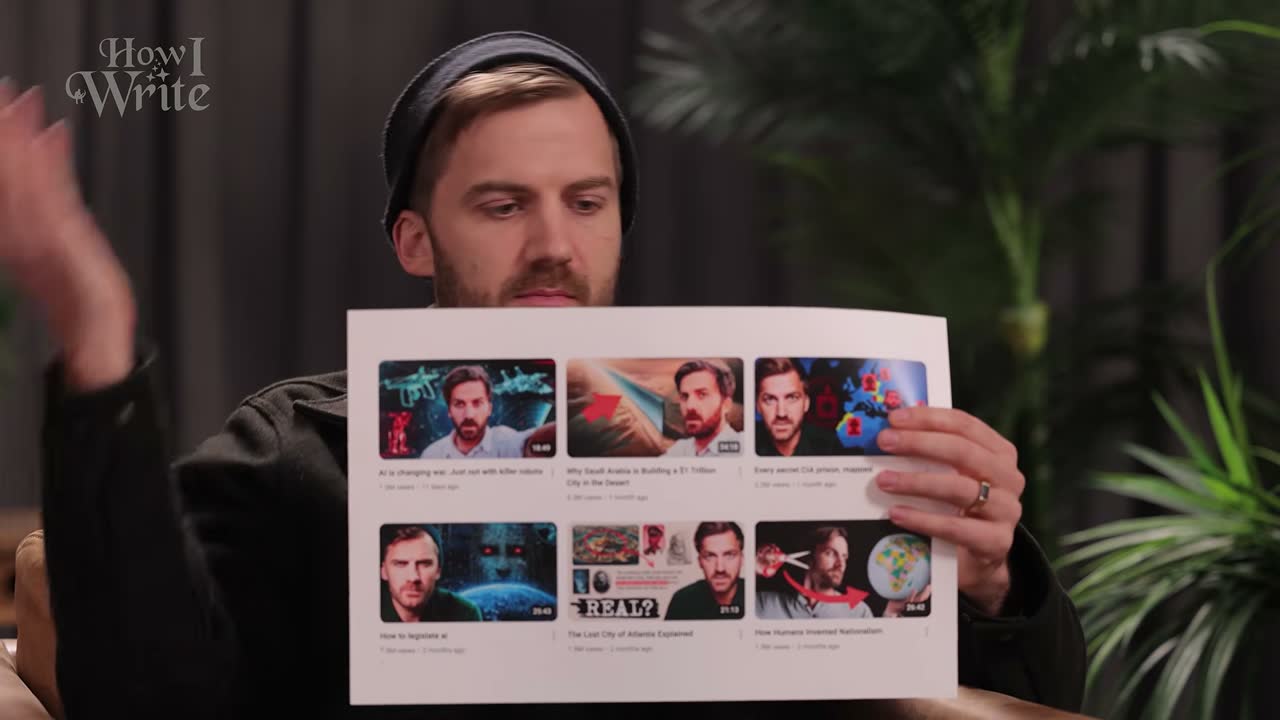
Printed grid of Johnny Harris thumbnails, including 'Why Saudi Arabia is Building a $1 Trillion City in the Desert', showing titles decided before production. Use the click as an entry point, then keep its promise. The title and thumbnail are a billboard and the story is the payoff. The Saudi video promised to explain a trillion-dollar desert city, then led viewers into oil history and the resource curse.
He calls this "folding in the vegetables". He restates the thumbnail's promise within the first minute and answers it by the end, because packaging that drifts from the video makes viewers feel betrayed.
3The two-column script
Write narration and visual direction side by side, one row per sentence. The left column holds a sentence or two of narration; the right column directs the animation, notes or annotated reference screenshots. Harris says every word must pair with a motion or action on screen.
He calls the right column coding, using colors and indentations to tell a future animator how to build each beat, and a macro (alt A) marks visual assets to collect. The team builds a "shame cut" of voiceover plus right-column screenshots straight from the script.
Every claim stays red until it has a citation. Claims are highlighted red until checked, then turn green with a citation tag and a note on the source, some backed by three or four sources such as academic articles and census data.
The comments column holds more words than the script. The team publishes a source doc for readers, a process built after facts fell through the cracks.
4Plain, active language for a smart viewer
Write who did what to whom, not concepts. Following Steven Pinker's classic style, Harris writes "they fled" instead of "the migration of 6,000 Mormons" and "America sending Ford to Japan" instead of "globalization".
He calls Pinker's The Sense of Style "my entire Bible of writing". "The migration of is a concept, they fled is an action."
Say "let me show you" and treat the viewer as a smart friend. Lines like "I want to show you what this map says", paired with a visual cue such as a circle on the object, frame the viewer as someone beside him looking at a discovery.
He says this lowers defenses, since viewers who pretend to know a reference stop being curious, and contrasts it with journalists who use jargon to impress peers.
Find fresh language and surprising details for familiar topics. Harris says most writers sit at the bottom of the canal using worn words, like an LLM predicting the next word. He wrote his Antarctica mapping video as if an alien were marvelling at it.
That intro calls a precise map "an impossibility made manifest by superhumans in the future". He also values details like an Economist note that the new Syrian leader's palace, five times the size of the White House, had no staff to serve coffee.
Alternate a precise explainer voice with a softer human one. He switches between technical play-by-play and poetic passages that put people at the center, pairing images like "undetonated bombs and abandoned bones".
The shift from thinking to feeling in language, music and visuals makes a piece more engaging and memorable. "It's a sweet and sour experience."
5How the Mormon history video was built
Chronology gives history videos a ready backbone. The Mormon history video reached about 4M views, roughly 50x normal. Chronology settled where it starts and ends, so the work became curation of a large info doc.
About a third of his videos work this way; others force him to fight for structure, which he calls brutal.
Open with action and emotion, not a preview. The video begins "It started with the murder of their prophet in Illinois" rather than "I want to tell you the story of the Mormons".
The script marks gunshot, epic and suspenseful sound, and slow motion so the cold open hits with tone, action and visual. He often opens with "look at this".
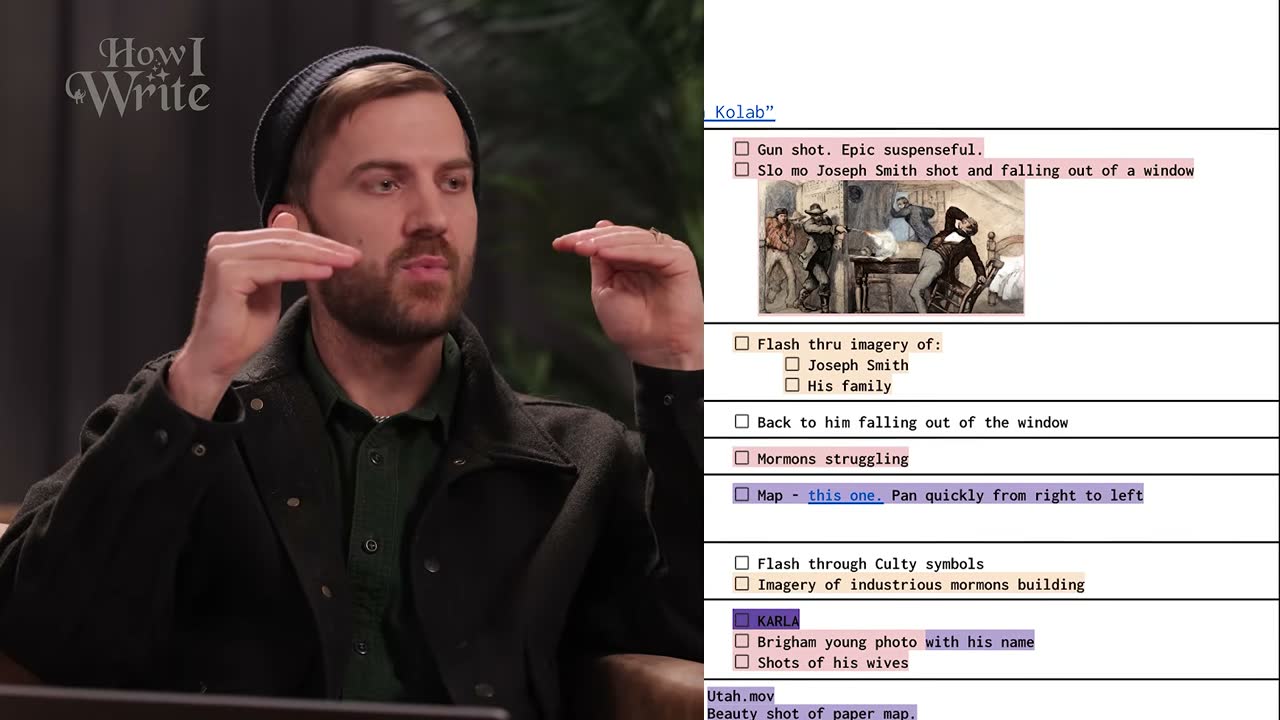
Johnny Harris's Mormons script visual column: color-coded shot directions like Joseph Smith falling from a window. Imagine how each word lands on the viewer. He added "husband to 40 wives" about Joseph Smith, though it is a familiar anti-Mormon trope that could alienate believers, judging most viewers would find it intriguing.
He calls empathizing with the viewer's mind as each fact lands his most important sensibility.
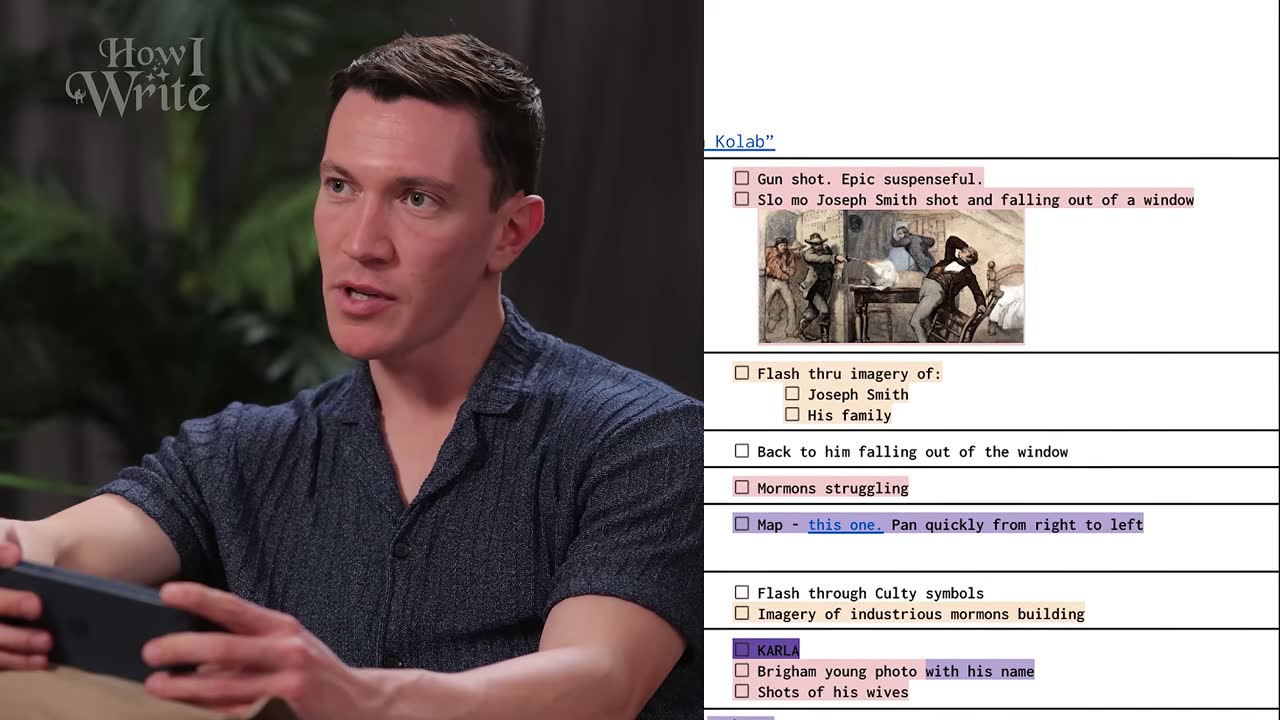
Johnny Harris's color-coded visual script: red checkbox items mark assets to collect, like the Joseph Smith shooting image. Load map icons with motives before moving them. The Mormons were loaded with fear for their spiritual vision and the federal government with a drive to expand west, so moving the government toward them created tension without explanation.
Icons also get short modern dialogue, such as asking for their own state to practice their religion, compressing a four-year lobbying effort. "I call this loading up the icon with motives."
Close softly, praising what you criticize. His history pieces end with a zoomed-out, personal postscript that puts praise and critique in one sentence, such as a beautiful valley and the sugarcoated history he was taught.
A collaborator pushed him not to lean too hard into apologizing for Mormon history, so the conclusion also names exploitation. "Life is complicated."
6Reporting in the field without a fixed story
- Every fact recorded on camera
- Every shot pre-produced
- Story shoehorned into scaffold
- 2018 Hong Kong: total nightmare
- Research done, no framing
- Seeks experiences and characters
- Voiceover written at home
Narration written after the story settles
From Johnny Harris on his process
Experience on location, write the narration after it settles. On a 2018 Hong Kong shoot Harris recorded every fact and explanation on camera, got every shot, and then could not wrestle with the story; he called it a total nightmare.
On Vox's Borders, pre-producing every shot shoehorned the story into his scaffold. Now he looks for experiences and characters in the field, then writes the voiceover word for word at home.
Gather knowledge before the trip, but shape the story after. Before Saudi Arabia he read books and talked to experts but did no storytelling work. For Finland he deliberately chose no framing in advance, treating the access as the story.
He calls storytelling "the curation of chaotic information about the world into a very firm linear presentation".
Dictate field notes as interviews change the story. He talks minutes of reflection into Apple Notes with transcription, because every interview changes his mind about what the story is.
He sometimes finds he never pressed the microphone button and has to repeat himself.
7Curiosity and craft over optimization
Harris chose craft over maximum output. Optimizing to 17 videos in flight drained his passion, so the team dialed back and accepted him as the bottleneck.
His bet is that audiences will keep wanting a human telling stories, as people still watch humans play chess though computers play better. "Everything is interesting. Everything has a story."
Guard early curiosity against the curse of knowledge. Every project hits a point where it feels far less cool than at the start; Harris remembers what it felt like not to know and imagines how he'd have wanted it explained.
"You have to hold it and guard it and then you have to push it up the other side of the valley."

Johnny Harris Reveals How He Writes YouTube Videos
It makes about 30 videos a year averaging 28 minutes, each a four-month pipeline built around a protected four-day scripting block and a two-column script. A team of 25 supports it, a Mormon history video got roughly 50x normal views, and it is now launching two more channels.
Each video runs a four-month pipeline from pitch to picture lock. Harris makes about 30 videos a year averaging 28 minutes. Each moves from a pitch and Slack greenlight, to a researcher's 3 to 4 weeks building a 60 to 80 page info doc, to a 3 to 4 day scripting week, to the edit.
The edit runs through a radio-edit assembly, rough cut, fine cut, audio lock and picture lock, with about 150 notes per cut, and everything is scheduled six months ahead. A team of 25 supports the work, and the company is now launching two more channels.
A hard scripting deadline makes the writing sharper and faster. The fixed four-day scripting window keeps Harris laser focused and prolific. A year of four videos a month on three-day sprints made the team good fast because nobody could be precious.
The cost is anger and doubt on day two or three when he hasn't cracked the explanation. Having dropped from 48 to about 30 videos a year, the team now lets some weeks run longer. "Constraints sharpen you."
Protect a daily writing block with no meetings, Slack or email. Harris writes from 9 a.m. to 2 p.m., three or sometimes four days a week, with no meetings, Slack or email.
He thinks about the block the night before, takes a ten-minute ramp up at a cleared desk, and plays his composer's music or synthwave mixes. He admits it is a bit voodoo and says an afternoon block would not work for him.
Settle why someone would click before writing the story. Harris drafts seven or more titles, mostly starting with "how" or "why", checks comparable videos on tools like 1 of 10 or ViewStats, and tests two or three packagings.
For the Saudi Arabia video he fixed the headline "why is Saudi Arabia building a futuristic city in the desert" before filming. The package sets the promise to answer, not the story itself.
Printed grid of Johnny Harris thumbnails, including 'Why Saudi Arabia is Building a $1 Trillion City in the Desert', showing titles decided before production. Use the click as an entry point, then keep its promise. The title and thumbnail are a billboard and the story is the payoff. The Saudi video promised to explain a trillion-dollar desert city, then led viewers into oil history and the resource curse.
He calls this "folding in the vegetables". He restates the thumbnail's promise within the first minute and answers it by the end, because packaging that drifts from the video makes viewers feel betrayed.
Write narration and visual direction side by side, one row per sentence. The left column holds a sentence or two of narration; the right column directs the animation, notes or annotated reference screenshots. Harris says every word must pair with a motion or action on screen.
He calls the right column coding, using colors and indentations to tell a future animator how to build each beat, and a macro (alt A) marks visual assets to collect. The team builds a "shame cut" of voiceover plus right-column screenshots straight from the script.
Every claim stays red until it has a citation. Claims are highlighted red until checked, then turn green with a citation tag and a note on the source, some backed by three or four sources such as academic articles and census data.
The comments column holds more words than the script. The team publishes a source doc for readers, a process built after facts fell through the cracks.
Write who did what to whom, not concepts. Following Steven Pinker's classic style, Harris writes "they fled" instead of "the migration of 6,000 Mormons" and "America sending Ford to Japan" instead of "globalization".
He calls Pinker's The Sense of Style "my entire Bible of writing". "The migration of is a concept, they fled is an action."
Say "let me show you" and treat the viewer as a smart friend. Lines like "I want to show you what this map says", paired with a visual cue such as a circle on the object, frame the viewer as someone beside him looking at a discovery.
He says this lowers defenses, since viewers who pretend to know a reference stop being curious, and contrasts it with journalists who use jargon to impress peers.
Find fresh language and surprising details for familiar topics. Harris says most writers sit at the bottom of the canal using worn words, like an LLM predicting the next word. He wrote his Antarctica mapping video as if an alien were marvelling at it.
That intro calls a precise map "an impossibility made manifest by superhumans in the future". He also values details like an Economist note that the new Syrian leader's palace, five times the size of the White House, had no staff to serve coffee.
Alternate a precise explainer voice with a softer human one. He switches between technical play-by-play and poetic passages that put people at the center, pairing images like "undetonated bombs and abandoned bones".
The shift from thinking to feeling in language, music and visuals makes a piece more engaging and memorable. "It's a sweet and sour experience."
Chronology gives history videos a ready backbone. The Mormon history video reached about 4M views, roughly 50x normal. Chronology settled where it starts and ends, so the work became curation of a large info doc.
About a third of his videos work this way; others force him to fight for structure, which he calls brutal.
Open with action and emotion, not a preview. The video begins "It started with the murder of their prophet in Illinois" rather than "I want to tell you the story of the Mormons".
The script marks gunshot, epic and suspenseful sound, and slow motion so the cold open hits with tone, action and visual. He often opens with "look at this".
Johnny Harris's Mormons script visual column: color-coded shot directions like Joseph Smith falling from a window. Imagine how each word lands on the viewer. He added "husband to 40 wives" about Joseph Smith, though it is a familiar anti-Mormon trope that could alienate believers, judging most viewers would find it intriguing.
He calls empathizing with the viewer's mind as each fact lands his most important sensibility.
Johnny Harris's color-coded visual script: red checkbox items mark assets to collect, like the Joseph Smith shooting image. Load map icons with motives before moving them. The Mormons were loaded with fear for their spiritual vision and the federal government with a drive to expand west, so moving the government toward them created tension without explanation.
Icons also get short modern dialogue, such as asking for their own state to practice their religion, compressing a four-year lobbying effort. "I call this loading up the icon with motives."
Close softly, praising what you criticize. His history pieces end with a zoomed-out, personal postscript that puts praise and critique in one sentence, such as a beautiful valley and the sugarcoated history he was taught.
A collaborator pushed him not to lean too hard into apologizing for Mormon history, so the conclusion also names exploitation. "Life is complicated."
Experience on location, write the narration after it settles. On a 2018 Hong Kong shoot Harris recorded every fact and explanation on camera, got every shot, and then could not wrestle with the story; he called it a total nightmare.
On Vox's Borders, pre-producing every shot shoehorned the story into his scaffold. Now he looks for experiences and characters in the field, then writes the voiceover word for word at home.
Gather knowledge before the trip, but shape the story after. Before Saudi Arabia he read books and talked to experts but did no storytelling work. For Finland he deliberately chose no framing in advance, treating the access as the story.
He calls storytelling "the curation of chaotic information about the world into a very firm linear presentation".
Dictate field notes as interviews change the story. He talks minutes of reflection into Apple Notes with transcription, because every interview changes his mind about what the story is.
He sometimes finds he never pressed the microphone button and has to repeat himself.
Harris chose craft over maximum output. Optimizing to 17 videos in flight drained his passion, so the team dialed back and accepted him as the bottleneck.
His bet is that audiences will keep wanting a human telling stories, as people still watch humans play chess though computers play better. "Everything is interesting. Everything has a story."
Guard early curiosity against the curse of knowledge. Every project hits a point where it feels far less cool than at the start; Harris remembers what it felt like not to know and imagines how he'd have wanted it explained.
"You have to hold it and guard it and then you have to push it up the other side of the valley."
More in News & Media
 News & Media
Substack
A platform where writers publish newsletters and charge readers for subscriptions.

 22 sources · 36 tips
AppAdvice
An app discovery and news site that features app deals and promotions.
 16 sources · 26 tips
 News & Media
The New York Times
A major newspaper that rebuilt a digital bundle with games, cooking and Wirecutter.
10 sources · 29 tips News & Media
Marginal Revolution
Tyler Cowen's economics blog, written daily for over two decades.
3 sources · 18 tips News & Media
TechCrunch
A technology news publication known for startup and funding coverage.
8 sources · 14 tips News & Media
The New Yorker
A weekly magazine of essays, reporting, fiction and humor.
7 sources · 15 tips News & Media
Zinio
A digital newsstand app offering over 6,000 magazines on web, iOS and Android.
4 sources · 13 tips News & Media
Mark Manson
A self-help author and blogger known for The Subtle Art of Not Giving a F*ck.
2 sources · 19 tips