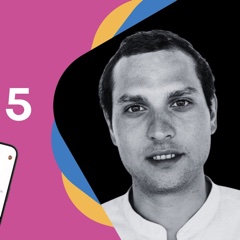
Yves Benchimol
CEO and co-founder of WeWard, the walk-to-earn app
Where to hear and read about Yves Benchimol1 episode or test

Yves Benchimol is co-founder and CEO of WeWard, a walk-to-earn app he built after closing a B2B analytics business. The thing most worth learning from him is to pick one user outcome (steps walked), judge every feature by it, and test each growth channel again in every new market.
the success of the number of steps of people is the success of the company.
How WeWard hit 20M users without paid ads — Yves Benchimol, WeWard
Yves Benchimol: the story and the lessons
1Yves Benchimol's path from B2B analytics to WeWard
Benchimol left a nearly profitable B2B business because it felt meaningless. His company sold footfall analytics to retailers such as Auchan, Carrefour and Galeries Lafayette. After a few years it was almost profitable with 10 people, but it was a lifestyle business that did not scale.
Competition was heavy, GDPR made the data work harder, and few people used the product. A recommendation only worked once staff acted on it in a physical store.
His own screen-bound lifestyle gave him the idea for a walking app. Coding all day and ordering food and cabs with one click made him want to use technology to get people outside. He calls WeWard a new product and a new company, not a pivot, because it moved from B2B to B2C.
He also considered products around sleep and phone disconnection. He chose walking because it cuts screen time, helps health and is easy to measure, since every phone and watch has a pedometer.
He kept the team, investors, money and office when he switched companies. Investors followed into the new company, so the old company's leftover money funded it. Selling the old business would have meant staying on to work for the buyer.
For him the hard part was deciding to stop, and the hardest step was calling clients to say the business was closing. In his words: "The main difficult thing is to say, okay, no, we're going to go 100% on something new".
Benchimol dropped Ethereum three to four months after building on it. The Ethereum version was laggy, with a coin taking about a minute to arrive, and scaling the blockchain had become a research project. Users did not care about the coin's security, so he moved to loyalty points in a normal database.
He says: "this is not our job to do that. Our job is to motivate people to walk." He describes that day as the moment he stopped being an engineer and became an entrepreneur focused on clients. Engineers welcomed the move despite hiring having leaned on the blockchain story.
2How Benchimol grew WeWard without paid ads
A small PR retainer replaced paid acquisition for four years. WeWard paid a PR agency about $3,000 to $5,000 a month and ran no Meta, Google or other direct user acquisition spend for its first four years. Some months brought zero downloads and some brought half a million.
Benchimol says half a million downloads bought through paid acquisition would cost enough to pay an agency for 10 years. Press worked because "money for walking" is an easy story for TV.
One prime-time TV segment brought 300,000 downloads in under five minutes. It aired seven or eight months after launch and the app crashed. Emails poured in from people who wanted access, which showed real demand.
Retention was very high compared with the market average, so WeWard then added ads. He says ads start making money past 100,000 users a day. The PR team had agreed to wait six months for payment because he had worked with them before, and the relationship lasted at least five years.
The press playbook worked in Italy and Spain but failed in the US. After moving to the US, he hired one of the most expensive US PR agencies. Journalists asked "So what?" and whether WeWard had raised money from anyone impressive.
He blames his own anonymity, not the agency or product: "It's just due to the fact that I'm nobody here in this country." He concluded that being French gives no edge in US consumer apps.
Benchimol pitched Venus Williams at a restaurant and won an investor. She sat at the next table. He waited for a slow moment, opened with being a fan of her career, then asked to tell his story. She and a European investment banker tested him on G7 retention and LTV, and she asked for his deck.
He wanted an ambassador, but she asked to be an investor too. He reframed the pitch as making Americans more active, and they talked for 10 to 15 minutes.
The ambassador and investor deal gave WeWard American credibility. The deal covers use of her image, joint content, TV appearances such as Good Morning America, and replies to journalists. Her face in the onboarding makes users read WeWard as an American product.
Benchimol says it affects hiring, press replies, CAC, retention and organic reach, but it is hard to quantify and no figures are given. He says a journalist will take a call with her over one with him.
3How WeWard measures and pays for walking
Benchimol judges every feature by steps walked, not time in the app. WeWard A/B tests each feature against steps. It does not make time in app a target, because users who do not improve their lifestyle leave after about six months.
His line: "the success of the number of steps of people is the success of the company." Rewards and revenue are discussed only after this measure is settled.
WeWard stacks loyalty, games and social feeds into motivational layers. Options include money, charity donations, social media access, beating friends and collecting cards. Each user gets the nudge that suits them, aimed at one behavior: walking more.
Retailer loyalty programs taught him how strongly points raise retention, and he read cognitive science books and applied nudge theory. "Whatever is your motivation to make you move, we're going to try to make it in the app."
A growth lead's idea turned screen time into a reward for walking. The head of growth in New York proposed locking social apps until a step goal is met. It lifts steps by 10%, and the first version was built with vibe coding.
The 10% figure comes with no test method or sample size. It also turned Benchimol's old goal of disconnecting people into a feature.
Revenue comes from many sources, each tied to the walking experience. WeWard earns from ads, in-app purchases, surveys, affiliate deals and a newer premium subscription. Ads and affiliate carry the business, and the subscription is still small but growing fast.
Each source must improve the experience, add steps or raise rewards. He agreed with a warning that the best CPMs come from gambling apps, which may hurt a brand long term.
He pitched affiliate deals to brands directly and turns some down. WeWard approached affiliate platforms and brands, offering to promote them for a commission only on sales. Partners include Nike, Adidas, Expedia, Booking.com and Amazon.
Brands like the fitness and wellness setting. WeWard rejects brands whose effect on how people act is opposite to its healthy lifestyle mission.
4Benchimol's wins, mistakes and what he changed
Rebuilding onboarding around commitment and emotion was his biggest recent win. WeWard applied advice from top apps on making users commit and creating emotion, using the celebrity and branding. It raised retention and LTV and unlocked more user acquisition.
It was a long project with many iterations. No figures are given.
Going back to B2B was his biggest failure. Many companies emailed asking for internal walking competitions, so WeWard built an enterprise community feature where people walk together and give to charity. It did not crack it.
His verdict: "I'm not good at B2B." The hosts called it a strategic retreat, and not working yet does not mean it never will.
The US was slow for two years until he moved there and invested more. The product was not adapted enough for the market and the company did not invest enough. Benchimol then moved to New York, saying founders based in the US tend to build unicorns.
Of 80 staff, 60 are in Paris, 10 in the US and 10 remote. Millions of Americans now download the app. Hiring was hard because top US marketers did not know him, and events and advisors built trust over time.
He says big step changes need bold bets, not just optimizing. Optimizing existing levers will not unlock a step change, though testing the paywall is still worth doing. His one universal rule is to admit you don't know, then explore, test and iterate.
WeWard's 80 people make it the biggest company he has run. He says people remember what worked more than what failed, but failure is part of learning.
App store review delays cap how fast WeWard can learn. Review can take up to 5 days, and this summer WeWard was stuck for more than five days with no explanation. A 24-hour review also means a broken release takes 24 hours to revert.
The more A/B tests run in parallel, the more the release cycle blocks learning. He recommends technology that avoids review for specific changes and a good contact at Apple.

How WeWard hit 20M users without paid ads — Yves Benchimol, WeWard
WeWard grew for four years with no Meta, Google or paid UA spend, relying on a small PR retainer, then used a celebrity ambassador and investor to break into the US. The episode covers affiliate revenue, measuring steps instead of screen time, and why pivoting is mostly a decision problem.
Benchimol left a nearly profitable B2B business because it felt meaningless. His company sold footfall analytics to retailers such as Auchan, Carrefour and Galeries Lafayette. After a few years it was almost profitable with 10 people, but it was a lifestyle business that did not scale.
Competition was heavy, GDPR made the data work harder, and few people used the product. A recommendation only worked once staff acted on it in a physical store.
His own screen-bound lifestyle gave him the idea for a walking app. Coding all day and ordering food and cabs with one click made him want to use technology to get people outside. He calls WeWard a new product and a new company, not a pivot, because it moved from B2B to B2C.
He also considered products around sleep and phone disconnection. He chose walking because it cuts screen time, helps health and is easy to measure, since every phone and watch has a pedometer.
He kept the team, investors, money and office when he switched companies. Investors followed into the new company, so the old company's leftover money funded it. Selling the old business would have meant staying on to work for the buyer.
For him the hard part was deciding to stop, and the hardest step was calling clients to say the business was closing. In his words: "The main difficult thing is to say, okay, no, we're going to go 100% on something new".
Benchimol dropped Ethereum three to four months after building on it. The Ethereum version was laggy, with a coin taking about a minute to arrive, and scaling the blockchain had become a research project. Users did not care about the coin's security, so he moved to loyalty points in a normal database.
He says: "this is not our job to do that. Our job is to motivate people to walk." He describes that day as the moment he stopped being an engineer and became an entrepreneur focused on clients. Engineers welcomed the move despite hiring having leaned on the blockchain story.
A small PR retainer replaced paid acquisition for four years. WeWard paid a PR agency about $3,000 to $5,000 a month and ran no Meta, Google or other direct user acquisition spend for its first four years. Some months brought zero downloads and some brought half a million.
Benchimol says half a million downloads bought through paid acquisition would cost enough to pay an agency for 10 years. Press worked because "money for walking" is an easy story for TV.
One prime-time TV segment brought 300,000 downloads in under five minutes. It aired seven or eight months after launch and the app crashed. Emails poured in from people who wanted access, which showed real demand.
Retention was very high compared with the market average, so WeWard then added ads. He says ads start making money past 100,000 users a day. The PR team had agreed to wait six months for payment because he had worked with them before, and the relationship lasted at least five years.
The press playbook worked in Italy and Spain but failed in the US. After moving to the US, he hired one of the most expensive US PR agencies. Journalists asked "So what?" and whether WeWard had raised money from anyone impressive.
He blames his own anonymity, not the agency or product: "It's just due to the fact that I'm nobody here in this country." He concluded that being French gives no edge in US consumer apps.
Benchimol pitched Venus Williams at a restaurant and won an investor. She sat at the next table. He waited for a slow moment, opened with being a fan of her career, then asked to tell his story. She and a European investment banker tested him on G7 retention and LTV, and she asked for his deck.
He wanted an ambassador, but she asked to be an investor too. He reframed the pitch as making Americans more active, and they talked for 10 to 15 minutes.
The ambassador and investor deal gave WeWard American credibility. The deal covers use of her image, joint content, TV appearances such as Good Morning America, and replies to journalists. Her face in the onboarding makes users read WeWard as an American product.
Benchimol says it affects hiring, press replies, CAC, retention and organic reach, but it is hard to quantify and no figures are given. He says a journalist will take a call with her over one with him.
Benchimol judges every feature by steps walked, not time in the app. WeWard A/B tests each feature against steps. It does not make time in app a target, because users who do not improve their lifestyle leave after about six months.
His line: "the success of the number of steps of people is the success of the company." Rewards and revenue are discussed only after this measure is settled.
WeWard stacks loyalty, games and social feeds into motivational layers. Options include money, charity donations, social media access, beating friends and collecting cards. Each user gets the nudge that suits them, aimed at one behavior: walking more.
Retailer loyalty programs taught him how strongly points raise retention, and he read cognitive science books and applied nudge theory. "Whatever is your motivation to make you move, we're going to try to make it in the app."
A growth lead's idea turned screen time into a reward for walking. The head of growth in New York proposed locking social apps until a step goal is met. It lifts steps by 10%, and the first version was built with vibe coding.
The 10% figure comes with no test method or sample size. It also turned Benchimol's old goal of disconnecting people into a feature.
Revenue comes from many sources, each tied to the walking experience. WeWard earns from ads, in-app purchases, surveys, affiliate deals and a newer premium subscription. Ads and affiliate carry the business, and the subscription is still small but growing fast.
Each source must improve the experience, add steps or raise rewards. He agreed with a warning that the best CPMs come from gambling apps, which may hurt a brand long term.
He pitched affiliate deals to brands directly and turns some down. WeWard approached affiliate platforms and brands, offering to promote them for a commission only on sales. Partners include Nike, Adidas, Expedia, Booking.com and Amazon.
Brands like the fitness and wellness setting. WeWard rejects brands whose effect on how people act is opposite to its healthy lifestyle mission.
Rebuilding onboarding around commitment and emotion was his biggest recent win. WeWard applied advice from top apps on making users commit and creating emotion, using the celebrity and branding. It raised retention and LTV and unlocked more user acquisition.
It was a long project with many iterations. No figures are given.
Going back to B2B was his biggest failure. Many companies emailed asking for internal walking competitions, so WeWard built an enterprise community feature where people walk together and give to charity. It did not crack it.
His verdict: "I'm not good at B2B." The hosts called it a strategic retreat, and not working yet does not mean it never will.
The US was slow for two years until he moved there and invested more. The product was not adapted enough for the market and the company did not invest enough. Benchimol then moved to New York, saying founders based in the US tend to build unicorns.
Of 80 staff, 60 are in Paris, 10 in the US and 10 remote. Millions of Americans now download the app. Hiring was hard because top US marketers did not know him, and events and advisors built trust over time.
He says big step changes need bold bets, not just optimizing. Optimizing existing levers will not unlock a step change, though testing the paywall is still worth doing. His one universal rule is to admit you don't know, then explore, test and iterate.
WeWard's 80 people make it the biggest company he has run. He says people remember what worked more than what failed, but failure is part of learning.
App store review delays cap how fast WeWard can learn. Review can take up to 5 days, and this summer WeWard was stuck for more than five days with no explanation. A 24-hour review also means a broken release takes 24 hours to revert.
The more A/B tests run in parallel, the more the release cycle blocks learning. He recommends technology that avoids review for specific changes and a good contact at Apple.