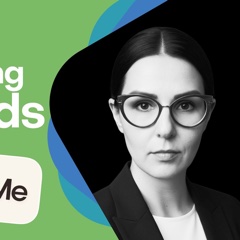
Yuliya Lennox
App growth and marketing leader (ex-BetterMe, Eva, Replika, Solid Starts, Higgsfield, PTA)
Where to hear and read about Yuliya Lennox1 episode or test

Yuliya Lennox is an app growth and marketing leader who has worked on BetterMe, Eva, Replika, Solid Starts, PTA and Higgsfield, after starting in marketing at Coca-Cola in Ukraine. The thing most worth learning from her is to never settle for stable ad numbers, and to keep testing ugly, product-first creative yourself.
Sometimes your feed is so pretty that you need something ugly to take your attention from it.
Make Ugly Ads to Grow Your App – Yuliya Lennox (Solid Starts)
Yuliya Lennox: the story and the lessons
1Yuliya Lennox's path from Coca-Cola to app growth
Lennox moved from Coca-Cola marketing in Ukraine into mobile apps at BetterMe. BetterMe was her first mobile app, and she joined as essentially the CMO.
Nobody there knew the playbook, so the team dipped its toes in and learned by trying. She sees the same pattern in founders launching apps today.
Eva taught her to stop waiting for a marketing savior. She joined a fully bootstrapped app spending about 35k a month on traffic, and the lesson was that no rescuer is coming.
The founder sat in every marketing meeting and thought up creatives himself, and Eva reached number two in its category behind Duolingo. When she left, he chose to run marketing himself because the product was his passion.
She now aims to pass on ten years of lessons, some painful. Her talk draws on BetterMe, Eva, Replika, Solid Starts, PTA and Higgsfield.
2How Lennox finds ads that win
Lennox treats steady CPMs and CPAs as a sign you stopped pushing. A user costing $30 who returns $50 feels safe to scale, but that comfort ends the search for the creative that halves CPA or triples purchases in a day.
Her rule: "never settle for mediocracy and always always be looking for those creatives that will move the needle."
She expects first creatives to be bad and the breakthrough to be sudden. At $100 to $500 a day, identical CPMs and CPAs can fool you into thinking LTV looks fine.
Her test is whether you ever thought "wow, this is so much better than everything before". The outsized returns go to people who write a new playbook, as with app tracking transparency and UGC.
She makes ugly ads that say what the product is in the first second. An unknown app cannot sell a feeling the way Coca-Cola can, so it should sell the product and the pain it solves first.
The caveat is that the case rests on a few anecdotes, mainly the belly fat ad, with no data on how often ugly ads win or lose.
The BetterMe belly fat ad is her example of the best ad ever. It was a shocking illustration of fat hanging off the front of a body, invented while she was at BetterMe. People still remember it years later, while polished workout ads are forgotten.
She puts performance spend first and makes brand spend justify itself. Awareness ads bring nothing short term, and she says nothing branded will work as well as something performance-driven.
Ladder's Hilary Duff partnership is brand marketing that cannot show ROI yet, though it did bring a sizable influx almost immediately. Subscription apps sell function, while Nike must sell prettiness.
At Solid Starts she learned ugly ads can cost trust. A fruit-made-into-babies ad fit Instagram trends but drew comments asking whether a company that made it should be trusted to feed babies.
Her test is whether making it ugly applies to what you sell. Her warning is that the brand may exist only in the heads of you, your family and some employees.
She tests creative in cheap markets that convert like the US. Testing 500 ads a week at US CPMs breaks the budget, while a similar-converting market like Indonesia costs $10 a day instead of $1,000.
Winners then come back to the US, and AI can localize the ads in a few hours.
3Lennox on localization, organic growth and finding a market
Lennox would bet on localization over everything else. AI can translate a service into any language in about 3 hours, and she says trying languages can double income. She names it her biggest win.
Turkey became a big market that few would have guessed.
She starts in the market she knows, then looks for similar ones. Babbel and Blinkist started in Germany, which gives results like the US, a market about 10 times bigger. Eva started in the founders' native language before adding others.
Founders from Lithuania and India all wanted the US first for its cash value, and she tells them to look at what they know first.
Replika's Japan bet failed even with a Japanese speaker on the team. The cultural localization did not work, because culture is harder than the team expected.
She sells in Taiwan but knows it is a fraction of what it could be without understanding the culture. Her advice is to look for similarities between people.
She saw organic growth stall at Replika and Solid Starts. Every follower who would join in the next five years joins early, then growth flattens, and paid ads on a loved product cannibalize organic about 50% of the time.
Flat growth is hard to sell to a buyer, and organic cannot be steered the way performance marketing can be adjusted daily.
She starts paid marketing on day one to feed organic. Eva's Instagram grew to roughly 7 million, and early ads brought followers who then came for free.
A generic app like a time tracker should not count on organic. She says finding something unique is about 50% of success.
She warns against copying the monetization of apps that got lucky. Some ChatGPT wrapper apps topped the store on word of mouth alone, and copying their paywalls earned nothing.
Their money did not come from the paywall. App Store search is the one organic channel that keeps paying for years, though it favors older apps.
She avoids red oceans unless the product has a unique spin. Crowded examples include the 2000th food scanning app, another AI note-taker and mental health apps.
Cal AI won through hustle and fast execution rather than a defensible product. In 2017 fitness seemed full, yet companies bigger than BetterMe now exist.
4How Lennox thinks about founders, teams and honest growth
She says founders must feel marketing with their own hands. Marketing is easy to understand but has to be felt by doing it, and a great CMO arrives only if you are very lucky.
She points to RevenueCat's CEO Jacob getting involved in priorities, which signals importance and brings his passion. She thinks developers stay necessary, but anyone can learn marketing.
She tells founders to sell an idea before building it. Sell a PDF or a concept, refund it if needed, and see whether enough people care before paying a developer or vibe coding.
Her own aquarium app idea was never tested this way. Friends and family approval is not proof, and reaching $20k a month on paid ads alone might cost $100k to $200k.
She hires people obsessed with the product's mission. At Solid Starts each person messaged the founder to say they wanted on the team no matter what, and she says the effect is 10 times higher than at Replika.
At Replika, ML people tested LLMs before they were popular. She wants expert-led teams, such as a mental health app built by doctors.
Higgsfield showed her what extreme effort looks like. The founders won physics olympiads, slept in the office and worked 17 hours a day, six days a week.
The core team chose it as their opportunity. She now pushes her own teams harder and meets Gen Z pushback.
She positions for what AI cannot do yet. In 2021 PTA started Zing, an AI training app, to become an AI company within five years.
Higgsfield bet on video AI when models were crude and investors passed. She says to accept lower margins and higher burn to be ready.
She shares test results with peers to learn faster. At PTA, the Flo parent company, apps shared tests so others could copy and localize them.
She suggests weekly calls with three or four adjacent apps: "sharing doesn't mean that you are losing something. It always means that you are gaining something."
Her biggest mistake to avoid is running several products at once. She joined a team running three apps at the same time, and none got enough attention.
Free developer time makes a new idea feel costless, but focus is not free. She says to run one product like a war room asking daily "What are we doing today?"
She draws a line at funnels that hide prices and stack upsells. A dieting-app quiz flow upsold a $1 plan after about 60 questions, and the card statement later showed $350 to $400.
Her line is taking money from a user who was never good enough to earn it, because there is no value behind the charge. She says marketers drift over it one small step at a time.

Make Ugly Ads to Grow Your App – Yuliya Lennox (Solid Starts)
Yuliya Lennox draws on a decade of growing apps to argue for ugly, product-first ads, founder-led marketing, and aggressive localization. She explains why stable ad performance is a warning sign and why organic growth plateaus, using examples from BetterMe, Eva, Replika and Solid Starts.
Lennox moved from Coca-Cola marketing in Ukraine into mobile apps at BetterMe. BetterMe was her first mobile app, and she joined as essentially the CMO.
Nobody there knew the playbook, so the team dipped its toes in and learned by trying. She sees the same pattern in founders launching apps today.
Eva taught her to stop waiting for a marketing savior. She joined a fully bootstrapped app spending about 35k a month on traffic, and the lesson was that no rescuer is coming.
The founder sat in every marketing meeting and thought up creatives himself, and Eva reached number two in its category behind Duolingo. When she left, he chose to run marketing himself because the product was his passion.
She now aims to pass on ten years of lessons, some painful. Her talk draws on BetterMe, Eva, Replika, Solid Starts, PTA and Higgsfield.
Lennox treats steady CPMs and CPAs as a sign you stopped pushing. A user costing $30 who returns $50 feels safe to scale, but that comfort ends the search for the creative that halves CPA or triples purchases in a day.
Her rule: "never settle for mediocracy and always always be looking for those creatives that will move the needle."
She expects first creatives to be bad and the breakthrough to be sudden. At $100 to $500 a day, identical CPMs and CPAs can fool you into thinking LTV looks fine.
Her test is whether you ever thought "wow, this is so much better than everything before". The outsized returns go to people who write a new playbook, as with app tracking transparency and UGC.
She makes ugly ads that say what the product is in the first second. An unknown app cannot sell a feeling the way Coca-Cola can, so it should sell the product and the pain it solves first.
The caveat is that the case rests on a few anecdotes, mainly the belly fat ad, with no data on how often ugly ads win or lose.
The BetterMe belly fat ad is her example of the best ad ever. It was a shocking illustration of fat hanging off the front of a body, invented while she was at BetterMe. People still remember it years later, while polished workout ads are forgotten.
She puts performance spend first and makes brand spend justify itself. Awareness ads bring nothing short term, and she says nothing branded will work as well as something performance-driven.
Ladder's Hilary Duff partnership is brand marketing that cannot show ROI yet, though it did bring a sizable influx almost immediately. Subscription apps sell function, while Nike must sell prettiness.
At Solid Starts she learned ugly ads can cost trust. A fruit-made-into-babies ad fit Instagram trends but drew comments asking whether a company that made it should be trusted to feed babies.
Her test is whether making it ugly applies to what you sell. Her warning is that the brand may exist only in the heads of you, your family and some employees.
She tests creative in cheap markets that convert like the US. Testing 500 ads a week at US CPMs breaks the budget, while a similar-converting market like Indonesia costs $10 a day instead of $1,000.
Winners then come back to the US, and AI can localize the ads in a few hours.
Lennox would bet on localization over everything else. AI can translate a service into any language in about 3 hours, and she says trying languages can double income. She names it her biggest win.
Turkey became a big market that few would have guessed.
She starts in the market she knows, then looks for similar ones. Babbel and Blinkist started in Germany, which gives results like the US, a market about 10 times bigger. Eva started in the founders' native language before adding others.
Founders from Lithuania and India all wanted the US first for its cash value, and she tells them to look at what they know first.
Replika's Japan bet failed even with a Japanese speaker on the team. The cultural localization did not work, because culture is harder than the team expected.
She sells in Taiwan but knows it is a fraction of what it could be without understanding the culture. Her advice is to look for similarities between people.
She saw organic growth stall at Replika and Solid Starts. Every follower who would join in the next five years joins early, then growth flattens, and paid ads on a loved product cannibalize organic about 50% of the time.
Flat growth is hard to sell to a buyer, and organic cannot be steered the way performance marketing can be adjusted daily.
She starts paid marketing on day one to feed organic. Eva's Instagram grew to roughly 7 million, and early ads brought followers who then came for free.
A generic app like a time tracker should not count on organic. She says finding something unique is about 50% of success.
She warns against copying the monetization of apps that got lucky. Some ChatGPT wrapper apps topped the store on word of mouth alone, and copying their paywalls earned nothing.
Their money did not come from the paywall. App Store search is the one organic channel that keeps paying for years, though it favors older apps.
She avoids red oceans unless the product has a unique spin. Crowded examples include the 2000th food scanning app, another AI note-taker and mental health apps.
Cal AI won through hustle and fast execution rather than a defensible product. In 2017 fitness seemed full, yet companies bigger than BetterMe now exist.
She says founders must feel marketing with their own hands. Marketing is easy to understand but has to be felt by doing it, and a great CMO arrives only if you are very lucky.
She points to RevenueCat's CEO Jacob getting involved in priorities, which signals importance and brings his passion. She thinks developers stay necessary, but anyone can learn marketing.
She tells founders to sell an idea before building it. Sell a PDF or a concept, refund it if needed, and see whether enough people care before paying a developer or vibe coding.
Her own aquarium app idea was never tested this way. Friends and family approval is not proof, and reaching $20k a month on paid ads alone might cost $100k to $200k.
She hires people obsessed with the product's mission. At Solid Starts each person messaged the founder to say they wanted on the team no matter what, and she says the effect is 10 times higher than at Replika.
At Replika, ML people tested LLMs before they were popular. She wants expert-led teams, such as a mental health app built by doctors.
Higgsfield showed her what extreme effort looks like. The founders won physics olympiads, slept in the office and worked 17 hours a day, six days a week.
The core team chose it as their opportunity. She now pushes her own teams harder and meets Gen Z pushback.
She positions for what AI cannot do yet. In 2021 PTA started Zing, an AI training app, to become an AI company within five years.
Higgsfield bet on video AI when models were crude and investors passed. She says to accept lower margins and higher burn to be ready.
She shares test results with peers to learn faster. At PTA, the Flo parent company, apps shared tests so others could copy and localize them.
She suggests weekly calls with three or four adjacent apps: "sharing doesn't mean that you are losing something. It always means that you are gaining something."
Her biggest mistake to avoid is running several products at once. She joined a team running three apps at the same time, and none got enough attention.
Free developer time makes a new idea feel costless, but focus is not free. She says to run one product like a war room asking daily "What are we doing today?"
She draws a line at funnels that hide prices and stack upsells. A dieting-app quiz flow upsold a $1 plan after about 60 questions, and the card statement later showed $350 to $400.
Her line is taking money from a user who was never good enough to earn it, because there is no value behind the charge. She says marketers drift over it one small step at a time.