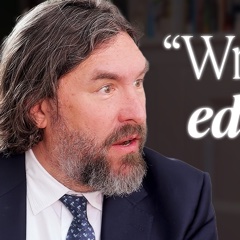
Wright Thompson
Senior writer at ESPN and author of The Barn
Where to hear and read about Wright Thompson1 episode or test

Wright Thompson is a senior writer at ESPN and the author of The Barn, who builds long nonfiction around a known ending, a hidden inner conflict and deep reporting. The habit most worth copying is that he writes fast, cuts hard, and treats every stuck draft as a reporting problem rather than a writing problem.
All overwritten really means is underreported.
How to Write Incredible Stories (Wright Thompson Interview)
Wright Thompson: the story and the lessons
1How Wright Thompson learned the craft through reps
Thompson built his skill by writing one length many times. He went from 1,200 words to 2,500, then 3,600 at the Kansas City Star, then 7,200 to 8,500 at ESPN, then 12,000 to 15,000. About 300 magazine stories came before The Barn.
He says there is no mystery to getting good: "It's just reps." His magazine pieces came out at 7,200 to 8,500 words almost every time, because he had learned to think at that length.
After 25 years he feels he only recently knows what he is doing. The work has gotten harder, because understanding the job keeps moving the goalposts. Over a long career, he says, writing is about how a piece is built, and the words matter once the structure is understood.
He sees the 300 magazine stories as a prelude to books, and after a canvas that big it is hard to go back.
He stopped hunting white whales and now follows what obsesses him. Early on he chased stories no one else could get, to impress bosses and readers. Now he says there is no good or bad idea, only something you are obsessed with enough to spend years on.
He cannot predict reception. A story he loved about Archie Manning went unread, while a night out with rapper Cal Wayne melted the internet. He calls the work a personal thing done publicly.
Thompson stays in sports because sports show who people are. His line is "Ball don't lie": you are what you do when the lights come on. He sees leaving sports for other magazines as ego and vanity.
He lists Steve Kerr's four values as joy, empathy, competitiveness and mindfulness, and says a writer needs them too.
2How Thompson wrote The Barn
Thompson treats a book as a different job from a long article. An article is a dispatch from one time and place, and a book builds a universe. The Barn rests on a map of 1900 railroads reaching Mississippi, the last place in the lower 48 to be settled, under the barn where Emmett Till was killed.
That makes the book a thought experiment: what if everything we think about ourselves is wrong? His editor Scott Moyers told him you can't depressurize the cabin, and that a book is a ball pushed downhill with obstacles cleared.
His first draft ran 280,000 words and he cut 173,000. He outlined The Barn only broadly and felt his way section by section, writing everything because he was not sure what was load-bearing. The cut left a book of about 107,000 words.
He calls it a rookie inefficiency he never wants to repeat. His first Atlantic draft also tried to hold the whole world, and editor Denise Wills saw the balls falling. A book is rhythmic juggling and an article is one hard throw at a target.
He needed years before he could face his own home place. The Barn made everything before it feel like practice for facing the Mississippi Delta, which he loves and hates. He says he could not have written it five years earlier.
He quotes Springsteen: you can be a ghost to your children or an ancestor. His model is Absalom, Absalom!, a multigenerational history of one piece of dirt, and he tried to go wide and deep at once.
For his next book he plans to storyboard far more. It has six arcs that seem unrelated. He wants the reader to connect them in the white space, about a quarter of the way in.
He admits he does not yet know when to get explicit about the connection.
3Wright Thompson's approach to reporting
Thompson treats overwritten prose as a sign of under-reporting. When a passage feels purple or hollow, he says the problem is a hole in his knowledge, not his sentences. You cannot write around a hole, and it reads badly later.
Every time he is stuck, it is because he has not reported enough or believes his own hype that he can write around it. He says: "All overwritten really means is underreported."
He defines reporting as working out who holds the answer. Decide what you want to know, figure out who in the world would know it, then work out how to get that person or place to tell you. He says reporting is mystified more than it should be.
He once waited over a year for an archive in Biarritz to open and photographed 1,600 pages of French. At ten minutes a page, he figures translating them takes about five and a half weeks.
He builds a one-page timeline from scattered documents. He pieced together a ten-month period in the life of a possible spy from 10 to 12 documents across six archives, all onto a single sheet.
He called holding it up one of the best feelings in a long time. It gives him a spine to write from.
Thompson hunts for the one detail that replaces fifty sentences. His example is the security code name "Yahweh" for Michael Jordan. The same list gave Estee as Venom, George as Butler and Yvette as Harmony, and it shows who runs the inner circle.
He holds up Baxter Holmes's ESPN story on Kobe, Jordan and the Black Mamba, where on-the-record details beat the rumors. In his words: "A great detail will do the work of you know, 50 shitty sentences."
He prefers long runs of dialogue to isolated quotes. Dialogue moves the reader faster than narration does. He calls long runs of it magic.
They exist only if the reporting went deep enough to get people to tell you things on the record in detail.
4How Thompson builds a profile
He builds each profile around one central complication. He repeats Gary Smith's definition: find the central complication of a life and how the person tries to solve it day to day. Most of that happens inside them.
His Tiger Woods piece turns on Nike giving an extreme introvert a marketing plan built for the extrovert Michael Jordan. Woods's boats are named Privacy and Solitude, which says a lot in one line.
He sets up inner life so plain actions carry the meaning. Once the reader knows Jordan misses his father every day, a scene of him falling asleep to Westerns needs no explanation. Scenes without interiority are origami, not a swan.
He dislikes the word "characters" and wants the people whose lives he is entrusted with to be as complex in their decisions as the writer.
He presents many people's versions of a subject without sorting them. Ten people from ten stages of a life give ten versions. His job is to present a fractal image of a complicated human being, not to reconcile them.
The truth sits where the story people tell about themselves meets what others say.
He keeps a driving question and no longer states it. The question guides his reporting and writing, but he trusts the reader to feel it. His Joe Montana profile was about time wearing away how people remember you, and he never says so.
For Steve Kerr the question is what the rest of his life will be once basketball ends. Some of the best questions he could not have outlined in advance.
He tries to see the story that already exists. Citing Virginia Woolf, he believes stories already exist and some people can see them. Forcing a shape onto one is where writers get into trouble, and he forced plenty early on.
"I'm not trying to make the path. I'm trying to see the path that was there before I got there."
5Thompson on structure and endings
Thompson decides the ending first and builds every choice toward it. On a Yankee Stadium piece he knew the last image before anything else: Lou Gehrig's widow dying in the 1980s with no one at her funeral. Every scene had to lead there.
A great ending makes the room feel hollow and echoey, and he loves that feeling. He says: "I always want to know what the ending is."
He wants endings that resolve the arc and leave a door open. A good ending is neither a bow nor a pile of wet noodles. His Caitlin Clark piece answers how she became Caitlin Clark and leaves open whether she can survive what comes next.
"Don't hammer the door shut. A story is supposed to open a door." A reader once emailed demanding an answer to his question. He bristled, then accepted that the reader has the final say.
Thompson reads a lost ending as a sign he has lost the story. His Ted Williams family story went through draft after draft with editor Paul Kix. He had the daughter, the filing cabinets and the diaries and still could not land it.
Once you can see the ending, he says, you are just following a map.
He uses the second section to ask the broad question. With Seth Wickersham he treats a magazine story's second section almost as a verb. It feels like the next step in time while widening the question the rest of the story answers.
He also makes each scene hit a different note so the story never repeats itself. Books have no second sections, which made the move from magazines hard.
6How Wright Thompson works day to day
Thompson drafts fast, edits slow and loves the cut. He races through a first draft to get down whatever is on fire, then goes back and cuts. He has tried to slow down and it does not suit him.
"I also write really fast and then edit slow." He says writer's block does not exist, only writer's vomit, because the words never stop.
He wrote 1,000 words a day on the book, wherever he was. He kept the count on vacation in the mountains and at the beach. He cut a lot of it, but the rhythm mattered.
He also wanted his kids to see him get up and do it.
He picks the method that fits the day's problem. He writes from a country office outside Oxford, Mississippi. On a good day he walks the town square every couple of hours. The day of the interview he wrote longhand, because he had a hand-built timeline to sit with in quiet.
He does not want the tail wagging the dog: "every day is a new problem."
Thompson skips brainstorming meetings and lets ideas come from friends. He says people in the room want to look good in front of the boss, not make the thing good. If he ran ESPN, no meeting could have chairs, and any meeting over 15 minutes would need tacos.
The best line he saw air in his place essays came from cameraman Kaelen Shouts, freezing in Scotland: "Scotland, where the cows wear coats."

How to Write Incredible Stories (Wright Thompson Interview)
Wright Thompson explains how he builds long nonfiction stories around a known ending, a hidden interior question and relentless reporting. The habit worth hearing is that he writes fast, cuts hard, and treats every stuck draft as a reporting problem rather than a writing problem.
Thompson built his skill by writing one length many times. He went from 1,200 words to 2,500, then 3,600 at the Kansas City Star, then 7,200 to 8,500 at ESPN, then 12,000 to 15,000. About 300 magazine stories came before The Barn.
He says there is no mystery to getting good: "It's just reps." His magazine pieces came out at 7,200 to 8,500 words almost every time, because he had learned to think at that length.
After 25 years he feels he only recently knows what he is doing. The work has gotten harder, because understanding the job keeps moving the goalposts. Over a long career, he says, writing is about how a piece is built, and the words matter once the structure is understood.
He sees the 300 magazine stories as a prelude to books, and after a canvas that big it is hard to go back.
He stopped hunting white whales and now follows what obsesses him. Early on he chased stories no one else could get, to impress bosses and readers. Now he says there is no good or bad idea, only something you are obsessed with enough to spend years on.
He cannot predict reception. A story he loved about Archie Manning went unread, while a night out with rapper Cal Wayne melted the internet. He calls the work a personal thing done publicly.
Thompson stays in sports because sports show who people are. His line is "Ball don't lie": you are what you do when the lights come on. He sees leaving sports for other magazines as ego and vanity.
He lists Steve Kerr's four values as joy, empathy, competitiveness and mindfulness, and says a writer needs them too.
Thompson treats a book as a different job from a long article. An article is a dispatch from one time and place, and a book builds a universe. The Barn rests on a map of 1900 railroads reaching Mississippi, the last place in the lower 48 to be settled, under the barn where Emmett Till was killed.
That makes the book a thought experiment: what if everything we think about ourselves is wrong? His editor Scott Moyers told him you can't depressurize the cabin, and that a book is a ball pushed downhill with obstacles cleared.
His first draft ran 280,000 words and he cut 173,000. He outlined The Barn only broadly and felt his way section by section, writing everything because he was not sure what was load-bearing. The cut left a book of about 107,000 words.
He calls it a rookie inefficiency he never wants to repeat. His first Atlantic draft also tried to hold the whole world, and editor Denise Wills saw the balls falling. A book is rhythmic juggling and an article is one hard throw at a target.
He needed years before he could face his own home place. The Barn made everything before it feel like practice for facing the Mississippi Delta, which he loves and hates. He says he could not have written it five years earlier.
He quotes Springsteen: you can be a ghost to your children or an ancestor. His model is Absalom, Absalom!, a multigenerational history of one piece of dirt, and he tried to go wide and deep at once.
For his next book he plans to storyboard far more. It has six arcs that seem unrelated. He wants the reader to connect them in the white space, about a quarter of the way in.
He admits he does not yet know when to get explicit about the connection.
Thompson treats overwritten prose as a sign of under-reporting. When a passage feels purple or hollow, he says the problem is a hole in his knowledge, not his sentences. You cannot write around a hole, and it reads badly later.
Every time he is stuck, it is because he has not reported enough or believes his own hype that he can write around it. He says: "All overwritten really means is underreported."
He defines reporting as working out who holds the answer. Decide what you want to know, figure out who in the world would know it, then work out how to get that person or place to tell you. He says reporting is mystified more than it should be.
He once waited over a year for an archive in Biarritz to open and photographed 1,600 pages of French. At ten minutes a page, he figures translating them takes about five and a half weeks.
He builds a one-page timeline from scattered documents. He pieced together a ten-month period in the life of a possible spy from 10 to 12 documents across six archives, all onto a single sheet.
He called holding it up one of the best feelings in a long time. It gives him a spine to write from.
Thompson hunts for the one detail that replaces fifty sentences. His example is the security code name "Yahweh" for Michael Jordan. The same list gave Estee as Venom, George as Butler and Yvette as Harmony, and it shows who runs the inner circle.
He holds up Baxter Holmes's ESPN story on Kobe, Jordan and the Black Mamba, where on-the-record details beat the rumors. In his words: "A great detail will do the work of you know, 50 shitty sentences."
He prefers long runs of dialogue to isolated quotes. Dialogue moves the reader faster than narration does. He calls long runs of it magic.
They exist only if the reporting went deep enough to get people to tell you things on the record in detail.
He builds each profile around one central complication. He repeats Gary Smith's definition: find the central complication of a life and how the person tries to solve it day to day. Most of that happens inside them.
His Tiger Woods piece turns on Nike giving an extreme introvert a marketing plan built for the extrovert Michael Jordan. Woods's boats are named Privacy and Solitude, which says a lot in one line.
He sets up inner life so plain actions carry the meaning. Once the reader knows Jordan misses his father every day, a scene of him falling asleep to Westerns needs no explanation. Scenes without interiority are origami, not a swan.
He dislikes the word "characters" and wants the people whose lives he is entrusted with to be as complex in their decisions as the writer.
He presents many people's versions of a subject without sorting them. Ten people from ten stages of a life give ten versions. His job is to present a fractal image of a complicated human being, not to reconcile them.
The truth sits where the story people tell about themselves meets what others say.
He keeps a driving question and no longer states it. The question guides his reporting and writing, but he trusts the reader to feel it. His Joe Montana profile was about time wearing away how people remember you, and he never says so.
For Steve Kerr the question is what the rest of his life will be once basketball ends. Some of the best questions he could not have outlined in advance.
He tries to see the story that already exists. Citing Virginia Woolf, he believes stories already exist and some people can see them. Forcing a shape onto one is where writers get into trouble, and he forced plenty early on.
"I'm not trying to make the path. I'm trying to see the path that was there before I got there."
Thompson decides the ending first and builds every choice toward it. On a Yankee Stadium piece he knew the last image before anything else: Lou Gehrig's widow dying in the 1980s with no one at her funeral. Every scene had to lead there.
A great ending makes the room feel hollow and echoey, and he loves that feeling. He says: "I always want to know what the ending is."
He wants endings that resolve the arc and leave a door open. A good ending is neither a bow nor a pile of wet noodles. His Caitlin Clark piece answers how she became Caitlin Clark and leaves open whether she can survive what comes next.
"Don't hammer the door shut. A story is supposed to open a door." A reader once emailed demanding an answer to his question. He bristled, then accepted that the reader has the final say.
Thompson reads a lost ending as a sign he has lost the story. His Ted Williams family story went through draft after draft with editor Paul Kix. He had the daughter, the filing cabinets and the diaries and still could not land it.
Once you can see the ending, he says, you are just following a map.
He uses the second section to ask the broad question. With Seth Wickersham he treats a magazine story's second section almost as a verb. It feels like the next step in time while widening the question the rest of the story answers.
He also makes each scene hit a different note so the story never repeats itself. Books have no second sections, which made the move from magazines hard.
Thompson drafts fast, edits slow and loves the cut. He races through a first draft to get down whatever is on fire, then goes back and cuts. He has tried to slow down and it does not suit him.
"I also write really fast and then edit slow." He says writer's block does not exist, only writer's vomit, because the words never stop.
He wrote 1,000 words a day on the book, wherever he was. He kept the count on vacation in the mountains and at the beach. He cut a lot of it, but the rhythm mattered.
He also wanted his kids to see him get up and do it.
He picks the method that fits the day's problem. He writes from a country office outside Oxford, Mississippi. On a good day he walks the town square every couple of hours. The day of the interview he wrote longhand, because he had a hand-built timeline to sit with in quiet.
He does not want the tail wagging the dog: "every day is a new problem."
Thompson skips brainstorming meetings and lets ideas come from friends. He says people in the room want to look good in front of the boss, not make the thing good. If he ran ESPN, no meeting could have chairs, and any meeting over 15 minutes would need tacos.
The best line he saw air in his place essays came from cameraman Kaelen Shouts, freezing in Scotland: "Scotland, where the cows wear coats."