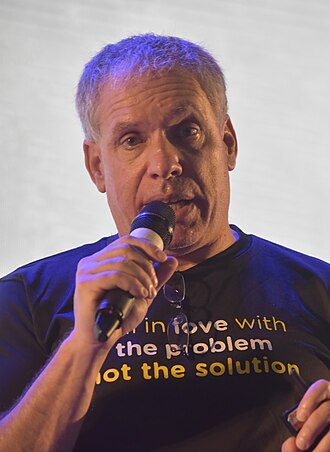
Uri Levine
Co-founder of Waze, serial founder of ten companies, board member and advisor, author of Fall in Love with the Problem, Not the Solution
Where to hear and read about Uri Levine1 episode or test

Uri Levine co-founded Waze, which sold to Google for over $1 billion after about $50 million raised, and he has co-founded 10 companies, served on 20 boards and advised 50 or more. The thing most worth learning from him is to fall in love with a real problem, then iterate until users keep coming back.
Focus is not about what we are doing, it's about what we are not doing.
Lessons from a 2-time unicorn builder, 50-time startup advisor and 20-time board member | Uri Levine
Uri Levine: the story and the lessons
1Uri Levine's case for falling in love with the problem
Levine has built, funded and advised startups at scale. He has co-founded 10 companies, four still operating, and built two unicorns. He has sat on 20 boards, advised 50 or more companies, and still sits on about a dozen boards.
Waze is one of the 10. Its sale to Google for over $1 billion was an astronomical sum at the time.
Levine starts from a problem, never from a solution. The problem becomes the North Star of the journey, so a founder deviates less from course. In 2007 'an AI crowd-sourced navigation system' drew a shrug, while 'I'll help you avoid traffic jams' made people care.
Founders' emails open with what they are doing, but he wants to know why. He prefers 'the problem we are solving is' or 'the value we create for you is' over 'our company is'.
Levine tests a problem on strangers, not friends. About 20 strangers is enough to validate it, though he says 100 really means getting out of your comfort zone. If they answer 'I know someone with this problem', it isn't real.
If they say 'no, the problem is...' and describe it in their own words, follow that. His line: 'If you happen to be the only person on the planet with this problem, I can recommend you a therapist.'
Levine's best ideas come from his own frustration. He hates traffic jams and hates leaving money on the table, and tells himself there must be a different way. Then he validates with many people, or many businesses for a B2B idea.
A big, real problem is not enough without personal passion, because the road is hard, complex and long. The founder falls in love first, then gets everyone else to love the same problem.
Levine says to fail fast, because nobody knows what works. A startup is a journey of failures and no one built it before. Failing early leaves time to retry the product, the go-to-market or the business model.
His rule: 'The biggest enemy of good enough is perfect.' Start with not good enough and iterate, like taking many shots instead of one half-court shot.
Oversee kept its problem and changed who it served. Oversee began with consumers who could rebook a flight cheaper when the price dropped, but travelers would not do the work. It moved to corporates, which can rebook automatically and save about 10% of the travel budget.
Levine says the B2C version was far harder than expected. Savings in corporate travel go straight to the bottom line.
2How Waze found product-market fit
Waze needed a year of rebuilding after going global. It went global at the end of 2009 and worked well in only about four places: the Czech Republic, Slovakia, Latvia and Ecuador. The team spoke to drivers who churned, built the next version and repeated, until it worked in early 2011.
Users wanted it to succeed, so they told the team exactly what was broken. In all, Waze took about four years to reach fit. 'Journey of failures. Iteration after iteration after iteration after iteration.'
Levine treats retention as the only product-market fit metric. Waze compared each new market with Israel on frequency of use and time between visits. For high-frequency products, three-month retention of 30, 40 or 50% is a good sign.
Users who stop before a fourth use have tried it twice and decided it isn't good enough. The signal fails for rare-use products like a yearly tax return.
Waze worked where approximate data was good enough. In the U.S., blocks run in hundreds, so a few known addresses let Waze estimate the rest. Japan never worked because houses are numbered by age, and without every house number the map is not good enough.
Levine's rule: 'If you need perfect information, crowdsource may not be the right way to do that.'
Users valued certainty over time saved. Waze set out to help drivers avoid traffic jams, but users valued knowing exactly when they would arrive. Traffic is worse today than in 2007, yet Waze still delivers that value.
A driver headed to San Francisco stays on the 101 and only wants to know how long it will take. 'Certainty creates way more value than saving time.'
Levine runs a company through one phase at a time. Early on, think about everything but execute only product-market fit, with developers and a product lead, not sales or marketing. Fail at fit and the company dies.
Changing phase is hard because the center of gravity moves, for example from product to marketing. Some companies never find the clutch. Waze planned to sell map data to governments, then chose advertising because sales cycles were too long.
Frequency of use decides whether growth or business model comes first. Ask a hundred people how they heard of Waze and 95 to 99 say someone told them, so Waze could grow before it had a business model. Without high frequency you must buy users forever, so settle the model first.
Coolness can stand in for frequency. Airbnb is used once or twice a year, yet 70 to 80% of its growth is still word-of-mouth.
3How Levine raises money and pitches investors
Waze raised little by American standards. It raised about $50 million in total, in rounds of $12 million and $30 million, then a small last round. Israeli startups run leaner than American ones, at much lower valuations.
Levine calls raising money a roller coaster in the dark, because founders must raise repeatedly and at first don't know how the game is played.
Levine tells the CEO to go alone and tell a story. Early investors mostly say they backed the CEO and the story. Bringing the team splits attention, and investors may remember the CEO as not unique.
Start with the problem, because investors are users too. If it isn't relevant to them, they dismiss the market. 'I like the CEO. I like the story. That's it.'
Levine expects about a hundred nos for each yes. About one third of customers buy, but investors say yes about 1% of the time. A VC partner sees 100 to 200 companies a year and invests in one or two.
He calls the refusals the big book of excuses why not. Arguing with a no is like arguing with a date who has said no, so learn the story, not the rebuttal.
Levine puts his strongest point on the first slide. The intro slide stays on screen longest and investors form a first impression almost at once. He puts the market size or the problem there, where most founders write 'Company XYZ intro'.
One leading Israeli VC partner told him he decides whether he likes an entrepreneur before they sit down.
Levine ends with 'one more story' instead of thank you. His last slide stays up during Q&A, so he uses it for a story chosen to fit the audience and the conversation so far. He keeps many closing stories ready.
Nobody cuts you off for one more story, and the audience is not impatient because the end is near.
Levine says a story sounds real because of its details. He coached a gift-card startup CEO with a five-minute story about a microwave that would not fit the cabinet. The CEO told it to an investor word for word as his own, and the investor still wanted the deal.
The story need not have happened to you, but a use case in three lines sounds fake. Watching real users supplies the details. 'How do you make a story make believe? With details.'
Levine admits investors reward confidence over honest uncertainty. The truth on user acquisition is that you don't yet know and will find out by experimenting. Investors want a business model, what customers pay and comparable companies.
His workable middle is to say exactly where the first experiments will start. When capital is easy entrepreneurs are choosers, and when it is tight they are beggars.
4How Levine hires and fires
Levine learns firing first, because it is the hard skill. Publishers asked him to rename the chapter 'hiring and firing' and he refused. About half the failed founders he asked blamed the team, and the other common answer was ego management and communication trouble.
In a startup the hard decisions always land on the CEO.
Levine calendars a 30-day check on every new hire. Thirty days after a hire, ask: knowing what I know today, would I hire this person? If not, let them go, or the best people will leave.
Failed founders said they knew within a month that the team was wrong. A yes at 30 days earns more equity, which he says buys loyalty for life. To confirm, ask top performers how sore they would feel if the person left.
Levine asks any decision the same question on a deadline. 'Knowing what I know now' applies to every choice, and a set timeline forces an answer. He tells his five grown children to look for what they can change at a disliked job and to ask again in 90 days.
Long journeys like raising children or building a startup are not judged at 30 days, so the test must fit the duration.
Levine ends every reference check with a yes or no. He asks the reference: would you hire this person? If they say yes, he asks why they didn't. A fast, unhesitating yes marks a strong candidate.
Asked for a reference once, he answered 'take the guy', and when asked for two words, 'take the guy fast'.
5What Levine knows about understanding users
Levine says to watch new users and ask why. People use the same product in different ways, and none is wrong. About 70% of his audiences watch the Waze screen and 20 to 30% follow the audio.
Steve Wozniak thanked him for taking a selfie with the iPhone volume button, saying it was finally used as he meant. When a new user does something unexpected, ask why, and the next version addresses the answer.
Levine says whoever wins the early majority wins the market. The early majority is about a third of the population and fears change. Shown Salesforce, they ask what is wrong with Excel, and they fear a product will make them feel like idiots.
His answer is simplicity: after adding features, remove the ones people don't use. Most product owners are innovators or early adopters, so they can't guess this without watching one.
Levine interviews the users who dropped out of the funnel. Teams usually talk to successful users at the bottom of the funnel. He says the users who did not register, use or return know what the team needs to know.
Lenny notes that people who were never a fit waste your time. The better targets are users far down the funnel who still bounced or churned, and Levine agrees.

Lessons from a 2-time unicorn builder, 50-time startup advisor and 20-time board member | Uri Levine
Uri Levine explains how to pick a problem worth solving, find product-market fit through repeated iteration, focus on one startup phase at a time, hire and fire decisively, and pitch investors. He built Waze on about $50 million raised and sold it to Google for over $1 billion, and he has built two unicorns.
Levine has built, funded and advised startups at scale. He has co-founded 10 companies, four still operating, and built two unicorns. He has sat on 20 boards, advised 50 or more companies, and still sits on about a dozen boards.
Waze is one of the 10. Its sale to Google for over $1 billion was an astronomical sum at the time.
Levine starts from a problem, never from a solution. The problem becomes the North Star of the journey, so a founder deviates less from course. In 2007 'an AI crowd-sourced navigation system' drew a shrug, while 'I'll help you avoid traffic jams' made people care.
Founders' emails open with what they are doing, but he wants to know why. He prefers 'the problem we are solving is' or 'the value we create for you is' over 'our company is'.
Levine tests a problem on strangers, not friends. About 20 strangers is enough to validate it, though he says 100 really means getting out of your comfort zone. If they answer 'I know someone with this problem', it isn't real.
If they say 'no, the problem is...' and describe it in their own words, follow that. His line: 'If you happen to be the only person on the planet with this problem, I can recommend you a therapist.'
Levine's best ideas come from his own frustration. He hates traffic jams and hates leaving money on the table, and tells himself there must be a different way. Then he validates with many people, or many businesses for a B2B idea.
A big, real problem is not enough without personal passion, because the road is hard, complex and long. The founder falls in love first, then gets everyone else to love the same problem.
Levine says to fail fast, because nobody knows what works. A startup is a journey of failures and no one built it before. Failing early leaves time to retry the product, the go-to-market or the business model.
His rule: 'The biggest enemy of good enough is perfect.' Start with not good enough and iterate, like taking many shots instead of one half-court shot.
Oversee kept its problem and changed who it served. Oversee began with consumers who could rebook a flight cheaper when the price dropped, but travelers would not do the work. It moved to corporates, which can rebook automatically and save about 10% of the travel budget.
Levine says the B2C version was far harder than expected. Savings in corporate travel go straight to the bottom line.
Waze needed a year of rebuilding after going global. It went global at the end of 2009 and worked well in only about four places: the Czech Republic, Slovakia, Latvia and Ecuador. The team spoke to drivers who churned, built the next version and repeated, until it worked in early 2011.
Users wanted it to succeed, so they told the team exactly what was broken. In all, Waze took about four years to reach fit. 'Journey of failures. Iteration after iteration after iteration after iteration.'
Levine treats retention as the only product-market fit metric. Waze compared each new market with Israel on frequency of use and time between visits. For high-frequency products, three-month retention of 30, 40 or 50% is a good sign.
Users who stop before a fourth use have tried it twice and decided it isn't good enough. The signal fails for rare-use products like a yearly tax return.
Waze worked where approximate data was good enough. In the U.S., blocks run in hundreds, so a few known addresses let Waze estimate the rest. Japan never worked because houses are numbered by age, and without every house number the map is not good enough.
Levine's rule: 'If you need perfect information, crowdsource may not be the right way to do that.'
Users valued certainty over time saved. Waze set out to help drivers avoid traffic jams, but users valued knowing exactly when they would arrive. Traffic is worse today than in 2007, yet Waze still delivers that value.
A driver headed to San Francisco stays on the 101 and only wants to know how long it will take. 'Certainty creates way more value than saving time.'
Levine runs a company through one phase at a time. Early on, think about everything but execute only product-market fit, with developers and a product lead, not sales or marketing. Fail at fit and the company dies.
Changing phase is hard because the center of gravity moves, for example from product to marketing. Some companies never find the clutch. Waze planned to sell map data to governments, then chose advertising because sales cycles were too long.
Frequency of use decides whether growth or business model comes first. Ask a hundred people how they heard of Waze and 95 to 99 say someone told them, so Waze could grow before it had a business model. Without high frequency you must buy users forever, so settle the model first.
Coolness can stand in for frequency. Airbnb is used once or twice a year, yet 70 to 80% of its growth is still word-of-mouth.
Waze raised little by American standards. It raised about $50 million in total, in rounds of $12 million and $30 million, then a small last round. Israeli startups run leaner than American ones, at much lower valuations.
Levine calls raising money a roller coaster in the dark, because founders must raise repeatedly and at first don't know how the game is played.
Levine tells the CEO to go alone and tell a story. Early investors mostly say they backed the CEO and the story. Bringing the team splits attention, and investors may remember the CEO as not unique.
Start with the problem, because investors are users too. If it isn't relevant to them, they dismiss the market. 'I like the CEO. I like the story. That's it.'
Levine expects about a hundred nos for each yes. About one third of customers buy, but investors say yes about 1% of the time. A VC partner sees 100 to 200 companies a year and invests in one or two.
He calls the refusals the big book of excuses why not. Arguing with a no is like arguing with a date who has said no, so learn the story, not the rebuttal.
Levine puts his strongest point on the first slide. The intro slide stays on screen longest and investors form a first impression almost at once. He puts the market size or the problem there, where most founders write 'Company XYZ intro'.
One leading Israeli VC partner told him he decides whether he likes an entrepreneur before they sit down.
Levine ends with 'one more story' instead of thank you. His last slide stays up during Q&A, so he uses it for a story chosen to fit the audience and the conversation so far. He keeps many closing stories ready.
Nobody cuts you off for one more story, and the audience is not impatient because the end is near.
Levine says a story sounds real because of its details. He coached a gift-card startup CEO with a five-minute story about a microwave that would not fit the cabinet. The CEO told it to an investor word for word as his own, and the investor still wanted the deal.
The story need not have happened to you, but a use case in three lines sounds fake. Watching real users supplies the details. 'How do you make a story make believe? With details.'
Levine admits investors reward confidence over honest uncertainty. The truth on user acquisition is that you don't yet know and will find out by experimenting. Investors want a business model, what customers pay and comparable companies.
His workable middle is to say exactly where the first experiments will start. When capital is easy entrepreneurs are choosers, and when it is tight they are beggars.
Levine learns firing first, because it is the hard skill. Publishers asked him to rename the chapter 'hiring and firing' and he refused. About half the failed founders he asked blamed the team, and the other common answer was ego management and communication trouble.
In a startup the hard decisions always land on the CEO.
Levine calendars a 30-day check on every new hire. Thirty days after a hire, ask: knowing what I know today, would I hire this person? If not, let them go, or the best people will leave.
Failed founders said they knew within a month that the team was wrong. A yes at 30 days earns more equity, which he says buys loyalty for life. To confirm, ask top performers how sore they would feel if the person left.
Levine asks any decision the same question on a deadline. 'Knowing what I know now' applies to every choice, and a set timeline forces an answer. He tells his five grown children to look for what they can change at a disliked job and to ask again in 90 days.
Long journeys like raising children or building a startup are not judged at 30 days, so the test must fit the duration.
Levine ends every reference check with a yes or no. He asks the reference: would you hire this person? If they say yes, he asks why they didn't. A fast, unhesitating yes marks a strong candidate.
Asked for a reference once, he answered 'take the guy', and when asked for two words, 'take the guy fast'.
Levine says to watch new users and ask why. People use the same product in different ways, and none is wrong. About 70% of his audiences watch the Waze screen and 20 to 30% follow the audio.
Steve Wozniak thanked him for taking a selfie with the iPhone volume button, saying it was finally used as he meant. When a new user does something unexpected, ask why, and the next version addresses the answer.
Levine says whoever wins the early majority wins the market. The early majority is about a third of the population and fears change. Shown Salesforce, they ask what is wrong with Excel, and they fear a product will make them feel like idiots.
His answer is simplicity: after adding features, remove the ones people don't use. Most product owners are innovators or early adopters, so they can't guess this without watching one.
Levine interviews the users who dropped out of the funnel. Teams usually talk to successful users at the bottom of the funnel. He says the users who did not register, use or return know what the team needs to know.
Lenny notes that people who were never a fit waste your time. The better targets are users far down the funnel who still bounced or churned, and Levine agrees.