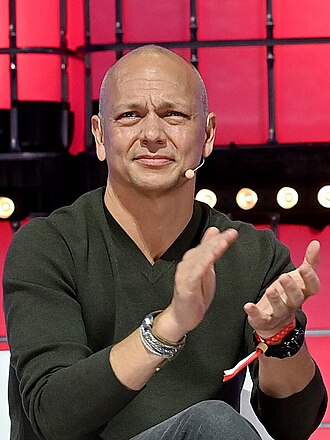
Tony Fadell
Creator of the iPod, co-creator of the iPhone, founder of Nest, founder of Build Collective
Where to hear and read about Tony Fadell1 episode or test

Tony Fadell co-created the iPod and iPhone, founded Nest, and now invests in deep tech through Build Collective. The most useful lesson is that a small team's informed opinion, aimed at a lasting pain and a technology that just became ready, makes a first version, and it takes about three generations of stubborn iteration to work.
You make the product, you fix the product and then you fix the business.
Tony Fadell: How to build real taste (and why AI makes it matter more)
Tony Fadell: the story and the lessons
1Tony Fadell's career: iPod, iPhone, Nest and Build
Fadell built hardware that defined three product categories. He co-created the iPod, the iPhone and the Nest thermostat, and co-authored over 300 patents.
He wrote the builder's book Build, was named the first designer in residence at the MIT Morningside Academy of Design, and lectures at the Media Lab.
General Magic taught him what too early looks like. He was on the General Magic team, which he says made the iPhone 15 years too early: cool, but nobody needed it.
He also calibrated single-touch resistive screens there, which gave him a sense of the limits of touch keyboards. Nest and the iPhone later used what General Magic learned.
2How Fadell backed the iPhone virtual keyboard
The keyboard fight was about serving a niche or everyone else. Only 1% or 2% of phone users had a BlackBerry or knew what one was. The other 98% were the open question.
It was the most heated debate of the project and ran the longest. Both sides had a real strategy behind them, not just a taste for one design.
Months of timed typing tests convinced him touch was good enough. The tests measured typing speed, error counts and how easily errors could be corrected. Scores climbed a little each round as fixes moved between hardware and software.
Multi-touch had only existed on a ping-pong-table-sized demo, so nothing consumer-sized could be tested early. His verdict: "Were we as good as a hardware keyboard? No. But were we good enough? Yes."
Fadell says a 1.0 needs a few tastemakers, not data. Steve Jobs chose the virtual keyboard and told dissenters to leave the project. Fadell argues a new category has few analogs, so data comes from some other product.
He calls for a "benevolent dictatorship" that explains what it decided and why, backed by prototypes and expert input. Leaders must be ready to say they might be wrong, correct later and take the heat.
He micromanages the key decisions, not daily operations. Early in his career he thought everything mattered, and it drove everyone nuts. He now picks a few things: customer-facing details, manufacturing or cost, and long-term vision.
On the keyboard, hardware, software, filtering and screen graphics all changed together, so he owned the tests and data across all of them. He also asks why repeatedly, since people find excuses when a system-level change is needed.
Fadell distrusts studies that let leaders avoid deciding. He says leaders hire consultants and studies to cover themselves, though those studies lack the full context because nobody buys the product or sees the whole experience.
He also says repeated kind lies build dysfunctional systems, and an unkind truth is sometimes needed when the team is fully against a decision.
3Fadell's test for what is worth building
Fadell always starts from a long-standing pain. Heating and cooling was about 50% of the energy bill, yet people hated the interface and just paid. Programmable thermostats were rarely used because programming one was as arcane as a VCR.
He says people stop noticing a pain because the product relieves a bigger one. Pains usually come from unintended consequences or the limits of the technology of the time. His line: "I always start from pain."
He pairs the pain with a technology that just became ready. The iPod arrived with portable mass storage, MP3s, lithium polymer cells and low-power ARM processors. The iPhone arrived with multi-touch, fast processors, Wi-Fi, digital cameras and YouTube.
For Nest, AI that learned schedules was a founding piece in 2010. In 2011 "AI thermostat" would have scared people, so it was called a learning thermostat.
The product is only one piece of a system to reinvent. Nest changed how the thermostat was installed and bought, selling through installers instead of Best Buy. The iPod needed iTunes and then the music store, and the iPhone needed the App Store.
The Nest cost $249, five to six times more than other thermostats, so it was pitched as saving $800 to $1,200 a year and paying for itself within a year or two.
4Why Fadell says nothing works the first time
Each product needed about three generations to work. The first two iPods sold only to Mac loyalists, under 1% of the market. The iPod took off in its third generation with Windows support and the iTunes music store.
Nest needed two smoke detector generations and several thermostat generations before the business worked. His sequence: make the product, fix it with customer feedback, then fix margins and volume.
Fadell's team shipped Windows support against Jobs's wishes. Jobs answered "Over my dead body" because he wanted the iPod to sell more Macs. The team kept a skunk works project going until it shipped.
The same happened with the stylus, which Jobs refused for fear of a pen-dominant device. A skunk works stylus still shipped and is now a big feature for artists and some professionals.
He priced the real cost of switching into the iPod. Without Windows support, the iPod effectively cost $3,000 (a Mac plus moving your digital life) instead of $349.
At $349 people could try the brand and then consider other Apple products. He says Apple was close to bankruptcy in 2001 with no retail stores, and there would probably have been no iPhone, and no Apple, without the iPod.
The first iPhone was no instant hit. It ran on 2.5G, only on AT&T, and only in the US.
Fadell says everyone at Apple, Jobs included, was wrong at times. His rule: "If you keep iterating and keep going... that's not failure. That's called learning."
5What happened to Nest after Google
The Nest smoke alarm faded because Google treated it as a stepchild. It was among the toughest products his team made, because the constraints are extreme. It was the best in its space for a decade, yet no one improved or replaced it.
He cites a cultural mismatch and probably a business mismatch with Google. It had features like Heads Up, which warns before a loud test noise.
He thinks Nest was just early on AI in the home. Sensors that track comings and goings and pick up audio without invading privacy give an AI assistant the context to work anywhere in the home.
The vision took about 15 years to arrive. Fadell sees room for a "Nest 2.0" and is getting business plans for it.
6Fadell on marketing and story as part of the product
Fadell writes the press release first and keeps it to three or four features. A customer only absorbs three or four key features, and beyond that it "becomes gobbledygook". He says do not add five more features expecting better sales, and do not cut a tentpole without asking how you will sell it.
He dislikes the label "working backwards": a filmmaker writes the script first and nobody calls that backwards.
He rewrote marketing for each wave of adopters and each region. Apple ran its US iPod marketing in Europe around the fourth generation, it resonated with no one, and sales stalled until the message was rewritten for slower adopters.
In 2001 Apple sold only in the US, Canada and Japan, so Europe had no installed base to start word of mouth. Late adopters trust certain early adopters, not the one who tries everything.
He thinks through the whole customer journey from day one. Marketing, sales, distribution, messaging and target market must be designed early, because customers only see the product through that lens.
He says OpenAI began as a viral technology demo and added product and product marketing teams late, and compares it to Netscape, where people bought the tool and then asked what to use it for.
He tells the story to people until it lands. Jobs told the iPhone story at least 10,000 times before going on stage. Fadell did the same for Nest, opening with "Do you know how much you spend on your energy bill every year?"
He says technology-led teams talk about the what, and the why is where the story is. He heard "1,000 songs in your pocket" for the first time and thought it was genius.
He borrows infomercial techniques but keeps the claims true. Infomercials plant a "virus of doubt", exaggerate the pain, then show an easy fix. He takes the emotional techniques and dials them back to the truth.
He learned honesty watching his father sell Levi's, who sometimes talked customers out of a purchase and sent them to a competitor down the street.
7Fadell on AI, craft and luxury software
He says working code is not the same as good code. Fadell says engineers who read Claude's leaked source called its main loop brittle and unreadable, after Dario Amodei said 90 to 100% of the code was AI-written. They said it should be split into 12 to 15 sub functions.
His view: code must also be secure, maintainable and easy to roll back, and skipping that trades "short-term gain for very, very long-term loss". These claims are asserted without evidence shown.
He uses agents for prototypes, then architects the real build. Run many prototypes to build an informed gut, lock in the architecture with expert review, then point the agent at narrow sub-parts.
He says software needs architects, optimizers, general coders and security reviewers. He is skeptical that a smarter AI alone fixes this.
He argues easy building makes craft the differentiator. He contrasts H&M, which doesn't last a washing, with handcrafted luxury, and says a real company can't be throwaway.
He calls the original Flighty luxury software and recommends it to every flyer he knows. He doubts an original like it could be vibe coded, since a model has no template for highly differentiated work.
He says AI will not wash away the functions behind a product. Product management sits between marketing, sales, distribution, manufacturing, engineering and support, and each function is a point of view for the customer.
A person who doesn't know what the functions are can't judge what a prompt produces. His closing advice: "We can use the machines, but don't cognitively surrender."
8Where Fadell is betting now
He expects voice to become the main interface, with touch as backup. Today's phones layer tap and swipe first, keyboard second and voice third. He says the order must "absolutely flip" once voice has real intelligence and memory behind it.
He still expects a display for years, since nobody wants turn-by-turn directions read aloud when a glance at a map is enough, and consumers don't yet trust AI enough. He wanted to remove displays at Nest and build around voice.
He says each software leap needs a matching hardware leap. In 1995 and 1996 people told him hardware was dead, and after the iPod it was mobile software. Now AI needs data centers and edge compute.
Investors now say they fund only companies with atoms in the plan, since anyone can vibe code a SaaS product. His reply: "Duh."
Fadell backs deep technology before it gets hot. He says that once valuations hit nine or ten digits, a small portfolio can't earn returns. He backed Groq early when it was cheap.
His examples include Simbe Robotics, about seven or eight years in, and Recursion, which has used AI in drug design for 10 years. His line: "When it's already hot, it's already too late to be in it."
Build Collective gets scientists to a workable product sooner. Its portfolio has at times topped 200 companies, focused on hardware, software, chemistry and chips with environmental, societal and health benefits.
Scientists and engineers often lack product and marketing sense, so Build helps with product management, operations, financing, org development and communications. The goal is a workable product by version one or two, not version four.
9Fadell's line on building products ethically
He refuses to design products that hook or addict users. Fadell says there are always other jobs and better companies, so don't chase money by tearing at the fabric of society.
His business case: "If you make your customers unhealthy, you're not going to have customers." He says he doesn't mean being preachy, only thinking about it.
He says leaders must draw clear lines on what they sell. When the iTunes store was growing into video, someone proposed adding porn. Jobs asked if that was the world they wanted their kids to grow up in, and shut it down.
Fadell objects to AI chatbots that turn personal connection into a product, saying they lose humanity for gain.
He wants digital consumption labeled like junk food. He compares the phone to a refrigerator that can hold good or junk food and be opened every five seconds. Digital food has no nutrition labels, warnings or age rules.
He says the iPhone was not meant to be addictive and social media was an unintended consequence. He wants Google and Apple to build more consumption tools.

Tony Fadell: How to build real taste (and why AI makes it matter more)
Tony Fadell explains how to make taste-driven product decisions for a 1.0, why marketing and the full customer journey define a product, and why AI-generated code and cognitive surrender are risks for builders. He backs it with first-hand stories from the iPod, iPhone and Nest, where each product needed about three generations to work.
Fadell built hardware that defined three product categories. He co-created the iPod, the iPhone and the Nest thermostat, and co-authored over 300 patents.
He wrote the builder's book Build, was named the first designer in residence at the MIT Morningside Academy of Design, and lectures at the Media Lab.
General Magic taught him what too early looks like. He was on the General Magic team, which he says made the iPhone 15 years too early: cool, but nobody needed it.
He also calibrated single-touch resistive screens there, which gave him a sense of the limits of touch keyboards. Nest and the iPhone later used what General Magic learned.
The keyboard fight was about serving a niche or everyone else. Only 1% or 2% of phone users had a BlackBerry or knew what one was. The other 98% were the open question.
It was the most heated debate of the project and ran the longest. Both sides had a real strategy behind them, not just a taste for one design.
Months of timed typing tests convinced him touch was good enough. The tests measured typing speed, error counts and how easily errors could be corrected. Scores climbed a little each round as fixes moved between hardware and software.
Multi-touch had only existed on a ping-pong-table-sized demo, so nothing consumer-sized could be tested early. His verdict: "Were we as good as a hardware keyboard? No. But were we good enough? Yes."
Fadell says a 1.0 needs a few tastemakers, not data. Steve Jobs chose the virtual keyboard and told dissenters to leave the project. Fadell argues a new category has few analogs, so data comes from some other product.
He calls for a "benevolent dictatorship" that explains what it decided and why, backed by prototypes and expert input. Leaders must be ready to say they might be wrong, correct later and take the heat.
He micromanages the key decisions, not daily operations. Early in his career he thought everything mattered, and it drove everyone nuts. He now picks a few things: customer-facing details, manufacturing or cost, and long-term vision.
On the keyboard, hardware, software, filtering and screen graphics all changed together, so he owned the tests and data across all of them. He also asks why repeatedly, since people find excuses when a system-level change is needed.
Fadell distrusts studies that let leaders avoid deciding. He says leaders hire consultants and studies to cover themselves, though those studies lack the full context because nobody buys the product or sees the whole experience.
He also says repeated kind lies build dysfunctional systems, and an unkind truth is sometimes needed when the team is fully against a decision.
Fadell always starts from a long-standing pain. Heating and cooling was about 50% of the energy bill, yet people hated the interface and just paid. Programmable thermostats were rarely used because programming one was as arcane as a VCR.
He says people stop noticing a pain because the product relieves a bigger one. Pains usually come from unintended consequences or the limits of the technology of the time. His line: "I always start from pain."
He pairs the pain with a technology that just became ready. The iPod arrived with portable mass storage, MP3s, lithium polymer cells and low-power ARM processors. The iPhone arrived with multi-touch, fast processors, Wi-Fi, digital cameras and YouTube.
For Nest, AI that learned schedules was a founding piece in 2010. In 2011 "AI thermostat" would have scared people, so it was called a learning thermostat.
The product is only one piece of a system to reinvent. Nest changed how the thermostat was installed and bought, selling through installers instead of Best Buy. The iPod needed iTunes and then the music store, and the iPhone needed the App Store.
The Nest cost $249, five to six times more than other thermostats, so it was pitched as saving $800 to $1,200 a year and paying for itself within a year or two.
Each product needed about three generations to work. The first two iPods sold only to Mac loyalists, under 1% of the market. The iPod took off in its third generation with Windows support and the iTunes music store.
Nest needed two smoke detector generations and several thermostat generations before the business worked. His sequence: make the product, fix it with customer feedback, then fix margins and volume.
Fadell's team shipped Windows support against Jobs's wishes. Jobs answered "Over my dead body" because he wanted the iPod to sell more Macs. The team kept a skunk works project going until it shipped.
The same happened with the stylus, which Jobs refused for fear of a pen-dominant device. A skunk works stylus still shipped and is now a big feature for artists and some professionals.
He priced the real cost of switching into the iPod. Without Windows support, the iPod effectively cost $3,000 (a Mac plus moving your digital life) instead of $349.
At $349 people could try the brand and then consider other Apple products. He says Apple was close to bankruptcy in 2001 with no retail stores, and there would probably have been no iPhone, and no Apple, without the iPod.
The first iPhone was no instant hit. It ran on 2.5G, only on AT&T, and only in the US.
Fadell says everyone at Apple, Jobs included, was wrong at times. His rule: "If you keep iterating and keep going... that's not failure. That's called learning."
The Nest smoke alarm faded because Google treated it as a stepchild. It was among the toughest products his team made, because the constraints are extreme. It was the best in its space for a decade, yet no one improved or replaced it.
He cites a cultural mismatch and probably a business mismatch with Google. It had features like Heads Up, which warns before a loud test noise.
He thinks Nest was just early on AI in the home. Sensors that track comings and goings and pick up audio without invading privacy give an AI assistant the context to work anywhere in the home.
The vision took about 15 years to arrive. Fadell sees room for a "Nest 2.0" and is getting business plans for it.
Fadell writes the press release first and keeps it to three or four features. A customer only absorbs three or four key features, and beyond that it "becomes gobbledygook". He says do not add five more features expecting better sales, and do not cut a tentpole without asking how you will sell it.
He dislikes the label "working backwards": a filmmaker writes the script first and nobody calls that backwards.
He rewrote marketing for each wave of adopters and each region. Apple ran its US iPod marketing in Europe around the fourth generation, it resonated with no one, and sales stalled until the message was rewritten for slower adopters.
In 2001 Apple sold only in the US, Canada and Japan, so Europe had no installed base to start word of mouth. Late adopters trust certain early adopters, not the one who tries everything.
He thinks through the whole customer journey from day one. Marketing, sales, distribution, messaging and target market must be designed early, because customers only see the product through that lens.
He says OpenAI began as a viral technology demo and added product and product marketing teams late, and compares it to Netscape, where people bought the tool and then asked what to use it for.
He tells the story to people until it lands. Jobs told the iPhone story at least 10,000 times before going on stage. Fadell did the same for Nest, opening with "Do you know how much you spend on your energy bill every year?"
He says technology-led teams talk about the what, and the why is where the story is. He heard "1,000 songs in your pocket" for the first time and thought it was genius.
He borrows infomercial techniques but keeps the claims true. Infomercials plant a "virus of doubt", exaggerate the pain, then show an easy fix. He takes the emotional techniques and dials them back to the truth.
He learned honesty watching his father sell Levi's, who sometimes talked customers out of a purchase and sent them to a competitor down the street.
He says working code is not the same as good code. Fadell says engineers who read Claude's leaked source called its main loop brittle and unreadable, after Dario Amodei said 90 to 100% of the code was AI-written. They said it should be split into 12 to 15 sub functions.
His view: code must also be secure, maintainable and easy to roll back, and skipping that trades "short-term gain for very, very long-term loss". These claims are asserted without evidence shown.
He uses agents for prototypes, then architects the real build. Run many prototypes to build an informed gut, lock in the architecture with expert review, then point the agent at narrow sub-parts.
He says software needs architects, optimizers, general coders and security reviewers. He is skeptical that a smarter AI alone fixes this.
He argues easy building makes craft the differentiator. He contrasts H&M, which doesn't last a washing, with handcrafted luxury, and says a real company can't be throwaway.
He calls the original Flighty luxury software and recommends it to every flyer he knows. He doubts an original like it could be vibe coded, since a model has no template for highly differentiated work.
He says AI will not wash away the functions behind a product. Product management sits between marketing, sales, distribution, manufacturing, engineering and support, and each function is a point of view for the customer.
A person who doesn't know what the functions are can't judge what a prompt produces. His closing advice: "We can use the machines, but don't cognitively surrender."
He expects voice to become the main interface, with touch as backup. Today's phones layer tap and swipe first, keyboard second and voice third. He says the order must "absolutely flip" once voice has real intelligence and memory behind it.
He still expects a display for years, since nobody wants turn-by-turn directions read aloud when a glance at a map is enough, and consumers don't yet trust AI enough. He wanted to remove displays at Nest and build around voice.
He says each software leap needs a matching hardware leap. In 1995 and 1996 people told him hardware was dead, and after the iPod it was mobile software. Now AI needs data centers and edge compute.
Investors now say they fund only companies with atoms in the plan, since anyone can vibe code a SaaS product. His reply: "Duh."
Fadell backs deep technology before it gets hot. He says that once valuations hit nine or ten digits, a small portfolio can't earn returns. He backed Groq early when it was cheap.
His examples include Simbe Robotics, about seven or eight years in, and Recursion, which has used AI in drug design for 10 years. His line: "When it's already hot, it's already too late to be in it."
Build Collective gets scientists to a workable product sooner. Its portfolio has at times topped 200 companies, focused on hardware, software, chemistry and chips with environmental, societal and health benefits.
Scientists and engineers often lack product and marketing sense, so Build helps with product management, operations, financing, org development and communications. The goal is a workable product by version one or two, not version four.
He refuses to design products that hook or addict users. Fadell says there are always other jobs and better companies, so don't chase money by tearing at the fabric of society.
His business case: "If you make your customers unhealthy, you're not going to have customers." He says he doesn't mean being preachy, only thinking about it.
He says leaders must draw clear lines on what they sell. When the iTunes store was growing into video, someone proposed adding porn. Jobs asked if that was the world they wanted their kids to grow up in, and shut it down.
Fadell objects to AI chatbots that turn personal connection into a product, saying they lose humanity for gain.
He wants digital consumption labeled like junk food. He compares the phone to a refrigerator that can hold good or junk food and be opened every five seconds. Digital food has no nutrition labels, warnings or age rules.
He says the iPhone was not meant to be addictive and social media was an unintended consequence. He wants Google and Apple to build more consumption tools.