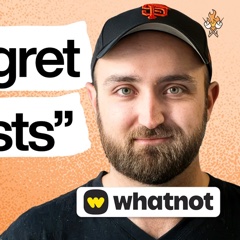
Tom Verrilli
Chief Product Officer at Whatnot, former CPO at Twitch and director of product growth at Twitter
Where to hear and read about Tom Verrilli1 episode or test

Tom Verrilli is Chief Product Officer at Whatnot, a live shopping marketplace, after serving as CPO at Twitch and director of product growth at Twitter. The thing most worth learning from him is to use product management as a targeted tool and keep a few senior people hands-on in the details instead of building layers of review.
We took all of our A players and then promoted them out of doing things.
This CPO regrets that product management exists | Tom Verrilli (CPO of Whatnot)
Tom Verrilli: the story and the lessons
1Why Tom Verrilli regrets that product management exists
Verrilli runs Whatnot's product team on the premise that PM should be used sparingly. He is CPO of Whatnot, after being CPO at Twitch and director of product growth at Twitter. Whatnot's product team starts from the line "we regret that product management exists".
He says the aim is engineers and designers so close to users that they make the same calls a PM would.
He says PM became a default seat through hiring ratios, not necessity. Early on, founders talked straight to engineers and designers. Later a fixed ratio of one PM per six engineers took hold.
He argues this leaves engineers and designers who never had to make decisions. Decision-making is a muscle built by reps, and every PM added takes reps away from them.
Verrilli thinks great PMs are rare and most add less value. Great PMs spread clarity, absorb ambiguity and help people decide on time. A notifications infrastructure team probably does not need one, since its engineers understand how it works.
He says engineers remember the great PMs mostly because they have worked with so many bad ones.
He says his model fits Whatnot and may not fit everyone. The evidence comes from one fast-growing company with founders deeply involved in product. He says it may not hold in every industry or in very large organizations, and no measured results on quality or speed are offered.
He asks listeners to assume half of what he said is wrong.
2How Verrilli structures the Whatnot product team
Whatnot hires a PM only for a specific need. About 21 PMs work across buyer, seller, and trust and risk while the company moves billions in GMV. PMs map to problems and core projects, not to teams, so some teams go a year without one.
"you don't hire a PM just for the sake of hiring one, you hire one with a really specific need."
Priorities are set top-down each cycle, each with a named owner. The CEO, the CPO and senior leads list the outcomes and critical projects, then name a DRI for each. PMs are matched by skill and reassigned after each 6-month planning cycle.
Not every owner is a PM. Engineers and designers can be DRIs of new product work, but everyone goes through product review. An important item with no owner goes to a PM "with a congratulations".
Verrilli keeps senior product leaders doing hands-on IC work. Whatnot's PM managers spend 90% or more of their time on IC work, and Verrilli spends about 50%. IC work means reading support tickets, pulling data, querying the code base, writing the spec and running the stand-up.
He says promoting top PMs out of the work wasted them and produced a yo-yo of work, rejection and rework. He does not mean shipping code, which he says engineers quietly rework.
He funds a few senior people with the pay of a layered org. He adds up five L5s under one L7 and four L7s under one VP, then pays three people director-to-VP money instead.
Skeptics said this would not scale without more layers. He says that proved untrue, but staying in the weeds takes effort. His rule is to do fewer things and "whole ass" them.
Verrilli puts one PM across two teams fighting over the same resource. At Twitch, ads and discovery fought over feed impressions. He put ads inside discovery under one PM who trades off organic against paid GMV, which ended months of back and forth.
He says separate owners drift from "company first" to "career first". "when you put the same person across multiple things, they tend to organically align those things"
3How Whatnot hires PMs under Verrilli
Every PM candidate does a hands-on case study and defends it. Candidates get a prompt and data, write a PRD and defend it verbally. 31,832 people applied in two years and Whatnot hired one.
He saw many candidates present well, then watched the thinking decay when pushed for specifics. He looks for macro system thinking plus micro impatience about validating quickly.
He screens out candidates whose specialty is alignment and politics. PMs who spend interviews on stakeholder management trend down. He prefers people who made decisions on a novel problem over those who polished an existing product at a big company.
He says he used to be one of them: "whose specialty wasn't technical or customer-oriented, it was politics."
The application numbers were meant to explain skill gaps, not discourage people. Whatnot still hires PMs, with payments and logistics high on the list. Two people were hired the day before the interview.
4How Verrilli reviews work and makes product decisions
He asks what the team will do if the experiment is green or red. If the team cannot answer, they have not thought it through. He also asks them to picture 1,000 times the expected usage and the knock-on effects before writing code.
The internal motto is "know then go": you need not solve every risk, only think through them. He cites Elizabeth Stone's advice to step one click back and see the problem as your manager does.
Verrilli plays the accordion: zoom out to plan, push in to ship. Teams fail by throwing spaghetti at the wall or by writing two-to-three-year roadmaps. He forms a belief, finds the smallest test, and if V1 works V2 follows the plan, and if not V3 must differ.
"you've got to constantly be zooming out and pushing back in"
He checks second-order effects before shipping a local fix. In live commerce a seller can hold up AirPods and skip the listing, but new buyers expect search, which cannot route to streams it does not know about. Forcing listings at about 3.5 minutes each would cut how much a seller sells per hour.
So you keep stretching through second-order effects before settling on a fix.
Verrilli says leaders must verify, then trust. He rejects "hire great people and get out of their way". Leaders sit in the details of tickets, code and data, and Whatnot's CEO clears his day to dig in when a review looks wrong.
Reviews had drifted into "listen for yes". Working alongside ICs turns it into us against the problem. "you can't make good macro decisions without the micro."
He asks how a data label was actually produced. When someone says "that was fraud", he asks how it got labeled and what the SOP is. If nobody knows, they do not know it was fraud, and a good director goes and finds out.
That work strengthens the labeling system. "it's too easy otherwise for growth to hide all sins."
Verrilli looks past averages to who depends on a feature. A feature used by 3% of people looks safe to deprecate, but for a small group it may be 100% of what they do. Whatnot sellers run businesses on such features.
He says his worst decisions came from relying on averages. He agrees with the Bezos line to trust the anecdote when data and anecdote disagree, and Whatnot's build document sets "batting 500" as the goal. "averages mean nothing to the individual"
5How Verrilli uses AI in product work
He pulls data himself instead of waiting on data scientists. In Hex Threads, PMs pull nuanced cohorts, trace one user's logs and build sensitivity and regression models. Work that took an L7 data scientist a week or two now happens in a thread.
He has spent less time with a data scientist this past year than ever, yet about 10 times more time in data.
He queries the code base with Claude instead of asking engineers. PMs ask Claude how things work, get rough level-of-effort estimates and trace feed logic. This saved one kickoff, an alignment meeting and a week of PRDs.
He used to aim for a boxes-and-lines understanding of systems. Now he says there is no excuse to skip the nuance layer.
Live products let Verrilli close the loop from customer to code. In his second week, a seller wanted a 3-second auction timer instead of 7. Two engineers saw it was a config, changed it and told the show's chat to refresh.
He adds that he would not touch production code that way himself. "that's the level of like responsiveness that you can get in a live environment"
He says AI does not absolve anyone from checking the work. An AI-found number does not remove the user's duty to check the analysis or code. Whatnot's data scientists now focus on correct tracking and attribution so people misread data less.
He expects fewer people relative to customer impact, not fewer overall, and sees small hybrid tech-lead roles rising.
Verrilli bets the durable PM skill is understanding customer, business and tech. He says the last five years paid PMs for storytelling, alignment and strategy, which Marty Cagan calls "product theater". As doing gets cheaper, translating customer, business and tech together becomes the point of leverage.
He says he is guilty of product theater too, since it was rewarded for so long.
6How Verrilli works with founders and CEOs
He pushes back on a CEO with curiosity and data, not tricks. He first asks what context he lacks, then whether the person's mind is made up. If it is, he does not fight. With data, he brings it. With two bare opinions, the CEO's wins.
"if you've got data, bring it." He coaches his own PMs to pause and ask why when he comes at them from an unexpected angle.
He says a CPO must not compete with the founder's vision. This is his fourth product-minded founder setup, and Whatnot has two, Grant and Logan. Before joining he had five or six coffees with Grant and spent a full day in LA working through roadmap problems.
He says the job is translating the founder's vision, and CPOs who compete with it fail. When a founder is on a problem, he checks it and steps out, and he asks whether they are open to a push.
He avoids the two dads problem of double oversight. A PM calls conflicting instructions and work redone for a second reviewer the "two dads problem". The CEO owns three or four priorities at a time, so he can clear time to work directly with the team.
Verrilli says top-down management works when leaders know the ground truth, and that micromanagement is steering without the details.
7What Verrilli learned at Twitter
He judges product market fit by fervor, not graphs. Twitter had nine heads of product in the two years Verrilli was there, yet it kept going. He says you could feel how much people loved it, and network effects stayed constant while everything else changed.
"if you manage to bottle lightning doesn't matter how badly you screw up the organization"
He calls stalled hard calls weak leadership, not complexity. Everyone knew the 140 character limit had to go, yet working group followed working group. It lifted almost two years after he left, and editing tweets took another two and a half years.
Tweets in Japan were six times more frequent than in Western markets because kanji packs more into each character. "most of the time you hear it's really complex. It isn't. Leadership's just weak."

This CPO regrets that product management exists | Tom Verrilli (CPO of Whatnot)
Whatnot runs about 20 PMs on a premise that product management should only be deployed where a specific need exists, with senior people staying hands-on in IC work instead of managing layers. The episode lays out how that model works in practice, how Whatnot hires PMs (31,832 applied in two years, one was hired), and how AI changes the work.
Verrilli runs Whatnot's product team on the premise that PM should be used sparingly. He is CPO of Whatnot, after being CPO at Twitch and director of product growth at Twitter. Whatnot's product team starts from the line "we regret that product management exists".
He says the aim is engineers and designers so close to users that they make the same calls a PM would.
He says PM became a default seat through hiring ratios, not necessity. Early on, founders talked straight to engineers and designers. Later a fixed ratio of one PM per six engineers took hold.
He argues this leaves engineers and designers who never had to make decisions. Decision-making is a muscle built by reps, and every PM added takes reps away from them.
Verrilli thinks great PMs are rare and most add less value. Great PMs spread clarity, absorb ambiguity and help people decide on time. A notifications infrastructure team probably does not need one, since its engineers understand how it works.
He says engineers remember the great PMs mostly because they have worked with so many bad ones.
He says his model fits Whatnot and may not fit everyone. The evidence comes from one fast-growing company with founders deeply involved in product. He says it may not hold in every industry or in very large organizations, and no measured results on quality or speed are offered.
He asks listeners to assume half of what he said is wrong.
Whatnot hires a PM only for a specific need. About 21 PMs work across buyer, seller, and trust and risk while the company moves billions in GMV. PMs map to problems and core projects, not to teams, so some teams go a year without one.
"you don't hire a PM just for the sake of hiring one, you hire one with a really specific need."
Priorities are set top-down each cycle, each with a named owner. The CEO, the CPO and senior leads list the outcomes and critical projects, then name a DRI for each. PMs are matched by skill and reassigned after each 6-month planning cycle.
Not every owner is a PM. Engineers and designers can be DRIs of new product work, but everyone goes through product review. An important item with no owner goes to a PM "with a congratulations".
Verrilli keeps senior product leaders doing hands-on IC work. Whatnot's PM managers spend 90% or more of their time on IC work, and Verrilli spends about 50%. IC work means reading support tickets, pulling data, querying the code base, writing the spec and running the stand-up.
He says promoting top PMs out of the work wasted them and produced a yo-yo of work, rejection and rework. He does not mean shipping code, which he says engineers quietly rework.
He funds a few senior people with the pay of a layered org. He adds up five L5s under one L7 and four L7s under one VP, then pays three people director-to-VP money instead.
Skeptics said this would not scale without more layers. He says that proved untrue, but staying in the weeds takes effort. His rule is to do fewer things and "whole ass" them.
Verrilli puts one PM across two teams fighting over the same resource. At Twitch, ads and discovery fought over feed impressions. He put ads inside discovery under one PM who trades off organic against paid GMV, which ended months of back and forth.
He says separate owners drift from "company first" to "career first". "when you put the same person across multiple things, they tend to organically align those things"
Every PM candidate does a hands-on case study and defends it. Candidates get a prompt and data, write a PRD and defend it verbally. 31,832 people applied in two years and Whatnot hired one.
He saw many candidates present well, then watched the thinking decay when pushed for specifics. He looks for macro system thinking plus micro impatience about validating quickly.
He screens out candidates whose specialty is alignment and politics. PMs who spend interviews on stakeholder management trend down. He prefers people who made decisions on a novel problem over those who polished an existing product at a big company.
He says he used to be one of them: "whose specialty wasn't technical or customer-oriented, it was politics."
The application numbers were meant to explain skill gaps, not discourage people. Whatnot still hires PMs, with payments and logistics high on the list. Two people were hired the day before the interview.
He asks what the team will do if the experiment is green or red. If the team cannot answer, they have not thought it through. He also asks them to picture 1,000 times the expected usage and the knock-on effects before writing code.
The internal motto is "know then go": you need not solve every risk, only think through them. He cites Elizabeth Stone's advice to step one click back and see the problem as your manager does.
Verrilli plays the accordion: zoom out to plan, push in to ship. Teams fail by throwing spaghetti at the wall or by writing two-to-three-year roadmaps. He forms a belief, finds the smallest test, and if V1 works V2 follows the plan, and if not V3 must differ.
"you've got to constantly be zooming out and pushing back in"
He checks second-order effects before shipping a local fix. In live commerce a seller can hold up AirPods and skip the listing, but new buyers expect search, which cannot route to streams it does not know about. Forcing listings at about 3.5 minutes each would cut how much a seller sells per hour.
So you keep stretching through second-order effects before settling on a fix.
Verrilli says leaders must verify, then trust. He rejects "hire great people and get out of their way". Leaders sit in the details of tickets, code and data, and Whatnot's CEO clears his day to dig in when a review looks wrong.
Reviews had drifted into "listen for yes". Working alongside ICs turns it into us against the problem. "you can't make good macro decisions without the micro."
He asks how a data label was actually produced. When someone says "that was fraud", he asks how it got labeled and what the SOP is. If nobody knows, they do not know it was fraud, and a good director goes and finds out.
That work strengthens the labeling system. "it's too easy otherwise for growth to hide all sins."
Verrilli looks past averages to who depends on a feature. A feature used by 3% of people looks safe to deprecate, but for a small group it may be 100% of what they do. Whatnot sellers run businesses on such features.
He says his worst decisions came from relying on averages. He agrees with the Bezos line to trust the anecdote when data and anecdote disagree, and Whatnot's build document sets "batting 500" as the goal. "averages mean nothing to the individual"
He pulls data himself instead of waiting on data scientists. In Hex Threads, PMs pull nuanced cohorts, trace one user's logs and build sensitivity and regression models. Work that took an L7 data scientist a week or two now happens in a thread.
He has spent less time with a data scientist this past year than ever, yet about 10 times more time in data.
He queries the code base with Claude instead of asking engineers. PMs ask Claude how things work, get rough level-of-effort estimates and trace feed logic. This saved one kickoff, an alignment meeting and a week of PRDs.
He used to aim for a boxes-and-lines understanding of systems. Now he says there is no excuse to skip the nuance layer.
Live products let Verrilli close the loop from customer to code. In his second week, a seller wanted a 3-second auction timer instead of 7. Two engineers saw it was a config, changed it and told the show's chat to refresh.
He adds that he would not touch production code that way himself. "that's the level of like responsiveness that you can get in a live environment"
He says AI does not absolve anyone from checking the work. An AI-found number does not remove the user's duty to check the analysis or code. Whatnot's data scientists now focus on correct tracking and attribution so people misread data less.
He expects fewer people relative to customer impact, not fewer overall, and sees small hybrid tech-lead roles rising.
Verrilli bets the durable PM skill is understanding customer, business and tech. He says the last five years paid PMs for storytelling, alignment and strategy, which Marty Cagan calls "product theater". As doing gets cheaper, translating customer, business and tech together becomes the point of leverage.
He says he is guilty of product theater too, since it was rewarded for so long.
He pushes back on a CEO with curiosity and data, not tricks. He first asks what context he lacks, then whether the person's mind is made up. If it is, he does not fight. With data, he brings it. With two bare opinions, the CEO's wins.
"if you've got data, bring it." He coaches his own PMs to pause and ask why when he comes at them from an unexpected angle.
He says a CPO must not compete with the founder's vision. This is his fourth product-minded founder setup, and Whatnot has two, Grant and Logan. Before joining he had five or six coffees with Grant and spent a full day in LA working through roadmap problems.
He says the job is translating the founder's vision, and CPOs who compete with it fail. When a founder is on a problem, he checks it and steps out, and he asks whether they are open to a push.
He avoids the two dads problem of double oversight. A PM calls conflicting instructions and work redone for a second reviewer the "two dads problem". The CEO owns three or four priorities at a time, so he can clear time to work directly with the team.
Verrilli says top-down management works when leaders know the ground truth, and that micromanagement is steering without the details.
He judges product market fit by fervor, not graphs. Twitter had nine heads of product in the two years Verrilli was there, yet it kept going. He says you could feel how much people loved it, and network effects stayed constant while everything else changed.
"if you manage to bottle lightning doesn't matter how badly you screw up the organization"
He calls stalled hard calls weak leadership, not complexity. Everyone knew the 140 character limit had to go, yet working group followed working group. It lifted almost two years after he left, and editing tweets took another two and a half years.
Tweets in Japan were six times more frequent than in Western markets because kanji packs more into each character. "most of the time you hear it's really complex. It isn't. Leadership's just weak."