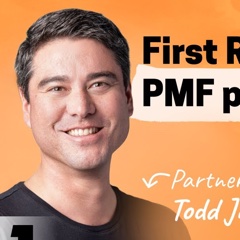
Todd Jackson
Partner at First Round Capital, former VP of Product and Design at Dropbox and Gmail product lead
Where to hear and read about Todd Jackson1 episode or test

Todd Jackson is a partner at First Round Capital who earlier led product at Gmail and was VP of Product and Design at Dropbox. The most useful thing to learn from him is that product-market fit comes in four levels, so you should know which level you are on and which of persona, problem, promise or product to change.
The word interesting is a polite way of saying no.
A framework for finding product-market fit | Todd Jackson (First Round Capital)
Todd Jackson: the story and the lessons
1Todd Jackson's path from Gmail to First Round
Jackson spent two decades building products before he became an investor. He was an early product lead on Gmail, then worked at Facebook. He started Cover, which First Round funded in 2013 and Twitter bought in 2014.
He was VP of product and design at Dropbox from 2015 to 2018. Cover is how he first met First Round.
He chose seed investing to help founders reach fit again and again. He has been a First Round partner for four years and was not a VC before that.
He likes seed because he can help founders who have not yet found fit get there.
Jackson built a fit framework because the usual advice was too vague to use. Founders hear 'you'll know it when you see it', while hiring a first salesperson gets tactical coverage. He asked founders what they did in their first six to nine months and looked for patterns.
It is built for sales-led B2B, where he sees more science. Bottom-up products are closer to consumer, with more alchemy and taste. He says it cannot guarantee success, only reduce the role of luck.
First Round turned the framework into an eight-session program. Sessions cover levels of fit, dollar-driven discovery, market validation, positioning, design partners, iteration and pivots, and founder-led sales. It takes about 10 hours a week.
It is aimed at technical, builder founders and covers work they were doing anyway.
2Jackson's four levels of product-market fit
Jackson defines fit as demand, satisfaction and efficiency together. Most definitions leave out efficiency. WeWork and Casper had demand and satisfaction but never efficiency, so the business did not work at scale.
He watches the marginal customer: each new one should be easier to win and serve. His vending machine example is a $100 machine with endless demand and happy users that is still not viable.
He says to earn satisfaction first, then demand, then efficiency. The three trade off. Marketing spend raises demand but lowers efficiency, and heavy automation raises efficiency but can hurt the customer experience.
The best enterprise companies reach extreme fit in roughly four to six years. "You don't go for all three of them at once from the very beginning."
At level one, do the work by hand for three to five customers. Vanta's founder filled out SOC 2 spreadsheets herself for design partners Segment, Front and Figma. One was chasing a Fortune 10 deal, and her work helped them land it.
Typical size is under 10 people and $0 to $500K ARR. Expect about 20 warm intros per customer and at least 50 conversations to reach three to five.
Level two is 5 to 25 customers and the start of a repeatable channel. ARR runs $500K to $5M with up to about 20 people. Targets: first call to close near 10% without a warm intro, magic number 0.5 to 0.75, regretted churn 10 to 20%, NRR at least 100%, burn multiple no worse than 5x.
Grit can win five or ten customers but not twenty-five, so cold outreach, content or events must start working. He calls the bands wide, not exact cutoffs.
Levels three and four tighten efficiency, then expand the market. Level three is about 100 customers and $5M to $25M ARR, with gross margin above 60%, burn multiple of 1 to 3 and NRR above 110%. Level four is beyond $25M ARR, with burn multiple under 1 and NRR above 120%.
At level four growth comes from new markets or products, and each product must find fit again. Verkada moved from cameras to alarms and badge readers, and Stripe added Radar and Atlas.
Jackson wants 12 to 18 months spent on level one. Josh Kopelman's line is that founders spend 99% of their time building and 1% picking the market. Jackson says that pick sets the boundaries for the next decade.
After that, level two takes about a year and level three about two years in a good case. If there is no pull after four to five years, returning the money is a legitimate choice.
3How Jackson spots a stuck startup and what to change
Most startups stall: roughly 60 to 70% never get past level two. Only about 30% reach level three or four. Level one is the most common place to get stuck, and level two is second.
The danger at level two is burning money at $1M to $3M ARR without noticing you have plateaued.
He reads level one yellow flags after six to twelve months of stalling. Customers would not be disappointed if the product vanished, or four or five customers each want a different key feature, which is really consulting. Usage may be low, and the next customer is very hard to find.
He suggests asking early customers to be blunt, as Persona's Rick Song did with his first five to ten. Song asked how painful it would be if Persona went away, and whether they would switch to a competitor at half the price.
Jackson treats 'no budget' and 'talk next year' as a polite no. Real demand sounds like 'this is expensive, but I'm going to make this work'. Other level two flags are regretted churn above 20% and 12 to 18 months without demand opening up.
A slow sales cycle with a low contract value is what he calls the quadrant of death.
When stuck, he changes persona, problem, promise or product, in that order. The first three are cheaper to change than the product. Lattice kept its HR-head persona but changed problem, promise and product. Vanta changed all four, and Plaid kept its code but changed the other three.
Jack Altman told him most founders pivot 10% when they need to pivot 200%. Jackson sees a psychological trap: founders hate throwing away what they built.
He recommends selling into an existing category over inventing one. Ironclad's 'AI legal assistant' pitch got nowhere because nobody searched for it. After a prospect emailed asking 'Are you a CLM?', they repositioned as a contract lifecycle management platform and beat 10 to 12 established vendors.
"If you actually have a really interesting spin on an existing category, there's already buyers spending money on that thing."
He holds up Looker as a company that did level one so well it flew through level two. Founder Lloyd Tabb spent 20 to 40 hours per prospect modeling their data before they bought. Looker reached a 75% close rate with zero churn.
That forward-deployed process made sales repeatable. Demand channels such as a couple of SDRs and AWS Redshift partner marketing came later.
4How Jackson tests demand with dollars, not politeness
Jackson tests whether people will spend money, not whether they like the idea. Customers are polite and poor at predicting their own behavior. He looks for a 'wow' reaction or real behavior, such as asking to meet again or requesting the deck.
"The word interesting is a polite way of saying no." He warns against 'happy ears', hearing only what supports your idea.
He starts from the customer's goals, then pitches a bold promise. He asked Lenny for his top three goals and what is hard about them. Then he pitched a service guaranteeing 500 top podcast guests, and Lenny said he would pay a lot for it.
The aim is to find extreme value independent of your idea before pitching.
He checks ability to pay by looking for existing budget. Ask whether the buyer is looking for a solution or building one in-house, where the budget comes from, and how third-party tools get approved. A buyer who tried to build it and failed wants it badly.
The best budget source is existing spend you can displace.
He asks fair, expensive and prohibitively expensive price questions. The sequence comes from Madhavan Ramanujam. The fair price is often a bargaining answer, while the expensive price is the one a buyer would actually pay if the product is good.
He also asks what they pay for the current tool.
He stops interviewing when he can predict 70 to 80% of the next answer. He matches demo fidelity to the product. Lattice sold with Figma mock-ups, Looker needed real customer data, and Vanta and Pilot did the actual work for early customers.

A framework for finding product-market fit | Todd Jackson (First Round Capital)
A four-level framework for finding product-market fit in sales-led B2B, built from First Round's data on hundreds of startups. It gives concrete benchmarks for each level, the signs you are stuck, and the four Ps (persona, problem, promise, product) to change when you are.
Jackson spent two decades building products before he became an investor. He was an early product lead on Gmail, then worked at Facebook. He started Cover, which First Round funded in 2013 and Twitter bought in 2014.
He was VP of product and design at Dropbox from 2015 to 2018. Cover is how he first met First Round.
He chose seed investing to help founders reach fit again and again. He has been a First Round partner for four years and was not a VC before that.
He likes seed because he can help founders who have not yet found fit get there.
Jackson built a fit framework because the usual advice was too vague to use. Founders hear 'you'll know it when you see it', while hiring a first salesperson gets tactical coverage. He asked founders what they did in their first six to nine months and looked for patterns.
It is built for sales-led B2B, where he sees more science. Bottom-up products are closer to consumer, with more alchemy and taste. He says it cannot guarantee success, only reduce the role of luck.
First Round turned the framework into an eight-session program. Sessions cover levels of fit, dollar-driven discovery, market validation, positioning, design partners, iteration and pivots, and founder-led sales. It takes about 10 hours a week.
It is aimed at technical, builder founders and covers work they were doing anyway.
Jackson defines fit as demand, satisfaction and efficiency together. Most definitions leave out efficiency. WeWork and Casper had demand and satisfaction but never efficiency, so the business did not work at scale.
He watches the marginal customer: each new one should be easier to win and serve. His vending machine example is a $100 machine with endless demand and happy users that is still not viable.
He says to earn satisfaction first, then demand, then efficiency. The three trade off. Marketing spend raises demand but lowers efficiency, and heavy automation raises efficiency but can hurt the customer experience.
The best enterprise companies reach extreme fit in roughly four to six years. "You don't go for all three of them at once from the very beginning."
At level one, do the work by hand for three to five customers. Vanta's founder filled out SOC 2 spreadsheets herself for design partners Segment, Front and Figma. One was chasing a Fortune 10 deal, and her work helped them land it.
Typical size is under 10 people and $0 to $500K ARR. Expect about 20 warm intros per customer and at least 50 conversations to reach three to five.
Level two is 5 to 25 customers and the start of a repeatable channel. ARR runs $500K to $5M with up to about 20 people. Targets: first call to close near 10% without a warm intro, magic number 0.5 to 0.75, regretted churn 10 to 20%, NRR at least 100%, burn multiple no worse than 5x.
Grit can win five or ten customers but not twenty-five, so cold outreach, content or events must start working. He calls the bands wide, not exact cutoffs.
Levels three and four tighten efficiency, then expand the market. Level three is about 100 customers and $5M to $25M ARR, with gross margin above 60%, burn multiple of 1 to 3 and NRR above 110%. Level four is beyond $25M ARR, with burn multiple under 1 and NRR above 120%.
At level four growth comes from new markets or products, and each product must find fit again. Verkada moved from cameras to alarms and badge readers, and Stripe added Radar and Atlas.
Jackson wants 12 to 18 months spent on level one. Josh Kopelman's line is that founders spend 99% of their time building and 1% picking the market. Jackson says that pick sets the boundaries for the next decade.
After that, level two takes about a year and level three about two years in a good case. If there is no pull after four to five years, returning the money is a legitimate choice.
Most startups stall: roughly 60 to 70% never get past level two. Only about 30% reach level three or four. Level one is the most common place to get stuck, and level two is second.
The danger at level two is burning money at $1M to $3M ARR without noticing you have plateaued.
He reads level one yellow flags after six to twelve months of stalling. Customers would not be disappointed if the product vanished, or four or five customers each want a different key feature, which is really consulting. Usage may be low, and the next customer is very hard to find.
He suggests asking early customers to be blunt, as Persona's Rick Song did with his first five to ten. Song asked how painful it would be if Persona went away, and whether they would switch to a competitor at half the price.
Jackson treats 'no budget' and 'talk next year' as a polite no. Real demand sounds like 'this is expensive, but I'm going to make this work'. Other level two flags are regretted churn above 20% and 12 to 18 months without demand opening up.
A slow sales cycle with a low contract value is what he calls the quadrant of death.
When stuck, he changes persona, problem, promise or product, in that order. The first three are cheaper to change than the product. Lattice kept its HR-head persona but changed problem, promise and product. Vanta changed all four, and Plaid kept its code but changed the other three.
Jack Altman told him most founders pivot 10% when they need to pivot 200%. Jackson sees a psychological trap: founders hate throwing away what they built.
He recommends selling into an existing category over inventing one. Ironclad's 'AI legal assistant' pitch got nowhere because nobody searched for it. After a prospect emailed asking 'Are you a CLM?', they repositioned as a contract lifecycle management platform and beat 10 to 12 established vendors.
"If you actually have a really interesting spin on an existing category, there's already buyers spending money on that thing."
He holds up Looker as a company that did level one so well it flew through level two. Founder Lloyd Tabb spent 20 to 40 hours per prospect modeling their data before they bought. Looker reached a 75% close rate with zero churn.
That forward-deployed process made sales repeatable. Demand channels such as a couple of SDRs and AWS Redshift partner marketing came later.
Jackson tests whether people will spend money, not whether they like the idea. Customers are polite and poor at predicting their own behavior. He looks for a 'wow' reaction or real behavior, such as asking to meet again or requesting the deck.
"The word interesting is a polite way of saying no." He warns against 'happy ears', hearing only what supports your idea.
He starts from the customer's goals, then pitches a bold promise. He asked Lenny for his top three goals and what is hard about them. Then he pitched a service guaranteeing 500 top podcast guests, and Lenny said he would pay a lot for it.
The aim is to find extreme value independent of your idea before pitching.
He checks ability to pay by looking for existing budget. Ask whether the buyer is looking for a solution or building one in-house, where the budget comes from, and how third-party tools get approved. A buyer who tried to build it and failed wants it badly.
The best budget source is existing spend you can displace.
He asks fair, expensive and prohibitively expensive price questions. The sequence comes from Madhavan Ramanujam. The fair price is often a bargaining answer, while the expensive price is the one a buyer would actually pay if the product is good.
He also asks what they pay for the current tool.
He stops interviewing when he can predict 70 to 80% of the next answer. He matches demo fidelity to the product. Lattice sold with Figma mock-ups, Looker needed real customer data, and Vanta and Pilot did the actual work for early customers.