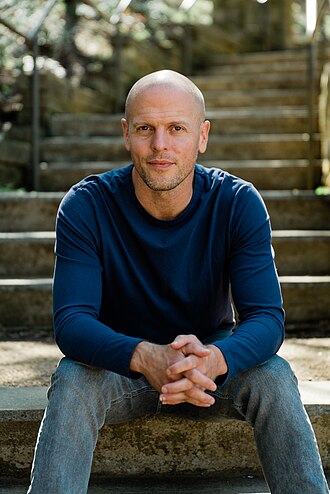
Tim Ferriss
Author of The 4-Hour Workweek and host of The Tim Ferriss Show
Where to hear and read about Tim Ferriss1 episode or test

Tim Ferriss is the author of The 4-Hour Workweek and host of The Tim Ferriss Show, and he treats writing as a way to check his own thinking. The habit most worth copying is a tiny, repeatable daily minimum that he stops before he is exhausted, paired with choosing interesting material before worrying about prose.
If you want to forge a new behavior, do less than you think you can do.
Why Writing Is the Key to Your Thinking | Tim Ferriss
Tim Ferriss: the story and the lessons
1How John McPhee and early drafts shaped Tim Ferriss's writing
Ferriss learned writing from line-by-line red ink in John McPhee's Princeton seminar. The seminar had about 12 students, a weekly three-hour lecture and weekly one-on-one sessions. Five pages came back with more red ink than original black ink.
McPhee's margin note "pea soup" meant the writing was amorphous and unclear. Ferriss still keeps his notes and papers from the class in a box, carried since 2000.
Ferriss cut the fancy words he could not defend. McPhee asked what a word or sentence meant, and if Ferriss could not defend it, it went. His thinking got crisper and his grades in other classes rose, even in Chinese.
His repeat offense was "trying to sound fancy or dress up your writing in some way that was patently absurd".
Ferriss now redlines his employees' emails and explains every change. He marks up email drafts in a Google Doc, then records a Loom or Zoom walkthrough of his reasons.
"The rationale behind the redlines is what matters." Draft by draft, he says, thinking and writing get clearer surprisingly quickly.
The 4-Hour Workweek worked once he wrote it like talking to friends. The first draft tried to sound smart and the second tried to be funny. The third worked when he wrote as if two glasses in with friends.
He composed in an email box because a Word document felt formal, then pasted the text into an editor once he had momentum.
Ferriss retired the four-hour brand instead of imitating himself. He could have franchised or licensed it, and outside pressure pushed him toward a "3-Hour Workweek" sequel. He saw diminishing returns and chose the long game.
Tools of Titans was the first book he enjoyed writing, after he designed his life around it with exercise, sauna and the right people. The experiment can fail: The 4-Hour Chef was boycotted by big retailers and ranked fourth on the Times list despite about 120,000 first-week sales.
2Tim Ferriss's rules for a writing habit that lasts
Ferriss writes two crappy pages a day, five days a week. He prefers that to ten pages in one day followed by a four a.m. bedtime and two lost days. Good days stretch to four, six or ten pages on their own.
He lived years of binge-and-panic writing and says it produced garbage. He cannot do 1,500 great words a day and warns against copying such outliers. His rule: "stop before you're exhausted".
Ferriss sets the bar low so he has no excuse to skip. Five Bullet Friday needs only five links. Some weeks that is all that goes out, and a Korea issue grew from five bullets to eight to five or six pages.
He compares it to IBM's low sales quotas, which made it easy to pick up the phone. He also applies it to exercise: ten minutes beats an hour you will skip.
Ferriss writes regularly as a checkup on his thinking. He kept the newsletter going even though the podcast was easier, more fun and far more lucrative. He believes you become a slower, duller thinker if you stop writing.
The newsletter also gives him an audience he owns, where social platforms only rent one.
Ferriss separates playing from judging and leans toward the mode he neglects. Seinfeld's advice is to treat yourself like a baby early on, then like a sergeant later. Ferriss leans toward sergeant, so he pushes himself to play more.
Perfectionism belongs later, like buffing the hood after the car is built and tested.
3How Ferriss picks material and does research
Ferriss says pick more interesting material before worrying about prose or voice. A-plus material survives B-minus writing, while B-minus material needs a McPhee or a David Foster Wallace to rescue it. He cites 50 Shades of Grey, which sold in huge numbers on a great premise.
The early cheat is to pick a more interesting subject or interview someone more interesting, and they need not be a star.
Ferriss prefers firsthand experiments over facts pulled from other books. His best work is mostly personal experimentation or interviews with people who ran firsthand experiments. Book-based research is depersonalized, so readers drift, and it gives no edge.
Anyone, and increasingly AI, can digest books and pull anecdotes. Self-experiments take more labor, so they are harder to imitate.
Ferriss asks whether he has enough raw material when writing stalls. His first diagnostic is research, not talent. He keeps walls of notebooks going back to age 16 or 17 and calls the habit hypergraphia.
If you have nothing interesting to write about, he says go do something interesting first.
Ferriss marks key research passages with three asterisks as he collects them. He clipped studies and interviews into Evernote and bolded the key parts with three asterisks, then searched for the asterisks later.
He warns research can be a very fancy way of not doing your homework.
Ferriss finds a category of one by reading middling reviews. For The 4-Hour Chef he read the three- and four-star reviews of the top books to see what was missing.
"If you know where to look or what questions to ask, you can find gaps."
Ferriss frames a book or chapter as a question to answer. The 4-Hour Body asked for the minimal effective dose across the 10 most important dimensions of fitness. The 4-Hour Chef asked whether he could take someone from zero to accelerated learner in eight weeks.
He applies the same framing to a single stuck chapter.
Ferriss asks outrageous questions that bend a constraint. He swaps "how do we hire a head of paid acquisition" for where you would put the 50K if you ran the business without paid acquisition.
Off-the-shelf questions sit inside your current assumptions, so you would already have solved them. Even if you never act on the answer, it changes how you see the original problem.
4How Ferriss structures, edits and unsticks his work
Ferriss builds each chapter as a standalone piece. His agent Jillian Manus advised making every chapter strong enough to read like a long magazine article. If he is stuck on chapter three, he can move to chapter eight.
Readers can jump around and the book still holds together. He applied this to The 4-Hour Workweek.
Ferriss opens chapters in the action. One 4-Hour Body chapter begins with him eating his third pizza at Shoreline Amphitheater while two friends stare in disgust.
Few authors earn a hundred pages of patience, so he puts something juicy early.
Ferriss had someone interview him when a chapter would not come. He was stuck for weeks on a chapter of The 4-Hour Workweek. A researcher interviewed him for 60 minutes and he knew exactly what to do.
Speaking it aloud, with her flagging anything unclear and asking follow-ups, solved it.
Ferriss asks readers to cut 20 percent, or one page in five. People will not volunteer cuts without permission, so a number gives them cover to be honest and shows what the piece really says.
"One out of every five pages can stay."
Ferriss uses a lawyer as a cheap editor for unclear thinking. Lawyers avoid ambiguous language because extra words add liability. He suggests asking a law professor for the best student with the sharpest eye for detail.
He has not tried the professor route but would bet such a student beats the average copy editor.
Ferriss compresses drafts to find the core idea. Jason Fried's exercise is to write 1,000 words, cut to 200, then a paragraph, then one sentence. Lifestyle Hustling became The 4-Hour Workweek this way.
At extreme compression a sharper idea often appears.
Ferriss uses TKs from fiction to keep writing without stopping to research. Writing about 13 chapters of fantasy world-building for The Legend of Cockpunch taught him to leave placeholders to fix later.
He wants that flow in nonfiction but never invents facts. He treats fiction and nonfiction as cross-training and switches when one stalls.
Ferriss lets silence do the work in interviews. Cal Fussman taught him that nervous interviewers fill space, while an uncomfortable guest eventually says something more interesting.
He also spends real time on the order of his questions.
5Ferriss on books, brand, fame and what he is writing next
Ferriss says only write a book if it can be your top priority for a year. A weak book stays attached to your name for life. Most people give it priority number six, and the book dies young.
He says skipping a book may be a great decision, and that the world already has a glut of mediocrity.
Ferriss keeps his voice by keeping his quirks. He hides inside jokes in his books, shared with a researcher, that make no sense to anyone else. Editors want them cut and he keeps them.
Writing has gotten harder with each book, so some fun is needed to keep going.
Ferriss protects his reputation with tight limits on endorsements. He turns down 80% of sponsors, including offers of millions of dollars. He calls reputation the new gold, since each person's trust is finite.
Sending two million newsletter readers to a hot sauce maker hurt quality when it scaled up.
Ferriss admits fame makes him reactive and tempts him into shiny projects. Inbound requests work like a slot machine and cut into deep creative work. His PR and paid acquisition skills drove the first book's success but pull him toward business distractions.
"I take the bait more than I should."
Ferriss left a psychedelics book unwritten after Michael Pollan's book did the job. He holds a wall of notebooks, hundreds of pages, on practices, dosages and edge cases. Reading a galley of How to Change Your Mind made him think Thank God, since it would drive the policy change he wanted.
The book would be deeply personal, so a ghostwriter feels wrong to him. He admits his hesitation rests on untested assumptions.
Ferriss is testing a credited collaborator on his first book in six years. It is not a ghostwriter, because he dislikes people calling themselves best-selling authors for books they did not write. He aims for 2024, with a highly tactical and shorter book.
He holds it lightly and will drop it if it fails. His edge is quality, since volume is a game machines win.

Why Writing Is the Key to Your Thinking | Tim Ferriss
Tim Ferriss argues that writing is how you check your thinking, and that good subject matter and a low daily bar matter more than polished prose or a famous voice. The habit worth stealing is the small, repeatable minimum (two crappy pages, five bullets) that you stop before you are exhausted.
Ferriss learned writing from line-by-line red ink in John McPhee's Princeton seminar. The seminar had about 12 students, a weekly three-hour lecture and weekly one-on-one sessions. Five pages came back with more red ink than original black ink.
McPhee's margin note "pea soup" meant the writing was amorphous and unclear. Ferriss still keeps his notes and papers from the class in a box, carried since 2000.
Ferriss cut the fancy words he could not defend. McPhee asked what a word or sentence meant, and if Ferriss could not defend it, it went. His thinking got crisper and his grades in other classes rose, even in Chinese.
His repeat offense was "trying to sound fancy or dress up your writing in some way that was patently absurd".
Ferriss now redlines his employees' emails and explains every change. He marks up email drafts in a Google Doc, then records a Loom or Zoom walkthrough of his reasons.
"The rationale behind the redlines is what matters." Draft by draft, he says, thinking and writing get clearer surprisingly quickly.
The 4-Hour Workweek worked once he wrote it like talking to friends. The first draft tried to sound smart and the second tried to be funny. The third worked when he wrote as if two glasses in with friends.
He composed in an email box because a Word document felt formal, then pasted the text into an editor once he had momentum.
Ferriss retired the four-hour brand instead of imitating himself. He could have franchised or licensed it, and outside pressure pushed him toward a "3-Hour Workweek" sequel. He saw diminishing returns and chose the long game.
Tools of Titans was the first book he enjoyed writing, after he designed his life around it with exercise, sauna and the right people. The experiment can fail: The 4-Hour Chef was boycotted by big retailers and ranked fourth on the Times list despite about 120,000 first-week sales.
Ferriss writes two crappy pages a day, five days a week. He prefers that to ten pages in one day followed by a four a.m. bedtime and two lost days. Good days stretch to four, six or ten pages on their own.
He lived years of binge-and-panic writing and says it produced garbage. He cannot do 1,500 great words a day and warns against copying such outliers. His rule: "stop before you're exhausted".
Ferriss sets the bar low so he has no excuse to skip. Five Bullet Friday needs only five links. Some weeks that is all that goes out, and a Korea issue grew from five bullets to eight to five or six pages.
He compares it to IBM's low sales quotas, which made it easy to pick up the phone. He also applies it to exercise: ten minutes beats an hour you will skip.
Ferriss writes regularly as a checkup on his thinking. He kept the newsletter going even though the podcast was easier, more fun and far more lucrative. He believes you become a slower, duller thinker if you stop writing.
The newsletter also gives him an audience he owns, where social platforms only rent one.
Ferriss separates playing from judging and leans toward the mode he neglects. Seinfeld's advice is to treat yourself like a baby early on, then like a sergeant later. Ferriss leans toward sergeant, so he pushes himself to play more.
Perfectionism belongs later, like buffing the hood after the car is built and tested.
Ferriss says pick more interesting material before worrying about prose or voice. A-plus material survives B-minus writing, while B-minus material needs a McPhee or a David Foster Wallace to rescue it. He cites 50 Shades of Grey, which sold in huge numbers on a great premise.
The early cheat is to pick a more interesting subject or interview someone more interesting, and they need not be a star.
Ferriss prefers firsthand experiments over facts pulled from other books. His best work is mostly personal experimentation or interviews with people who ran firsthand experiments. Book-based research is depersonalized, so readers drift, and it gives no edge.
Anyone, and increasingly AI, can digest books and pull anecdotes. Self-experiments take more labor, so they are harder to imitate.
Ferriss asks whether he has enough raw material when writing stalls. His first diagnostic is research, not talent. He keeps walls of notebooks going back to age 16 or 17 and calls the habit hypergraphia.
If you have nothing interesting to write about, he says go do something interesting first.
Ferriss marks key research passages with three asterisks as he collects them. He clipped studies and interviews into Evernote and bolded the key parts with three asterisks, then searched for the asterisks later.
He warns research can be a very fancy way of not doing your homework.
Ferriss finds a category of one by reading middling reviews. For The 4-Hour Chef he read the three- and four-star reviews of the top books to see what was missing.
"If you know where to look or what questions to ask, you can find gaps."
Ferriss frames a book or chapter as a question to answer. The 4-Hour Body asked for the minimal effective dose across the 10 most important dimensions of fitness. The 4-Hour Chef asked whether he could take someone from zero to accelerated learner in eight weeks.
He applies the same framing to a single stuck chapter.
Ferriss asks outrageous questions that bend a constraint. He swaps "how do we hire a head of paid acquisition" for where you would put the 50K if you ran the business without paid acquisition.
Off-the-shelf questions sit inside your current assumptions, so you would already have solved them. Even if you never act on the answer, it changes how you see the original problem.
Ferriss builds each chapter as a standalone piece. His agent Jillian Manus advised making every chapter strong enough to read like a long magazine article. If he is stuck on chapter three, he can move to chapter eight.
Readers can jump around and the book still holds together. He applied this to The 4-Hour Workweek.
Ferriss opens chapters in the action. One 4-Hour Body chapter begins with him eating his third pizza at Shoreline Amphitheater while two friends stare in disgust.
Few authors earn a hundred pages of patience, so he puts something juicy early.
Ferriss had someone interview him when a chapter would not come. He was stuck for weeks on a chapter of The 4-Hour Workweek. A researcher interviewed him for 60 minutes and he knew exactly what to do.
Speaking it aloud, with her flagging anything unclear and asking follow-ups, solved it.
Ferriss asks readers to cut 20 percent, or one page in five. People will not volunteer cuts without permission, so a number gives them cover to be honest and shows what the piece really says.
"One out of every five pages can stay."
Ferriss uses a lawyer as a cheap editor for unclear thinking. Lawyers avoid ambiguous language because extra words add liability. He suggests asking a law professor for the best student with the sharpest eye for detail.
He has not tried the professor route but would bet such a student beats the average copy editor.
Ferriss compresses drafts to find the core idea. Jason Fried's exercise is to write 1,000 words, cut to 200, then a paragraph, then one sentence. Lifestyle Hustling became The 4-Hour Workweek this way.
At extreme compression a sharper idea often appears.
Ferriss uses TKs from fiction to keep writing without stopping to research. Writing about 13 chapters of fantasy world-building for The Legend of Cockpunch taught him to leave placeholders to fix later.
He wants that flow in nonfiction but never invents facts. He treats fiction and nonfiction as cross-training and switches when one stalls.
Ferriss lets silence do the work in interviews. Cal Fussman taught him that nervous interviewers fill space, while an uncomfortable guest eventually says something more interesting.
He also spends real time on the order of his questions.
Ferriss says only write a book if it can be your top priority for a year. A weak book stays attached to your name for life. Most people give it priority number six, and the book dies young.
He says skipping a book may be a great decision, and that the world already has a glut of mediocrity.
Ferriss keeps his voice by keeping his quirks. He hides inside jokes in his books, shared with a researcher, that make no sense to anyone else. Editors want them cut and he keeps them.
Writing has gotten harder with each book, so some fun is needed to keep going.
Ferriss protects his reputation with tight limits on endorsements. He turns down 80% of sponsors, including offers of millions of dollars. He calls reputation the new gold, since each person's trust is finite.
Sending two million newsletter readers to a hot sauce maker hurt quality when it scaled up.
Ferriss admits fame makes him reactive and tempts him into shiny projects. Inbound requests work like a slot machine and cut into deep creative work. His PR and paid acquisition skills drove the first book's success but pull him toward business distractions.
"I take the bait more than I should."
Ferriss left a psychedelics book unwritten after Michael Pollan's book did the job. He holds a wall of notebooks, hundreds of pages, on practices, dosages and edge cases. Reading a galley of How to Change Your Mind made him think Thank God, since it would drive the policy change he wanted.
The book would be deeply personal, so a ghostwriter feels wrong to him. He admits his hesitation rests on untested assumptions.
Ferriss is testing a credited collaborator on his first book in six years. It is not a ghostwriter, because he dislikes people calling themselves best-selling authors for books they did not write. He aims for 2024, with a highly tactical and shorter book.
He holds it lightly and will drop it if it fails. His edge is quality, since volume is a game machines win.