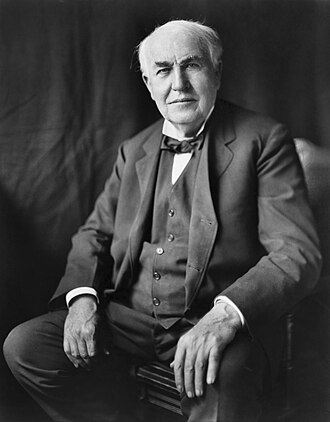
Thomas Edison
Inventor of the phonograph and the electric light system, founder of the Menlo Park laboratory
Where to hear and read about Thomas Edison1 episode or test

Thomas Edison was a self-taught inventor who rose from train newsboy and telegraph operator to build the Menlo Park laboratory, the phonograph and the electric light system that became General Electric. His lesson cuts both ways: reading everything on a subject and outworking everyone produced world-changing inventions, but scattered focus and bad partners let others capture most of the wealth and control.
The trouble with other inventors is that they try a few things and quit. I never quit until I get what I want.
The Biography of Thomas Edison
Thomas Edison: the story and the lessons
1Thomas Edison's childhood: a family of misfits and a mother who let him follow his bent
Edison came from stubborn, independent pioneers short on education. His family was full of dissidents and strong individualists. His father, Sam Edison, joined a revolt against the Canadian government and ran more than 80 miles to the US border, chased by the King's men.
That flight made Edison an American, born into an age that idolized the lone inventor and saw invention as the road to freedom and wealth. His lifelong grab for patents fit that country.
A public beating at six showed him the world's cruelty. He set a small fire in the barn just to see what it would do, and his father whipped him in front of the neighbors after advertising the beating in advance.
Edison still described it vividly 60 years later.
His mother homeschooled him after teachers judged him dull. Nancy Edison read him Gibbon, the history of England, Shakespeare and Dickens, and he became a rapid reader by nine. He ran every experiment in The School of Natural Philosophy, spending all his pocket money on chemicals.
She moved him to learn what interested him most and let him go that way. "She let me follow my bent."
A balloonist's disappearance only made him want to fly. As a boy he pressed his nose to the window of Sam Winchester's shop, where a hydrogen passenger balloon was being built. Winchester rose, drifted toward Lake Erie and was never seen again.
Edison's reaction was that he wanted to do that too.
2Edison the train boy: newspapers, a rescue and the telegraph
At 12 he went to work selling papers on the daily train. His father's business setbacks sent him out to sell newspapers and sweets to passengers. He left at dawn and got home at 10 or 11 at night.
He read the Detroit Public Library from the bottom shelf up. On train layovers in Detroit, he started at the first book on the bottom shelf and read through the lot. A library subscription later cost him about two full days of pay.
"I did not read a few books, I read the library."
He printed his own paper instead of selling someone else's. Around 15 he edited, printed and sold a newspaper in the baggage car for 8 cents a copy to about 400 readers. It was said to be the first newspaper published on a train.
A friend talked him into printing personal stories about local figures. One subject beat him and threw him in the river, and Edison shut the paper down. Owning the product was smart; letting someone else steer it was the mistake.
Saving a child earned him the telegraph trade. He snatched station master Mackenzie's three-year-old off the track in front of a moving car. The grateful father, who had seen Edison hanging over his telegraph table, taught him to operate.
Operating paid about $75 a month, a safe floor while he chased inventions. Civil War demand meant he could find work almost anywhere from 16, and some operators, like Andrew Carnegie, became industrial magnates.
The telegraph was the frontier technology of his youth. It was the most advanced use of electricity before electric light, and from 1850 to 1880 the whole information economy ran on it. His first experiments aimed to improve it.
The phonograph, electric light and early movies all grew out of this work. He said electricity obsessed him day and night.
Faraday's book reshaped his life and his schedule. At about 19 or 20 he bought a used copy of Faraday's Experimental Researches in Electricity and took the night shift because fewer messages came in. He read from 4 a.m. through the next day without sleeping.
Faraday, like Edison, was poor, nearly unschooled and self-taught. Edison called finding the book one of the decisive events of his life.
3Edison's early inventions and the partners who took the profit
He wanted autonomy more than riches. His goal was his own shop, projects of his own choosing, and enough income to repeat it tomorrow, so he would never return to the servitude of an employee.
His first products improved things that already existed. Stock tickers already existed, so he refined them for gold and securities traders who paid for faster information.
Senra calls this imitation preceding creation: early products copy earlier ones until the founder knows enough to create.
Older backers bought his patent rights for almost nothing. He sold the rights to his stock ticker improvements to a large telegraph company and got almost nothing. With his Boston credit ruined, he reached New York with not a coin in his pocket.
Experienced men saw a country bumpkin who knew inventing and little else. Senra's rule: "You can't make a good deal with a bad person."
Fixing a crashed system in two hours got him hired. At 22 he sought out Pope, an engineer at the Gold Indicator Company. The system failed that day, customers rushed the office, and Edison traced it to a contact spring dropped between the gear wheels.
The owner, Law, yelled at a stranger to fix it, then hired him on the spot at a higher salary than he had ever had. Soon after, Edison stood at the machine as Jay Gould tried to corner gold, watching men lose fortunes.
His first big payday frightened him. He planned to ask $5,000 but asked Western Union for an offer instead, and it offered $40,000.
He said he felt near fainting, then sat up all night in a dingy boarding house afraid of being murdered for the cash.
Jay Gould used his patents as pawns in a war on Western Union. Gould paid Edison $30,000, used the news of Edison joining his camp to short Western Union stock, and made 20 to 30 times that in one day.
Edison, then 27, only wanted the best invention and later called it a strange financial warfare. He did learn that patents, even unused ones, work as bargaining chips, and Senra's takeaway is to ask what asset in your company is valuable to others.
4Why Edison built Menlo Park
He built Menlo Park to invent all day without running a business. At 26 he tried to be inventor and manufacturer at once. After a decade of financial stress in New York, near 30 he quit business for a quiet retreat in New Jersey.
It was among the first labs to chase practical commercial uses of research. Senra reads it as building a company you actually enjoy working in.
1876 to 1881 were his happiest and most fruitful years. Menlo Park produced the phonograph and the electric light work.
Asked how families would amuse themselves out there, he said: "They would invent things, and after that they would invent more things."
His tinkering produced discoveries even he did not pursue. Charles Kettering said Edison put a straight wire inside a bulb and pulled current out of a vacuum, finding a source of free electrons.
He turned back from that hidden world of electronic science for more immediately rewarding work. Josephson wrote that he could no more stop experimenting than stop breathing.
5How Edison sold belief and funded the electric light
Western Union saw no use for recorded voice. Edison had a way to record and replay voice and pitched it to the telegraph monopoly, which saw no conceivable use for it.
Incumbents reject what threatens their income. James Dyson met the same wall with vacuum makers who sold $500 million of bags a year. The fix is to build it yourself, which is why Edison made the phonograph.
Backers funded his confidence, not a finished invention. Dispelling night from civilization needed huge capital from the Vanderbilts, the Morgan circle and Western Union executives. Edison said their money was invested in confidence in his ability.
He carried an air of supreme confidence that he imbued in everyone around him. While backers swung between hope and pessimism, he treated each difficulty as temporary and managed their expectations.
Morgan held control while keeping his name off the board. Morgan's partner sat as director and the company had to bank with Morgan's firm.
Edison believed the Morgan connection made success more likely. Weak companies that needed Morgan's money were taken over and combined, which the era called being morganized.
The filament hunt sent his agents across the world. Edison tested perhaps tens of thousands of materials. One agent died of yellow fever in the West Indies, and Frank McGowan spent 15 months by canoe on the upper Amazon.
McGowan came home, took a large sum of cash, left a cafe and was never seen again. Edison drew resolve from Hugo's Toilers of the Sea, seeing his own fight in its hero freeing a ship from a reef.
He lost his name and his company to General Electric. Morgan erased Edison's name from the company that became General Electric without telling him. Edison sold his stock and left in frustration.
Senra suspects he regretted leaving Menlo Park for the New York struggle.
6How Thomas Edison led his men
His men worked with him, not for him. He was as dirty as any workman, approachable, then severe about keeping them hustling. He kept them long hours but worked longer himself.
His child-like enthusiasm intrigued co-workers, and many stayed almost their whole lives. John Ott said: "He made me feel that I was making something with him and that I wasn't just a workman."
Famous in New York, he still jumped into dug-up streets. He worked beside young electricians covered in grease while building the electric system and cared nothing for frills.
Senra links this to Sam Zemurray standing in the Honduran fields and Steve Jobs scorning a CEO who ate lunch alone in his office.
He prized hustle above reverence. Explorer Henry Stanley said he would most like to hear Jesus's voice; Edison chose Napoleon and laughed, "I like a hustler."
He loved the word: "I've got so much to do and life is so short, I'm going to hustle."
7Edison's method: read everything, then outwork everyone
He mastered all prior work before running an experiment. He lay on the floor among 50 books on a subject, reading for hours, then returned to manual work refreshed.
His method required complete knowledge of everything done in a field, including records of past experiments. Edwin Land did the same with every book on light.
For the multiplex telegraph he ran 2,000 experiments in six weeks. He read a pile of books five feet high, ate at his desk, slept in his chair and had a solution.
Fewer than 10 people in America knew his tricks with currents, relays and resistances.
He treated problems as the rule, not the exception. Building the electric industry brought fresh difficulties at every step, and after each failed trial he worked day and night.
He said he was never discouraged, though he could not say the same of his associates. "Nothing that's good works by itself. You've got to make the damn thing work."
8What Edison's lack of focus cost him
Curiosity pulled him in many directions at once. Ford, Jobs and Land each stayed on one idea for a lifetime. Edison invented the phonograph and waited about 10 years to exploit it.
Senra estimates focus left the others 50 to 100 times richer, though Edison was by no means poor and his choices may have been better for the world. Buffett and Bill Gates both named focus as what mattered most.
Unlike Ford, Land and Jobs, he never kept control of his work. Bad partners and financiers took his patents, his profits and finally his name on the company.
His obsession cost his associates and children their family life. John Ott said, "My children grew up without knowing their father." Edison's own kids said they never knew their dad.
His charisma drew people into work that hurt them. Senra's warning is that obsessive founders need guardrails on their drive.

The Biography of Thomas Edison
Edison's life shows how deep study, relentless experimentation and a lab built around his own bent produced world-changing inventions, while weak focus and poor partners cost him most of the wealth. The story is worth hearing because it sets his strengths against the focus of Ford, Jobs and Land, and shows what he gave up.
Edison came from stubborn, independent pioneers short on education. His family was full of dissidents and strong individualists. His father, Sam Edison, joined a revolt against the Canadian government and ran more than 80 miles to the US border, chased by the King's men.
That flight made Edison an American, born into an age that idolized the lone inventor and saw invention as the road to freedom and wealth. His lifelong grab for patents fit that country.
A public beating at six showed him the world's cruelty. He set a small fire in the barn just to see what it would do, and his father whipped him in front of the neighbors after advertising the beating in advance.
Edison still described it vividly 60 years later.
His mother homeschooled him after teachers judged him dull. Nancy Edison read him Gibbon, the history of England, Shakespeare and Dickens, and he became a rapid reader by nine. He ran every experiment in The School of Natural Philosophy, spending all his pocket money on chemicals.
She moved him to learn what interested him most and let him go that way. "She let me follow my bent."
A balloonist's disappearance only made him want to fly. As a boy he pressed his nose to the window of Sam Winchester's shop, where a hydrogen passenger balloon was being built. Winchester rose, drifted toward Lake Erie and was never seen again.
Edison's reaction was that he wanted to do that too.
At 12 he went to work selling papers on the daily train. His father's business setbacks sent him out to sell newspapers and sweets to passengers. He left at dawn and got home at 10 or 11 at night.
He read the Detroit Public Library from the bottom shelf up. On train layovers in Detroit, he started at the first book on the bottom shelf and read through the lot. A library subscription later cost him about two full days of pay.
"I did not read a few books, I read the library."
He printed his own paper instead of selling someone else's. Around 15 he edited, printed and sold a newspaper in the baggage car for 8 cents a copy to about 400 readers. It was said to be the first newspaper published on a train.
A friend talked him into printing personal stories about local figures. One subject beat him and threw him in the river, and Edison shut the paper down. Owning the product was smart; letting someone else steer it was the mistake.
Saving a child earned him the telegraph trade. He snatched station master Mackenzie's three-year-old off the track in front of a moving car. The grateful father, who had seen Edison hanging over his telegraph table, taught him to operate.
Operating paid about $75 a month, a safe floor while he chased inventions. Civil War demand meant he could find work almost anywhere from 16, and some operators, like Andrew Carnegie, became industrial magnates.
The telegraph was the frontier technology of his youth. It was the most advanced use of electricity before electric light, and from 1850 to 1880 the whole information economy ran on it. His first experiments aimed to improve it.
The phonograph, electric light and early movies all grew out of this work. He said electricity obsessed him day and night.
Faraday's book reshaped his life and his schedule. At about 19 or 20 he bought a used copy of Faraday's Experimental Researches in Electricity and took the night shift because fewer messages came in. He read from 4 a.m. through the next day without sleeping.
Faraday, like Edison, was poor, nearly unschooled and self-taught. Edison called finding the book one of the decisive events of his life.
He wanted autonomy more than riches. His goal was his own shop, projects of his own choosing, and enough income to repeat it tomorrow, so he would never return to the servitude of an employee.
His first products improved things that already existed. Stock tickers already existed, so he refined them for gold and securities traders who paid for faster information.
Senra calls this imitation preceding creation: early products copy earlier ones until the founder knows enough to create.
Older backers bought his patent rights for almost nothing. He sold the rights to his stock ticker improvements to a large telegraph company and got almost nothing. With his Boston credit ruined, he reached New York with not a coin in his pocket.
Experienced men saw a country bumpkin who knew inventing and little else. Senra's rule: "You can't make a good deal with a bad person."
Fixing a crashed system in two hours got him hired. At 22 he sought out Pope, an engineer at the Gold Indicator Company. The system failed that day, customers rushed the office, and Edison traced it to a contact spring dropped between the gear wheels.
The owner, Law, yelled at a stranger to fix it, then hired him on the spot at a higher salary than he had ever had. Soon after, Edison stood at the machine as Jay Gould tried to corner gold, watching men lose fortunes.
His first big payday frightened him. He planned to ask $5,000 but asked Western Union for an offer instead, and it offered $40,000.
He said he felt near fainting, then sat up all night in a dingy boarding house afraid of being murdered for the cash.
Jay Gould used his patents as pawns in a war on Western Union. Gould paid Edison $30,000, used the news of Edison joining his camp to short Western Union stock, and made 20 to 30 times that in one day.
Edison, then 27, only wanted the best invention and later called it a strange financial warfare. He did learn that patents, even unused ones, work as bargaining chips, and Senra's takeaway is to ask what asset in your company is valuable to others.
He built Menlo Park to invent all day without running a business. At 26 he tried to be inventor and manufacturer at once. After a decade of financial stress in New York, near 30 he quit business for a quiet retreat in New Jersey.
It was among the first labs to chase practical commercial uses of research. Senra reads it as building a company you actually enjoy working in.
1876 to 1881 were his happiest and most fruitful years. Menlo Park produced the phonograph and the electric light work.
Asked how families would amuse themselves out there, he said: "They would invent things, and after that they would invent more things."
His tinkering produced discoveries even he did not pursue. Charles Kettering said Edison put a straight wire inside a bulb and pulled current out of a vacuum, finding a source of free electrons.
He turned back from that hidden world of electronic science for more immediately rewarding work. Josephson wrote that he could no more stop experimenting than stop breathing.
Western Union saw no use for recorded voice. Edison had a way to record and replay voice and pitched it to the telegraph monopoly, which saw no conceivable use for it.
Incumbents reject what threatens their income. James Dyson met the same wall with vacuum makers who sold $500 million of bags a year. The fix is to build it yourself, which is why Edison made the phonograph.
Backers funded his confidence, not a finished invention. Dispelling night from civilization needed huge capital from the Vanderbilts, the Morgan circle and Western Union executives. Edison said their money was invested in confidence in his ability.
He carried an air of supreme confidence that he imbued in everyone around him. While backers swung between hope and pessimism, he treated each difficulty as temporary and managed their expectations.
Morgan held control while keeping his name off the board. Morgan's partner sat as director and the company had to bank with Morgan's firm.
Edison believed the Morgan connection made success more likely. Weak companies that needed Morgan's money were taken over and combined, which the era called being morganized.
The filament hunt sent his agents across the world. Edison tested perhaps tens of thousands of materials. One agent died of yellow fever in the West Indies, and Frank McGowan spent 15 months by canoe on the upper Amazon.
McGowan came home, took a large sum of cash, left a cafe and was never seen again. Edison drew resolve from Hugo's Toilers of the Sea, seeing his own fight in its hero freeing a ship from a reef.
He lost his name and his company to General Electric. Morgan erased Edison's name from the company that became General Electric without telling him. Edison sold his stock and left in frustration.
Senra suspects he regretted leaving Menlo Park for the New York struggle.
His men worked with him, not for him. He was as dirty as any workman, approachable, then severe about keeping them hustling. He kept them long hours but worked longer himself.
His child-like enthusiasm intrigued co-workers, and many stayed almost their whole lives. John Ott said: "He made me feel that I was making something with him and that I wasn't just a workman."
Famous in New York, he still jumped into dug-up streets. He worked beside young electricians covered in grease while building the electric system and cared nothing for frills.
Senra links this to Sam Zemurray standing in the Honduran fields and Steve Jobs scorning a CEO who ate lunch alone in his office.
He prized hustle above reverence. Explorer Henry Stanley said he would most like to hear Jesus's voice; Edison chose Napoleon and laughed, "I like a hustler."
He loved the word: "I've got so much to do and life is so short, I'm going to hustle."
He mastered all prior work before running an experiment. He lay on the floor among 50 books on a subject, reading for hours, then returned to manual work refreshed.
His method required complete knowledge of everything done in a field, including records of past experiments. Edwin Land did the same with every book on light.
For the multiplex telegraph he ran 2,000 experiments in six weeks. He read a pile of books five feet high, ate at his desk, slept in his chair and had a solution.
Fewer than 10 people in America knew his tricks with currents, relays and resistances.
He treated problems as the rule, not the exception. Building the electric industry brought fresh difficulties at every step, and after each failed trial he worked day and night.
He said he was never discouraged, though he could not say the same of his associates. "Nothing that's good works by itself. You've got to make the damn thing work."
Curiosity pulled him in many directions at once. Ford, Jobs and Land each stayed on one idea for a lifetime. Edison invented the phonograph and waited about 10 years to exploit it.
Senra estimates focus left the others 50 to 100 times richer, though Edison was by no means poor and his choices may have been better for the world. Buffett and Bill Gates both named focus as what mattered most.
Unlike Ford, Land and Jobs, he never kept control of his work. Bad partners and financiers took his patents, his profits and finally his name on the company.
His obsession cost his associates and children their family life. John Ott said, "My children grew up without knowing their father." Edison's own kids said they never knew their dad.
His charisma drew people into work that hurt them. Senra's warning is that obsessive founders need guardrails on their drive.