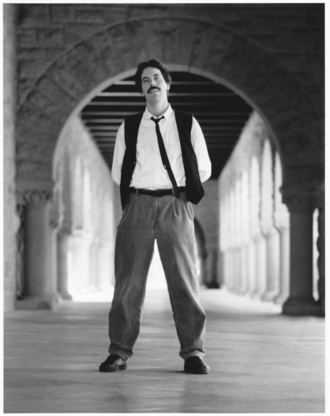
Ted Gioia
Music historian and critic, writer of The Honest Broker newsletter
Where to hear and read about Ted Gioia1 episode or test

Ted Gioia is a music historian and critic who writes The Honest Broker newsletter, with an Oxford economics degree, a Stanford MBA and a consulting past. The thing most worth learning from him is to feed your writing with decades of demanding reading and expertise outside writing, and to protect your readers' trust over every other reward.
I think that it's death to try to chase the culture
How to Write Well (in a Distracting World) — Ted Gioia
Ted Gioia: the story and the lessons
1Ted Gioia's path from jazz expert to Honest Broker
Gioia began as a jazz expert and widened to the whole Western canon. He holds an Oxford economics degree and a Stanford MBA, and he consulted to fund his writing. His first book was on West Coast jazz.
He says nobody was more surprised than he was by how much erudition improved his writing, and he credits it, not growth tactics, for his career.
A drunk Australian in a China hotel bar gave him the newsletter's name. Sent to set up a company in China, Gioia got contradictory advice from powerful contacts until the Australian told him to find the honest broker. With no rule of law, that person charges nothing upfront, makes introductions, and years later asks for a favor.
Gioia saw his own writing problem had the same solution: be the person readers can trust, and shoot straight.
He has read hard books every morning for about 50 years. It started at 5:30 a.m. in high school. At Boston Consulting Group, with about 340 consultants worldwide, he advised Fortune 500 CEOs in his early twenties, read Sartre at Stanford before work and played piano in a practice room after. He owned no TV until his mid-30s.
He calls it extreme-sport discipline and says he is not a role model.
The payoff from all that study arrived late and unplanned. In his 40s people began responding to him with new gravitas, and they hired him to help raise money. The education had seeped into how he built sentences and arguments.
He says it is too slow to work as a career strategy: "You have to have a love of learning."
He read the classics first and contemporary work only around age 45. He felt he could not review a contemporary novel until he had read 300 to 500 classics. His listening flipped from 80% old music when young to 80% new music now.
With that base he reads Breaking Bad as Greek tragedy, with Walter White's need for self-aggrandisement as the tragic flaw.
2How Ted Gioia reads, researches and builds expertise
Gioia tells writers to become experts in something besides writing. His MBA and consulting work taught him to read financial statements and forecast trends, and he applies them to culture. A product-launch model borrowed from disease spread showed that innovation happens in dense, mixed populations, which explains jazz in New Orleans.
The blues grew in isolated rural areas, so he reads it as survival of an old tradition, not innovation. He notes law graduates make strong sports reporters, because athletes keep getting arrested.
He reads 40 or 50 books on a subject, then moves on. This gives him authority without turning him into a dilettante or a pedant, the two bad options Unamuno names. His shelves hold 30 or 40 books each on the music of ancient Rome and ancient Greece.
He will never go to the granularity of knowing how many hairs Cannonball Adderley had on his back.
He stops reading to write a few paragraphs, then goes back. Reading Hegel on Greek openness to foreigners, he walked the five feet to his computer, wrote a few paragraphs, saved the file and returned to the book. He spends more time on input than output.
He rewrites sources in his own words and notes the sentences that resonate. Hegel's word was "heterogeneity", not "diversity". His image: "the reading is like fuel in the tank".
He reads some writers purely for their sentences, even when he disagrees. About 1,500 pages into Gibbon's Decline and Fall he rejected its ultra-rationalism but kept reading for the prose. Shelby Foote reread Proust so its style would infuse his own writing.
Reading a style is not imitating it. You see the possibilities and then "find your own home".
He starts a big research project with a one-line premise. His current project tests whether today's algorithmic, rationalist culture needs a humanistic reawakening like Romanticism around 1800. He has spent 18 to 24 months reading Byron, Blake, Burke, Tocqueville and Carlyle's three volumes on the French Revolution.
The premise gives the heavy reading a purpose. He does it for the future, hoping to write something fair, convincing and honest.
3Ted Gioia's rules for honest writing
Gioia ranks his relationship with the reader above every other reward. He lists the temptations: telling readers what they want to hear, writing what editors want, flattering musicians to become friends, chasing tenure, or tilting an argument for a cause. He estimates about 50% of circulating writing carries an agenda.
He tests each piece on three questions: is it fair, is it accurate, and will it persuade all fair-minded observers. If it fails the last, "I have failed".
He admits his own limits to drop the cool pose. Music writing tempts the writer to pose, as Lester Bangs and Hunter Thompson did, and Gioia fears the widening gap between image and self with age. He published the story of the cops arresting him at Stanley Crouch's house after he misread an alarm.
He compares it to wearing a hair shirt. Knausgaard shows the effect: a writer who makes himself look bad earns trust on everything else.
He keeps a private journal of brutally honest daily irritations. Each day he writes down what annoyed him or what people should have done differently, and shows it to no one. After about 30 days, reading it back reveals risk-taking ideas he did not know he had.
Society rewards fitting in, and Gioia says 99% of social situations reward adapting to others, so you need a private place to give yourself permission to be honest.
He accepts that some readers will be upset and picks the right enemies. He tells new subscribers to expect the unexpected, so readers know he takes chances. He cites Stewart Brand and Kevin Kelly, who aimed to alienate about a tenth of the Whole Earth Catalog's readers.
His version: "if you are going to make enemies make the right kind of enemies".
4How Gioia shapes style and takes risks in his writing
Gioia changes his prose style to suit each subject. He took the habit from critic Hugh Kenner, who wrote like Pound on Pound and like Yeats on Yeats. West Coast Jazz is flashy with striking adjectives, while his Delta blues book is lazier and more open, with metaphors of soil, crops and rivers.
For the Delta book he read Mississippi authors to absorb the voice, and its first page is unlike the West Coast one.
On Substack he writes as he would talk to a friend at dinner. Frequent emails make readers feel they know the writer, so his prose turned conversational without a plan. Fellow Substack writer Dan Stone warned him readers would act like longtime friends.
The setting makes showing off with Shakespeare or Plato awkward, so he matches his register to the relationship he really has with the reader.
He hides an obscure allusion in a throwaway aside for the one reader. He wrote that music awoke him from his "dogmatic slumber", Kant's phrase about Hume. He figures perhaps one reader in a thousand catches it, and that reader enjoys it.
The surface stays direct while the writing carries layers for the expert reader.
He serializes his book on Substack with self-contained chapters. Music to Raise the Dead, on the Orpheus myth and music's power to bring people back from the dead, had 10 of 12 chapters out at recording. Any chapter can be read alone, because readers do not usually look to email newsletters for books.
It keeps footnotes and is less conversational than his usual posts. His goal was a direct line to the reader with no editor or publisher between: "if I can do it for a newsletter, why not for a book".
He stays open to the moment instead of recreating his best passage. After John Handy's inspired solo, Charles Mingus told him never to play it again. Handy later understood it meant staying open, not repeating it.
Gioia brings that into his writing and trusts a piece that takes on a life of its own. He says he must take risks to reach a higher level than routine allows.
He tries to recall his dreams first thing every morning. He treats dreams as the last safe place for something wild and unpredictable, and he reads strange, visionary writers to be jarred out of routine. He tosses aside books by the crazy maniacs.
He points to songs that arrived in dreams, including Yesterday, Let It Be and Keith Richards's Satisfaction riff, recorded in his sleep.
5Why Gioia plays the long game against formula and distraction
Gioia calls himself the enemy of formula. He loses interest when he can guess a movie's ending in five minutes. He blames studio dependence on formula for Hollywood's slump, citing a six-month moving average of box office that points down.
Publishers say they want fresh voices and then ask for last week's bestseller. He writes directly to readers instead.
A viral clip of Gioia got 2 million views and no readers. Short clips cannot build a relationship, because there is nothing to engage with in ten seconds. The editors who told him to dumb it down are out of a job, and his subscriber base grew 30% in 10 weeks.
He compares the slow path to organic food growing faster than processed food.
He treats distraction as a third category beside art and entertainment. Art is demanding and entertainment is formulaic, but a pet video or a photo of a meal is only a jolt of dopamine. In the last 12 to 18 months every major platform shifted to scrolling reels, with a hit every 15 seconds to keep people on the phone for more ads.
Friends at a big potato chip company told him they spent years tuning a chip so its flavor faded in seconds. He assumes Silicon Valley ran similar research.
He chooses his values first and accepts slow results. He says this approach will not pay off in 4, 8 or 12 weeks, and that we need a "slowness revolution". He thinks in terms of 2,000 to 3,000 years.
Otherwise, he says, he is not the honest broker. He allows that other people take different paths to success or happiness.
He refuses to play the anger game that goes viral. The angrier his opinions on social media, the more likely they spread, but he holds to a measured, fair and kind path and credits it for part of his success. His core values are kindness, love, forgiveness and compassion.
He expects the culture to turn from anger toward kindness within 5 to 10 years, citing Soros's reflexivity: trends eventually reverse.

How to Write Well (in a Distracting World) — Ted Gioia
Ted Gioia argues that good writing comes from trust, honesty and a huge intake of difficult reading, not from chasing formulas or fast platforms. His worth-hearing habit is fifty years of demanding books every morning before he writes in the afternoon, with an honest private journal as the source of fresh ideas.
Gioia began as a jazz expert and widened to the whole Western canon. He holds an Oxford economics degree and a Stanford MBA, and he consulted to fund his writing. His first book was on West Coast jazz.
He says nobody was more surprised than he was by how much erudition improved his writing, and he credits it, not growth tactics, for his career.
A drunk Australian in a China hotel bar gave him the newsletter's name. Sent to set up a company in China, Gioia got contradictory advice from powerful contacts until the Australian told him to find the honest broker. With no rule of law, that person charges nothing upfront, makes introductions, and years later asks for a favor.
Gioia saw his own writing problem had the same solution: be the person readers can trust, and shoot straight.
He has read hard books every morning for about 50 years. It started at 5:30 a.m. in high school. At Boston Consulting Group, with about 340 consultants worldwide, he advised Fortune 500 CEOs in his early twenties, read Sartre at Stanford before work and played piano in a practice room after. He owned no TV until his mid-30s.
He calls it extreme-sport discipline and says he is not a role model.
The payoff from all that study arrived late and unplanned. In his 40s people began responding to him with new gravitas, and they hired him to help raise money. The education had seeped into how he built sentences and arguments.
He says it is too slow to work as a career strategy: "You have to have a love of learning."
He read the classics first and contemporary work only around age 45. He felt he could not review a contemporary novel until he had read 300 to 500 classics. His listening flipped from 80% old music when young to 80% new music now.
With that base he reads Breaking Bad as Greek tragedy, with Walter White's need for self-aggrandisement as the tragic flaw.
Gioia tells writers to become experts in something besides writing. His MBA and consulting work taught him to read financial statements and forecast trends, and he applies them to culture. A product-launch model borrowed from disease spread showed that innovation happens in dense, mixed populations, which explains jazz in New Orleans.
The blues grew in isolated rural areas, so he reads it as survival of an old tradition, not innovation. He notes law graduates make strong sports reporters, because athletes keep getting arrested.
He reads 40 or 50 books on a subject, then moves on. This gives him authority without turning him into a dilettante or a pedant, the two bad options Unamuno names. His shelves hold 30 or 40 books each on the music of ancient Rome and ancient Greece.
He will never go to the granularity of knowing how many hairs Cannonball Adderley had on his back.
He stops reading to write a few paragraphs, then goes back. Reading Hegel on Greek openness to foreigners, he walked the five feet to his computer, wrote a few paragraphs, saved the file and returned to the book. He spends more time on input than output.
He rewrites sources in his own words and notes the sentences that resonate. Hegel's word was "heterogeneity", not "diversity". His image: "the reading is like fuel in the tank".
He reads some writers purely for their sentences, even when he disagrees. About 1,500 pages into Gibbon's Decline and Fall he rejected its ultra-rationalism but kept reading for the prose. Shelby Foote reread Proust so its style would infuse his own writing.
Reading a style is not imitating it. You see the possibilities and then "find your own home".
He starts a big research project with a one-line premise. His current project tests whether today's algorithmic, rationalist culture needs a humanistic reawakening like Romanticism around 1800. He has spent 18 to 24 months reading Byron, Blake, Burke, Tocqueville and Carlyle's three volumes on the French Revolution.
The premise gives the heavy reading a purpose. He does it for the future, hoping to write something fair, convincing and honest.
Gioia ranks his relationship with the reader above every other reward. He lists the temptations: telling readers what they want to hear, writing what editors want, flattering musicians to become friends, chasing tenure, or tilting an argument for a cause. He estimates about 50% of circulating writing carries an agenda.
He tests each piece on three questions: is it fair, is it accurate, and will it persuade all fair-minded observers. If it fails the last, "I have failed".
He admits his own limits to drop the cool pose. Music writing tempts the writer to pose, as Lester Bangs and Hunter Thompson did, and Gioia fears the widening gap between image and self with age. He published the story of the cops arresting him at Stanley Crouch's house after he misread an alarm.
He compares it to wearing a hair shirt. Knausgaard shows the effect: a writer who makes himself look bad earns trust on everything else.
He keeps a private journal of brutally honest daily irritations. Each day he writes down what annoyed him or what people should have done differently, and shows it to no one. After about 30 days, reading it back reveals risk-taking ideas he did not know he had.
Society rewards fitting in, and Gioia says 99% of social situations reward adapting to others, so you need a private place to give yourself permission to be honest.
He accepts that some readers will be upset and picks the right enemies. He tells new subscribers to expect the unexpected, so readers know he takes chances. He cites Stewart Brand and Kevin Kelly, who aimed to alienate about a tenth of the Whole Earth Catalog's readers.
His version: "if you are going to make enemies make the right kind of enemies".
Gioia changes his prose style to suit each subject. He took the habit from critic Hugh Kenner, who wrote like Pound on Pound and like Yeats on Yeats. West Coast Jazz is flashy with striking adjectives, while his Delta blues book is lazier and more open, with metaphors of soil, crops and rivers.
For the Delta book he read Mississippi authors to absorb the voice, and its first page is unlike the West Coast one.
On Substack he writes as he would talk to a friend at dinner. Frequent emails make readers feel they know the writer, so his prose turned conversational without a plan. Fellow Substack writer Dan Stone warned him readers would act like longtime friends.
The setting makes showing off with Shakespeare or Plato awkward, so he matches his register to the relationship he really has with the reader.
He hides an obscure allusion in a throwaway aside for the one reader. He wrote that music awoke him from his "dogmatic slumber", Kant's phrase about Hume. He figures perhaps one reader in a thousand catches it, and that reader enjoys it.
The surface stays direct while the writing carries layers for the expert reader.
He serializes his book on Substack with self-contained chapters. Music to Raise the Dead, on the Orpheus myth and music's power to bring people back from the dead, had 10 of 12 chapters out at recording. Any chapter can be read alone, because readers do not usually look to email newsletters for books.
It keeps footnotes and is less conversational than his usual posts. His goal was a direct line to the reader with no editor or publisher between: "if I can do it for a newsletter, why not for a book".
He stays open to the moment instead of recreating his best passage. After John Handy's inspired solo, Charles Mingus told him never to play it again. Handy later understood it meant staying open, not repeating it.
Gioia brings that into his writing and trusts a piece that takes on a life of its own. He says he must take risks to reach a higher level than routine allows.
He tries to recall his dreams first thing every morning. He treats dreams as the last safe place for something wild and unpredictable, and he reads strange, visionary writers to be jarred out of routine. He tosses aside books by the crazy maniacs.
He points to songs that arrived in dreams, including Yesterday, Let It Be and Keith Richards's Satisfaction riff, recorded in his sleep.
Gioia calls himself the enemy of formula. He loses interest when he can guess a movie's ending in five minutes. He blames studio dependence on formula for Hollywood's slump, citing a six-month moving average of box office that points down.
Publishers say they want fresh voices and then ask for last week's bestseller. He writes directly to readers instead.
A viral clip of Gioia got 2 million views and no readers. Short clips cannot build a relationship, because there is nothing to engage with in ten seconds. The editors who told him to dumb it down are out of a job, and his subscriber base grew 30% in 10 weeks.
He compares the slow path to organic food growing faster than processed food.
He treats distraction as a third category beside art and entertainment. Art is demanding and entertainment is formulaic, but a pet video or a photo of a meal is only a jolt of dopamine. In the last 12 to 18 months every major platform shifted to scrolling reels, with a hit every 15 seconds to keep people on the phone for more ads.
Friends at a big potato chip company told him they spent years tuning a chip so its flavor faded in seconds. He assumes Silicon Valley ran similar research.
He chooses his values first and accepts slow results. He says this approach will not pay off in 4, 8 or 12 weeks, and that we need a "slowness revolution". He thinks in terms of 2,000 to 3,000 years.
Otherwise, he says, he is not the honest broker. He allows that other people take different paths to success or happiness.
He refuses to play the anger game that goes viral. The angrier his opinions on social media, the more likely they spread, but he holds to a measured, fair and kind path and credits it for part of his success. His core values are kindness, love, forgiveness and compassion.
He expects the culture to turn from anger toward kindness within 5 to 10 years, citing Soros's reflexivity: trends eventually reverse.