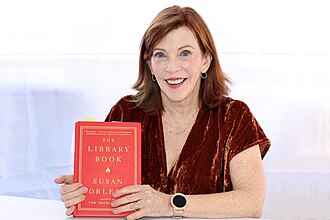
Susan Orlean
Staff writer at The New Yorker and author of The Library Book
Where to hear and read about Susan Orlean1 episode or test

Susan Orlean is a staff writer at The New Yorker and the author of The Orchid Thief and The Library Book. The one thing most worth learning from her is that a staged process of research, digestion, structure, a daily word quota and hard editing frees a writer to be creative instead of overwhelmed.
I'm really in the same position as the reader. I'm just a little ahead of them.
Award-Winning Author Reveals Her Writing Process (Susan Orlean Interview)
Susan Orlean: the story and the lessons
1How Susan Orlean finds and chooses her book subjects
Orlean's first book proposal failed because she did not want to write it. She brought an agent 12 ideas and says 11 and a half were not good. He backed the most marketable one, she wrote that proposal, and publishers passed with warm rejections.
She says she did not yet know what made a good book idea. Her advice for a first-time author is to be "literally burning with the desire to do the book".
A publisher who asked what she really wanted got her first book. Joanie Evans, head of an imprint at Simon & Schuster, liked her writing and asked if this was the book she wanted. Orlean blurted out a book about Saturday night in America, and the answer was "Great. Done."
The idea grew from a Boston Globe story on two people training for the new Iron Man, which she would expand to three people over a year. She guesses the earlier proposal felt too much like a magazine piece, or that she did not seem invested.
Orlean chooses book subjects for depth, not width. Her first test is whether she is deeply in love with the subject. Her second is how many layers down it goes, because holding a reader for 300 pages takes more dimension than a 10,000 word magazine piece.
Rin Tin Tin looked like a nothing subject but opened onto World War I, the German Shepherd breed, silent film, Warner Brothers and the rise of Hollywood. She calls a good subject a prism: turn it and you see a new side each time, yet every side belongs to the same story.
Orlean writes about things she found fascinating and did not care about before. She does not collect orchids and does not even like Florida, yet she wrote The Orchid Thief. She goes through the discovery first, then tells it, so the reader follows with her as a proxy.
Her stories have no built-in urgency like celebrity, war or murder, so her own fascination has to carry the reader through the first minute.
Orlean had a friend interview her to write her memoir. A memoir removed the discovery that drives her reporting. She hired a journalist friend, gave her no questions, and asked only what she was interested in.
She barely used the transcripts. Hearing her story told to a stranger showed her what readers might care about, and the friend zeroed in on parts of her life she had written off as dull.
2Orlean's research, digestion and index card method
Orlean does all her research before writing a word, and it takes years. The Library Book took three or four years of research. Learning how arson is investigated alone took six to eight weeks.
Research days run on tasks, not hours, such as an interview with the head of the LA Fire Department's arson unit. Her rule: "I can't write yet. I don't know what I'm writing about."
She schedules a digestion phase between reporting and drafting. She types up notes, moves cards and thinks about the lead and tone, with no words on the page. It looks unproductive, and it is where the structure appears.
She says we underestimate the time needed to digest. Jumping from reporting straight to writing is hard.
Orlean finds structure by moving index cards around a big floor. She used about 700 5 by 8 cards for each of her last two books, Rin Tin Tin and The Library Book. Each card holds one chunk of thought, and she lays them out and moves them by hand.
Handling the cards reminds her what she has and what fits together. The cost is floor space, and the dog has to stay out.
Big sources become one card that points back to the document. For a legal document she wrote "card number 35, legal document" rather than splitting it into a million pieces. The card tells her which section the material belongs to.
Card size is a matter of intuition, not a rule. It can be as small as a dog's name.
She sorts cards into themes, then writes the connective tissue. The Library Book jumps around in time, so she grouped cards into themes such as fire and arson, the library's history and Harry Peak. Each pile already held part of the story.
A pile of separate stories is not yet a book, so she then built the links between them. She also had to keep regrounding herself in the time frame.
3Why Orlean writes to a daily word quota
Orlean writes about a thousand words a day, five days a week. The quota turns a huge book into a task that can be finished. Once she hits the number, the day's job is done, and she takes a sixth day only if she is behind.
Her New Yorker editor taught her the habit. She finds the deadline liberating because it stops her from staring into the void.
Orlean says structure frees her creativity instead of killing it. Overwhelmed, she would organize her knife drawer, do laundry or go for a walk. A small daily goal removes the dread and leaves her relaxed enough to work one sentence until it is right.
She is not temperamentally like Kerouac with his fast scroll. The routine never removed the poetry for her.
She treats the quota like a budget and like marathon pacing. Marathon training taught her to set a reachable goal and stretch a little past it. She finished the New York City Marathon at almost exactly her trained time.
She refused to drive the route beforehand. Holding one comfortable pace mile by mile gets you to the end, and the same goes for a book.
She edits yesterday's pages before writing today's. After a night's sleep the pages are fresh enough to judge but distant enough to see what is wrong. What felt perfect on Monday reads as improvable on Tuesday.
She says it is a great time to edit, as long as it does not stop her moving ahead.
4How Orlean edits her own prose
Orlean reads every draft aloud as her first line of editing. She calls it her biggest trick. Reading aloud exposes sentences that do not work, repeated words and spots that are not clicking.
If she gets bored while reading, that passage is probably boring, so she fixes or cuts it. Then she checks each sentence for rhythm, logic and purpose.
She rereads whole drafts many times to catch her bad habits. Habits such as grammatical crutches and too many adjectives only show up on the fourth read or later. She read her memoir Joyride in full more times than she can count.
She enjoys the tedium because she keeps feeling she can turn the dial a little higher. She compares it to a great car made by improving every single part.
She became a brutal self editor once she wrote on a computer. Early on she felt every word was gold and was indignant when anything was cut. On a computer she could move a sentence and put it back if she missed it.
That freedom led her to try a passage without a favorite sentence, then to remove flab hard.
Orlean cut habitual "would" and writes the plain past tense. A New Yorker editor showed her that "I would go to the store" is weaker than "I went to the store". The habitual "would" is a placeholder that reads as passive.
She keeps it only when she truly means the deep past. She now sees it everywhere when she reads.
She picks one vivid image instead of stringing adjectives together. Too many adjectives go mushy and cancel each other out. Her Laroche description stacks several, but each names one distinct quality of his physical presence.
This matches David Perell's "pick one" rule: one good example, made vivid, then move on.
Orlean pulls her punches so the punchy line lands. As a young writer she was seduced by clever, snappy writing. She now thinks the stronger tone is more confident and less "look at me".
She calls overwriting a classic young writer error and says it is exhausting to read.
5How Orlean hooks readers with leads and story
Orlean opens The Orchid Thief with a jarring detail about a person. She describes John Laroche as sharply handsome "in spite of the fact that he is missing all his front teeth". The ideal reaction is "wait, what?", because confusion makes people read a little more.
She spent a lot of time on that lead. On paper the story was a man arrested with orchids taken from a Florida swamp.
With obscure subjects, Orlean leads with a vivid person. She cannot rely on celebrity, war or murder, so she asks readers for a minute and promises a payoff. She says "people are very interested in people".
She counted on readers meeting Laroche and wanting more, even if they did not care about orchids.
She turns information into story with mood, characters and a reason to care. A list of bullet points is a snoozefest. Her test is whether a dinner guest would listen for an hour to the biggest library fire in American history.
The reader must be engaged in the characters and told, subtly, why to listen.

Award-Winning Author Reveals Her Writing Process (Susan Orlean Interview)
Susan Orlean walks through a deliberate nonfiction process: years of research with no writing, index cards to find structure, a daily word quota, and heavy self-editing. The most useful parts are reading drafts aloud, hunting your own grammatical crutches, and opening with a jarring detail about a person.
Orlean's first book proposal failed because she did not want to write it. She brought an agent 12 ideas and says 11 and a half were not good. He backed the most marketable one, she wrote that proposal, and publishers passed with warm rejections.
She says she did not yet know what made a good book idea. Her advice for a first-time author is to be "literally burning with the desire to do the book".
A publisher who asked what she really wanted got her first book. Joanie Evans, head of an imprint at Simon & Schuster, liked her writing and asked if this was the book she wanted. Orlean blurted out a book about Saturday night in America, and the answer was "Great. Done."
The idea grew from a Boston Globe story on two people training for the new Iron Man, which she would expand to three people over a year. She guesses the earlier proposal felt too much like a magazine piece, or that she did not seem invested.
Orlean chooses book subjects for depth, not width. Her first test is whether she is deeply in love with the subject. Her second is how many layers down it goes, because holding a reader for 300 pages takes more dimension than a 10,000 word magazine piece.
Rin Tin Tin looked like a nothing subject but opened onto World War I, the German Shepherd breed, silent film, Warner Brothers and the rise of Hollywood. She calls a good subject a prism: turn it and you see a new side each time, yet every side belongs to the same story.
Orlean writes about things she found fascinating and did not care about before. She does not collect orchids and does not even like Florida, yet she wrote The Orchid Thief. She goes through the discovery first, then tells it, so the reader follows with her as a proxy.
Her stories have no built-in urgency like celebrity, war or murder, so her own fascination has to carry the reader through the first minute.
Orlean had a friend interview her to write her memoir. A memoir removed the discovery that drives her reporting. She hired a journalist friend, gave her no questions, and asked only what she was interested in.
She barely used the transcripts. Hearing her story told to a stranger showed her what readers might care about, and the friend zeroed in on parts of her life she had written off as dull.
Orlean does all her research before writing a word, and it takes years. The Library Book took three or four years of research. Learning how arson is investigated alone took six to eight weeks.
Research days run on tasks, not hours, such as an interview with the head of the LA Fire Department's arson unit. Her rule: "I can't write yet. I don't know what I'm writing about."
She schedules a digestion phase between reporting and drafting. She types up notes, moves cards and thinks about the lead and tone, with no words on the page. It looks unproductive, and it is where the structure appears.
She says we underestimate the time needed to digest. Jumping from reporting straight to writing is hard.
Orlean finds structure by moving index cards around a big floor. She used about 700 5 by 8 cards for each of her last two books, Rin Tin Tin and The Library Book. Each card holds one chunk of thought, and she lays them out and moves them by hand.
Handling the cards reminds her what she has and what fits together. The cost is floor space, and the dog has to stay out.
Big sources become one card that points back to the document. For a legal document she wrote "card number 35, legal document" rather than splitting it into a million pieces. The card tells her which section the material belongs to.
Card size is a matter of intuition, not a rule. It can be as small as a dog's name.
She sorts cards into themes, then writes the connective tissue. The Library Book jumps around in time, so she grouped cards into themes such as fire and arson, the library's history and Harry Peak. Each pile already held part of the story.
A pile of separate stories is not yet a book, so she then built the links between them. She also had to keep regrounding herself in the time frame.
Orlean writes about a thousand words a day, five days a week. The quota turns a huge book into a task that can be finished. Once she hits the number, the day's job is done, and she takes a sixth day only if she is behind.
Her New Yorker editor taught her the habit. She finds the deadline liberating because it stops her from staring into the void.
Orlean says structure frees her creativity instead of killing it. Overwhelmed, she would organize her knife drawer, do laundry or go for a walk. A small daily goal removes the dread and leaves her relaxed enough to work one sentence until it is right.
She is not temperamentally like Kerouac with his fast scroll. The routine never removed the poetry for her.
She treats the quota like a budget and like marathon pacing. Marathon training taught her to set a reachable goal and stretch a little past it. She finished the New York City Marathon at almost exactly her trained time.
She refused to drive the route beforehand. Holding one comfortable pace mile by mile gets you to the end, and the same goes for a book.
She edits yesterday's pages before writing today's. After a night's sleep the pages are fresh enough to judge but distant enough to see what is wrong. What felt perfect on Monday reads as improvable on Tuesday.
She says it is a great time to edit, as long as it does not stop her moving ahead.
Orlean reads every draft aloud as her first line of editing. She calls it her biggest trick. Reading aloud exposes sentences that do not work, repeated words and spots that are not clicking.
If she gets bored while reading, that passage is probably boring, so she fixes or cuts it. Then she checks each sentence for rhythm, logic and purpose.
She rereads whole drafts many times to catch her bad habits. Habits such as grammatical crutches and too many adjectives only show up on the fourth read or later. She read her memoir Joyride in full more times than she can count.
She enjoys the tedium because she keeps feeling she can turn the dial a little higher. She compares it to a great car made by improving every single part.
She became a brutal self editor once she wrote on a computer. Early on she felt every word was gold and was indignant when anything was cut. On a computer she could move a sentence and put it back if she missed it.
That freedom led her to try a passage without a favorite sentence, then to remove flab hard.
Orlean cut habitual "would" and writes the plain past tense. A New Yorker editor showed her that "I would go to the store" is weaker than "I went to the store". The habitual "would" is a placeholder that reads as passive.
She keeps it only when she truly means the deep past. She now sees it everywhere when she reads.
She picks one vivid image instead of stringing adjectives together. Too many adjectives go mushy and cancel each other out. Her Laroche description stacks several, but each names one distinct quality of his physical presence.
This matches David Perell's "pick one" rule: one good example, made vivid, then move on.
Orlean pulls her punches so the punchy line lands. As a young writer she was seduced by clever, snappy writing. She now thinks the stronger tone is more confident and less "look at me".
She calls overwriting a classic young writer error and says it is exhausting to read.
Orlean opens The Orchid Thief with a jarring detail about a person. She describes John Laroche as sharply handsome "in spite of the fact that he is missing all his front teeth". The ideal reaction is "wait, what?", because confusion makes people read a little more.
She spent a lot of time on that lead. On paper the story was a man arrested with orchids taken from a Florida swamp.
With obscure subjects, Orlean leads with a vivid person. She cannot rely on celebrity, war or murder, so she asks readers for a minute and promises a payoff. She says "people are very interested in people".
She counted on readers meeting Laroche and wanting more, even if they did not care about orchids.
She turns information into story with mood, characters and a reason to care. A list of bullet points is a snoozefest. Her test is whether a dinner guest would listen for an hour to the biggest library fire in American history.
The reader must be engaged in the characters and told, subtly, why to listen.