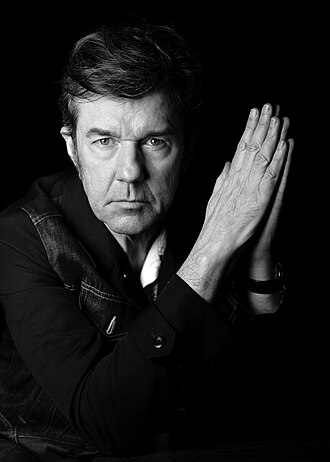
Stefan Sagmeister
Designer and author of six books
Where to hear and read about Stefan Sagmeister1 episode or test

Stefan Sagmeister is a designer and the author of six books, including Things I Have Learned in My Life So Far, who closes his studio for a year every seven years. The most useful thing to learn from him is to write honestly in a private diary, then push each piece until you cannot make it any better.
All you have to do is being honest. It will be automatically interesting.
How to Create Original Ideas — Stefan Sagmeister
Stefan Sagmeister: the story and the lessons
1How Sagmeister forces new ideas
Sagmeister starts a design from something unrelated to it. Using Edward de Bono's method, he designs a glass by starting from a sock. The result was a glass hard at the top and soft at the base that stands on uneven camping ground, and it took about 10 seconds.
Starting from existing glasses only gets you a similar glass. The random object raises new questions, such as whether a drinking container could be elastic, and it could be made by injection molding a hard and a soft material together. He says "my chance of designing something new are better if I don't start with a glass but with something random."
He says designers repeat themselves because old brain connections are strongest. The oldest connection between synapses wins, so a designer trying something new lands on what they did two years ago.
The brain is lazy. A forced starting point only pushes it through what he calls semi-new synapses, and the end result is still a glass.
He tries a new direction privately before taking it to a bigger stage. Experimenting for himself lowers the hurdles. With nothing at risk he can find his sea legs and try this and that.
If it fails he is only a bit frustrated. If it works, doing it on the bigger stage is much easier.
2Sagmeister's diary, honesty and sabbaticals
Sagmeister types his diary so he can reread it. He began keeping diaries at 10 or 12, but his handwriting was unreadable exactly when life went very well or very badly. Typing on a computer made rechecking possible.
Rereading showed him a change he had wanted eight years earlier and still had not made. The diary began to shape the studio's design work.
He writes the diary every Saturday morning and rates a short list. At the start of the year he picks things he wants to improve, and a calendar reminder every Saturday prompts him to rate himself on each. New Year's intentions were gone by January 5th, and a daily app for about three months felt bothersome and got sloppy.
He is a list maker and ran about eight lists during The Happy Film. Some weeks one item gets terrible marks, but the rating still reminds him what he should not do.
When a brief is open, he mines his diary for what is true. After his first sabbatical a client gave him no constraints, and he found it very hard. He went to his diary list of about 15 things he had learned and made complicated typography from one of them.
Because he wrote the list privately, he knew it was true for him: "I know this to be true for me." That list grew into a series of exhibitions and books.
He believes honest work is automatically interesting. Grant Crisp told Sagmeister's students that everybody who is honest is interesting, and it hit him like a lightning bolt. He says it is easier to be honest than to sit down and need a great idea.
Audiences feel dishonesty within a second, as with a conference speaker repeating a cliché. A friend's line on writer's block fits: be more honest. A social filter asking what he is supposed to say blocks people from what they believe.
He takes a year-long sabbatical every seven years. The first one meant closing a thriving studio in the dot-com boom, which felt unprofessional and scary. He made nothing that year, and the diary from it became the exhibitions and books on what he has learned.
The second was easy because the first had such a clear impact. He read 20 to 25 books on his latest sabbatical, the same as in busy times, so wanting more time to read was a delusion.
He plans only the first two or three months of a sabbatical. With no plan the first time, he was busy and frustrated and created nothing. Now he needs the plan for only two or three months.
By month three enough projects are running that the plan is unnecessary.
3Sagmeister on beauty as a function
Sagmeister says functional design is easy and beauty is the hard part. He can design 50 merely functional chairs in an afternoon. A chair that is also beautiful and fits today means fighting 5,000 years of chair history.
Beauty was taboo in his 1980s art school, where mentioning it got you laughed out of the room. Functionalism had pushed it out of design from the 1950s to about 2000.
He builds beauty by questioning every element. He treats shape, form, color, composition, material and texture as a checklist and asks how to improve each. He cites Enzo Ferrari asking of every part of a normal car how to make it better.
"Excellence is really just a byproduct of 10,000 things that are thought of consciously and tweaked and refined." A film may have 100,000 such details.
He pushes each piece until he cannot push it further. He calls it pushification. Obsession is ruinous in his life but useful in his work: on his last sabbatical he smoked two cigars the first day and 12 the second.
A piece pushed until he is lost is often a good piece, and he accepts it as "right now my level of pushification."
He now values staying with one idea over constant change. Young, he preferred the Beatles over the Stones and Bowie over Dylan. James Turrell has made dozens of skyspaces, each 2 to 5% better, so Sagmeister checks a skyspace's date before visiting.
Japanese knife makers and sushi chefs refine one practice for decades, and temples are rebuilt every 20 years so each generation learns how.
He argues beauty makes people behave better and makes things last. The High Line has almost no litter while the neighboring Meatpacking District is full of it. At the Skyscape in Lech, Austria, skiers in noisy boots walk in, look up and sit down with no sign telling them to.
The Pantheon is 2,000 years old because every culture that held it found it beautiful. His 35-year-old bag was repaired every 5 years because he loved it.
He says ugly sustainable products undermine their own cause. Solar panels and added insulation on Central European houses are often dreadful to look at. Panels designed with beauty in mind should raise a home's resale value.
A beautiful object is kept and repaired, which beats a jute or cotton bag sold as sustainable.
He sees globalization making design look the same everywhere. Hotel rooms in Kuala Lumpur and Frankfurt are the same box with a different surface material. Only a threat to identity breaks the pattern.
Ukraine under attack shows the opposite, with design stores where everything carries Ukrainian stories and patterns. He compares it to a tree growing deeper roots in heavy wind.
4How Sagmeister makes work for other people
Sagmeister cuts artspeak and writes plain, short text. At the MASS museum in Mexico, a 15-sentence artspeak entry text is crossed out and the same content follows by hand in four clear sentences. A museum visitor will read perhaps two sentences.
He says wall text should be "as short and as precise as possible."
He keeps one hard passage so clarity is not mistaken for simplicity. An astronomer's colleagues took his very clear first book for a children's book. Now he adds one opaque chapter so readers value the clarity of the rest.
Sagmeister says he should have kept one or two artspeak lines in his beauty show.
He designs album covers by asking the band why they made the album. He talked to bands about the album, not the cover, and visited the studio to hear half-finished songs. He treats the job as translating how the music feels into something visual.
For Jay-Z or the Stones he had to listen on site for fear of leaks. Mick Jagger wanted a design that would look good embroidered on a baseball cap, since the Stones earn more from merch than music.
He serves the audience's world, not only his own taste. A cover for Lou Reed must please Lou Reed's fans. If they hate it, he failed, even if he thinks it is good.
His museum work runs under his own name, but the show must still change how visitors see the world. He has done no commercial work in years.
He aims for work that is both good and popular. He calls it the hardest thing to make and not selling out. Experts see far more than the public, so their taste drifts from the reader's.
A New York Times panel of about a dozen experts chose mostly boxy, Bauhaus-style buildings, and readers' comments were furious. Almost no living architect was on the list.
He argues that work made with care makes viewers generous. He felt comfortable in a kitschy Milan hotel full of butterflies, though it was not his taste, because its makers clearly believed it was beautiful.
Gas stations, furniture stores and fast food places are designed for convenience, and people leave as soon as they can.
He made human-looking work against the cold modernism of his youth. Modernism was 60 or 70 years old when he came of age and felt machine-made. His studio made things that were obviously made by humans.
He compares it to a human voice on the phone beating an answering machine. By the 1980s, he says, conservative designers clung to modernism out of laziness.
He admits that wanting to be liked limits his work. Making only likable things is a limitation, and he thinks he has this problem more than most.
He says his life would be richer if he cared less about being liked.

How to Create Original Ideas — Stefan Sagmeister
Sagmeister shows that original, clear work comes from forcing your brain off its well-worn paths, writing honestly for yourself in a diary, and refining the piece until you cannot push it further. The technique worth hearing is his weekly diary with a short rating list, and the diary's list of things he had learned later turned into his books and exhibitions.
Sagmeister starts a design from something unrelated to it. Using Edward de Bono's method, he designs a glass by starting from a sock. The result was a glass hard at the top and soft at the base that stands on uneven camping ground, and it took about 10 seconds.
Starting from existing glasses only gets you a similar glass. The random object raises new questions, such as whether a drinking container could be elastic, and it could be made by injection molding a hard and a soft material together. He says "my chance of designing something new are better if I don't start with a glass but with something random."
He says designers repeat themselves because old brain connections are strongest. The oldest connection between synapses wins, so a designer trying something new lands on what they did two years ago.
The brain is lazy. A forced starting point only pushes it through what he calls semi-new synapses, and the end result is still a glass.
He tries a new direction privately before taking it to a bigger stage. Experimenting for himself lowers the hurdles. With nothing at risk he can find his sea legs and try this and that.
If it fails he is only a bit frustrated. If it works, doing it on the bigger stage is much easier.
Sagmeister types his diary so he can reread it. He began keeping diaries at 10 or 12, but his handwriting was unreadable exactly when life went very well or very badly. Typing on a computer made rechecking possible.
Rereading showed him a change he had wanted eight years earlier and still had not made. The diary began to shape the studio's design work.
He writes the diary every Saturday morning and rates a short list. At the start of the year he picks things he wants to improve, and a calendar reminder every Saturday prompts him to rate himself on each. New Year's intentions were gone by January 5th, and a daily app for about three months felt bothersome and got sloppy.
He is a list maker and ran about eight lists during The Happy Film. Some weeks one item gets terrible marks, but the rating still reminds him what he should not do.
When a brief is open, he mines his diary for what is true. After his first sabbatical a client gave him no constraints, and he found it very hard. He went to his diary list of about 15 things he had learned and made complicated typography from one of them.
Because he wrote the list privately, he knew it was true for him: "I know this to be true for me." That list grew into a series of exhibitions and books.
He believes honest work is automatically interesting. Grant Crisp told Sagmeister's students that everybody who is honest is interesting, and it hit him like a lightning bolt. He says it is easier to be honest than to sit down and need a great idea.
Audiences feel dishonesty within a second, as with a conference speaker repeating a cliché. A friend's line on writer's block fits: be more honest. A social filter asking what he is supposed to say blocks people from what they believe.
He takes a year-long sabbatical every seven years. The first one meant closing a thriving studio in the dot-com boom, which felt unprofessional and scary. He made nothing that year, and the diary from it became the exhibitions and books on what he has learned.
The second was easy because the first had such a clear impact. He read 20 to 25 books on his latest sabbatical, the same as in busy times, so wanting more time to read was a delusion.
He plans only the first two or three months of a sabbatical. With no plan the first time, he was busy and frustrated and created nothing. Now he needs the plan for only two or three months.
By month three enough projects are running that the plan is unnecessary.
Sagmeister says functional design is easy and beauty is the hard part. He can design 50 merely functional chairs in an afternoon. A chair that is also beautiful and fits today means fighting 5,000 years of chair history.
Beauty was taboo in his 1980s art school, where mentioning it got you laughed out of the room. Functionalism had pushed it out of design from the 1950s to about 2000.
He builds beauty by questioning every element. He treats shape, form, color, composition, material and texture as a checklist and asks how to improve each. He cites Enzo Ferrari asking of every part of a normal car how to make it better.
"Excellence is really just a byproduct of 10,000 things that are thought of consciously and tweaked and refined." A film may have 100,000 such details.
He pushes each piece until he cannot push it further. He calls it pushification. Obsession is ruinous in his life but useful in his work: on his last sabbatical he smoked two cigars the first day and 12 the second.
A piece pushed until he is lost is often a good piece, and he accepts it as "right now my level of pushification."
He now values staying with one idea over constant change. Young, he preferred the Beatles over the Stones and Bowie over Dylan. James Turrell has made dozens of skyspaces, each 2 to 5% better, so Sagmeister checks a skyspace's date before visiting.
Japanese knife makers and sushi chefs refine one practice for decades, and temples are rebuilt every 20 years so each generation learns how.
He argues beauty makes people behave better and makes things last. The High Line has almost no litter while the neighboring Meatpacking District is full of it. At the Skyscape in Lech, Austria, skiers in noisy boots walk in, look up and sit down with no sign telling them to.
The Pantheon is 2,000 years old because every culture that held it found it beautiful. His 35-year-old bag was repaired every 5 years because he loved it.
He says ugly sustainable products undermine their own cause. Solar panels and added insulation on Central European houses are often dreadful to look at. Panels designed with beauty in mind should raise a home's resale value.
A beautiful object is kept and repaired, which beats a jute or cotton bag sold as sustainable.
He sees globalization making design look the same everywhere. Hotel rooms in Kuala Lumpur and Frankfurt are the same box with a different surface material. Only a threat to identity breaks the pattern.
Ukraine under attack shows the opposite, with design stores where everything carries Ukrainian stories and patterns. He compares it to a tree growing deeper roots in heavy wind.
Sagmeister cuts artspeak and writes plain, short text. At the MASS museum in Mexico, a 15-sentence artspeak entry text is crossed out and the same content follows by hand in four clear sentences. A museum visitor will read perhaps two sentences.
He says wall text should be "as short and as precise as possible."
He keeps one hard passage so clarity is not mistaken for simplicity. An astronomer's colleagues took his very clear first book for a children's book. Now he adds one opaque chapter so readers value the clarity of the rest.
Sagmeister says he should have kept one or two artspeak lines in his beauty show.
He designs album covers by asking the band why they made the album. He talked to bands about the album, not the cover, and visited the studio to hear half-finished songs. He treats the job as translating how the music feels into something visual.
For Jay-Z or the Stones he had to listen on site for fear of leaks. Mick Jagger wanted a design that would look good embroidered on a baseball cap, since the Stones earn more from merch than music.
He serves the audience's world, not only his own taste. A cover for Lou Reed must please Lou Reed's fans. If they hate it, he failed, even if he thinks it is good.
His museum work runs under his own name, but the show must still change how visitors see the world. He has done no commercial work in years.
He aims for work that is both good and popular. He calls it the hardest thing to make and not selling out. Experts see far more than the public, so their taste drifts from the reader's.
A New York Times panel of about a dozen experts chose mostly boxy, Bauhaus-style buildings, and readers' comments were furious. Almost no living architect was on the list.
He argues that work made with care makes viewers generous. He felt comfortable in a kitschy Milan hotel full of butterflies, though it was not his taste, because its makers clearly believed it was beautiful.
Gas stations, furniture stores and fast food places are designed for convenience, and people leave as soon as they can.
He made human-looking work against the cold modernism of his youth. Modernism was 60 or 70 years old when he came of age and felt machine-made. His studio made things that were obviously made by humans.
He compares it to a human voice on the phone beating an answering machine. By the 1980s, he says, conservative designers clung to modernism out of laziness.
He admits that wanting to be liked limits his work. Making only likable things is a limitation, and he thinks he has this problem more than most.
He says his life would be richer if he cared less about being liked.