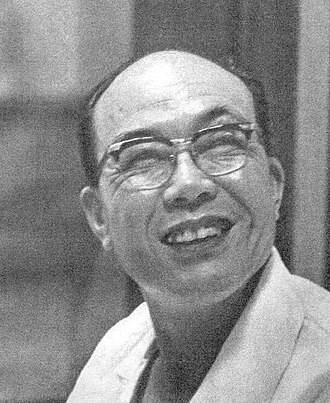
Soichiro Honda
Founder of Honda
Where to hear and read about Soichiro Honda1 episode or test

Soichiro Honda was a blacksmith's son and self-taught mechanic who founded Honda in 1949 and built the Super Cub, which has sold over 100 million units. The lesson most worth taking from him is how he guarded what he was best at, engines and research, by handing finance and sales to a partner and giving research its own company.
Success can only be achieved through repeated failure. In fact, success represents 1% of your work, which results only from the 99% that is called failure.
The Practical Genius of Honda
Soichiro Honda: the story and the lessons
1Soichiro Honda's childhood among engines
Honda loved machines from early childhood and never stopped. Before age 10 he was drawn to the sound and blue, oily smoke of a mill motor 4 km away, and his grandfather carried him there on his back. After first seeing a car, he rubbed its dripped oil on his arms.
He kept that thrill into his 70s. Asked what he did in retirement, he answered "Fumbling with machines."
Hardship and a blacksmith father shaped his habits. Only four of the nine Honda children reached adulthood, and his mother mended his rice-straw-soled shoes every night. His father wanted things straight and logical even in small matters.
From his father Honda took the urge to get to the root of things and do them his own way. His first heroes were the village electricians, with pliers and screwdrivers at their hips.
He left for Tokyo at 16 to become a car mechanic. He found a help-wanted ad in the trade magazine The World of Wheels, read in his father's bicycle repair shop, and talked his reluctant father into letting him go.
He was the eldest son and a notorious truant, and he never finished school.
2How Honda built a repair shop on the hardest jobs
A slow apprenticeship tested him until an earthquake opened the way. Custom made him wait over a year before doing the work he wanted, which he called the most trying time of his life. The great earthquake struck when he was about 17, and vehicles piled up for hand repair.
He learned to drive, ride and fix them. After six years his master trusted him enough to help him set up his own shop.
Seen as too young, he took repairs other shops called hopeless. Customers favored two older rivals, so he built his name on jobs others had failed at. By 25 the shop earned 1,000 yen a month and employed 50 people.
"Start with the hardest problem first" later became a founding principle of Honda.
Cast metal spokes were his first product and first patent. Wooden spokes had burned in the earthquake fires, so he made metal ones, which trading companies exported as far as India.
It was the first of over 100 patents he would hold personally.
He played as hard as he worked, and had a temper. He spent lavishly on geisha houses, once drove his car off a bridge into mud, and turned a fire hose on tax officials after an argument.
Nicknamed Mr. Thunder, his temper blew up like a summer storm and left no grudges. He said those years taught him human nature "through life in the raw."
3Why Honda left repair for manufacturing
He gave up a thriving garage because it could never reach the world. He reasoned that "a garage was a garage after all" and no orders would come from Tokyo or America, so he moved into piston rings.
His father and old friends, acting as his board, tried to stop him. He fell ill with severe facial neuralgia for two months, and it vanished overnight once a go-between won the board over.
He learned the trade by living in the factory. Knowing nothing about the craft, he worked day and night and slept on a straw mat on the factory floor.
Toyota returned 47 of his first 50 piston rings. Hand-made quality was too uneven, so he became a disciple of interchangeability and built automatic machines that untrained workers could run.
Women workers ran them as wartime male labor ran short in the 1930s, and he later carried this experience into motorcycle production.
4How Honda started a motorcycle company from postwar shortage
He built his first motorbike because he needed one himself. Gasoline shortages made driving his car impossible and he wanted to avoid crowded trains, so he fitted a surplus military radio-generator engine to a bicycle. It sold at once.
Selling the piston ring company had netted about $125,000, giving him time and money. When the surplus engines ran out, he designed his own motor.
He trusted his own judgment over relatives and friends. Critics told him to open a garage, or said a motorbike was only for black marketers. He answered that it was needed because it saved scarce gasoline, and his wife used one to gather food in the countryside.
In 1949, at age 43, he began the company.
Selling on credit nearly bankrupted him. Pleased that people found his invention useful, he sold bikes to shops on credit, and many never paid or closed.
"I was not paying much attention to profits," he said. This is what sent him looking for a partner strong in finance.
5Honda and Takeo Fujisawa: a partner for everything else
Honda sought a partner who was his opposite. He knew he was weak in finance and marketing, so he recruited Takeo Fujisawa, a man of very different temperament, and left the business side to him.
Fujisawa's wife warned that two unconventional characters would never get along. Honda's view: "a person who cannot mix with people of different temperaments is rather a useless person." The verdict on the partnership is that there is no Honda without Fujisawa.
Fujisawa fixed cash flow by making shops pay up front. Wholesale shops had to pay before receiving bikes, ending the credit losses that had nearly sunk the company.
One letter to 18,000 bicycle shops built a 5,000-dealer network. With fewer than 200 distributors, Fujisawa wrote to bicycle shop owners across Japan, reminding them their fathers had mastered the foreign bicycle and promising to teach them to sell and repair the new motor bicycle.
It worked almost overnight. The letter read in part: "You have hardly seen one, and you do not know how to sell it or how to repair it, but we intend to help you do both."
6How Honda made the Super Cub for people who did not ride
The Dream served a narrow cult, so Honda designed a bicycle replacement. The first model, the Dream, was heavy and expensive and drew moderate demand. The Super Cub was built to substitute for the hugely popular bicycle.
It was meant for "the man in the street, his wife, and his kids." It has been built for over 60 years and sold over 100 million units.
Honda treated the motorcycle's image as the real barrier. In America motorcycles were seen as toys for delinquents and black leather gangs, so the resistance was acceptance, not unfamiliarity. Honda became the largest motorcycle advertiser on US network TV and ran a saturated campaign in Time and Life.
The ads showed students, housewives and businessmen riding under the slogan "You meet the nicest people on a Honda," and aimed at parents too. One mother told a dealer she would not let her son buy a motorcycle but would buy him a Honda.
7Why Honda refused protection and bet on machine tools
He stayed out while rivals asked the government to restrict imports. Honda decided to win through technology instead, resolving to prove that "high quality goods know no national boundaries."
He spent about ten times the company's assets on top machine tools. He reasoned that quality products need quality tools, and that even if the company failed the machines would remain "working for the people."
Japan fell into recession right after the purchase and Honda could not pay.
A banker who believed in the tools saved him, and Honda stayed loyal. Kawaraha, a supporter inside his main creditor, argued against foreclosure because the equipment was excellent and could be sold. Honda squeaked through after 6 months.
He kept doing business with that small bank long after better options existed.
8How Honda protected research, racing and engines
Losing at the Isle of Man race pushed him into research. German and Italian bikes with the same cylinder count had three times the horsepower. He was "flabbergasted," then set out to learn why, focusing on horsepower per cylinder.
"There is no reason why something which could be done by foreigners could not be done by the Japanese."
He spun R&D into a separate company funded by a share of sales. Research got a fixed portion of sales and handed its results to manufacturing. He said over 99% of research is failure, so inside a profit-driven maker it would suffer.
"Had we left research in the parent company, it would have been treated like a stepchild." A research institute should let individuals do their best; a factory should maximize efficiency.
He called racing floating research. Racing pushed engine quality, and what was learned went straight into standard products.
"We want to apply the knowledge we gain in the race to production."
He kept Honda an engine company and refused partnerships. He insisted the company's products must have an engine, and went alone while Mitsubishi joined Chrysler and Isuzu joined General Motors.
Sony's Masaru Ibuka credited this focus for engine technology that Honda alone has, comparing him to Edwin Land. The focus at one point made sales fall and outsiders predicted bankruptcy before a breakthrough made sales boom.
9Soichiro Honda's principles for leading and building
Honda treated failure as the price of success. Wartime bombings and an earthquake destroyed his plants, and he kept rebuilding, calling scrap fuel tanks "Truman's gift."
Looking back he saw "a series of failures, a series of regrets," but each mistake had a different cause and he never repeated one.
Technology must start from a human need. His R&D principle was respect for humanity: "There is a need, hence the technology." He warned against being used by the machine.
He held that results depend on what is in people's brains, not budget: "If their brains are on strike, then nothing is going to work." He also urged seeking any problem's solution at its root.
He worked in the lab and saw himself as an employee. He spent almost all his time in the labs, smeared with grease beside engineers, and young staff described a president they could talk with on the level.
"I am president of the company only when I'm considering its future, but most of the time I'm just one of the employees."
He kept the company young and welcomed generational conflict. He wrote youthfulness into management policy and let each R&D engineer propose and own any project. He told new hires they worked first for themselves and second for the company.
"If you only have older experienced engineers, you're not going to get anywhere." In his 60s he admitted he could no longer keep up, and retired because he felt the new technology was beyond him.
Dyson learned a repeatable improvement loop from Honda. Take an existing product, notice what is bad, clumsy or overcomplicated, improve it without stopping, and keep enough control of the company to keep improving it.
Both took an old, narrow market, made it respectable and grew it far beyond expectations.

The Practical Genius of Honda
Soichiro Honda built Honda around engines, research and a partner who ran the business side, and he made the Super Cub the best-selling motor vehicle of all time. The story shows how splitting research from manufacturing, targeting non-enthusiasts and refusing protection built a company that lasted.
Honda loved machines from early childhood and never stopped. Before age 10 he was drawn to the sound and blue, oily smoke of a mill motor 4 km away, and his grandfather carried him there on his back. After first seeing a car, he rubbed its dripped oil on his arms.
He kept that thrill into his 70s. Asked what he did in retirement, he answered "Fumbling with machines."
Hardship and a blacksmith father shaped his habits. Only four of the nine Honda children reached adulthood, and his mother mended his rice-straw-soled shoes every night. His father wanted things straight and logical even in small matters.
From his father Honda took the urge to get to the root of things and do them his own way. His first heroes were the village electricians, with pliers and screwdrivers at their hips.
He left for Tokyo at 16 to become a car mechanic. He found a help-wanted ad in the trade magazine The World of Wheels, read in his father's bicycle repair shop, and talked his reluctant father into letting him go.
He was the eldest son and a notorious truant, and he never finished school.
A slow apprenticeship tested him until an earthquake opened the way. Custom made him wait over a year before doing the work he wanted, which he called the most trying time of his life. The great earthquake struck when he was about 17, and vehicles piled up for hand repair.
He learned to drive, ride and fix them. After six years his master trusted him enough to help him set up his own shop.
Seen as too young, he took repairs other shops called hopeless. Customers favored two older rivals, so he built his name on jobs others had failed at. By 25 the shop earned 1,000 yen a month and employed 50 people.
"Start with the hardest problem first" later became a founding principle of Honda.
Cast metal spokes were his first product and first patent. Wooden spokes had burned in the earthquake fires, so he made metal ones, which trading companies exported as far as India.
It was the first of over 100 patents he would hold personally.
He played as hard as he worked, and had a temper. He spent lavishly on geisha houses, once drove his car off a bridge into mud, and turned a fire hose on tax officials after an argument.
Nicknamed Mr. Thunder, his temper blew up like a summer storm and left no grudges. He said those years taught him human nature "through life in the raw."
He gave up a thriving garage because it could never reach the world. He reasoned that "a garage was a garage after all" and no orders would come from Tokyo or America, so he moved into piston rings.
His father and old friends, acting as his board, tried to stop him. He fell ill with severe facial neuralgia for two months, and it vanished overnight once a go-between won the board over.
He learned the trade by living in the factory. Knowing nothing about the craft, he worked day and night and slept on a straw mat on the factory floor.
Toyota returned 47 of his first 50 piston rings. Hand-made quality was too uneven, so he became a disciple of interchangeability and built automatic machines that untrained workers could run.
Women workers ran them as wartime male labor ran short in the 1930s, and he later carried this experience into motorcycle production.
He built his first motorbike because he needed one himself. Gasoline shortages made driving his car impossible and he wanted to avoid crowded trains, so he fitted a surplus military radio-generator engine to a bicycle. It sold at once.
Selling the piston ring company had netted about $125,000, giving him time and money. When the surplus engines ran out, he designed his own motor.
He trusted his own judgment over relatives and friends. Critics told him to open a garage, or said a motorbike was only for black marketers. He answered that it was needed because it saved scarce gasoline, and his wife used one to gather food in the countryside.
In 1949, at age 43, he began the company.
Selling on credit nearly bankrupted him. Pleased that people found his invention useful, he sold bikes to shops on credit, and many never paid or closed.
"I was not paying much attention to profits," he said. This is what sent him looking for a partner strong in finance.
Honda sought a partner who was his opposite. He knew he was weak in finance and marketing, so he recruited Takeo Fujisawa, a man of very different temperament, and left the business side to him.
Fujisawa's wife warned that two unconventional characters would never get along. Honda's view: "a person who cannot mix with people of different temperaments is rather a useless person." The verdict on the partnership is that there is no Honda without Fujisawa.
Fujisawa fixed cash flow by making shops pay up front. Wholesale shops had to pay before receiving bikes, ending the credit losses that had nearly sunk the company.
One letter to 18,000 bicycle shops built a 5,000-dealer network. With fewer than 200 distributors, Fujisawa wrote to bicycle shop owners across Japan, reminding them their fathers had mastered the foreign bicycle and promising to teach them to sell and repair the new motor bicycle.
It worked almost overnight. The letter read in part: "You have hardly seen one, and you do not know how to sell it or how to repair it, but we intend to help you do both."
The Dream served a narrow cult, so Honda designed a bicycle replacement. The first model, the Dream, was heavy and expensive and drew moderate demand. The Super Cub was built to substitute for the hugely popular bicycle.
It was meant for "the man in the street, his wife, and his kids." It has been built for over 60 years and sold over 100 million units.
Honda treated the motorcycle's image as the real barrier. In America motorcycles were seen as toys for delinquents and black leather gangs, so the resistance was acceptance, not unfamiliarity. Honda became the largest motorcycle advertiser on US network TV and ran a saturated campaign in Time and Life.
The ads showed students, housewives and businessmen riding under the slogan "You meet the nicest people on a Honda," and aimed at parents too. One mother told a dealer she would not let her son buy a motorcycle but would buy him a Honda.
He stayed out while rivals asked the government to restrict imports. Honda decided to win through technology instead, resolving to prove that "high quality goods know no national boundaries."
He spent about ten times the company's assets on top machine tools. He reasoned that quality products need quality tools, and that even if the company failed the machines would remain "working for the people."
Japan fell into recession right after the purchase and Honda could not pay.
A banker who believed in the tools saved him, and Honda stayed loyal. Kawaraha, a supporter inside his main creditor, argued against foreclosure because the equipment was excellent and could be sold. Honda squeaked through after 6 months.
He kept doing business with that small bank long after better options existed.
Losing at the Isle of Man race pushed him into research. German and Italian bikes with the same cylinder count had three times the horsepower. He was "flabbergasted," then set out to learn why, focusing on horsepower per cylinder.
"There is no reason why something which could be done by foreigners could not be done by the Japanese."
He spun R&D into a separate company funded by a share of sales. Research got a fixed portion of sales and handed its results to manufacturing. He said over 99% of research is failure, so inside a profit-driven maker it would suffer.
"Had we left research in the parent company, it would have been treated like a stepchild." A research institute should let individuals do their best; a factory should maximize efficiency.
He called racing floating research. Racing pushed engine quality, and what was learned went straight into standard products.
"We want to apply the knowledge we gain in the race to production."
He kept Honda an engine company and refused partnerships. He insisted the company's products must have an engine, and went alone while Mitsubishi joined Chrysler and Isuzu joined General Motors.
Sony's Masaru Ibuka credited this focus for engine technology that Honda alone has, comparing him to Edwin Land. The focus at one point made sales fall and outsiders predicted bankruptcy before a breakthrough made sales boom.
Honda treated failure as the price of success. Wartime bombings and an earthquake destroyed his plants, and he kept rebuilding, calling scrap fuel tanks "Truman's gift."
Looking back he saw "a series of failures, a series of regrets," but each mistake had a different cause and he never repeated one.
Technology must start from a human need. His R&D principle was respect for humanity: "There is a need, hence the technology." He warned against being used by the machine.
He held that results depend on what is in people's brains, not budget: "If their brains are on strike, then nothing is going to work." He also urged seeking any problem's solution at its root.
He worked in the lab and saw himself as an employee. He spent almost all his time in the labs, smeared with grease beside engineers, and young staff described a president they could talk with on the level.
"I am president of the company only when I'm considering its future, but most of the time I'm just one of the employees."
He kept the company young and welcomed generational conflict. He wrote youthfulness into management policy and let each R&D engineer propose and own any project. He told new hires they worked first for themselves and second for the company.
"If you only have older experienced engineers, you're not going to get anywhere." In his 60s he admitted he could no longer keep up, and retired because he felt the new technology was beyond him.
Dyson learned a repeatable improvement loop from Honda. Take an existing product, notice what is bad, clumsy or overcomplicated, improve it without stopping, and keep enough control of the company to keep improving it.
Both took an old, narrow market, made it respectable and grew it far beyond expectations.