Shweta Shrivastava
Senior Director of Product Management at Waymo, former CPO at Nauto, ex-Amazon Web Services and Cisco
Where to hear and read about Shweta Shrivastava1 episode or test
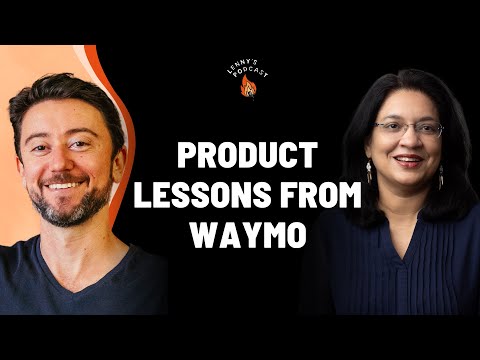
Shweta Shrivastava is a senior director of product management at Waymo, with earlier senior product roles at Nauto, AWS and Cisco. The most useful thing to learn from her is how to make a product feel trustworthy by designing predictability in deliberately, and to pair every safety metric with one that keeps the product useful.
if there's no conflict if there's no contention then something is missing
Product lessons from Waymo | Shweta Shrivastava (Waymo, Amazon, Cisco)
Shweta Shrivastava: the story and the lessons
1Who Shweta Shrivastava is and what she runs at Waymo
Shrivastava moved from Cisco and AWS through driver safety to Waymo. She is senior director of product management at Waymo, whose cars already run in San Francisco, LA and Phoenix. Before that she was chief product officer at Nauto, working on AI-assisted driver safety, and head of product management for AWS database and analytics services.
Before AWS she was at Cisco. In all she has 15+ years in senior product roles.
Her team owns the driving software, the test tools and the ride-hailing business. Her group covers onboard software, simulation and commercial scaling. The onboard software sets the vehicle's actual behavior and trajectory, simulation validates how well the system performs, and the third team scales ride-hailing commercially.
Ride-hailing is one of the main go-to-market uses of the technology.
She says deep tech product work takes technical depth and long-game tenacity. Waymo product managers must get into the details as far as needed and accept more uncertainty and ambiguity than in other product roles. Making driverless service a broad reality is a long journey, so they keep improving the product over time.
"you have to have that tenacity to play the long game". She says people self-select for the mission, which is cutting the roughly 1.35 million traffic deaths a year, mostly from driving errors and distraction.
2How Waymo builds rider trust in a car with no driver
Waymo designed for full autonomy from day one, so predictability is built in. Driver assist relies on a human taking over in hard moments, and Waymo has no such expectation. Riders typically say the first five minutes feel like a wow, then it feels normal.
She says the ease is engineered: "it's not a happenstance that it feels that way".
Waymo trains on good human driving and throws away the bad. Deep learning models learn from human driving data, with bad driving discarded. The system reads pedestrian body orientation, gaze, signs and gestures, so the car is safer than a human without feeling robotic.
On a rainy San Francisco ride the car inched into a lane of moving traffic to ask for a gap, signaling intent through motion since there is no driver to make eye contact with. "it has to feel very human-like but in a good way".
She treats local social norms as part of the driving task. Pedestrians cross without a walk sign in some San Francisco spots but not others. Explicit rules and signals are not enough, so the system is taught the norms of each location and how to react to them.
"we don't realize how sophisticated how interactive and how social driving really is".
Trust comes from many small transparency touches, not one feature. An in-car monitor shows riders what the car sees. Rider support calls if a seat belt is not buckled, which shows a human is reachable.
"it has to be a bunch of small things to make it feel natural transparent and trustworthy".
Waymo changed correct behavior that still felt wrong to riders. The cars never exceed the speed limit, which many riders appreciate. But on San Francisco hills they did not slow downhill the way human drivers subconsciously do, even when already under the limit.
The team learned riders expected the slowdown and changed the driving to match, because it gives "a more natural Driving Experience".
3How Waymo measures progress and holds the safety bar
She pairs safety metrics with progress metrics so neither is gamed. Waymo aims to beat the human collision rate per 100,000 miles and tracks road-rule compliance. It also counts unduly stopped vehicles, rescue-help instances per week and how much the car slows other road users.
A car that never moves is perfectly safe, so the opposing metrics force it to be appropriately assertive. "you can be very safe if you're not moving at all that's one problem".
Waymo builds its own yardstick for human driving. She says there is no single standard safety benchmark that everyone uses, and Waymo has enough data to form its own view of human performance. Priors are used to judge what adequate performance is.
She calls the collisions-per-distance description a simplification, since several things go into calculating both the benchmark and Waymo's result against it.
Waymo tracks commercial and operational metrics next to driving behavior. Every metric falls into commercial and operational, or system behavior. Commercial ones include trips per week, active users and cost per ride, reviewed daily or weekly depending on the metric.
Because Waymo is past the pilot phase, funnel metrics matter as much as driving data.
She keeps the MVP idea but sets an extremely high safety floor. Shipping small and iterating with real-world deployment still applies. The safety bar is extremely high and corners cannot be cut.
"the MVP bar itself for safety is extremely high for us".
She keeps long-term investors bought in with commercial results. Waymo shows meaningful progress in commercial deployments, not only technology: a paid service in Phoenix, a public service in San Francisco and LA testing under way. It has been accelerating milestones and beating its own expectations.
Waymo won't do anything unnatural for short-term brownie points because investors see through it. "the rubber meets the road".
She argues L4 service city by city is good enough. L4 means no human at the wheel and none expected. L5 would drive anywhere, even with no map and no priors, and she says it may become niche.
Expanding L4 to more cities realizes the self-driving dream in a big way. Snow driving is one capability Waymo has yet to build.
4Shrivastava's rules for product managers and careers
She works backwards from the customer problem, starting with a press release. Amazon PMs write the launch press release before building anything, which forces a thorough value proposition. Waymo has its own version, adapted by each product team.
She admits "working backwards" has become a platitude but urges new PMs to follow it.
She decides what she is not building, even at a startup. It is easy to be swayed when one customer asks for this and another for that. Prioritization and a crisp scope are the defense.
"a product that tries to be all things to all people usually doesn't end up going anywhere".
She was first PM on Honeycode, a way to disrupt Amazon's own model. Honeycode was a no-code app development platform, a first of its kind for Amazon in a space AWS had never entered, which had been mostly infrastructure. She says market leaders drift into incremental strategy and get surprised by upstarts.
"you need to disrupt yourself before somebody else does". Her most recommended books are Crossing the Chasm by Geoffrey Moore and The Innovator's Dilemma by Clayton Christensen.
She calls listening and empathy the most underrated PM skills. It takes a beginner's mindset and not jumping in with ideas. Then you challenge your own assumptions, and if there is never conflict or contention in conversations, you are probably not listening well.
She built the skill by repeating it across companies and cultures, such as learning an engineering leader's constraints and what impact means to them.
She says the way to get promoted is not to want it too badly. Focus on work with the right business outcome and give it full effort so the impact is visible. Still tell your manager you want stretch work and high-visibility projects.
Visible maneuvering sends a negative signal and distracts from the work. "the way to get promoted is to not want it too badly".
She asks senior candidates to describe a real failure. People who say they never failed, or who dress up a success as a failure, usually lack self-awareness or depth of experience. She looks for solid, real examples.
She applies a rule of seven to email threads that go nowhere. If a thread reaches seven emails without resolution, get on a call or into a room. Bigger companies may allow closer to ten, but the limit stays.
Threads get worse as more people chime in and no one asks where the thing is headed.

Product lessons from Waymo | Shweta Shrivastava (Waymo, Amazon, Cisco)
Waymo's product lead explains how a fully driverless service builds rider trust through predictable, human-like behavior, and how it balances safety metrics against commercial ones. She also shares general product lessons on working backwards, saying no, disrupting yourself, listening, and getting promoted.
Shrivastava moved from Cisco and AWS through driver safety to Waymo. She is senior director of product management at Waymo, whose cars already run in San Francisco, LA and Phoenix. Before that she was chief product officer at Nauto, working on AI-assisted driver safety, and head of product management for AWS database and analytics services.
Before AWS she was at Cisco. In all she has 15+ years in senior product roles.
Her team owns the driving software, the test tools and the ride-hailing business. Her group covers onboard software, simulation and commercial scaling. The onboard software sets the vehicle's actual behavior and trajectory, simulation validates how well the system performs, and the third team scales ride-hailing commercially.
Ride-hailing is one of the main go-to-market uses of the technology.
She says deep tech product work takes technical depth and long-game tenacity. Waymo product managers must get into the details as far as needed and accept more uncertainty and ambiguity than in other product roles. Making driverless service a broad reality is a long journey, so they keep improving the product over time.
"you have to have that tenacity to play the long game". She says people self-select for the mission, which is cutting the roughly 1.35 million traffic deaths a year, mostly from driving errors and distraction.
Waymo designed for full autonomy from day one, so predictability is built in. Driver assist relies on a human taking over in hard moments, and Waymo has no such expectation. Riders typically say the first five minutes feel like a wow, then it feels normal.
She says the ease is engineered: "it's not a happenstance that it feels that way".
Waymo trains on good human driving and throws away the bad. Deep learning models learn from human driving data, with bad driving discarded. The system reads pedestrian body orientation, gaze, signs and gestures, so the car is safer than a human without feeling robotic.
On a rainy San Francisco ride the car inched into a lane of moving traffic to ask for a gap, signaling intent through motion since there is no driver to make eye contact with. "it has to feel very human-like but in a good way".
She treats local social norms as part of the driving task. Pedestrians cross without a walk sign in some San Francisco spots but not others. Explicit rules and signals are not enough, so the system is taught the norms of each location and how to react to them.
"we don't realize how sophisticated how interactive and how social driving really is".
Trust comes from many small transparency touches, not one feature. An in-car monitor shows riders what the car sees. Rider support calls if a seat belt is not buckled, which shows a human is reachable.
"it has to be a bunch of small things to make it feel natural transparent and trustworthy".
Waymo changed correct behavior that still felt wrong to riders. The cars never exceed the speed limit, which many riders appreciate. But on San Francisco hills they did not slow downhill the way human drivers subconsciously do, even when already under the limit.
The team learned riders expected the slowdown and changed the driving to match, because it gives "a more natural Driving Experience".
She pairs safety metrics with progress metrics so neither is gamed. Waymo aims to beat the human collision rate per 100,000 miles and tracks road-rule compliance. It also counts unduly stopped vehicles, rescue-help instances per week and how much the car slows other road users.
A car that never moves is perfectly safe, so the opposing metrics force it to be appropriately assertive. "you can be very safe if you're not moving at all that's one problem".
Waymo builds its own yardstick for human driving. She says there is no single standard safety benchmark that everyone uses, and Waymo has enough data to form its own view of human performance. Priors are used to judge what adequate performance is.
She calls the collisions-per-distance description a simplification, since several things go into calculating both the benchmark and Waymo's result against it.
Waymo tracks commercial and operational metrics next to driving behavior. Every metric falls into commercial and operational, or system behavior. Commercial ones include trips per week, active users and cost per ride, reviewed daily or weekly depending on the metric.
Because Waymo is past the pilot phase, funnel metrics matter as much as driving data.
She keeps the MVP idea but sets an extremely high safety floor. Shipping small and iterating with real-world deployment still applies. The safety bar is extremely high and corners cannot be cut.
"the MVP bar itself for safety is extremely high for us".
She keeps long-term investors bought in with commercial results. Waymo shows meaningful progress in commercial deployments, not only technology: a paid service in Phoenix, a public service in San Francisco and LA testing under way. It has been accelerating milestones and beating its own expectations.
Waymo won't do anything unnatural for short-term brownie points because investors see through it. "the rubber meets the road".
She argues L4 service city by city is good enough. L4 means no human at the wheel and none expected. L5 would drive anywhere, even with no map and no priors, and she says it may become niche.
Expanding L4 to more cities realizes the self-driving dream in a big way. Snow driving is one capability Waymo has yet to build.
She works backwards from the customer problem, starting with a press release. Amazon PMs write the launch press release before building anything, which forces a thorough value proposition. Waymo has its own version, adapted by each product team.
She admits "working backwards" has become a platitude but urges new PMs to follow it.
She decides what she is not building, even at a startup. It is easy to be swayed when one customer asks for this and another for that. Prioritization and a crisp scope are the defense.
"a product that tries to be all things to all people usually doesn't end up going anywhere".
She was first PM on Honeycode, a way to disrupt Amazon's own model. Honeycode was a no-code app development platform, a first of its kind for Amazon in a space AWS had never entered, which had been mostly infrastructure. She says market leaders drift into incremental strategy and get surprised by upstarts.
"you need to disrupt yourself before somebody else does". Her most recommended books are Crossing the Chasm by Geoffrey Moore and The Innovator's Dilemma by Clayton Christensen.
She calls listening and empathy the most underrated PM skills. It takes a beginner's mindset and not jumping in with ideas. Then you challenge your own assumptions, and if there is never conflict or contention in conversations, you are probably not listening well.
She built the skill by repeating it across companies and cultures, such as learning an engineering leader's constraints and what impact means to them.
She says the way to get promoted is not to want it too badly. Focus on work with the right business outcome and give it full effort so the impact is visible. Still tell your manager you want stretch work and high-visibility projects.
Visible maneuvering sends a negative signal and distracts from the work. "the way to get promoted is to not want it too badly".
She asks senior candidates to describe a real failure. People who say they never failed, or who dress up a success as a failure, usually lack self-awareness or depth of experience. She looks for solid, real examples.
She applies a rule of seven to email threads that go nowhere. If a thread reaches seven emails without resolution, get on a call or into a room. Bigger companies may allow closer to ten, but the limit stays.
Threads get worse as more people chime in and no one asks where the thing is headed.