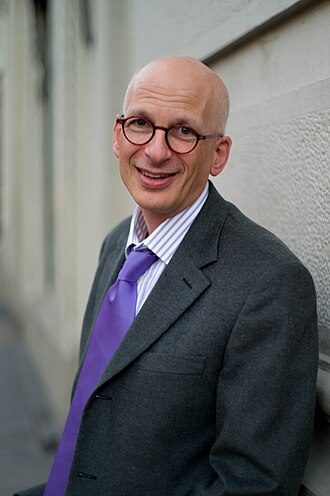
Seth Godin
Author of 21 books including Purple Cow and This Is Strategy, blogger, founder of Yoyodyne and Squidoo, former product manager at Spinnaker Software
Where to hear and read about Seth Godin1 episode or test

Seth Godin is an author of 21 books, a daily blogger and founder of Yoyodyne and Squidoo, who began as a product manager at Spinnaker Software. The thing most worth learning from him is to choose a small audience on purpose, make a promise worth remarking on, and keep it.
A brand is a promise. It's what do I expect from you. It's would I miss you if you were gone.
Seth Godin's best tactics for building remarkable products, strategies, brands and more
Seth Godin: the story and the lessons
1How Seth Godin learned product at Spinnaker
Godin turned a secret summer project into running product at Spinnaker. He was Spinnaker's 30th employee at a company that made educational games. The project was illustrated adventure games with music, based on science fiction, and Spinnaker had acquired Ray Bradbury and Arthur C. Clarke.
He had read every science fiction book in the Clearfield Public Library. After the project began he barely attended Stanford business school and took many red-eye flights.
He won 40 engineers with no authority by praising them in print. Engineers were in demand, so he wrote an internal newsletter on an early Mac that named each engineer who helped, and put a copy in every mailbox. Within three or four months, 40 engineers were working for him and none reported to him.
It worked because the project was good and the recognition was real.
Five products in a row went gold and saved the company. Godin concluded that you don't make a product and then hand it to some marketing yahoo to add a logo. Marketing is the product.
The team's test was whether the buyer they had described was delighted, not whether the boss was pleased.
A hard ship date showed him how much a product manager carries. RadioShack had ordered 3,000 stores times five times five, and missing the date meant a cancelled order and bankruptcy. With no source control or cloud, the plan lived in his head, so he stayed in the office 22 days.
After shipping, Herbie Hancock called to say he had stayed up all night playing Fahrenheit 451. Godin was 24.
His career since runs through books, companies and a daily blog. He has published 21 books, 18 of them international bestsellers, including Purple Cow, Permission Marketing and Linchpin. He founded Yoyodyne and Squidoo and started the altMBA program.
His blog is close to 10,000 days in a row, and it is the one place to follow his work because he avoids social media.
2How Godin builds products people talk about
Godin defines remarkable as worth making a remark about. Google launched with two buttons on its homepage against Yahoo's 183 links. Godin sent lost friends to Google because telling them to just type in what they wanted raised his status as a tech expert.
Marissa Mayer repeatedly refused to add another button, and the refusal became the promise. A gimmicky viral video does not count.
He builds the spread into the product itself. The test is whether the product works better for users when they tell others. Microsoft Word beat WordPerfect because coworkers needed the same format.
He says software as a service without a built-in network effect is almost certain to fail. "You cannot hope that Apple's going to pick you, promote you, and magically have you be successful."
Godin judges a startup by traction, not buzz. He credits Steve Blank's two questions: do people who engage stick around and come back, and do they tell their friends. There is no evidence Oreo's Super Bowl blackout tweet sold one more cookie.
IHOP's fake switch to International House of Burgers was a buzz stunt too. "Buzz does not sell hamburgers."
He reads Tesla's Model S as a story and the Cybertruck as a miss. The Model S gave people a talking point in its popping door handles and a demo in its zero to 60 in 2.4 seconds. The divisive Cybertruck ignored the skeptical pickup buyers it needed.
In some years the Ford F-150 earned more than 100% of Ford's profit. People buy pickups to show neighbors they value utility, even if they never use the bed.
Godin says a good launch creates tension, not stress. Tension is the open question a promise creates: the customer imagines a better life, then wonders whether you told the truth. Stress is being stuck between two bad options.
At ten, he bought PF Flyers on the promise they would make him fast enough to outrun a bully, and held the shoes to it. They did not deliver.
3Godin's four strategy choices
Godin starts by choosing the smallest viable audience. That choice fixes the language, budget, problem, technical skill and temper of the people you serve. A wedding photographer in the Hamptons should expect spoiled, cranky clients.
The Humane Pin pitched itself as a finished Apple-quality product, then shipped something unfinished. A pitch to about 400 Raspberry Pi tinkerers would have given it room to experiment.
He picks the competition knowingly. Competing with Walmart means it will keep cutting prices, because that is what Walmart does.
He says skipping these choices is fear, and a plan that tries to serve everyone has no chance.
He has one hard talk with the boss about whose taste counts. Pleasing the boss makes that the goal. Instead, agree that you are matching the taste of specific customers, such as 400 agreed people, and later meetings get easier.
"I'm not trying to match your taste, I'm trying to match the taste of these 400 people that we've agreed are our customers."
He treats distribution as part of the product. His video games sat in Target and Lechmere while rivals sat in Ziploc bags in computer stores. Steam and downloadable shareware later changed everything about the product.
A two-person food startup planned to sell on Shopify and to airports and hotels at once. He told them to pick one.
4Why Godin says a brand is a promise you keep
Godin separates a logo from a brand. A brand is what people expect from you and whether they would miss you if you were gone. Nike opening a hotel would be predictable, but Hyatt making sneakers would not.
"Hyatt Hotels has a logo, Nike has a brand." A brand also says what it does not do.
He tests loyalty by asking whether people would pay extra. Airline points are bribery, not loyalty. Godin pays extra for Claude because it is kind and clear about what it doesn't know, and uses ChatGPT only when he has no other option because it over-promises.
"Loyalty is would you pay extra to stick with this?"
He tells AI companies to sell the promise, not the feature. AI will stop being a feature the way electricity is not a feature, and many things run on electricity without being electricity companies. Ask what is in it for the user, then pick a hard, remarkable promise and plan how to keep it.
An absurd promise can only be broken once. Big claims may work on investors, but consumers punish them.
He says Jaguar re-logoed when it needed a new promise. A new logo is not a new promise, and Jaguar gave up awareness assets it already owned. Starting a car brand from scratch costs a hundred million to a billion dollars to earn trust.
He supports going all electric as a possible new promise. His advice is to win over 50 authoritative people and change them with the car.
5Seth Godin's working rules
Godin defines quality as meeting spec, then improving the spec. Quality is not luxury or perfection. Refusing to ship something that meets spec is hiding, and high standards mean making the spec better for the people you serve.
"If you meet spec, you're done. If you don't think the spec is good enough, make a better spec."
He never asks for a project extension. A project ends when time or money runs out, and good intentions are no reason for more. A professional expects the unexpected and plans for it.
He never blames customers for not reading the manual. Empathy is the job, not a kindness. A product is made for other people, so their mistakes are the maker's mistakes.
"If you're saying that to your customers, you made a mistake, they did not make a mistake."
He asks what system a fear is protecting before acting. Systems invent culture to protect themselves, so a scary idea may be one the system wants you to fear. Told that downloadable software would be pirated, he tried it, having spent only five months on the software.
Hiring systems reward sameness. One company's last four hires were all captains of an Ivy League tennis team.
He waits for the right wave and the right people. Better waves make better surfers, so choose the company, market and key hires carefully. Hurrying to meet an imaginary deadline ships mediocre work, and mediocre only means average.
His son passes up waves others take, because he knows he can ride the right one better.
Godin writes every word himself and uses Claude as editor. He has no team, so the promise is that he wrote it. He uploads a list of four items and asks what he missed, and uploads chapters to ask which claims he isn't sustaining.
He calls it a "patient editor that is so hard to find in the real world," since real editors lack the pay and time.
He keeps a queue of posts so the streak stays a pleasure. With spare ideas banked for tomorrow, he has time to rewrite today's post. His mindset moved from "I have to write" to "I get to write."
Post number 10,000 in a row arrives at the start of 2025.
He leads by painting the customer's picture of the future. The picture must be built on empathy and show where the people you serve want to go, not where you do. Hard work does not entitle you to funding, market share or a good price.
He says it is very difficult to change what people want, but helpful to offer a way to get there.

Seth Godin's best tactics for building remarkable products, strategies, brands and more
Seth Godin explains how to build products people talk about, why brands are promises rather than logos, and why choosing your customers, competition, validation source and distribution shapes your future. He draws on his start as a product manager at Spinnaker, where five games in a row went gold and saved the company, and on nearly 10,000 daily blog posts in a row.
Godin turned a secret summer project into running product at Spinnaker. He was Spinnaker's 30th employee at a company that made educational games. The project was illustrated adventure games with music, based on science fiction, and Spinnaker had acquired Ray Bradbury and Arthur C. Clarke.
He had read every science fiction book in the Clearfield Public Library. After the project began he barely attended Stanford business school and took many red-eye flights.
He won 40 engineers with no authority by praising them in print. Engineers were in demand, so he wrote an internal newsletter on an early Mac that named each engineer who helped, and put a copy in every mailbox. Within three or four months, 40 engineers were working for him and none reported to him.
It worked because the project was good and the recognition was real.
Five products in a row went gold and saved the company. Godin concluded that you don't make a product and then hand it to some marketing yahoo to add a logo. Marketing is the product.
The team's test was whether the buyer they had described was delighted, not whether the boss was pleased.
A hard ship date showed him how much a product manager carries. RadioShack had ordered 3,000 stores times five times five, and missing the date meant a cancelled order and bankruptcy. With no source control or cloud, the plan lived in his head, so he stayed in the office 22 days.
After shipping, Herbie Hancock called to say he had stayed up all night playing Fahrenheit 451. Godin was 24.
His career since runs through books, companies and a daily blog. He has published 21 books, 18 of them international bestsellers, including Purple Cow, Permission Marketing and Linchpin. He founded Yoyodyne and Squidoo and started the altMBA program.
His blog is close to 10,000 days in a row, and it is the one place to follow his work because he avoids social media.
Godin defines remarkable as worth making a remark about. Google launched with two buttons on its homepage against Yahoo's 183 links. Godin sent lost friends to Google because telling them to just type in what they wanted raised his status as a tech expert.
Marissa Mayer repeatedly refused to add another button, and the refusal became the promise. A gimmicky viral video does not count.
He builds the spread into the product itself. The test is whether the product works better for users when they tell others. Microsoft Word beat WordPerfect because coworkers needed the same format.
He says software as a service without a built-in network effect is almost certain to fail. "You cannot hope that Apple's going to pick you, promote you, and magically have you be successful."
Godin judges a startup by traction, not buzz. He credits Steve Blank's two questions: do people who engage stick around and come back, and do they tell their friends. There is no evidence Oreo's Super Bowl blackout tweet sold one more cookie.
IHOP's fake switch to International House of Burgers was a buzz stunt too. "Buzz does not sell hamburgers."
He reads Tesla's Model S as a story and the Cybertruck as a miss. The Model S gave people a talking point in its popping door handles and a demo in its zero to 60 in 2.4 seconds. The divisive Cybertruck ignored the skeptical pickup buyers it needed.
In some years the Ford F-150 earned more than 100% of Ford's profit. People buy pickups to show neighbors they value utility, even if they never use the bed.
Godin says a good launch creates tension, not stress. Tension is the open question a promise creates: the customer imagines a better life, then wonders whether you told the truth. Stress is being stuck between two bad options.
At ten, he bought PF Flyers on the promise they would make him fast enough to outrun a bully, and held the shoes to it. They did not deliver.
Godin starts by choosing the smallest viable audience. That choice fixes the language, budget, problem, technical skill and temper of the people you serve. A wedding photographer in the Hamptons should expect spoiled, cranky clients.
The Humane Pin pitched itself as a finished Apple-quality product, then shipped something unfinished. A pitch to about 400 Raspberry Pi tinkerers would have given it room to experiment.
He picks the competition knowingly. Competing with Walmart means it will keep cutting prices, because that is what Walmart does.
He says skipping these choices is fear, and a plan that tries to serve everyone has no chance.
He has one hard talk with the boss about whose taste counts. Pleasing the boss makes that the goal. Instead, agree that you are matching the taste of specific customers, such as 400 agreed people, and later meetings get easier.
"I'm not trying to match your taste, I'm trying to match the taste of these 400 people that we've agreed are our customers."
He treats distribution as part of the product. His video games sat in Target and Lechmere while rivals sat in Ziploc bags in computer stores. Steam and downloadable shareware later changed everything about the product.
A two-person food startup planned to sell on Shopify and to airports and hotels at once. He told them to pick one.
Godin separates a logo from a brand. A brand is what people expect from you and whether they would miss you if you were gone. Nike opening a hotel would be predictable, but Hyatt making sneakers would not.
"Hyatt Hotels has a logo, Nike has a brand." A brand also says what it does not do.
He tests loyalty by asking whether people would pay extra. Airline points are bribery, not loyalty. Godin pays extra for Claude because it is kind and clear about what it doesn't know, and uses ChatGPT only when he has no other option because it over-promises.
"Loyalty is would you pay extra to stick with this?"
He tells AI companies to sell the promise, not the feature. AI will stop being a feature the way electricity is not a feature, and many things run on electricity without being electricity companies. Ask what is in it for the user, then pick a hard, remarkable promise and plan how to keep it.
An absurd promise can only be broken once. Big claims may work on investors, but consumers punish them.
He says Jaguar re-logoed when it needed a new promise. A new logo is not a new promise, and Jaguar gave up awareness assets it already owned. Starting a car brand from scratch costs a hundred million to a billion dollars to earn trust.
He supports going all electric as a possible new promise. His advice is to win over 50 authoritative people and change them with the car.
Godin defines quality as meeting spec, then improving the spec. Quality is not luxury or perfection. Refusing to ship something that meets spec is hiding, and high standards mean making the spec better for the people you serve.
"If you meet spec, you're done. If you don't think the spec is good enough, make a better spec."
He never asks for a project extension. A project ends when time or money runs out, and good intentions are no reason for more. A professional expects the unexpected and plans for it.
He never blames customers for not reading the manual. Empathy is the job, not a kindness. A product is made for other people, so their mistakes are the maker's mistakes.
"If you're saying that to your customers, you made a mistake, they did not make a mistake."
He asks what system a fear is protecting before acting. Systems invent culture to protect themselves, so a scary idea may be one the system wants you to fear. Told that downloadable software would be pirated, he tried it, having spent only five months on the software.
Hiring systems reward sameness. One company's last four hires were all captains of an Ivy League tennis team.
He waits for the right wave and the right people. Better waves make better surfers, so choose the company, market and key hires carefully. Hurrying to meet an imaginary deadline ships mediocre work, and mediocre only means average.
His son passes up waves others take, because he knows he can ride the right one better.
Godin writes every word himself and uses Claude as editor. He has no team, so the promise is that he wrote it. He uploads a list of four items and asks what he missed, and uploads chapters to ask which claims he isn't sustaining.
He calls it a "patient editor that is so hard to find in the real world," since real editors lack the pay and time.
He keeps a queue of posts so the streak stays a pleasure. With spare ideas banked for tomorrow, he has time to rewrite today's post. His mindset moved from "I have to write" to "I get to write."
Post number 10,000 in a row arrives at the start of 2025.
He leads by painting the customer's picture of the future. The picture must be built on empathy and show where the people you serve want to go, not where you do. Hard work does not entitle you to funding, market share or a good price.
He says it is very difficult to change what people want, but helpful to offer a way to get there.