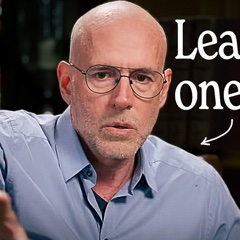
Scott Galloway
NYU marketing professor, author and host of the Prof G podcast
Where to hear and read about Scott Galloway1 episode or test

Scott Galloway is an NYU marketing professor, author of The Four and host of the Prof G podcast, known for fearless, funny, data-heavy storytelling. The thing most worth learning from him is his pipeline: pick a bold claim, test it in public, have a team gather the data and draft, then rewrite hard for voice, humor and emotion.
Our objective isn't to be right. We'd like to be right, but our objective is to catalyze a conversation.
NYU Professor: Writing Masterclass in 84 Minutes – Scott Galloway
Scott Galloway: the story and the lessons
1How Scott Galloway became an author at 52
Galloway wrote his first book at 52 and wishes he had started sooner. He thought about The Four for 10 years before writing it, and says he wishes he had started 20 years earlier. His NYU dean told him to do peer-reviewed research or write a book.
He judged 98 to 99% of that research irrelevant, so he wrote the book. Perell compares his voice to Howard Stern, Jim Cramer and Clayton Christensen combined.
Galloway tests a book idea in a newsletter and a talk first. Newsletter posts act as a petri dish, then a talk tests the idea. His DLD talk on The Four was filmed without his knowing and drew 300,000 to 400,000 views.
Bob Lefsetz endorsed the talk, and agent Jim Levine then turned up at his office and urged him to write the book. He calls a YouTube talk 'the minor league for his books'.
Galloway uses deadlines and a franchise to get books written. He is signing a three-book deal, one book every 18 months. The Algebra series covers happiness and wealth, with masculinity, work and mating to come.
He copies movie franchises because sequels make the most money, and says he needs deadline pressure. He can build a talk in a couple of days, but a book is the hardest thing he does. On the blank page: 'almost 90% of it is just starting'.
Galloway has been broke before and has now built wealth three times. He says this is the third time he has been wealthy, and that having been broke adds to his credibility. He sold his company L2 for $160 million after ten years of work.
2Why Galloway can write fearlessly
Galloway says fearless writing rests on money and unconditional love. He owns his businesses and has all the money he needs, so nobody can fire him. He says that gives him both the privilege and the obligation to speak his mind.
Perell's takeaway is that timid writing may come from lacking unconditional love, not from weak technique.
Galloway writes for an audience of his sons at 40. He wants them to think 'Dad was fearless' even if some of his takes aged badly.
Picturing that one reader removes the fear of strangers' approval. He says he writes 'as if the only audience is my boys when they're 40'.
Galloway models himself on Muhammad Ali. He says people who change the world are excellent at their craft, fearless and artistic. Ali was shunned, stripped of his gold medals, refused the draft and stayed impoverished.
Saying 'I am so pretty' in the most macho sport was the artistry Galloway tries to channel.
Galloway absorbs professional losses in about a day. MSNBC, Fox, a book deal and a Bloomberg TV show have all dropped him, and each bothered him for about a day. His code is to attack only people much more powerful than himself.
He says atheism helps: accepting that everyone will soon be dead removes the fear of what people think.
Galloway accepts that being himself costs him some clients. He is genuinely profane and vulgar, and says it is not an act. Walmart stopped inviting him because the talk of sex and erectile dysfunction didn't suit the Bible Belt.
His view is that a strong brand is defined by who it is not for. He still wants approval and gets bummed by online shaming, and says: don't try to offend, but don't fear it.
Galloway writes what other men feel but never say. A man in his 50s talking openly about emotion fills an empty space. He still grieves his mother, who died 20 years ago, and powerful men write to say they stare at their mother's photo too.
He says few safe places exist for men to be vulnerable.
3How Galloway's team drafts and he rewrites
Galloway has a team of 14 draft, and he rewrites in his voice. He gives talking points and gets back about 1,500 words. Drafts come back 'bloodied', and he adds metaphors, examples and anecdotes.
He puts 51% of his influence down to others, scale and platforms, and 49% to himself. He finds editing a bad draft easier than starting from nothing.
Galloway sharpens arguments with young staff in editorial meetings. Eight to ten people join, and a few young muses show him how out of date his view is. A shared Google Doc carries notes like 'Scott, personal anecdote needed here'.
Others add data and flag where a chart belongs.
Galloway gives staff a topic and angle, not a request for his voice. Asked for a post in his voice, AI inserted dick jokes and data and came out anodyne. He hands staff a topic and an angle, such as incentives, and adds the voice himself.
His example was the Brittney Griner trade, which he argues gave hostage-takers an incentive to seize someone else. 'It's just very difficult to tell someone to be like you.'
Galloway says his superpower is attracting and keeping talent. He can't draw, so two full-time people make charts and sketches. Katherine Dillon of Prophet Media proofs everything for consistent style and voice.
He earns well over a million dollars a book and spends about half before it is published. For the masculinity book he asked researchers to study rites of passage across cultures, then asked for charts.
Galloway edits by adding metaphor and emotion, then cutting filler. He regularly trims an 1,800-word post to 1,100 words. He borrows the rule Steve Jobs gave Nike's Phil Knight: cut two thirds of the SKUs.
Every edit he asks how to get rid of the filler.
Galloway holds writing to a tighter standard than speaking. Listeners forgive a tangent or a missed word, but the written word has to be close to perfect. Readers grant depth, while listeners demand entertainment.
He calls himself a good writer, not yet a great one, and a better presenter than writer. He plans to read more books, such as Dune and John Irving.
4How Galloway builds a talk that looks effortless
Galloway picks one central claim first and backfills with data. He asks what the core message is and which medium carries it. His claim: wealth and opportunity are being moved from young to old on purpose.
Chris Anderson heard his idea of a war on the young and said that was the talk. A Google Doc skeleton came first, then analysts returned weekly with 80 to 100 slides that were only titles.
Galloway's TED Talk took 8 to 12 weeks of mostly unseen labor. The split was about 2 weeks of creative work, 6 to 10 weeks of analyst work and 2 weeks of fact-checking. He clicks through the deck 15 to 20 times and rehearses little.
His slides are his outline and teleprompter. He has taught a 90-minute class twice a week for 22 years and gives about 50 talks a year.
Galloway spends extra weeks choreographing the order of the slides. After 150 slides were built, he spent 2 more weeks on chunking, pacing and sequence. A 39-second clip holds about a dozen chart moves yet does not feel rushed.
He asks what comes before what, where the dramatic pause goes and where the reveal lands.
Galloway swaps one word to change the frame. He changed 'old versus young' to 'incumbents versus entrants', which sounds less like class warfare. He also replaces words with images, since we read images 30 to 50 times faster.
Galloway breaks the rhythm with humor, then holds a pause. He shows an unrelated funny slide, pauses, and says 'I just like this slide.' He opened the TED Talk with a joke about TED as a Brazilian telenovela.
He describes humor as softening the beach so you can invade with ideas.
Galloway gives the audience a pause to feel something. Any real emotion works: nostalgia for his father, fear, anger, or the thrill of discovery. He shows a photo of his kids or a dad and son, and says people stop and feel.
He admits this is emotionally manipulative, but it works because he means it.
Galloway opens with a provocative question and returns to it at the end. His TED Talk asked 'Do we love our children?', which gets a quick yes. After the argument, the question becomes whether our actions show it.
He ties it to Reagan's rule: tell them what you will tell them, tell them, then tell them what you told them. A good frame has readers answer the same question differently at the end.
5Galloway's method for bold arguments backed by data
Galloway aims to start a conversation, not to be right. His Social Security talk led to an invitation to speak in Congress on means testing, raising the age and lifting the cap. One option he floats: cut the rate from 6% to 4% on all income, giving a $160,000 earner back $3,200.
He admits he may be wrong and asks only that the topic be discussed.
Galloway slays a sacred cow and calls himself a class traitor. He told wealthy executives he pays the same $9,000 in Social Security tax as someone earning $160,000, while making $16 million.
He turns the same candor on his own industry: tenure requires about $3 million in escrow, and he says two thirds of tenured colleagues add no value.
Galloway brings data as receipts for his opinions. He prepared 148 slides for one talk, which signals that the speaker did the work, even to people who disagree.
He admits data can be framed or spun, so it supports a narrative and does not replace one.
Galloway maps the blast radius of one surprising number. Nvidia added the market cap of the global auto industry plus Sweden's GDP in a year. He asks what second and third order effects follow, such as San Francisco housing and California's budget.
He lists effects on a walk, picks the best four of 28 ideas, then adds humor and narrative. He sees a 30 to 60 minute talk in it.
Galloway talks openly about money as part of the provocation. He calls the taboo on money talk a way to keep poor and middle-class people where they are. Bosses discourage sharing pay, so Lisa never learns that Bob makes 30% more.
He shares his own income partly as a flex, and to make the point that rich people talk about money all the time.
6What Galloway teaches about storytelling, brand and career
Galloway calls storytelling the one skill he would hand his sons. The best narrative wins attention and cheap capital. Jeff Bezos' 1997 investor letter made you want to buy the stock, and companies that say they are at the center of AI see their stock rise 10 to 12%.
When his boys were young, they could not return home until they had spoken to a stranger. He says the key skill is learning how to open.
Galloway says narrative sets apart companies that look alike. When competitors look and feel alike, a tight story earns cheap capital, which lets a firm invest faster and build monopoly power. He cites Loom.
A story can be one sentence, then straight back to the point.
Galloway defines brand as irrational margin. He describes 20 cents of peanut butter paste sold as $3 of maternal love. Brands target the young because older buyers get smart with money.
His father bought six pairs of $8 Costco shoes and fixed his shoe budget for life at $48. His summary: branding gets you to make a stupid decision that adds shareholder value.
Galloway tells people to follow talent and own a narrow niche. Mastery brings money, prestige and comradery, and those make you passionate. Authors should own something narrow first, such as run-down 18th century London hotels, then widen.
He says the specific crowds out the general, and credibility lets you expand.
Galloway signs off with 'life is so rich' to stay present. He struggles with anger and depression, which keep him dwelling on the past and planning the future.
His biggest fear is looking back on great prosperity and feeling he was never really there.

NYU Professor: Writing Masterclass in 84 Minutes – Scott Galloway
Scott Galloway explains how he writes and speaks with fearless, opinionated intimacy: pick a provocative argument, back it with data, and rewrite with a team until it is tight. The technique worth hearing is his pipeline of testing ideas in a newsletter and a talk, having analysts draft, then editing the draft hard for voice, humor and emotion.
Galloway wrote his first book at 52 and wishes he had started sooner. He thought about The Four for 10 years before writing it, and says he wishes he had started 20 years earlier. His NYU dean told him to do peer-reviewed research or write a book.
He judged 98 to 99% of that research irrelevant, so he wrote the book. Perell compares his voice to Howard Stern, Jim Cramer and Clayton Christensen combined.
Galloway tests a book idea in a newsletter and a talk first. Newsletter posts act as a petri dish, then a talk tests the idea. His DLD talk on The Four was filmed without his knowing and drew 300,000 to 400,000 views.
Bob Lefsetz endorsed the talk, and agent Jim Levine then turned up at his office and urged him to write the book. He calls a YouTube talk 'the minor league for his books'.
Galloway uses deadlines and a franchise to get books written. He is signing a three-book deal, one book every 18 months. The Algebra series covers happiness and wealth, with masculinity, work and mating to come.
He copies movie franchises because sequels make the most money, and says he needs deadline pressure. He can build a talk in a couple of days, but a book is the hardest thing he does. On the blank page: 'almost 90% of it is just starting'.
Galloway has been broke before and has now built wealth three times. He says this is the third time he has been wealthy, and that having been broke adds to his credibility. He sold his company L2 for $160 million after ten years of work.
Galloway says fearless writing rests on money and unconditional love. He owns his businesses and has all the money he needs, so nobody can fire him. He says that gives him both the privilege and the obligation to speak his mind.
Perell's takeaway is that timid writing may come from lacking unconditional love, not from weak technique.
Galloway writes for an audience of his sons at 40. He wants them to think 'Dad was fearless' even if some of his takes aged badly.
Picturing that one reader removes the fear of strangers' approval. He says he writes 'as if the only audience is my boys when they're 40'.
Galloway models himself on Muhammad Ali. He says people who change the world are excellent at their craft, fearless and artistic. Ali was shunned, stripped of his gold medals, refused the draft and stayed impoverished.
Saying 'I am so pretty' in the most macho sport was the artistry Galloway tries to channel.
Galloway absorbs professional losses in about a day. MSNBC, Fox, a book deal and a Bloomberg TV show have all dropped him, and each bothered him for about a day. His code is to attack only people much more powerful than himself.
He says atheism helps: accepting that everyone will soon be dead removes the fear of what people think.
Galloway accepts that being himself costs him some clients. He is genuinely profane and vulgar, and says it is not an act. Walmart stopped inviting him because the talk of sex and erectile dysfunction didn't suit the Bible Belt.
His view is that a strong brand is defined by who it is not for. He still wants approval and gets bummed by online shaming, and says: don't try to offend, but don't fear it.
Galloway writes what other men feel but never say. A man in his 50s talking openly about emotion fills an empty space. He still grieves his mother, who died 20 years ago, and powerful men write to say they stare at their mother's photo too.
He says few safe places exist for men to be vulnerable.
Galloway has a team of 14 draft, and he rewrites in his voice. He gives talking points and gets back about 1,500 words. Drafts come back 'bloodied', and he adds metaphors, examples and anecdotes.
He puts 51% of his influence down to others, scale and platforms, and 49% to himself. He finds editing a bad draft easier than starting from nothing.
Galloway sharpens arguments with young staff in editorial meetings. Eight to ten people join, and a few young muses show him how out of date his view is. A shared Google Doc carries notes like 'Scott, personal anecdote needed here'.
Others add data and flag where a chart belongs.
Galloway gives staff a topic and angle, not a request for his voice. Asked for a post in his voice, AI inserted dick jokes and data and came out anodyne. He hands staff a topic and an angle, such as incentives, and adds the voice himself.
His example was the Brittney Griner trade, which he argues gave hostage-takers an incentive to seize someone else. 'It's just very difficult to tell someone to be like you.'
Galloway says his superpower is attracting and keeping talent. He can't draw, so two full-time people make charts and sketches. Katherine Dillon of Prophet Media proofs everything for consistent style and voice.
He earns well over a million dollars a book and spends about half before it is published. For the masculinity book he asked researchers to study rites of passage across cultures, then asked for charts.
Galloway edits by adding metaphor and emotion, then cutting filler. He regularly trims an 1,800-word post to 1,100 words. He borrows the rule Steve Jobs gave Nike's Phil Knight: cut two thirds of the SKUs.
Every edit he asks how to get rid of the filler.
Galloway holds writing to a tighter standard than speaking. Listeners forgive a tangent or a missed word, but the written word has to be close to perfect. Readers grant depth, while listeners demand entertainment.
He calls himself a good writer, not yet a great one, and a better presenter than writer. He plans to read more books, such as Dune and John Irving.
Galloway picks one central claim first and backfills with data. He asks what the core message is and which medium carries it. His claim: wealth and opportunity are being moved from young to old on purpose.
Chris Anderson heard his idea of a war on the young and said that was the talk. A Google Doc skeleton came first, then analysts returned weekly with 80 to 100 slides that were only titles.
Galloway's TED Talk took 8 to 12 weeks of mostly unseen labor. The split was about 2 weeks of creative work, 6 to 10 weeks of analyst work and 2 weeks of fact-checking. He clicks through the deck 15 to 20 times and rehearses little.
His slides are his outline and teleprompter. He has taught a 90-minute class twice a week for 22 years and gives about 50 talks a year.
Galloway spends extra weeks choreographing the order of the slides. After 150 slides were built, he spent 2 more weeks on chunking, pacing and sequence. A 39-second clip holds about a dozen chart moves yet does not feel rushed.
He asks what comes before what, where the dramatic pause goes and where the reveal lands.
Galloway swaps one word to change the frame. He changed 'old versus young' to 'incumbents versus entrants', which sounds less like class warfare. He also replaces words with images, since we read images 30 to 50 times faster.
Galloway breaks the rhythm with humor, then holds a pause. He shows an unrelated funny slide, pauses, and says 'I just like this slide.' He opened the TED Talk with a joke about TED as a Brazilian telenovela.
He describes humor as softening the beach so you can invade with ideas.
Galloway gives the audience a pause to feel something. Any real emotion works: nostalgia for his father, fear, anger, or the thrill of discovery. He shows a photo of his kids or a dad and son, and says people stop and feel.
He admits this is emotionally manipulative, but it works because he means it.
Galloway opens with a provocative question and returns to it at the end. His TED Talk asked 'Do we love our children?', which gets a quick yes. After the argument, the question becomes whether our actions show it.
He ties it to Reagan's rule: tell them what you will tell them, tell them, then tell them what you told them. A good frame has readers answer the same question differently at the end.
Galloway aims to start a conversation, not to be right. His Social Security talk led to an invitation to speak in Congress on means testing, raising the age and lifting the cap. One option he floats: cut the rate from 6% to 4% on all income, giving a $160,000 earner back $3,200.
He admits he may be wrong and asks only that the topic be discussed.
Galloway slays a sacred cow and calls himself a class traitor. He told wealthy executives he pays the same $9,000 in Social Security tax as someone earning $160,000, while making $16 million.
He turns the same candor on his own industry: tenure requires about $3 million in escrow, and he says two thirds of tenured colleagues add no value.
Galloway brings data as receipts for his opinions. He prepared 148 slides for one talk, which signals that the speaker did the work, even to people who disagree.
He admits data can be framed or spun, so it supports a narrative and does not replace one.
Galloway maps the blast radius of one surprising number. Nvidia added the market cap of the global auto industry plus Sweden's GDP in a year. He asks what second and third order effects follow, such as San Francisco housing and California's budget.
He lists effects on a walk, picks the best four of 28 ideas, then adds humor and narrative. He sees a 30 to 60 minute talk in it.
Galloway talks openly about money as part of the provocation. He calls the taboo on money talk a way to keep poor and middle-class people where they are. Bosses discourage sharing pay, so Lisa never learns that Bob makes 30% more.
He shares his own income partly as a flex, and to make the point that rich people talk about money all the time.
Galloway calls storytelling the one skill he would hand his sons. The best narrative wins attention and cheap capital. Jeff Bezos' 1997 investor letter made you want to buy the stock, and companies that say they are at the center of AI see their stock rise 10 to 12%.
When his boys were young, they could not return home until they had spoken to a stranger. He says the key skill is learning how to open.
Galloway says narrative sets apart companies that look alike. When competitors look and feel alike, a tight story earns cheap capital, which lets a firm invest faster and build monopoly power. He cites Loom.
A story can be one sentence, then straight back to the point.
Galloway defines brand as irrational margin. He describes 20 cents of peanut butter paste sold as $3 of maternal love. Brands target the young because older buyers get smart with money.
His father bought six pairs of $8 Costco shoes and fixed his shoe budget for life at $48. His summary: branding gets you to make a stupid decision that adds shareholder value.
Galloway tells people to follow talent and own a narrow niche. Mastery brings money, prestige and comradery, and those make you passionate. Authors should own something narrow first, such as run-down 18th century London hotels, then widen.
He says the specific crowds out the general, and credibility lets you expand.
Galloway signs off with 'life is so rich' to stay present. He struggles with anger and depression, which keep him dwelling on the past and planning the future.
His biggest fear is looking back on great prosperity and feeling he was never really there.