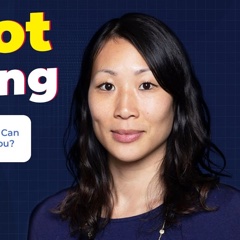
Samantha Pang
VP of Customer Success and Growth at Helpshift
Where to hear and read about Samantha Pang1 episode or test

Samantha Pang is VP of Customer Success and Growth at Helpshift, which sells in-app support automation to mobile app and game makers. The thing most worth learning from her is to layer support from FAQs to bots to agents, because users only care that the problem gets solved.
As long as they're able to get their problem resolved they don't really care whether they're talking to a bot or an agent.
Chatbot Marketing to Decrease Complaints & Improve Product
Samantha Pang: the story and the lessons
1Why Samantha Pang says users accept support bots
Pang holds that users want a fix, not a human. Over two years of COVID, response time and CSAT improved while agent numbers fell as automation grew. CSAT keeps rising each year as the automated share goes up.
Lockdowns brought more players to mobile games, including people who had never played, and customers deployed bots because agents could not get into physical offices. Remote agent teams handled the growing volume faster than agents in offices.
Pang has bots collect user details so agents start on the problem. The bot gathers name, email and last level played through taps or typed entries. An agent doing this by chat would need three to five messages.
Complex problems still go to a human, but the agent arrives with the full context already collected.
2Samantha Pang's layered in-app support journey
Pang says build the FAQ help center before any bot. A branded in-app help center lets users solve common questions with no bot or agent. Customers with a strong knowledge base reach up to 90 percent self-service, and some reach 99 percent.
Teams track which FAQs are read and marked helpful, including across languages, and publish new articles fast when top issues change.
Intents built from ticket history point users to the right FAQs. AI reads past tickets to find top problem types and shows them as intents when a user wants more help. A quick search bot then shows the top three matching FAQs, deflecting about 9 percent of tickets on average and up to 30 percent for some customers.
A new customer can import ticket history from another tool. Each FAQ a user picks makes the AI more accurate.
Custom bots act on the authenticated user's account. In a fintech trading app demo, the bot knew the user, let him pick which bank card was lost, blocked it and arranged a replacement for the next day. The flow took about two minutes, against a five-hour phone call during COVID.
This works because support runs inside the app and the bot connects to backend systems.
Pang routes premium users and complex cases to humans after the bot. Rules based on intent category, user type and other traits decide whether the bot finishes or hands off. Legal and policy questions, or VIP users, can go to an agent.
The agent sees what the bot collected and tried, so the user does not repeat themselves. Pang notes a premium user may still prefer a human once the custom bot is done.
A feedback bot sorts happy users from unhappy ones. When a user says the problem is solved, a five-star prompt appears. Four or five stars can ask for an app store rating, and one or two stars ask why the score was low.
The user then returns to the app where they left off, in the customer's own branding. Complaints are captured privately before they reach a store review.
3What Helpshift customers report and how fast they launch
Automation takes repetitive tickets so agents do meaningful work. One case study showed a 17 hour drop in average customer wait time and a 20 percent improvement in resolution.
Agents report more meaningful work and higher CSAT, and prioritized queues help teams tune their routine. Brands also see users return to the app because the experience feels personalized.
Pang's team aims to get customers live within 30 days. Known common problem types for each vertical give new customers a head start. The case study customer deployed and integrated in three weeks.
The SDK supports iOS, Android, Unreal, Unity, Xamarin and React Native, and runs on over three billion mobile devices.

Chatbot Marketing to Decrease Complaints & Improve Product
In-app support can be automated end to end with a help center, intent-based quick search, custom bots, human handoff and a feedback bot, so users self-serve and agents handle only the hard cases. Helpshift customers report up to 90 to 99 percent self-service, a 17 hour cut in average wait time and a 20 percent resolution improvement.
Pang holds that users want a fix, not a human. Over two years of COVID, response time and CSAT improved while agent numbers fell as automation grew. CSAT keeps rising each year as the automated share goes up.
Lockdowns brought more players to mobile games, including people who had never played, and customers deployed bots because agents could not get into physical offices. Remote agent teams handled the growing volume faster than agents in offices.
Pang has bots collect user details so agents start on the problem. The bot gathers name, email and last level played through taps or typed entries. An agent doing this by chat would need three to five messages.
Complex problems still go to a human, but the agent arrives with the full context already collected.
Pang says build the FAQ help center before any bot. A branded in-app help center lets users solve common questions with no bot or agent. Customers with a strong knowledge base reach up to 90 percent self-service, and some reach 99 percent.
Teams track which FAQs are read and marked helpful, including across languages, and publish new articles fast when top issues change.
Intents built from ticket history point users to the right FAQs. AI reads past tickets to find top problem types and shows them as intents when a user wants more help. A quick search bot then shows the top three matching FAQs, deflecting about 9 percent of tickets on average and up to 30 percent for some customers.
A new customer can import ticket history from another tool. Each FAQ a user picks makes the AI more accurate.
Custom bots act on the authenticated user's account. In a fintech trading app demo, the bot knew the user, let him pick which bank card was lost, blocked it and arranged a replacement for the next day. The flow took about two minutes, against a five-hour phone call during COVID.
This works because support runs inside the app and the bot connects to backend systems.
Pang routes premium users and complex cases to humans after the bot. Rules based on intent category, user type and other traits decide whether the bot finishes or hands off. Legal and policy questions, or VIP users, can go to an agent.
The agent sees what the bot collected and tried, so the user does not repeat themselves. Pang notes a premium user may still prefer a human once the custom bot is done.
A feedback bot sorts happy users from unhappy ones. When a user says the problem is solved, a five-star prompt appears. Four or five stars can ask for an app store rating, and one or two stars ask why the score was low.
The user then returns to the app where they left off, in the customer's own branding. Complaints are captured privately before they reach a store review.
Automation takes repetitive tickets so agents do meaningful work. One case study showed a 17 hour drop in average customer wait time and a 20 percent improvement in resolution.
Agents report more meaningful work and higher CSAT, and prioritized queues help teams tune their routine. Brands also see users return to the app because the experience feels personalized.
Pang's team aims to get customers live within 30 days. Known common problem types for each vertical give new customers a head start. The case study customer deployed and integrated in three weeks.
The SDK supports iOS, Android, Unreal, Unity, Xamarin and React Native, and runs on over three billion mobile devices.
 Helpshift