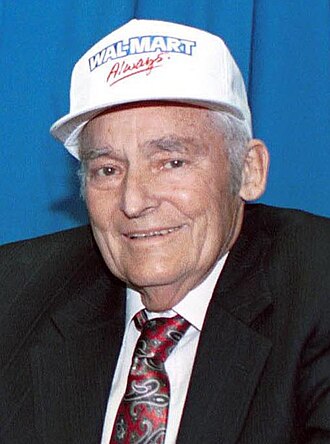
Sam Walton
Founder of Walmart
Where to hear and read about Sam Walton1 book · 2 episodes and tests
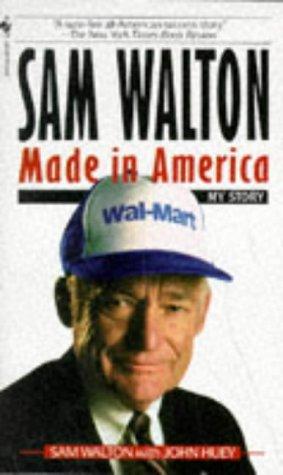

Sam Walton founded Walmart, growing a single lost Ben Franklin variety store into the largest retailer in America by 1990 and the largest company in the world by revenue. The most useful thing to learn from him is how one simple idea, buy cheap and sell low every day, pursued with relentless cost control, open copying of rivals and a fast willingness to change course, can beat far better funded competitors.
Control your expenses better than your competition. This is where you can always find your competitive advantage.
How Sam Walton Worked
Sam Walton: the story and the lessons
1Sam Walton's early life and accidental start in retail
The Depression taught Walton thrift and a habit of hard work. Born in 1918 in Kingfisher, Oklahoma, Walton grew up in Missouri while his father, who financed farms, foreclosed on farmers in person and brought the boys along.
Walton said his parents' approach to money was simple: "they just didn't spend it." His father would not tolerate sons who were not industrious, ambitious and decent, and said "The secret is work, work, work."
He was a hustler and a winner long before business. He sold magazines, rabbits and pigeons, became Missouri's youngest Eagle Scout at 13, and quarterbacked an unbeaten high school team to the 1935 state title.
At the University of Missouri he hired helpers for his paper routes and earned $4,000 to $5,000 a year. He later wrote that Kmart and other rivals just became "Jeff City High School," the team he beat for that title.
Walton drifted into retail for a paycheck, not a plan. Unable to afford Wharton, he took a J.C. Penney job at $85 a month in Des Moines over a Sears offer.
Founder James Cash Penney taught him to wrap a box with the least twine and paper, a lesson that profit hides in saved paper and string. A heart irregularity kept him out of combat in World War II.
Penney gave him the small-town and incentive lessons he used for 50 years. Penney's strength was small towns, it put customer satisfaction ahead of profit, and a manager on a 25% bonus waved a $65,000 check in 1940.
Watching that check made the trainees run faster, and Walton later copied all three ideas into Walmart.
2How Sam Walton built and lost his first store in Newport
Walton bought a weak franchise sight unseen with borrowed money. At 27, in 1945, he bought a Ben Franklin store in Newport, Arkansas for $25,000 from his father-in-law, a store doing about $72,000 with rent of 5% of sales.
A rival across the street sold over $150,000 a year. Walton set a goal of the most profitable variety store in Arkansas within five years, and later said "I was the sucker Butler Brothers sent to save him."
He cut out the franchisor by buying straight from manufacturers. Butler Brothers took about a 25% markup, so Walton knocked on manufacturers' doors and hauled goods home in a trailer behind his pickup.
He was small enough that Butler Brothers did not notice. He priced those goods as loss leaders to pull families in, and added a sidewalk ice cream machine and popcorn machine.
Walton found lower prices earned more total profit. An item bought at 80 cents sold three times the volume at $1.00 as at $1.20, so profit rose even at a thinner margin per item.
Most stores then marked goods up about 45%, a gross margin near 33%. He applied the discount across the whole store, not just promoted items: "By cutting your price you can boost your sales to a point where you can earn far more at the cheaper retail price."
The store became the best Ben Franklin in the region, then the landlord took it. By year five it did about $250,000 in sales and $30,000 to $40,000 in profit, but the lease had no renewal clause and the landlord wanted the store for himself.
The landlord paid $50,000 for the franchise and assets. At 32, after five and a half years, Walton was back to zero and called it the low point of his business life.
Walton refused to be beaten and started again at once. When his lawyer said he was finished, he clenched and unclenched his fists, then planned a new store.
"No, I'm not whipped. I found Newport, and I found the store. I can find another good town and another Ben Franklin."
3From Bentonville to the first Walmart
After the lost lease, Walton insisted on owning his buildings. In Bentonville he bought the building rather than rent it.
"I insist on buying the building that the store is in. I need control over my own destiny."
He picked Bentonville for family and quail, not the market. The town had 3,000 people and three variety stores, and the store he bought had done only $32,000 the year before.
He wanted to be the best, not one of the best, yet could not afford a desk and used plywood on two sawhorses for five or six years.
Copying self-service made his store a regional destination. After riding an overnight bus to Minnesota to see self-service stores, he reopened on July 29, 1950 as Walton's Five and Dime, the third self-service variety store in the country.
It did $90,000 in its first year, roughly the whole town's variety market, likely because shoppers drove in from other towns.
Long drives between stores gave him the idea of a chain and a plane. Commutes of 8 to 10 hours each way convinced him that running two stores well meant he could run a dozen, and he learned to fly.
A chartered pilot made the trip in 90 minutes. He later scouted sites with his brother Bud from cheap prop planes, flying sideways over towns and then negotiating directly with landowners.
Bigger stores in small towns showed him the power of volume. A 13,000 square foot store in a town of 2,000 could do a million dollars, and his larger family centers did $1 to $2 million each.
When he could not stock hula hoops, he and his crew made several thousand a night from plastic pipe.
His franchisor rejected discounting, so he built it alone. Walton asked Butler Brothers to back a discount format at about 12.5% profit instead of 20 to 25%, and they refused because it would anger their other franchisees.
A day later an executive found him on his hands and knees in a Kmart with a spiral notebook: "This is just part of the education process. I'm still learning."
The first Walmart opened in 1962 with one promise: lowest price on everything. It opened July 2, 1962 in Rogers, Arkansas, when Walton was 44, was profitable from day one and did about $1 million in year one.
The short name, suggested by manager Bob Bogle, meant cheaper signs. If everyone else sold an item at 25 cents, Walmart sold it at 21. Even at 48, Walton had only four Walmarts alongside 18 Ben Franklin stores.
4How Walmart outgrew Kmart
Small towns let Walmart grow unnoticed for about ten years. Kmart chased big cities and ignored towns it thought unworthy of a store.
Walton said that if Kmart had jumped on them early, "I hate to think of that." He also found small towns held "much much much more business" than he had dreamed.
Being cash-starved forced Walmart to build a leaner back end. Kmart had 250 stores and $800 million in sales by about 1967 on its parent's warehouses, while Walmart, near $10 million, built its own distribution centers and trucks.
Distribution centers broke bulk goods into each store's daily order, and new markets began at the edge of a truck's one-day range. Walton said, "The things that we were forced to learn to do because we started out under financed and under capitalized... contributed mightily to the way we've grown."
He built core infrastructure in house when none existed. Logistics became the product that let Walmart price below Kmart and still profit.
Kmart's borrowed network worked for a decade or two but was never built for lowest cost.
Walton embraced computers without understanding them. In 1966 he enrolled in an IBM seminar, and in 1979 Walmart spent $500 million on a system linking stores and warehouses, reaching a $24 million private satellite network by 1987.
Stores reported daily sales from 36 departments. He hired tech-savvy younger people and pushed back hard on their spending.
He forecast his own growth almost exactly. With $21 million in 1969 sales, he told skeptical insurers 1975 would reach $230 million, and it came in at $236 million.
Walmart went public on October 1, 1970, raising about $4.5 million, and revenue grew 77% in 1971.
Once a format worked, he scaled it fast through acquisitions. From 1974 to 1977 stores went from 78 to 153 and sales from $167 million to $478 million.
He could build two or three stores a year himself but buy 16 at once, and once converted a 104-store chain to Walmarts.
Sam's Club came straight from studying Sol Price. In January 1983 he flew to San Diego to study Price's club, and Sam's went from 3 clubs in 1983 to 105 with over $5 billion in sales by 1990.
Walton said he stole more ideas from Price than from anyone. Walmart became America's largest retailer in 1990.
5Sam Walton's rules for running a store
Walton took one simple idea extremely seriously. Buy cheap, sell low every day, with a smile, and push it as far as it goes, with no 5, 10 or 15 year plan.
Money was a game to him that tested how far one concept could go.
He copied whatever rivals did well. He took bonuses from Penney, discounting from Kmart and clubs from Price, and told managers to bring home one good idea from every competitor.
He dug in dumpsters for receipts and said, "We're really not concerned with what they're doing wrong. We're concerned with what they're doing right."
Walton treated low cost as his competitive advantage. Walmart's administrative costs were 2% of revenue, and it was 26 times Jamesway's size with margins three times as high and $210 sales per square foot.
His view: you can make many mistakes and recover with an efficient operation, but brilliance cannot save an inefficient one.
He refused to pay for a supplier's inefficiency. Buyers skipped vendor programs, picked up goods with Walmart trucks, and gave the business to whoever offered 90 cents against a dollar.
"If you buy the thing for a buck 25 you've just bought someone else's inefficiency." This made relations tense, and P&G and Walmart were enemies for years.
The customer was always right, and rule two pointed back to rule one. Stores replaced defective shoes cheerfully and threw in socks for the hassle.
When a friend's daughter was refused a refund on shorts, Walton had the manager hold them up at the Saturday meeting: "Every once in a while, you have to refresh their memory."
Walton held firm principles but changed plans fast. He called it a low RC factor, resistance to change, and reversed his view of computers as overhead after his lieutenants convinced him.
"We have a low resistance to change. We call it our RC factor."
6How Walton led, paid and pushed his people
Managers owned a stake in their own store and others. Starting in 1952 with Willard Walker in Fayetteville, each store was a partnership with the manager invested, and managers could invest in new stores.
After the IPO, profit sharing and a stock purchase plan with a 15% discount reached hourly associates, some of whom made millions. Home Depot modeled its plan on it.
He managed by walking around stores and docks. He rode 100 miles in a semi-truck and showed up at 2:30 a.m. with donuts to ask dock workers for ideas.
When they asked for an extra shower, they got it. He despised comfortable offices.
Saturday meetings spread winning ideas across stores weekly. Store managers met every Saturday morning to share P&L numbers and what worked.
By 1987 he broadcast himself to stores over the satellite network, including the Saturday meeting.
Walton recruited patiently and drove people hard. He chased David Glass for years after Glass wrote him off at a chaotic second Walmart, and Glass later became CEO.
Staffers called him "that old slave driver" and executives burned out or were fired. Glass said "Sam has never gotten to the point where he is comfortable."
7Sam Walton's mistakes and what he changed
Skipping the lease fine print cost him his first store. He never checked for a renewal clause in Newport, and afterward always bought his buildings.
A shopping center venture taught him to stay a merchant. He thought developing shopping centers with no money was "a pure cinch," but his first one failed and he ran out of money.
He went back to building stores and never lost that focus again.
Hypermart USA came too early. After seeing Carrefour in Brazil, he launched Hypermart USA in the late 80s, but only about three oversized stores were built.
After his death in 1992, smaller Supercenters made Walmart the largest US grocer, with grocery now 55% of revenue.
8Family, control and Walton's indifference to wealth
Helen Walton set the small-town, family-only strategy. She vetoed a St. Louis department store, refusing outside partners and any town over 10,000.
She held a finance degree, rare for a woman then.
A family partnership kept Walmart safe from raiders. In 1953, on L.S. Robson's advice, the Waltons formed what became Walton Enterprises, which owns about 36% of Walmart.
Each of four children owned a fifth from 1954, shares worth about $5,000 then and almost $2 billion each by the late 1980s. He warned heirs that changing it would make him "come back and haunt you."
He kept headquarters in Bentonville on purpose. Moving would be "the last thing we do unless they run us out of here."
"The best thing we ever did was to hide back there in the hills and eventually build a company that makes folks want to find us."
Walton cared little for attention or paper wealth. A 500-point market drop knocked a billion dollars off his stock, and he had not heard of it.
Named richest in America by Forbes in 1985, he still drove an old pickup with dog cages. He wrote Made in America while dying of cancer.

How Sam Walton Worked
Sam Walton built the largest retail empire of his era from a handful of simple ideas applied for decades: sell cheap every day, keep costs lowest, copy what works and change course fast. The story is worth hearing for how he turned a lost lease, tiny towns and thin capital into a chain that went from 4 discount stores at age 48 to 105 Sam's Clubs in seven years.
The Depression taught Walton thrift and a habit of hard work. Born in 1918 in Kingfisher, Oklahoma, Walton grew up in Missouri while his father, who financed farms, foreclosed on farmers in person and brought the boys along.
Walton said his parents' approach to money was simple: "they just didn't spend it." His father would not tolerate sons who were not industrious, ambitious and decent, and said "The secret is work, work, work."
He was a hustler and a winner long before business. He sold magazines, rabbits and pigeons, became Missouri's youngest Eagle Scout at 13, and quarterbacked an unbeaten high school team to the 1935 state title.
At the University of Missouri he hired helpers for his paper routes and earned $4,000 to $5,000 a year. He later wrote that Kmart and other rivals just became "Jeff City High School," the team he beat for that title.
Walton drifted into retail for a paycheck, not a plan. Unable to afford Wharton, he took a J.C. Penney job at $85 a month in Des Moines over a Sears offer.
Founder James Cash Penney taught him to wrap a box with the least twine and paper, a lesson that profit hides in saved paper and string. A heart irregularity kept him out of combat in World War II.
Penney gave him the small-town and incentive lessons he used for 50 years. Penney's strength was small towns, it put customer satisfaction ahead of profit, and a manager on a 25% bonus waved a $65,000 check in 1940.
Watching that check made the trainees run faster, and Walton later copied all three ideas into Walmart.
Walton bought a weak franchise sight unseen with borrowed money. At 27, in 1945, he bought a Ben Franklin store in Newport, Arkansas for $25,000 from his father-in-law, a store doing about $72,000 with rent of 5% of sales.
A rival across the street sold over $150,000 a year. Walton set a goal of the most profitable variety store in Arkansas within five years, and later said "I was the sucker Butler Brothers sent to save him."
He cut out the franchisor by buying straight from manufacturers. Butler Brothers took about a 25% markup, so Walton knocked on manufacturers' doors and hauled goods home in a trailer behind his pickup.
He was small enough that Butler Brothers did not notice. He priced those goods as loss leaders to pull families in, and added a sidewalk ice cream machine and popcorn machine.
The store became the best Ben Franklin in the region, then the landlord took it. By year five it did about $250,000 in sales and $30,000 to $40,000 in profit, but the lease had no renewal clause and the landlord wanted the store for himself.
The landlord paid $50,000 for the franchise and assets. At 32, after five and a half years, Walton was back to zero and called it the low point of his business life.
Walton refused to be beaten and started again at once. When his lawyer said he was finished, he clenched and unclenched his fists, then planned a new store.
"No, I'm not whipped. I found Newport, and I found the store. I can find another good town and another Ben Franklin."
After the lost lease, Walton insisted on owning his buildings. In Bentonville he bought the building rather than rent it.
"I insist on buying the building that the store is in. I need control over my own destiny."
He picked Bentonville for family and quail, not the market. The town had 3,000 people and three variety stores, and the store he bought had done only $32,000 the year before.
He wanted to be the best, not one of the best, yet could not afford a desk and used plywood on two sawhorses for five or six years.
Long drives between stores gave him the idea of a chain and a plane. Commutes of 8 to 10 hours each way convinced him that running two stores well meant he could run a dozen, and he learned to fly.
A chartered pilot made the trip in 90 minutes. He later scouted sites with his brother Bud from cheap prop planes, flying sideways over towns and then negotiating directly with landowners.
Bigger stores in small towns showed him the power of volume. A 13,000 square foot store in a town of 2,000 could do a million dollars, and his larger family centers did $1 to $2 million each.
When he could not stock hula hoops, he and his crew made several thousand a night from plastic pipe.
His franchisor rejected discounting, so he built it alone. Walton asked Butler Brothers to back a discount format at about 12.5% profit instead of 20 to 25%, and they refused because it would anger their other franchisees.
A day later an executive found him on his hands and knees in a Kmart with a spiral notebook: "This is just part of the education process. I'm still learning."
The first Walmart opened in 1962 with one promise: lowest price on everything. It opened July 2, 1962 in Rogers, Arkansas, when Walton was 44, was profitable from day one and did about $1 million in year one.
The short name, suggested by manager Bob Bogle, meant cheaper signs. If everyone else sold an item at 25 cents, Walmart sold it at 21. Even at 48, Walton had only four Walmarts alongside 18 Ben Franklin stores.
Small towns let Walmart grow unnoticed for about ten years. Kmart chased big cities and ignored towns it thought unworthy of a store.
Walton said that if Kmart had jumped on them early, "I hate to think of that." He also found small towns held "much much much more business" than he had dreamed.
Walton embraced computers without understanding them. In 1966 he enrolled in an IBM seminar, and in 1979 Walmart spent $500 million on a system linking stores and warehouses, reaching a $24 million private satellite network by 1987.
Stores reported daily sales from 36 departments. He hired tech-savvy younger people and pushed back hard on their spending.
He forecast his own growth almost exactly. With $21 million in 1969 sales, he told skeptical insurers 1975 would reach $230 million, and it came in at $236 million.
Walmart went public on October 1, 1970, raising about $4.5 million, and revenue grew 77% in 1971.
Once a format worked, he scaled it fast through acquisitions. From 1974 to 1977 stores went from 78 to 153 and sales from $167 million to $478 million.
He could build two or three stores a year himself but buy 16 at once, and once converted a 104-store chain to Walmarts.
Sam's Club came straight from studying Sol Price. In January 1983 he flew to San Diego to study Price's club, and Sam's went from 3 clubs in 1983 to 105 with over $5 billion in sales by 1990.
Walton said he stole more ideas from Price than from anyone. Walmart became America's largest retailer in 1990.
Walton took one simple idea extremely seriously. Buy cheap, sell low every day, with a smile, and push it as far as it goes, with no 5, 10 or 15 year plan.
Money was a game to him that tested how far one concept could go.
He copied whatever rivals did well. He took bonuses from Penney, discounting from Kmart and clubs from Price, and told managers to bring home one good idea from every competitor.
He dug in dumpsters for receipts and said, "We're really not concerned with what they're doing wrong. We're concerned with what they're doing right."
Walton treated low cost as his competitive advantage. Walmart's administrative costs were 2% of revenue, and it was 26 times Jamesway's size with margins three times as high and $210 sales per square foot.
His view: you can make many mistakes and recover with an efficient operation, but brilliance cannot save an inefficient one.
The customer was always right, and rule two pointed back to rule one. Stores replaced defective shoes cheerfully and threw in socks for the hassle.
When a friend's daughter was refused a refund on shorts, Walton had the manager hold them up at the Saturday meeting: "Every once in a while, you have to refresh their memory."
Walton held firm principles but changed plans fast. He called it a low RC factor, resistance to change, and reversed his view of computers as overhead after his lieutenants convinced him.
"We have a low resistance to change. We call it our RC factor."
Managers owned a stake in their own store and others. Starting in 1952 with Willard Walker in Fayetteville, each store was a partnership with the manager invested, and managers could invest in new stores.
After the IPO, profit sharing and a stock purchase plan with a 15% discount reached hourly associates, some of whom made millions. Home Depot modeled its plan on it.
He managed by walking around stores and docks. He rode 100 miles in a semi-truck and showed up at 2:30 a.m. with donuts to ask dock workers for ideas.
When they asked for an extra shower, they got it. He despised comfortable offices.
Walton recruited patiently and drove people hard. He chased David Glass for years after Glass wrote him off at a chaotic second Walmart, and Glass later became CEO.
Staffers called him "that old slave driver" and executives burned out or were fired. Glass said "Sam has never gotten to the point where he is comfortable."
Skipping the lease fine print cost him his first store. He never checked for a renewal clause in Newport, and afterward always bought his buildings.
A shopping center venture taught him to stay a merchant. He thought developing shopping centers with no money was "a pure cinch," but his first one failed and he ran out of money.
He went back to building stores and never lost that focus again.
A family partnership kept Walmart safe from raiders. In 1953, on L.S. Robson's advice, the Waltons formed what became Walton Enterprises, which owns about 36% of Walmart.
Each of four children owned a fifth from 1954, shares worth about $5,000 then and almost $2 billion each by the late 1980s. He warned heirs that changing it would make him "come back and haunt you."
He kept headquarters in Bentonville on purpose. Moving would be "the last thing we do unless they run us out of here."
"The best thing we ever did was to hide back there in the hills and eventually build a company that makes folks want to find us."
Walton cared little for attention or paper wealth. A 500-point market drop knocked a billion dollars off his stock, and he had not heard of it.
Named richest in America by Forbes in 1985, he still drove an old pickup with dog cages. He wrote Made in America while dying of cancer.

Walmart
Sam Walton built the world's largest retailer by copying the best ideas from rivals, cutting prices on everything, and building his own logistics when no one else would partner with him. The decision to go it alone after Butler Brothers refused to help, and to run lean on reinvested cash flow, let a small Arkansas chain beat Kmart, Woolco and Target.
The Depression taught Walton thrift and a habit of hard work. Born in 1918 in Kingfisher, Oklahoma, Walton grew up in Missouri while his father, who financed farms, foreclosed on farmers in person and brought the boys along.
Walton said his parents' approach to money was simple: "they just didn't spend it." His father would not tolerate sons who were not industrious, ambitious and decent, and said "The secret is work, work, work."
He was a hustler and a winner long before business. He sold magazines, rabbits and pigeons, became Missouri's youngest Eagle Scout at 13, and quarterbacked an unbeaten high school team to the 1935 state title.
At the University of Missouri he hired helpers for his paper routes and earned $4,000 to $5,000 a year. He later wrote that Kmart and other rivals just became "Jeff City High School," the team he beat for that title.
Walton drifted into retail for a paycheck, not a plan. Unable to afford Wharton, he took a J.C. Penney job at $85 a month in Des Moines over a Sears offer.
Founder James Cash Penney taught him to wrap a box with the least twine and paper, a lesson that profit hides in saved paper and string. A heart irregularity kept him out of combat in World War II.
Walton bought a weak franchise sight unseen with borrowed money. At 27, in 1945, he bought a Ben Franklin store in Newport, Arkansas for $25,000 from his father-in-law, a store doing about $72,000 with rent of 5% of sales.
A rival across the street sold over $150,000 a year. Walton set a goal of the most profitable variety store in Arkansas within five years, and later said "I was the sucker Butler Brothers sent to save him."
He cut out the franchisor by buying straight from manufacturers. Butler Brothers took about a 25% markup, so Walton knocked on manufacturers' doors and hauled goods home in a trailer behind his pickup.
He was small enough that Butler Brothers did not notice. He priced those goods as loss leaders to pull families in, and added a sidewalk ice cream machine and popcorn machine.
Walton found lower prices earned more total profit. An item bought at 80 cents sold three times the volume at $1.00 as at $1.20, so profit rose even at a thinner margin per item.
Most stores then marked goods up about 45%, a gross margin near 33%. He applied the discount across the whole store, not just promoted items: "By cutting your price you can boost your sales to a point where you can earn far more at the cheaper retail price."
The store became the best Ben Franklin in the region, then the landlord took it. By year five it did about $250,000 in sales and $30,000 to $40,000 in profit, but the lease had no renewal clause and the landlord wanted the store for himself.
The landlord paid $50,000 for the franchise and assets. At 32, after five and a half years, Walton was back to zero and called it the low point of his business life.
He picked Bentonville for family and quail, not the market. The town had 3,000 people and three variety stores, and the store he bought had done only $32,000 the year before.
He wanted to be the best, not one of the best, yet could not afford a desk and used plywood on two sawhorses for five or six years.
Copying self-service made his store a regional destination. After riding an overnight bus to Minnesota to see self-service stores, he reopened on July 29, 1950 as Walton's Five and Dime, the third self-service variety store in the country.
It did $90,000 in its first year, roughly the whole town's variety market, likely because shoppers drove in from other towns.
Long drives between stores gave him the idea of a chain and a plane. Commutes of 8 to 10 hours each way convinced him that running two stores well meant he could run a dozen, and he learned to fly.
A chartered pilot made the trip in 90 minutes. He later scouted sites with his brother Bud from cheap prop planes, flying sideways over towns and then negotiating directly with landowners.
Bigger stores in small towns showed him the power of volume. A 13,000 square foot store in a town of 2,000 could do a million dollars, and his larger family centers did $1 to $2 million each.
When he could not stock hula hoops, he and his crew made several thousand a night from plastic pipe.
His franchisor rejected discounting, so he built it alone. Walton asked Butler Brothers to back a discount format at about 12.5% profit instead of 20 to 25%, and they refused because it would anger their other franchisees.
A day later an executive found him on his hands and knees in a Kmart with a spiral notebook: "This is just part of the education process. I'm still learning."
The first Walmart opened in 1962 with one promise: lowest price on everything. It opened July 2, 1962 in Rogers, Arkansas, when Walton was 44, was profitable from day one and did about $1 million in year one.
The short name, suggested by manager Bob Bogle, meant cheaper signs. If everyone else sold an item at 25 cents, Walmart sold it at 21. Even at 48, Walton had only four Walmarts alongside 18 Ben Franklin stores.
Small towns let Walmart grow unnoticed for about ten years. Kmart chased big cities and ignored towns it thought unworthy of a store.
Walton said that if Kmart had jumped on them early, "I hate to think of that." He also found small towns held "much much much more business" than he had dreamed.
Being cash-starved forced Walmart to build a leaner back end. Kmart had 250 stores and $800 million in sales by about 1967 on its parent's warehouses, while Walmart, near $10 million, built its own distribution centers and trucks.
Distribution centers broke bulk goods into each store's daily order, and new markets began at the edge of a truck's one-day range. Walton said, "The things that we were forced to learn to do because we started out under financed and under capitalized... contributed mightily to the way we've grown."
He built core infrastructure in house when none existed. Logistics became the product that let Walmart price below Kmart and still profit.
Kmart's borrowed network worked for a decade or two but was never built for lowest cost.
Walton embraced computers without understanding them. In 1966 he enrolled in an IBM seminar, and in 1979 Walmart spent $500 million on a system linking stores and warehouses, reaching a $24 million private satellite network by 1987.
Stores reported daily sales from 36 departments. He hired tech-savvy younger people and pushed back hard on their spending.
He forecast his own growth almost exactly. With $21 million in 1969 sales, he told skeptical insurers 1975 would reach $230 million, and it came in at $236 million.
Walmart went public on October 1, 1970, raising about $4.5 million, and revenue grew 77% in 1971.
Sam's Club came straight from studying Sol Price. In January 1983 he flew to San Diego to study Price's club, and Sam's went from 3 clubs in 1983 to 105 with over $5 billion in sales by 1990.
Walton said he stole more ideas from Price than from anyone. Walmart became America's largest retailer in 1990.
He copied whatever rivals did well. He took bonuses from Penney, discounting from Kmart and clubs from Price, and told managers to bring home one good idea from every competitor.
He dug in dumpsters for receipts and said, "We're really not concerned with what they're doing wrong. We're concerned with what they're doing right."
He refused to pay for a supplier's inefficiency. Buyers skipped vendor programs, picked up goods with Walmart trucks, and gave the business to whoever offered 90 cents against a dollar.
"If you buy the thing for a buck 25 you've just bought someone else's inefficiency." This made relations tense, and P&G and Walmart were enemies for years.
Managers owned a stake in their own store and others. Starting in 1952 with Willard Walker in Fayetteville, each store was a partnership with the manager invested, and managers could invest in new stores.
After the IPO, profit sharing and a stock purchase plan with a 15% discount reached hourly associates, some of whom made millions. Home Depot modeled its plan on it.
Saturday meetings spread winning ideas across stores weekly. Store managers met every Saturday morning to share P&L numbers and what worked.
By 1987 he broadcast himself to stores over the satellite network, including the Saturday meeting.
Skipping the lease fine print cost him his first store. He never checked for a renewal clause in Newport, and afterward always bought his buildings.
Hypermart USA came too early. After seeing Carrefour in Brazil, he launched Hypermart USA in the late 80s, but only about three oversized stores were built.
After his death in 1992, smaller Supercenters made Walmart the largest US grocer, with grocery now 55% of revenue.
Helen Walton set the small-town, family-only strategy. She vetoed a St. Louis department store, refusing outside partners and any town over 10,000.
She held a finance degree, rare for a woman then.
A family partnership kept Walmart safe from raiders. In 1953, on L.S. Robson's advice, the Waltons formed what became Walton Enterprises, which owns about 36% of Walmart.
Each of four children owned a fifth from 1954, shares worth about $5,000 then and almost $2 billion each by the late 1980s. He warned heirs that changing it would make him "come back and haunt you."
Walton cared little for attention or paper wealth. A 500-point market drop knocked a billion dollars off his stock, and he had not heard of it.
Named richest in America by Forbes in 1985, he still drove an old pickup with dog cages. He wrote Made in America while dying of cancer.