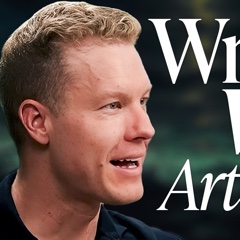
Sam Parr
Founder of The Hustle, co-host of My First Million and founder of Hampton
Where to hear and read about Sam Parr1 episode or test

Sam Parr is the founder of The Hustle, co-host of My First Million and founder of Hampton. The habit most worth copying is his: he copies great writing out by hand for ten minutes before he writes anything of his own.
it's that your slope wasn't slippery enough
Inside the Mind of a Newsletter Mogul (Sam Parr Interview)
Sam Parr: the story and the lessons
1How Sam Parr built The Hustle on email
Parr blended copywriting and journalism after a hot dog stand wore him out. He wanted to sell at scale without working constantly, so he learned copywriting. He took Neville Medhora's course, cold-emailed him and hosted an event for him in San Francisco.
About ten friends paid $10 each toward Medhora's $300 flight, and Medhora slept on Parr's couch and later was best man at his wedding. Ted Turner's biography inspired Parr, an outsider from Missouri, to mix the two crafts.
He chose email because a blog could not bring readers back. Even BuzzFeed's 100 million monthly uniques have to return every day. At the time newsletters were mostly Motley Fool and scammy affiliate sites, and no one took email seriously.
The blog existed only to feed email subscribers, and the core metric was opens each day.
Parr bet on email with arithmetic before building anything. He started testing email in 2014 and launched The Hustle in 2016. One million subscribers emailed daily at a 50% open rate is about 15 million reads a month, which he figured could earn around $2 million a month.
He calls it a rough bet, not a forecast. When the CEO of a large digital media company said it would never make money, his reply was that on a phone nobody cares whether they are in Chrome, Safari or an email app.
The list compounded every year until The Hustle was sold. It grew from 150,000 subscribers in year one to 500,000 in year two, 1 million in year three and 1.7 million at the sale in year four. The company sold with 30 to 40 staff.
HubSpot bought it. The early engine was plain blogging, because he already knew how to bring people to a website.
At 4 million subscribers, about three people can serve the whole list. Near 4 million subscribers, the same math gives about 120 million reads a month. That is the list today, after the sale, and these are reads, not unique people.
Parr admits the multiplication doesn't exactly add up, but says the math is just there.
2How Parr grew The Hustle's first 150,000 subscribers on Reddit
Parr went where his readers already gathered. The Hustle's audience was young, about 60% young men. He picked the self-publishing subreddit because he guessed some of his readers were there, and used Reddit as his channel rather than Twitter.
His test for each post was what content would get popular in that subreddit.
He wrote a scam story the subreddit would care about, then proved it. He wrote about a Kindle hustler who earned $60,000 a month by merging seduction books, adding a sexy title and fake reviews. Parr then became a bestseller himself with a barely changed copy of a popular book.
He picked romance because it had the most liquidity, meaning the most new books and buyers, then combined niches into a werewolf who becomes a Navy SEAL. Harlequin threatened to sue in the second week. Two blog posts went viral and brought about a million visitors.
He ran a new stunt every month. One was Soylent, which he called Slim Fast for nerds. A man lived on it for 30 days and the post went to the Soylent subreddit.
His point is that doing crazy things over and over is what built the list.
3Sam Parr's writing habits
Parr copied great sales letters by hand for months. He spent an hour a day locked in a room copying the best sales letters of all time with pen and paper, never typing. It taught him the texture and patterns of good writing, even writing he didn't want to imitate.
He compares it to learning piano by copying songs before blending styles into your own. He first read about copy work in the Ben Franklin biography, and says children were taught this way until the 1920s or 1930s.
He still copies an author for ten minutes before he writes. He picks an author who matches the mood he needs. When he feels weak he copies Anthony Bourdain, who he thinks approached the keyboard with boldness.
His motto is 'bold, fast, fun', tattooed on his arm as BFF.
Parr deletes the first five paragraphs of a draft. Nine times out of ten, he says, those paragraphs are warm-up and should go. The good writing starts after them.
He cites the line credited to David Ogilvy about being a lousy writer but a world-class editor. Boldness, he says, comes out in editing.
He tests phrases on live people like a comedian. While writing the Hampton vision and website copy, he tried phrases on Zoom calls and watched faces. If a phrase didn't land, he changed it.
'Business group therapy' made eyebrows move, so he kept it and built the copy around it.
Parr puts stakes on an idea the moment he has it. He dictates ideas into ChatGPT voice transcription on walks and won't enter his house after dinner until the idea is written down. He keeps a blog no one knows about, which still gets about 100 visitors a day from search.
Knowing something is public puts his back against the wall. His example of stakes: post a shirtless photo and promise another in 60 days.
4How Parr writes copy that sells
Parr's style is colloquial copy, not direct response. Direct-response sites like Motley Fool use 3,000 words and frameworks to walk a reader to a purchase. Parr's craft is closer to designing in Photoshop: words that make people feel a certain way.
He ranks copy above design in importance. His models are old Rolex, Porsche and Wall Street Journal ads, plus Felix Dennis, whom he describes as Richard Branson and Mick Jagger having a baby.
He writes copy the way people talk in a bar. The Hustle's popup said it was a daily newsletter with some crazy blog posts and promised a dollar back if you didn't like it. It works because it sounds like something said out loud.
Blog posts plus that popup helped grow The Hustle to 150,000 subscribers in year one.
Parr spends his time on the headline first. He told Hustle writers that a great article with a weak headline is a tree falling in the woods. Lifting click rate from 1% to 10% is a far bigger gain than polishing the body.
He thinks in headlines from the first idea, asking what the YouTube title would be. He does it because it frames the hook, not for clicks.
He blames a weak opening, not length, when people stop reading. A piece that feels too long didn't have a slippery enough slope. Readers who get past the opening are more likely to finish.
He points to Lord of the Rings marathons and hour-and-a-half comedy sets: people stay for long things with payoffs. Pieces under 500 or over 2,000 words work best, and the middle is no man's land. Zach Crockett's Sunday stories, all hits and no deep cuts, drew 2 to 5 million views each.
Parr uses Attention, Interest, Desire, Action on cold traffic. He applies AIDA to popups and article footers: grab attention with a vivid image, build interest, show facts on how it solves their problem, then ask for the action.
His made-up example is gym guys carrying gallon jugs, a 30% muscle-growth claim, then a buy link.
He made the welcome email a place to impress. Nine times out of ten the welcome email was generic. His said a bell rang in the office at each signup, an operations head ran outside to hug a stranger and another employee did 15 push-ups.
The brand was a little bro, so he could get away with being obnoxious. He calls this 'forgotten text' that always has to be good.
Parr studies a company's early pages on the Web Archive. He finds the article announcing a Series A or revenue milestone, then looks at the company's phrasing three months earlier. It is like studying LeBron's workouts at 13, not at his peak.
Morning Brew's early homepage was just an email box, and The Hustle did the same. Both later changed it as committees added complexity. His answer to critics is 'yeah but this worked'.
He positions against whatever the dominant voice in a space is doing. He cites Ben Thompson answering standard tech coverage with business-model analysis, and Barstool answering suited, desk-bound ESPN with pizza bros. His rule is to look at what's working and go the opposite.
5What Parr believes about words that stick
Parr coins short repeatable phrases because forgettable ones change nothing. At Hampton the confidentiality oath was a long sentence nobody remembered. He swapped it for three words: nothing, no one, nobody.
He sees leaders from cult founders to presidents repeating the same lines, and says good CEOs tell one story again and again, tweaking a word each time.
He learns rhetorical devices to make lines memorable. He read Elements of Eloquence on the advice of HubSpot CTO Dharmesh Shah. He cites antithesis ('not because it's easy but because it's hard'), repeating a word with two meanings, and merism ('in sickness and in health').
Shah split 100 HubSpot employees into groups of 10 and gave one speech 10 times. A Zoom plugin counted laughs, with a target of one about every 90 seconds.
Parr writes deep feeling in simple words. He admires Hemingway and Salinger for writing at close to a fifth-grade level yet carrying depth. A Catcher in the Rye sentence can just say he was sad.
He suggests running great authors through the Hemingway app to see it.
He now keeps some flourish instead of cutting everything unnecessary. Parr long believed in removing every unneeded word, then decided 'your writing needs to have some soul'. Phrases like 'hook, line and sinker' add rhythm and character.
He points to Armstrong's 'one small step for man' line as a memorable pairing.
He values small physical detail that lets readers see the scene. He praises Nick Bilton's American Kingpin for recreating Ross Ulbricht's arrest in Parr's own San Francisco neighborhood. Bilton used weather records, wind direction, Facebook photos and Ulbricht's daily diary.
Parr lived in Glen Park, five doors from the library where Ulbricht was arrested, and says the bakery and street details were right.
6How Parr hires, thinks and keeps going
Parr hired unproven writers with a spark, like buying stock early. Roughly 30 of the 40 to 50 people hired over the years are now prominent in newsletters or run agencies. Trung came from an analytics company, Steph was a product manager and Zach was just a blogger.
Steph's personal blog had one headline that sold him: 'to be great just be good consistently'. He DMed her.
He reads the bottom fourth of a resume for an entertaining story. He asks about studies and sports, and wants a good story. If you spent $200,000 on college and can't entertain him about your favorite class, he doesn't want you around.
New hires learned the house voice by rewriting the daily email by hand for a few weeks, then were told to get after it.
Parr writes to think and prefers memos to presentations. He cites Stephen King: you can be a good speaker without thinking clearly, but not a great writer. Writing forces you to work out how an idea will be carried out.
He notes that friends at Amazon now write memos of about 40 pages, up from six.
He learned at Hampton to write what a company stands against. He was good at writing what his companies stood for and bad at writing what they were against. At The Hustle he hired self-described artists and found them too slow.
Hampton has a deliberately masculine brand, aimed at people aggressive about business and emotional growth. He says it is exclusive and not for everyone.
Parr reads a book a week, at night for fun and by day for work. He doesn't drink or go to bars, so he reads on his Kindle from about 10:30 to midnight. By day he spends half an hour to an hour taking notes on how a book applies to him.
He is reading a history of Berkshire Hathaway's acquisitions because Hampton has money to reinvest. He uses Goodreads over Amazon and counts anything above 4.2 as world class.
His drive comes from grudges and from stories of hardship. He says he is driven by grudges against a high school girlfriend and people who mocked him, and by wanting to prove to his father he is good enough. He reads about shipwrecks and Sacagawea to put his own struggles in proportion.
He says imposter syndrome never goes away, and still feels it around billionaires at Hustle Con. His rule: if an astronaut who walked on the moon has it, everyone will.

Inside the Mind of a Newsletter Mogul (Sam Parr Interview)
Sam Parr explains how he writes colloquial copy that sells, from handwritten copy work to headline discipline to testing phrases on live people. The habit worth hearing is copying great writing by hand for ten minutes before he writes anything of his own.
Parr blended copywriting and journalism after a hot dog stand wore him out. He wanted to sell at scale without working constantly, so he learned copywriting. He took Neville Medhora's course, cold-emailed him and hosted an event for him in San Francisco.
About ten friends paid $10 each toward Medhora's $300 flight, and Medhora slept on Parr's couch and later was best man at his wedding. Ted Turner's biography inspired Parr, an outsider from Missouri, to mix the two crafts.
He chose email because a blog could not bring readers back. Even BuzzFeed's 100 million monthly uniques have to return every day. At the time newsletters were mostly Motley Fool and scammy affiliate sites, and no one took email seriously.
The blog existed only to feed email subscribers, and the core metric was opens each day.
Parr bet on email with arithmetic before building anything. He started testing email in 2014 and launched The Hustle in 2016. One million subscribers emailed daily at a 50% open rate is about 15 million reads a month, which he figured could earn around $2 million a month.
He calls it a rough bet, not a forecast. When the CEO of a large digital media company said it would never make money, his reply was that on a phone nobody cares whether they are in Chrome, Safari or an email app.
The list compounded every year until The Hustle was sold. It grew from 150,000 subscribers in year one to 500,000 in year two, 1 million in year three and 1.7 million at the sale in year four. The company sold with 30 to 40 staff.
HubSpot bought it. The early engine was plain blogging, because he already knew how to bring people to a website.
At 4 million subscribers, about three people can serve the whole list. Near 4 million subscribers, the same math gives about 120 million reads a month. That is the list today, after the sale, and these are reads, not unique people.
Parr admits the multiplication doesn't exactly add up, but says the math is just there.
Parr went where his readers already gathered. The Hustle's audience was young, about 60% young men. He picked the self-publishing subreddit because he guessed some of his readers were there, and used Reddit as his channel rather than Twitter.
His test for each post was what content would get popular in that subreddit.
He wrote a scam story the subreddit would care about, then proved it. He wrote about a Kindle hustler who earned $60,000 a month by merging seduction books, adding a sexy title and fake reviews. Parr then became a bestseller himself with a barely changed copy of a popular book.
He picked romance because it had the most liquidity, meaning the most new books and buyers, then combined niches into a werewolf who becomes a Navy SEAL. Harlequin threatened to sue in the second week. Two blog posts went viral and brought about a million visitors.
He ran a new stunt every month. One was Soylent, which he called Slim Fast for nerds. A man lived on it for 30 days and the post went to the Soylent subreddit.
His point is that doing crazy things over and over is what built the list.
Parr copied great sales letters by hand for months. He spent an hour a day locked in a room copying the best sales letters of all time with pen and paper, never typing. It taught him the texture and patterns of good writing, even writing he didn't want to imitate.
He compares it to learning piano by copying songs before blending styles into your own. He first read about copy work in the Ben Franklin biography, and says children were taught this way until the 1920s or 1930s.
He still copies an author for ten minutes before he writes. He picks an author who matches the mood he needs. When he feels weak he copies Anthony Bourdain, who he thinks approached the keyboard with boldness.
His motto is 'bold, fast, fun', tattooed on his arm as BFF.
Parr deletes the first five paragraphs of a draft. Nine times out of ten, he says, those paragraphs are warm-up and should go. The good writing starts after them.
He cites the line credited to David Ogilvy about being a lousy writer but a world-class editor. Boldness, he says, comes out in editing.
He tests phrases on live people like a comedian. While writing the Hampton vision and website copy, he tried phrases on Zoom calls and watched faces. If a phrase didn't land, he changed it.
'Business group therapy' made eyebrows move, so he kept it and built the copy around it.
Parr puts stakes on an idea the moment he has it. He dictates ideas into ChatGPT voice transcription on walks and won't enter his house after dinner until the idea is written down. He keeps a blog no one knows about, which still gets about 100 visitors a day from search.
Knowing something is public puts his back against the wall. His example of stakes: post a shirtless photo and promise another in 60 days.
Parr's style is colloquial copy, not direct response. Direct-response sites like Motley Fool use 3,000 words and frameworks to walk a reader to a purchase. Parr's craft is closer to designing in Photoshop: words that make people feel a certain way.
He ranks copy above design in importance. His models are old Rolex, Porsche and Wall Street Journal ads, plus Felix Dennis, whom he describes as Richard Branson and Mick Jagger having a baby.
He writes copy the way people talk in a bar. The Hustle's popup said it was a daily newsletter with some crazy blog posts and promised a dollar back if you didn't like it. It works because it sounds like something said out loud.
Blog posts plus that popup helped grow The Hustle to 150,000 subscribers in year one.
Parr spends his time on the headline first. He told Hustle writers that a great article with a weak headline is a tree falling in the woods. Lifting click rate from 1% to 10% is a far bigger gain than polishing the body.
He thinks in headlines from the first idea, asking what the YouTube title would be. He does it because it frames the hook, not for clicks.
He blames a weak opening, not length, when people stop reading. A piece that feels too long didn't have a slippery enough slope. Readers who get past the opening are more likely to finish.
He points to Lord of the Rings marathons and hour-and-a-half comedy sets: people stay for long things with payoffs. Pieces under 500 or over 2,000 words work best, and the middle is no man's land. Zach Crockett's Sunday stories, all hits and no deep cuts, drew 2 to 5 million views each.
Parr uses Attention, Interest, Desire, Action on cold traffic. He applies AIDA to popups and article footers: grab attention with a vivid image, build interest, show facts on how it solves their problem, then ask for the action.
His made-up example is gym guys carrying gallon jugs, a 30% muscle-growth claim, then a buy link.
He made the welcome email a place to impress. Nine times out of ten the welcome email was generic. His said a bell rang in the office at each signup, an operations head ran outside to hug a stranger and another employee did 15 push-ups.
The brand was a little bro, so he could get away with being obnoxious. He calls this 'forgotten text' that always has to be good.
Parr studies a company's early pages on the Web Archive. He finds the article announcing a Series A or revenue milestone, then looks at the company's phrasing three months earlier. It is like studying LeBron's workouts at 13, not at his peak.
Morning Brew's early homepage was just an email box, and The Hustle did the same. Both later changed it as committees added complexity. His answer to critics is 'yeah but this worked'.
He positions against whatever the dominant voice in a space is doing. He cites Ben Thompson answering standard tech coverage with business-model analysis, and Barstool answering suited, desk-bound ESPN with pizza bros. His rule is to look at what's working and go the opposite.
Parr coins short repeatable phrases because forgettable ones change nothing. At Hampton the confidentiality oath was a long sentence nobody remembered. He swapped it for three words: nothing, no one, nobody.
He sees leaders from cult founders to presidents repeating the same lines, and says good CEOs tell one story again and again, tweaking a word each time.
He learns rhetorical devices to make lines memorable. He read Elements of Eloquence on the advice of HubSpot CTO Dharmesh Shah. He cites antithesis ('not because it's easy but because it's hard'), repeating a word with two meanings, and merism ('in sickness and in health').
Shah split 100 HubSpot employees into groups of 10 and gave one speech 10 times. A Zoom plugin counted laughs, with a target of one about every 90 seconds.
Parr writes deep feeling in simple words. He admires Hemingway and Salinger for writing at close to a fifth-grade level yet carrying depth. A Catcher in the Rye sentence can just say he was sad.
He suggests running great authors through the Hemingway app to see it.
He now keeps some flourish instead of cutting everything unnecessary. Parr long believed in removing every unneeded word, then decided 'your writing needs to have some soul'. Phrases like 'hook, line and sinker' add rhythm and character.
He points to Armstrong's 'one small step for man' line as a memorable pairing.
He values small physical detail that lets readers see the scene. He praises Nick Bilton's American Kingpin for recreating Ross Ulbricht's arrest in Parr's own San Francisco neighborhood. Bilton used weather records, wind direction, Facebook photos and Ulbricht's daily diary.
Parr lived in Glen Park, five doors from the library where Ulbricht was arrested, and says the bakery and street details were right.
Parr hired unproven writers with a spark, like buying stock early. Roughly 30 of the 40 to 50 people hired over the years are now prominent in newsletters or run agencies. Trung came from an analytics company, Steph was a product manager and Zach was just a blogger.
Steph's personal blog had one headline that sold him: 'to be great just be good consistently'. He DMed her.
He reads the bottom fourth of a resume for an entertaining story. He asks about studies and sports, and wants a good story. If you spent $200,000 on college and can't entertain him about your favorite class, he doesn't want you around.
New hires learned the house voice by rewriting the daily email by hand for a few weeks, then were told to get after it.
Parr writes to think and prefers memos to presentations. He cites Stephen King: you can be a good speaker without thinking clearly, but not a great writer. Writing forces you to work out how an idea will be carried out.
He notes that friends at Amazon now write memos of about 40 pages, up from six.
He learned at Hampton to write what a company stands against. He was good at writing what his companies stood for and bad at writing what they were against. At The Hustle he hired self-described artists and found them too slow.
Hampton has a deliberately masculine brand, aimed at people aggressive about business and emotional growth. He says it is exclusive and not for everyone.
Parr reads a book a week, at night for fun and by day for work. He doesn't drink or go to bars, so he reads on his Kindle from about 10:30 to midnight. By day he spends half an hour to an hour taking notes on how a book applies to him.
He is reading a history of Berkshire Hathaway's acquisitions because Hampton has money to reinvest. He uses Goodreads over Amazon and counts anything above 4.2 as world class.
His drive comes from grudges and from stories of hardship. He says he is driven by grudges against a high school girlfriend and people who mocked him, and by wanting to prove to his father he is good enough. He reads about shipwrecks and Sacagawea to put his own struggles in proportion.
He says imposter syndrome never goes away, and still feels it around billionaires at Hustle Con. His rule: if an astronaut who walked on the moon has it, everyone will.